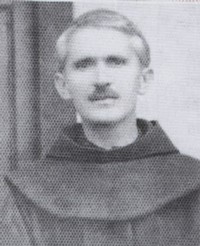
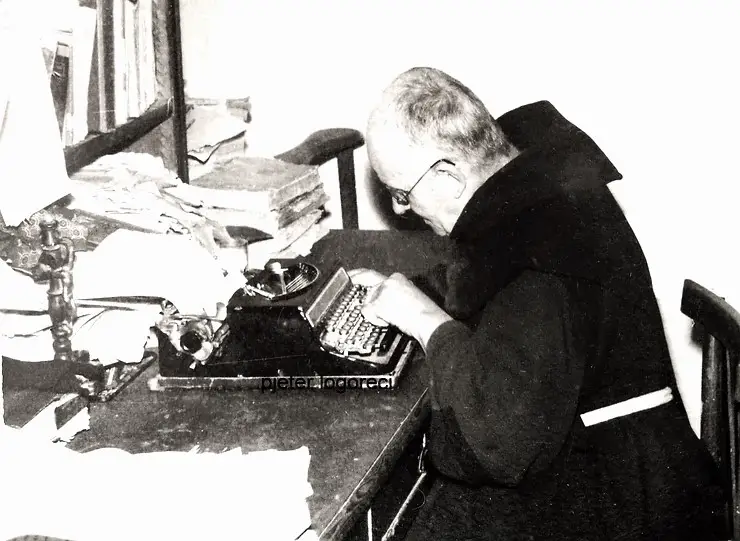

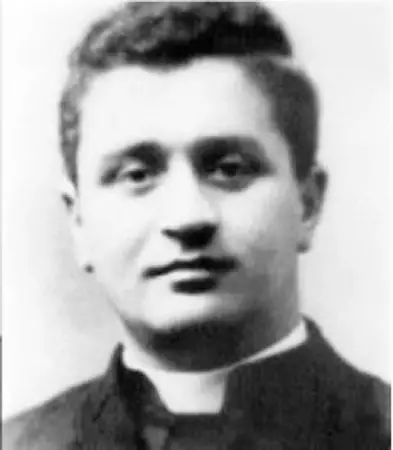
Memorie.al / I met Father Marin Sirdani around late 1959 or early 1960, when he was released from prison for the second time. He lived at the Assembly of “Arra e Madhe,” near his friend, the distinguished linguist Father Justin Rrota, my spiritual leader. He was aware that he would not live long, as he had emerged from prison devastated by tuberculosis. This prominent historian wrote no more after his release. He occupied himself with organizing old manuscripts and leaving instructions for Father Justin, hoping the latter would live long; yet, both died within less than two years of each other, in 1962 and 1964.
I had read his study “What They Blame Skanderbeg For” back then, but I was very young and unable to understand many things. Father Justin had told me: “He is the best historian we have.” It took years and years for me to realize that Father Marin Sirdani, like his brother Dom Aleksandër Sirdani, was among the brightest stars in the Albanian sky, and that no cloud, black or red, could ever darken their light through the centuries.
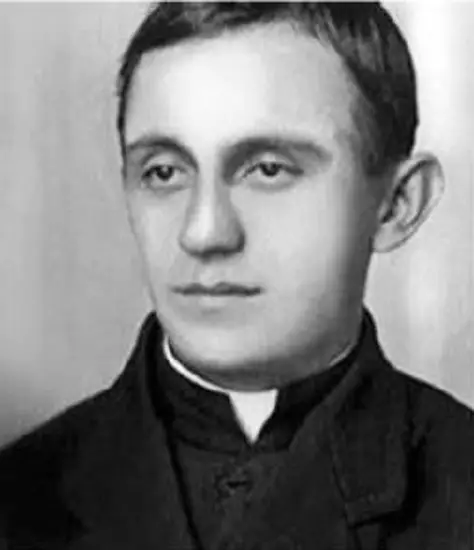
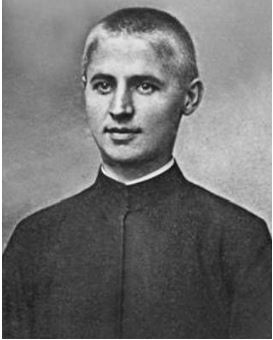
Marin was the eldest of the brothers. He was born in 1885 in distant, rugged Boga, into a noble family known throughout the northern regions. Their father, Daka, lost his wife early and remained a widower with two orphaned sons: Marin was only seven, and Aleksandër was two years younger. Their father, who chose never to remarry, dedicated himself to raising his children. Rugged and poor Boga, and the Balkan conflicts erupting on all sides, made the Sirdani family’s life even harder.
Boga, under Ottoman occupation and the pressure of Montenegro – which, supported by Serbia and Russia, sought new territories at the expense of its neighbors – had reduced the highlanders to a state where survival was difficult. In these circumstances, Dakë Sirdani had to leave his village and seek refuge in Gucia, where he had friends and relatives and where life was slightly better. With the help of the local priest and relatives, he managed to send his sons to school in Shkodra, where they completed primary education together.
After this, the two brothers took different paths but followed the same road: the priesthood. Marin, after completing secondary school at the Franciscan College (or Fishta’s Lyceum, as the people of Shkodra called it), chose the Order of Saint Francis. After continuing higher studies in Graz, Austria, he returned to his Homeland in 1916 and was ordained a priest.
Aleksandër, the younger brother, also attended the College in Shkodra, but at the Saverian College, opened and maintained by the Jesuits. Like his brother, he pursued higher studies in Austria, in Innsbruck – an important center for Albanology where, among others, Eqrem Çabej, Father Anton Harapi, and Dom Nikollë Gàzulli studied. In the same year, 1916, he was also ordained a priest, but in the Jesuit Order.
They returned eager to serve their Homeland in all fields where they had the ability and training. In that period (and why not today as well), religious education had a special priority, as five centuries of Ottoman bondage had damaged everything in the land of Kastrioti, particularly the Christian faith – for, as Frang Bardhi left us, “where the Turk’s footsteps, grass grows no more.”
During the first years of his priesthood, Father Marin served in Mirdita and Dukagjin – times and areas he would later utilize for the publication of his work, “Skanderbeg According to Folklore.”
From the beginning, he demonstrated a rare will and an unparalleled cultural horizon; therefore, in 1922, he was called to Shkodra to the Franciscan College. There, alongside Father Gjergj Fishta, Monsignor Vinçenc Prendushi, and many prominent Shkodran intellectuals, they opened the first full-cycle lyceum, called the ‘Classical Lyceum,’ named “Illyricum.”
Father Marin taught History and Christian Doctrine there; at the same time, he became the pivot of a circle of young Shkodran intellectuals from various fields, which would soon provide a contribution rarely matched in the history of national culture. The learned professor was soon appointed Director of the Gymnasium.
Meanwhile, he wrote the works: “On National History,” “The Albania of Albanians,” “The National Work of the Franciscans,” as well as legends that today are treasures in the journals Hylli i Dritës and Leka, as well as in many newspapers of the time, for he had the rare ability to communicate with all social strata, as well as with intellectuals of different regional and religious backgrounds.
When he also became the Dean of the Franciscan Assembly of the “Arra e Madhe” neighborhood in Shkodra, he showed extraordinary interest and similar skill in communicating with the youth, showing concern and even making sacrifices – which more than once caused him trouble – for the schooling and education of young people. Typifying his role and values as an educator are the words of Father Fishta: “The youth of Shkodra do not yet know what a distinguished personality resides among them.”
It has been said by others that Father Marin Sirdani was one of our most learned historians – specifically a historian whose scientific historical impartiality and analysis have not yet been equaled in this country; a methodologist who, unfortunately, was not taken as an example by those who would later undo history. Yet, perhaps few know the role Father Marin Sirdani played in the difficult, treacherous negotiations between the Communist State and the Catholic Church.
His comprehensive preparation, determination, and clarity that the Albanian Catholic Church had to be saved at all costs more than once put the Government Commission – headed by Mehmet Shehu himself – in difficulty. To get rid of such a difficult interlocutor, they threw him into prison for a second time, on the charge (unproven even with falsifications at trial) that he had attempted to establish contact with the Vatican.
The younger brother, Dom Aleksandër Sirdani, who spent half his life in our Mountains as a priest, dedicated himself like few others to collecting the national spiritual wealth: legends, myths, folk tales, proverbs, traditions, and even ancient superstitions still encountered in the highlands.
Along with his friends, Father Donat Kurti and Dom Nikollë Gàzulli, they – like bees collecting nectar – gathered a spiritual wealth of our people that would form a true ethnographic corpus; regardless of the fact that, like much of his work, and that of his brother, Father Justin Rrota, Father Donat Kurti, and Dom Nikollë Gàzulli, their very executioners would later exploit these works to obtain academic degrees.
Nevertheless, despite the massacre, burning, and loss of a good portion of the manuscripts, with only what he left published in the journals of the time, he remains one of the best ethnographers of our country.
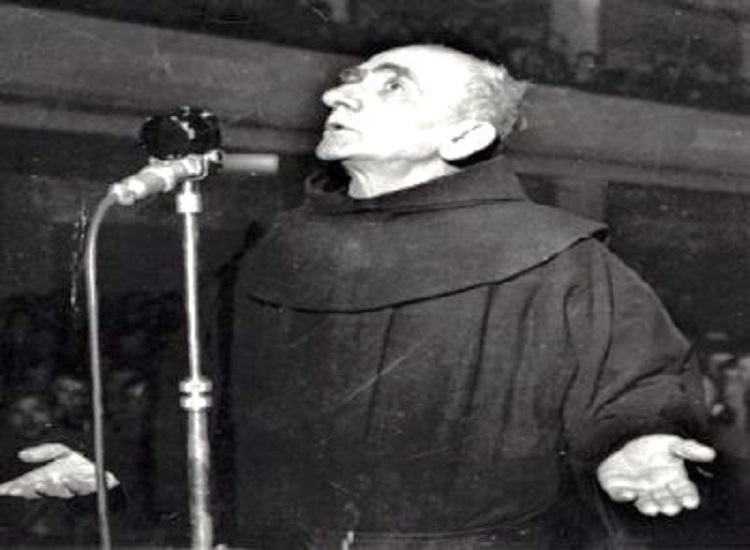
Yet, on July 26, 1948, Dom Leka – as the people called him – filled with bitterness for what was happening, but also with an almost biblical faith, during Sunday Mass in his beloved Boga, told the believers: “Brothers and sisters, a black cloud has covered us, but do not be afraid, for it too shall pass, and a white cloud will come again, and we shall emerge into the light once more, like the stones of the river after the rain when the sun shines upon them,” borrowing the famous line from our golden Epos of the Heroes (Kreshnikët).
Prophetic words, but which, to the misfortune of this people, were proven true only after 43 years of an unparalleled Calvary. It was those words, coming from the mouth of one who was conscious of the consequences yet ready for sacrifice that caused the executioners of the time to rush toward Boga.
On July 27, 1948, using the words of the previous day’s sermon as a pretext, they arrested him and dragged him behind a horse from Boga to Koplik. He arrived at the infamous prison of Koplik without shoes or his cassock, unrecognizable, where the most inhuman tortures began upon him, as well as upon other priests. Here is how Fritz Radovani describes the macabre death of Dom Lekë Sirdani and Dom Pjetër Çuni:
“In July 1948, while coming on a bicycle toward Shkodra (referring to Dom Pjetër Çuni), he was stopped on the road and taken to the investigator’s office in Koplik. There, as a former policeman, S. N., told me, he found Dom Aleksandër and Father Florian Berisha S.J., who were being massacred along with many highlanders.
The priests were tortured more than the others, he recounts. He did not know why, but an order was given: ‘Thrust the stakes into them; even if they die, do not fear!’ No one knew the reason, nor dared to ask, as it cost Xhemal Selimi nothing to kill you on the spot. The black pit was open for anyone!
One day, Asllan Lici and Pal Mëlyshi arrived early at the Section (as the police of that time, the Internal Section, was called). Xhemali was waiting for them in the office. After a short conversation, the three of them came out and gave the order to go to the cells of Dom Aleksandër and Dom Pjetër, to bind them and take them behind the Section building.
Fortunately, this man [the witness] did not have the peril of executing that order, as four others had been assigned. They bound them and took them out through a side door. They made them walk somewhat quickly, even though they were exhausted from suffering.
Xhemali entered the office, while Asllan and Pal ordered the policemen to go to the horse stables and bring two new, strong pitchforks. The order was to be obeyed, but one could not guess what the thugs intended to do. The pitchforks were brought. Asllan came out first, limping, followed by Pal, with his usual swagger. They approached the bound priests, saying: ‘Move it, you pups of the Pope, for now we shall satisfy your whims; you think you can deceive us with your scribblings…! Why don’t you tell us which criminals you are connected with and to whom you have taken bread in the mountains?’ They did not wait for an answer but headed toward a latrine pit of the Section, which was always open. They ordered the priests to be brought near the pit. Those watching from the windows thought pressure was being applied to make them talk… but suddenly, Asllan placed his hands on Dom Pjetër’s chest and Pal grabbed Dom Aleksandër by the arm, and, cursing God with the filthiest words, they gave them a push, and they fell inside the black pit.
When the priests tried to rise, the executioners pushed them down with the pitchforks to submerge them, saying: ‘Heh… speak… where is that Christ of yours… speak… this will be the end of all priests… Do you see your Christ anywhere, you filth among filth…?’
Above the shack of the latrine pit, only the soiled edges of the two cassocks were seen. No one saw their faces again. The thugs continued to push them with the pitchforks until even their lifeless bodies were submerged. After a few minutes, the priests drowned… They thought that along with the lifeless bodies, their work would also vanish…!
Albania is too small for such great crimes. There are much larger countries that have also suffered under the bloody communist heel, but the crimes there are never of our proportions.”
I do not wish to burden the reader further, even though there are other, even more chilling testimonies. But even what I brought from Fritz Radovani is enough to reflect the ugliness and barbarity of a system that disfigured everything, to the extent that to this day we continue to experience its consequences. / Memorie.al