

By Prof. Abas ERMENJI
Memorie.al/Who would have thought two months ago that today we would gather to commemorate the departed Mid’hat Frashëri! We could not believe it then, and we can hardly believe it now; it feels as if it were not true, as if our Elder were still among us, around us, looking upon us with kindness, speaking to us, offering us counsel. That sweet, white-haired face refuses to leave our minds for even a moment, and it feels as if that sentence of his – as simple as all great thoughts are – constantly echoes in our souls: “We must be the servants of Albania.”
Mid’hat Frashëri; who was always with us, in the guerrilla bands, in the mountains, on foot or mounted on a mule, but always near the Flag; Mid’hat Frashëri who was never shaken, who was always himself, who neither flared up nor grew cold whether our forces marched toward victory, or when the enemy pursued us with fire and death, or when we retreated through rain and mud, or when we took the paths of exile. Always with us on the harsh floorboards of the camps, always with us when we had to live on bread and water alone. No one ever heard him complain, or say, “I am tired” or “I am not well.” He was conscious of his mission; he understood what strength he gave us, and what faith his presence inspired within us.
A worthy heir to the generation of the National Renaissance (Rilindja), it fell upon him to carry the spirit of Naim, Abdyl, and Vaso Pasha into young hearts. He was the man who bound the insurgent tradition of the past century with the fierce struggle for freedom being fought today. He closed the curtain on a past era and opened the page of our new history. As such, he himself felt the power he exercised over us. Through him, through his sparkling eyes, through that “salt upon which snow had fallen” (his white hair), a century of history spoke to us; the example of two generations of heroes appeared before us, and we became three times stronger.
Mid’hat Frashëri was a charming and beloved elder; his speech was always seasoned with a subtle humor that reflected the clarity of a delicate soul and a broad mind that met human vanities with a smile. But sometimes, suddenly, the humor would fade from his lips, the lines of his face would deepen like the furrows of a majestic cliff, his eyes would cast a different light, and our Elder would take on the aura of a patriarch; this happened in those moments when we had to prove ourselves as Servants of Albania. Mid’hat Frashëri generally viewed human affairs with the slight mockery of a philosopher; he had only one passion where mockery had no place, where he surrendered himself with mysticism: Service to Albania.
Born alongside the League of Prizren, at a time when hopes for a free fatherland were being born, and raised with the warm spirit of the National Awakening, it was understandable that Mid’hat Frashëri would become a fanatic of one religion: the religion of “Albania.” And to this cult, he dedicated his entire work, his entire life, for half a century.
The activity of this Albanian fanatic extended to all directions of national life. From a very young age, nurtured by the example of his uncles Naim and Sami, by the example of Vaso Pasha, Jani Vreto, and other men of the pen and thought who strove from abroad to refine the language, to revive the national idea, and to show the Albanian his history and his duties, Mid’hat Frashëri dedicated himself to the craft of writing.
He was a member of the Society of Istanbul, published the National Calendar, and in Thessaloniki and Sofia, alongside the distinguished patriot Kristo Luarasi, directed the newspaper “Liria” (Freedom) and the periodical “Dituria” (Knowledge). He published literary and social works such as “Hi e Shpuzë” (Ashes and Embers) and “Plagët t’ona” (Our Wounds), and in 1908, he participated in the Congress of Monastir, where the Albanian alphabet was discussed for the final time.
Everything related to Albanian life interested Mid’hat Frashëri: the language, the history, the needs of the country, and the national cause. Therefore, his writings are diverse: here he tells tales with a moral or patriotic meaning; there he records historical events; elsewhere he offers advice on how to love the fatherland, how to love one another, and how to become wise and industrious. All these writings are poured out with a pleasant simplicity, like a conversation around the hearth. The struggle with the pen was the preparation for the struggle with arms.
First, the people had to be awakened; they had to be shaken from the lethargy of hundreds of years; they had to know themselves through their language and history, to then be capable of engaging in the organized struggle for liberty and independence. The standard-bearers of the Renaissance understood this urgent need well. We can imagine what weight burdened the hearts of those men when they saw a people lost in darkness, unable to recognize them – when they saw the Albanian language without its own alphabet – Albanian, the language of the ancient Oracles, the language with which Teuta commanded the sea and Gjergj Kastrioti led his soldiers to the assault.
We understand the despair of those hearts from the giant sigh of Vaso Pasha: “O Albania, poor Albania / Who has cast your head into the ashes.” In that school, in that burning heat of love for the Fatherland, the soul of Mid’hat Frashëri was kneaded and matured. Herein lays the root of his fanaticism for the language, the nation, the history, the borders, and everything that touches Albania.
But “Lumo Skëndo” did not limit himself to writings and advice; he threw himself into action, involved himself in the clashes of the uprisings, pushed the people into the struggle for the protection of the borders, was there where the Flag was raised, participated in 1912 in the Government of Vlora, and during the time of Wied, in the Government of Durrës.
During the First World War, he strived alongside other patriots to clear the dark misconceptions that certain foreign circles held regarding Albania. At the end of the war, he went to the Peace Conference in Paris as a member of the Albanian delegation, where he sought to defend the 1913 borders with the energy of a fanatic and the finesse of a diplomat. To shed light on Albania’s rights to the outside world, he wrote and published in French: “L’affaire de l’Epire”, “Les albanais chez eux, et à l’étranger”, and “Albanais et Slaves”.
In international conferences, with the skill of a seasoned diplomat, he tried to shift the judgments of foreign circles in favor of his country. He served as the Minister of Albania in Paris, and later in Athens, until 1925. Then, he withdrew from the branch of diplomacy and dedicated himself entirely to the mission of an apostle.
The habit he had formed in his youth – to counsel Albanians to love their country, to become good and wise workers, to guard the national heritage with tenderness – Mid’hat Frashëri kept for his entire life.
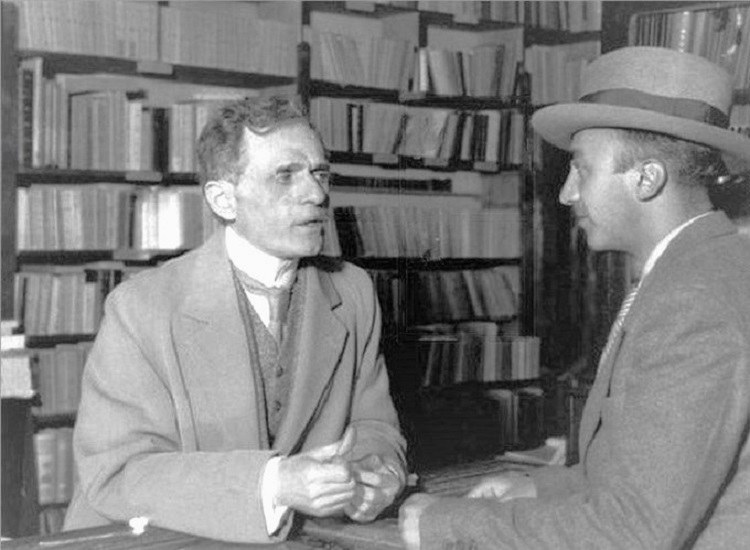
His bookstore in Tirana was a school of “Albanianism,” a place where almost only matters concerning our country, our affairs, and our national life were discussed. Students, teachers, scholars of every field, learned and unlearned men, entered and exited his bookstore as if it were their own home. He had something to say to everyone. To one, he gave advice; to another, he told something of what he had seen and heard; to someone else, he recounted how skillfully Albanians distinguish themselves abroad.
And then, the conversation would turn to Kosovo…! There lay his greatest wound; and Mid’hat Frashëri would speak and speak for hours on end about Kosovo and the Kosovars, recounting the events of that region one by one, starting from the League of Prizren. “Ethnic Albania,” he would say with emotion, “we must work to make Ethnic Albania,” and often the Elder’s deep eyes would fill with tears.
The storm of April 1939 shook his nerves once more and gave him the strength of a young man. He understood that a new period in the history of Albania was opening and, without hesitation, he chose to take the first step with the vigor of a youth. He gathered the old patriots, he gathered the fiery youth, he gathered the teachers, and told them to brace themselves for a long struggle. And thus was born “Balli Kombëtar.”
We come now to the pinnacle of Mid’hat Frashëri’s life, to that line of thought that rises above the others: Mid’hat Frashëri understood the new times and, instead of remaining frozen in the past, as generally happens among the elderly, he took upon himself the giant burden of leading the nation from one historical phase to another. He understood the great reasons for today’s struggles, felt the historical moment in which we live, and, to be in harmony with the times, he met the new needs of the Albanians with the Decalogue of Balli Kombëtar.
Indeed, the struggle that peoples fight today for political freedom, for a fairer distribution of wealth and the fruits of labor, is the offspring of the civilization of the time; it is the thrust of science and the machine, which severed the old bonds between men, broke the social forms of the past, and awakened the need for a new equilibrium. In a time when the torrent of history pulls peoples forward, wanting to remain anchored in the past is equivalent to standing against a wave, or like a drowning man trying to hold onto rotten roots. Mid’hat Frashëri proved himself above social prejudices and ways of thinking tied to the time of his upbringing; he proved himself one of those tireless leaders who never stand still, but March alongside time.
Though in age he belonged to another generation – a generation that fought only for the political independence of Albania – in thought, Mid’hat Frashëri crossed into the new times and showed himself a man capable of ruling two epochs. He knew how to stand at the forefront of the struggle when it was necessary for Albania to emerge as its own mistress, but later he also knew how to point the way of progress to the Albanians when the time came for our people to emerge from the social condition of the Middle Ages and adopt a new spirit and health. He knew how to show us the paths toward the future with the Decalogue of Balli Kombëtar. Herein lays his greatness.
We all know that our Elder found it difficult to be called old. Immediately, his sparkling eyes would darken, and he had the question ready: “Who is old?!” By this, he meant that since he stayed with the youth, he had the thoughts and the soul of the youth. I cannot forget that evening in July 1948, in Athens, when we dined with him on the last night before he departed for Turkey. Touched by our presence around him, he stood and spoke: “I depart from you with emotion, for I feel myself part of your circle, I feel myself one with you, a youth like you, in soul and in thought,” and as he spoke, his eyes filled with tears.
And so it truly was. Mid’hat Frashëri belongs to our generation, as he belonged to the generation of the Renaissance. He is the man of two epochs; the man who unites the spirit of the National Renaissance with the progressive momentum of today. He is the mediator who binds the old Albanian tradition with new social ideas. He fought then for the liberation of Albania; he fought now for the liberation of the Albanian people.
When he was close to victory, bloody communism cut his path. It tried to break him with arms but could not. Thousands of Martyrs fell in that epic duel. The most distinguished men of Albania gave their lives to bring democratic freedoms to the country. Around “Balli Kombëtar,” under the commands of Mid’hat Frashëri, the flower of youth rushed forth. A part of them was reaped while defending the tradition of the Albanian. Others emerged through those trails of blood to continue the work, to continue the struggle.
The balance of power tipped toward the army of terror because it benefited from the weight of international communism. Then Mid’hat Frashëri was forced to retreat, but not to break. He took the paths of exile with white hair, where he showed himself to be as strong and steadfast as he had been when his hair was black. Everyone grew weary except him. Everyone was shaken except him. From within the dark walls of the camps, he sought through words and writings to enlighten the outside world about Albania and Albanian issues.
As the leader of “Balli Kombëtar,” in cooperation with patriots from other groups, he recently formed the “Free Albania” Committee – the final act of his life. As he was striving to raise the voice of Albania among the peoples of the free world, death intervened and said “enough” – and Mid’hat Frashëri fell majestically in the midst of battle, just as the champions of ideas fall.
That which neither exhaustion nor old age could tear from the ranks of the struggle, death finally did. This was our Mid’hat Frashëri. But how is it that he seems still alive to us, that we still hear his voice, and our souls remain filled with that sweet, white-haired face?
This is understood if we consider that to us, Mid’hat Frashëri did not merely hold the value of a man, but brought with him the memory of a century of history. Through him, through his sparkling eyes, through that “salt upon which snow had fallen,” time spoke to us from the League of Prizren; Ali Pasha of Gucia spoke to us, Hoti and Gruda spoke to us, Vaso Pasha of Shkodra spoke to us, Naim, Vreto, De Rada, Fishta spoke to us, the Kosovo Uprising spoke to us, the Flag of Vlora spoke to us, the struggle of yesterday spoke to us, the struggle of today spoke to us.
From the words, from the gaze of Mid’hat Frashëri, this entire chain of historical memories poured into our souls, warming us, intoxicating us, teaching us to bind today’s struggle with that of yesterday. Through the work of Mid’hat Frashëri, we understood how the soul of Albania flows like an unbroken line, from time to time, and from one generation to the next.
Mid’hat Frashëri was not only the man of “Balli Kombëtar.” He was the inspirer of national love, the Standard-bearer of the Albanians, without distinction of party or political leaning. The memory of Mid’hat Frashëri must be kept and honored by all those Albanians who truly wish to see an Ethnic Albania, free and flourishing. His memory must be honored just as the flags of battles are honored.
Because he was the man through whom the chain of historical memories flowed to us, that is why it feels as if he has not died: because our history is immortal. Just as he seems alive to us now, so will he seem alive in every age; his face will pass from us to our sons, to our sons’ sons, to our most distant descendants, and it will shine joyfully whenever Albanians prove themselves to be “the Servants of Albania.”/Memorie.al