
Memorie.al / The history of world football knows many scandals that have occurred inside and outside the football fields – clashes of footballers on and off the field, interference by fans of one team or another, threats and enticements of club officials towards referees, bribery, displays of corruption that have resulted in the exclusion of footballers, coaches, officials, but never the exclusion of an entire team from continuing the championship. And this is because football regulations do not foresee such actions…! This does not include cases where machinations were used to favor one team or another, as happened in the 2005-2006 season in Italy, where, as a result of the so-called ‘Calciopoli’ process, ‘Juventus’ was stripped of its championship title and sentenced to play in the second division, and ‘Milan’, ‘Fiorentina’, ‘Lazio’, ‘Reggina’, etc., were forced to start the championship with a few points less.
But what happened on June 24, 1967, after the match “17 Nëntori” – “Partizani”, when both teams were excluded from continuing that championship is an unprecedented and unique example! What had happened? Until the 1965-66 championship, when ‘Vllaznia’ had been declared champion twice in a row in 1945 and 1946, only two teams had won consecutive championships: these were ‘Partizani’, founded in 1946 (11 times) and ‘Dinamo’, founded in 1950 (6 times).
And so, in the last match of the 1965-66 championship, “17 Nëntori” of Tirana, by defeating “Partizani” 2-0, won for the first time in the history of post-World War II championships the title of champion. It was truly a very heavy slap given to these two privileged teams of the communist leadership, the two teams of the Ministry of Defense and the Ministry of Internal Affairs, respectively. Thus, a myth was broken.
On the surface, there was nothing wrong here. In fact, the geography of champions was expanding. But the communist leadership would have liked any other team to win the championship, except “17 Nëntori”, i.e., “Tirana”, six-time champions since 1930 when the first championship was held, interrupted in 1939 as a result of the invasion of Albania by fascist Italy.
Why this desire, why this spite?
Hatred against the communist dictatorship was silent, because its violence through the weapon of this dictatorship, the State Security, was very great. Thus, this hatred sought expression in indirect ways. And football became one of those ways. The sports fans of “17 Nëntori” – and these were not only native Tirana residents, but also thousands upon thousands of others in the capital and other cities of the country – rejoiced immensely when their team defeated “Dinamo” and, especially, “Partizani”.
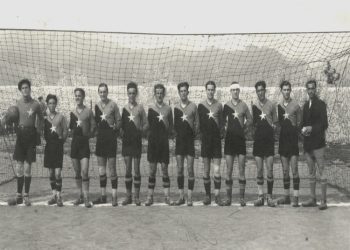
They expressed this joy openly with the chants: “Forca Tirana” (Power Tirana) and in the matches against “Partizani” also with the chant “Bjeruni të kuqve” (Hit the Reds)! Because its players played in red jerseys. (Even in the 1950s, they also wore black shorts, like our national team). It was a phenomenon similar to the chants of Tirana sports fans in the years 1942-43, when “Shprefeja”, a team of young people from Tirana’s neighborhoods, played against the Italian fascist teams. When the fascist soldiers shouted: “Forza li azzurri!” they responded with the chants: “Forca të kuqtë” (Power the reds), because “Shprefeja’s” jerseys were red and the shorts black, i.e., the colors of the national flag.
On the external appearance, the chant “Bjeruni të kuqve”, indeed somewhat harsh, was simply a natural chant at a sporting event. So, “attack and defeat the reds”, just as “Partizani” fans could shout: “Hit the white and blues”. However, this chant did not sound good to the ears of the Political Bureau members who watched the matches between these two teams from the leadership tribune, because it could also be understood as: “Hit the red one”, which was the symbol of communism.
With the exception of Enver Hoxha, Mehmet Shehu, and Hysni Kapo, all the other Politburo members could be seen every Sunday in the tribune. And all of them, except Kadri Hazbiu, were fanatical fans of “Partizani”. In fact, General-Leutnant Petrit Dume would sometimes go down to the locker rooms during halftime of “Partizani’s” match and intervene to have this or that footballer removed who, in his opinion, was not playing well. In fact, once, as Miço Ndini, the well-known footballer of “Partizani” in the 1960s, testifies, this general, after a loss of “Partizani” to “Skënderbeu”, would catch up with the “Partizani” bus traveling back to Tirana with his car, stop it, and insult the footballers!
Let us return to “17 Nëntori”. After a victory of their team against “Besa” in Kavajë, in early winter 1967, the Tirana fans, upon arriving at the train station, did not disperse but headed to the Club of the Officers’ Home, on “Rruga e Kavajës” (later the Writers’ Union Club), and there continued with the chants: “Tirana, Tirana”! And let us not forget that at that very moment, General Petrit Dume was in the Club, along with other hierarchs of the dictatorship, who, undoubtedly, were left astonished.
This was an open provocation; there was no doubt about that! But could anyone be arrested, when they could easily reply: “I did nothing, except shout with my friends: Power Tirana”. The Politburo members also disliked the fact that Tirana sports fans called their team by its old name, “Tirana”, and not “17 Nëntori”, as this Club was named after the communists came to power, in honor of the liberation of the capital! So, this was the atmosphere in which the 1967 championship was held. The red caste could not swallow a second victory of “17 Nëntori” in this championship after the victory of the previous year.
Seeing that this team was pulling away from “Partizani” and “Dinamo”, the leadership of the Ministry of Defense began to use the strangest machinations. Precisely during this period, the footballers of “17 Nëntori”, Ali Mema and Gëzim Kasmi, both physical education teachers, were sent, the first to Shkodra (six months) and the second to Skrapar (18 months), to perform… their military service. (This entire machination was carried out directly on the orders of Petrit Dume). Thus, the Tirana team was forced to play throughout that season without these two starting players.
And yet, the avalanche of “Tirana” (I will continue to call this team by this name now) was unstoppable. And so came June 24, 1967. A Saturday. Why was this match played on Saturday and not Sunday, when there was no other match on the calendar?
Here, too, there was a trick: on Sunday, “Vllaznia” was hosting “Dinamo” in Shkodër. Until that week, “Tirana” led with 33 points, “Dinamo” had 31, and “Partizani” 25, out of any fight for the title. But it was absolutely necessary that “Tirana” not repeat the success of the previous year. It was expected, therefore, that “Partizani” would win against “Tirana”. And then, do whatever it takes, even exert pressure in one way or another on “Vllaznia” (which also had no title aspirations), so that “Dinamo” would win.
In this way, both “Tirana” and “Dinamo” would be tied on points, and thus the possibility would be created for “Dinamo” to win the championship – in other words, another military team, but this time of the Ministry of Internal Affairs. The truth is that this desire of the communist leadership was not so easy to realize, because in the last three matches of the championship, “Tirana” would face “Tomori”, “Lokomotiva”, and “Traktori”, which were at the bottom of the standings of the 1966-67 season.
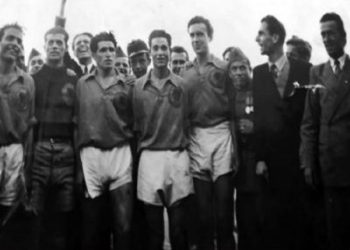
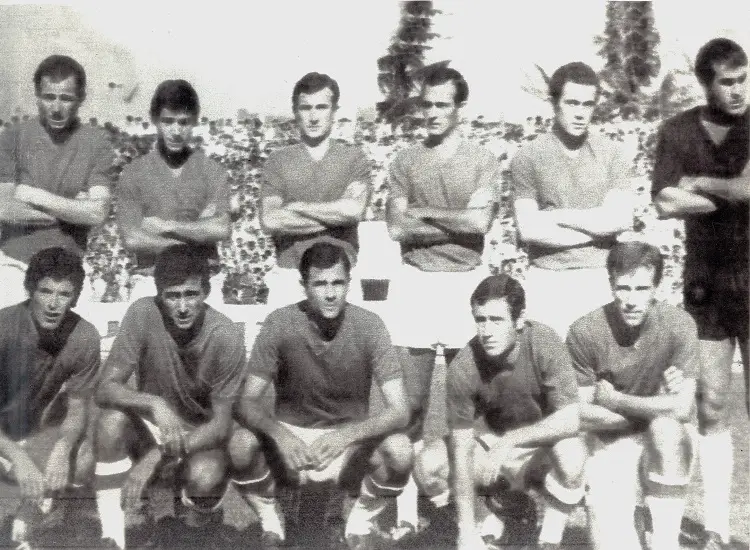
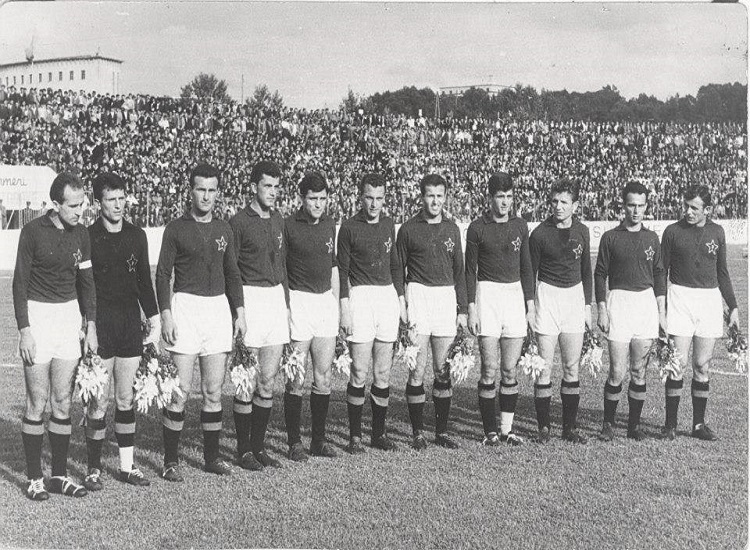
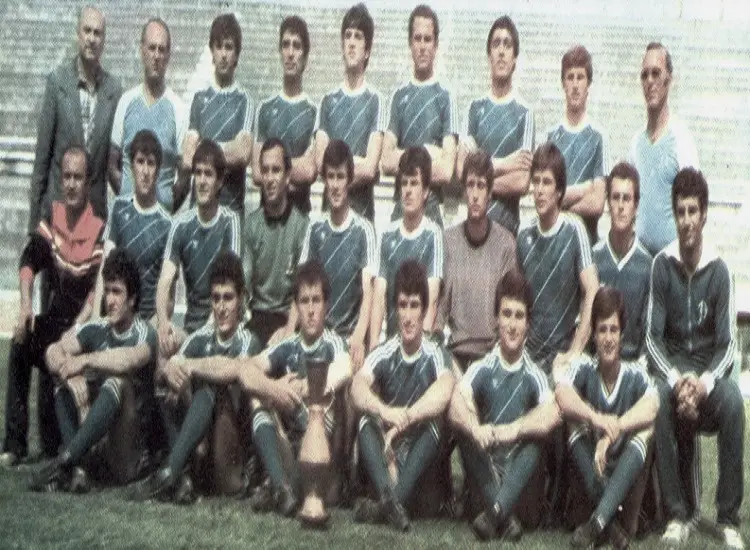
However, “Tirana” demolished every speculation of the leadership of the red dome; it defeated “Partizani” before their eyes with a score of 2-1. In that season, both teams fielded the following footballers: “Tirana”: Bujar Tafai, Elini, Fatmir Frashëri, Perikli Dhales, Petrit Gjoni, Luigj Bytyçi, Osman Mema, Niko Xhaçka, Pavllo Bukoviku, Skënder Hyka, Xhux Kazanxhi, Bahri Ishka (coaches: Myslym Alla and Enver Shehu).
“Partizani”: Mikel Janku, Jozja, Mihal Gjika, Spiro Gjika, Iliaz Dingu, Ramazan Rragami, Shule, Muharrem Karriqi, Lin Shllaku, Selami Dani, Rudi Panajot Pano, Robert Jashari, Ismet Shaqiri (coaches: Refik Resmja and Miço Ndini).
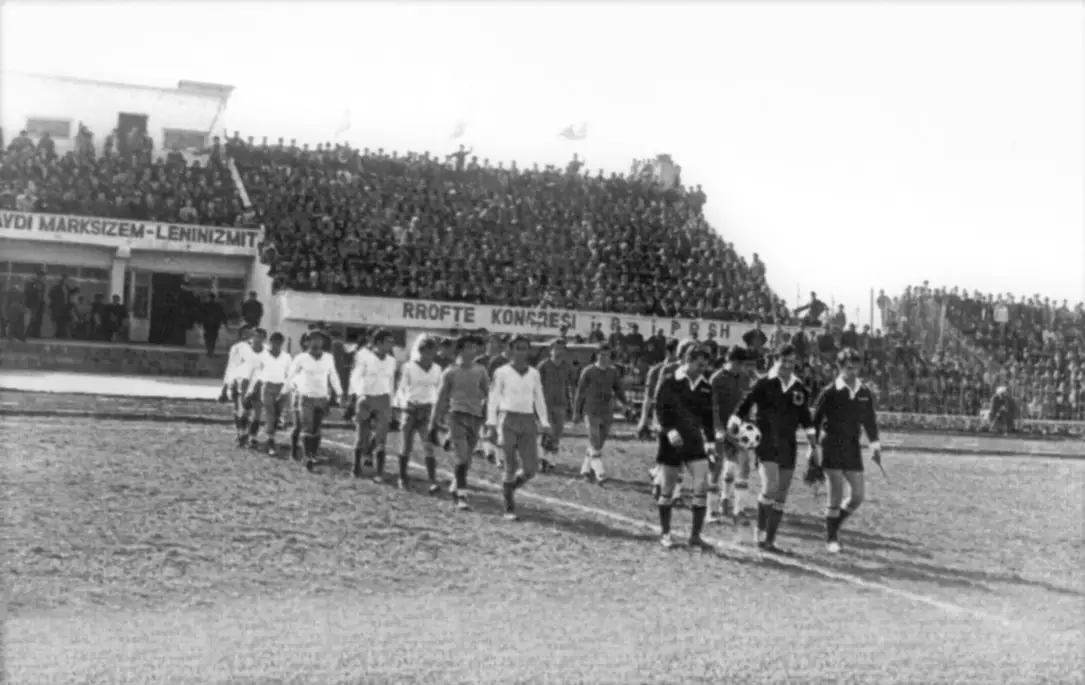
I will not go into the composition of the teams or the chronicle of the game, which, shamefully, is not even reflected in the pages of the “Sporti Popullor” newspaper. But towards the end of the second half, i.e., of the entire match, there were instances of rough play, caused by players from both sides. This tense atmosphere continued even after the match ended, in front of the locker rooms. But there were no scandals, no fights, and, moreover, no interference from the fans of either side on the field.
The referee could have sent off players from both teams, as far as the regulations allowed. Even the players who caused the altercations could have been suspended for a few matches. All of this could have happened, still in accordance with football regulations. (Meanwhile, “Dinamo” could only manage a draw in Shkodër and thus remained three points behind “Tirana”, which, as we said above, having easier matches, was now cementing its path to winning the championship title for the second time in a row.)
As a result, after the end of the “Tirana”-“Partizani” match, enthusiastic chants broke out again in the stadium: “Tirana, Tirana”, which, as always, grated on the ears of the top communist leaders. So they left the stadium frowning and got into their black cars, disappearing into the leaders’ “Block”. However, they were plotting something evil…! And here is the scandalous evil: in the newspaper “Sporti Popullor” of June 27, 1967, the decision of the Albanian Football Federation was published, according to which both teams were excluded from the 1966-67 championship for “pronounced unsportsmanlike conduct”.
This absurd decision fell like a bomb on Albanian sports opinion. How was it possible that the AFF dared to take such a decision, and on what facts, when only a few footballers had quarreled with each other? Years later, when I became involved with this terribly dramatic event, I asked former leaders of the Albanian Football Federation and even of the State Committee for Physical Culture and Sports. But unfortunately, they all shrugged their shoulders, explaining that they did not… remember the details of this decision! Then I turned to the General Directorate of State Archives and opened the relevant files of this high state institution. Sadly, I found neither a single minute of any AFF meeting concerning this match, nor any decision, nothing…!
So the question arises: Who made this decision? The Presidency of the AFF? Which of its members, including its chairman, or the chairman or presidency of the Committee for Physical Culture and Sports, would have dared to take such a step to exclude two teams from continuing the championship, especially when one of them was none other than “Partizani” of the Ministry of Defense, the chosen team of the “Red Dome”?!
It is clear that this decision was dictated by the Political Bureau itself. And better than anyone else, this was known to Ramiz Alia, who was the head of propaganda in the Political Bureau and the one who never missed not only “Partizani’s” matches, but also those of other teams. The motive is very clear: by excluding “Tirana”, the “de jure” champion, “de facto” “Dinamo” became champion, i.e., ultimately, another team of the dictatorship. And in public opinion, the idea was created: “Look, along with ‘Tirana’, ‘Partizani’ was also excluded, so the punishment was equal for both teams.”
But it was forgotten, or pretended to be forgotten, that in this way “Tirana” was denied the championship title in a championship they had almost won three weeks before its end. This was a very heavy blow given to this team and its fans. It was a war that had started in September 1966. At that time, the well-known Tirana footballer, Skënder Halili, one of the greatest center-backs of Albanian football of all time, after completing his military service in the ranks of “Dinamo”, refused the proposal of the leaders of the Ministry of Internal Affairs to continue playing in the ranks of this team, even though they offered him good working and living conditions. He returned to his beloved “Tirana”, to his teammates, to the fans who welcomed him with open arms.
But the leaders of the Ministry of Internal Affairs ‘kept a grudge’ for this refusal. And so, a pretext was found to destroy him completely. He was suddenly arrested, before “Tirana” was to leave for an international match. The order was given directly by the minister himself, Kadri Hazbiu, because he was found with… 60 American dollars, and as a result, he was sentenced to several years in prison. Thus, at the age of 24, the sporting life of this footballer, who would have given so much to Albanian football, came to an end. But the dictatorship didn’t care. What mattered was that an “enemy” was destroyed.
His premature death in 1981 and his funeral, which, despite the bad weather, was attended by hundreds and hundreds of sports fans, was a silent display of protest against the dictatorship. Then, this war, as we saw, continued with the “performance” of military service outside Tirana by Ali Mema and Gëzim Kasmi. However, this did not defeat “Tirana”. That it was the best team of those years, it proved by winning the championships of 1968, 1968-69, and 1969-70, thus writing one of the most glorious pages not only of this Club but also of Albanian football.
Years later, I had the chance to talk with Skënder Jareci, a former footballer and later also coach of “Dinamo”. Recalling the exclusion of “Tirana” from the 1966-67 championship, he told me: “When my players with the cup in their hands began the so-called lap around the stadium, I felt very sorry. That cup and that lap belonged to ‘Tirana’ and only to ‘Tirana’.”
Driven by this great sporting drama, in 1997 I began writing the novel entitled “Tirana, Two Hours before the Punishment”. I had to talk with footballers of that time, the goalkeeper Elini, the defenders Frashëri, Osman Mema (brother of Ali Mema), with “Partizani’s” goalkeeper Mikel Janku, with the legendary Panajot Pano…! But also with the coach of “Partizani” of those years, Refik Resmja.
“‘Tirana’s’ exclusion,” he told me then, “was an ugly act of the dictatorship. I was extremely indignant, although I was not happy that we lost the match to them that day. But ‘Tirana’ deserved the victory, just as it would have deserved to win that championship.”
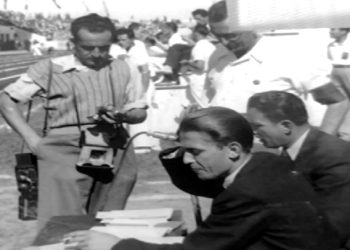
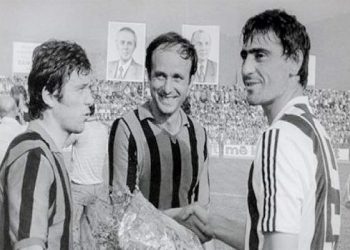
February 1998. I set off for a month with my wife and son to the USA, where I have lived for almost eight years. My novel “Two Hours before the Punishment”, dedicated to this painful event, has just been published. On the front cover is the photograph of “Tirana” of those years by the master of photography, Petrit Kumi, and on the back, photos of this match, published for the first time and taken from the archive of the well-known sports photojournalist, Enver Shabani.
Lutfi Nuri, one of the sponsors of the novel’s publication and at that time also president of the Sports Club “Tirana”, organizes the presentation of the book in the large hall of the Writers’ Union Club. At the head of the hall, in armchairs arranged in a semicircle, are seated a good number of footballers from both teams that faced each other that June day in 1967, and next to them, Myslym Alla, coach of “Tirana”, and the assistant coach of “Partizani”, Miço Ndini.
The promotion takes the form of a discussion, interspersed with a concert by some of the well-known actors of the State Variety Theater, featuring Skënder Sallaku, Mariana Kondi, and singers Ema Qazmi and Kasem Hallulli, who sing songs for “Tirana” of those years. There are many guests, among them the former head of the “17 Nëntori” Club, Lame Konomi, the former footballer and well-known intellectual, Prof. Dr. Skënder Begeja, the now-popular Radio Tirana commentator, Ismet Bellova, who commented on this match, sports journalists…! And they share their memories of this match, express regret and indignation at this ugly act of the dictatorship that killed “Tirana”, the unannounced champion of the 1966-67 seasons.
At the end of this gathering, I find myself surrounded by footballers and sports fans that congratulate me on the publication of this novel and thank me for being the initiator, after 31 years, to recall this match and to bring together footballers from both teams in such an event. Thus, I take with me to America one of the most touching memories of my life in sports environments, where I have spent about 50 years…! / Memorie.al