

By Dashnor Kaloçi
Part thirteen
Memorie.al / The history of parliamentary elections in our country, or more accurately, the attempts at elections, have its origins in the era of Ottoman rule when Albania was part of the Turkish Empire. One of the first Albanian deputies elected to the first Turkish Parliament, which opened its proceedings in December 1877, was Abdyl Frashëri. However, that parliament did not last long, as it was dissolved by the Sultan himself due to the outbreak of the Russo-Turkish War. Following the dissolution of Turkey’s first parliament, there were several other attempts at elections, but they all failed for various reasons. The first regular elections in Albania were held only in 1908, when the Young Turks came to power in Turkey. Those elections were not direct but were held through representation, otherwise known as the two-tier voting system (secondary electors).
The first Turkish Parliament opened on December 10, 1908, and out of 266 deputies, 27 were Albanians elected from the four vilayets of Albania. At that time, members of the “Committee of Union and Progress” in Turkey, which included many Albanians, split and grouped into three political factions. The first group was “Union and Progress” (the Turkish-Macedonian party) with 164 deputies, consisting of 130 Turks, 5 Arabs, 1 Greek, and 15 Albanians, led by Hasan Prishtina, a deputy from Kosovo.
The second group, called “Liberal Union” (the Greek-Albanian party), consisted of 45 deputies and included 12 Albanians led by Ismail Qemali. Among the other Albanian deputies in the Turkish Parliament at the time were Esad Pashë Toptani, Nexhip Draga, Rexhep Pashë Mati, etc. After 1908, there were several other elections where Albanians continued to vote for their representatives in the Turkish Parliament, a process that lasted until November 1912, when Independence was proclaimed and Ismail Qemali was elected head of the Government.
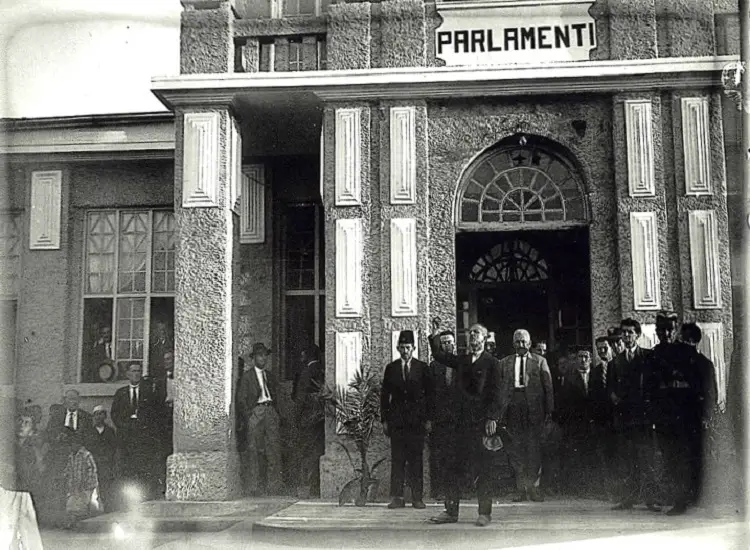
Meanwhile, the first parliamentary elections in Albania took place in the spring of 1921, as they had not been held until then due to World War I, in which Albania was also involved. The first Albanian Parliament opened on April 21 of that year; the first building of the Albanian Parliament was located where the Academy of Sciences stands today. In that parliament, 76 deputies participated, elected following a relatively regular process from the nine prefectures of the country: Berat, Durrës, Elbasan, Gjirokastra, Korça, Kosovo, Shkodra, Vlora, and the Albanian colony in the USA.
As in the past, those elections were conducted through a system of representation, or secondary electors, where based on territorial division, representatives of each province had the right to elect their deputy. The aforementioned, along with a brief history of parliamentary elections in Albania from that period until 1991, has been published by Memorie.al in previous issues. Here, we are publishing the complete Basic Statute of the Albanian Republic (the Constitution) of 1925, where a special place is held by the parliamentary election legislation of that time, as well as the Parliament’s regulations regarding the rights and duties of deputies, published by the “NIKAJ” Printing House in 1925.
Continued from the previous issue
Albanian Republic Fundamental Statute (1925)
(Tirana, “Nikaj” Printing House, 1925)
Penal Code 1928
BOOK TWO: Offenses
Offenses against the Inviolability of Secrets
CHAPTER X
Boasting of Influence with Officials
ARTICLE 233. – Anyone who, boasting of possessing influence or whose word carries weight with a State official or a member of the Legislative Chambers, accepts or causes to be given or promised to themselves or others, money or other benefits, whether as encouragement or reward for mediating with that official, or under the pretext of purchasing favor or compensating them, shall be punished with heavy imprisonment from three months to two years, and a heavy fine from one hundred to two thousand gold francs.
If the offender is a State official, a permanent disqualification from public office shall be added in every case.
CHAPTER XI
Non-fulfillment of Obligations and Fraud in Public Supplies
ARTICLE 234. – Anyone who, failing to fulfill the obligations undertaken, leaves a shortage of food or other necessary items for a public establishment or service, or to prevent or preempt a public calamity, shall be punished with heavy imprisonment from six months to three years and a heavy fine exceeding five hundred gold francs.
If the non-fulfillment arises solely from negligence, the offender shall be punished with imprisonment up to one year and a heavy fine up to three thousand gold francs.
ARTICLE 235. – Anyone who commits fraud regarding the type, quality, or quantity of the items indicated in the preceding article shall be punished with heavy imprisonment from six months to five years and a heavy fine exceeding five hundred gold francs.
Whenever fraud occurs in other supplies destined for a public establishment or service, the punishment shall be heavy imprisonment up to two years and a heavy fine up to three thousand gold francs.
CHAPTER XII
General Provisions for the Preceding Chapters
ARTICLE 236. – For the purposes of the penal law, the following are considered State officials:
- All those entrusted with public functions, whether temporary or permanent, paid or unpaid, in the service of the State, Prefectures, Sub-prefectures, Provinces, Municipalities, Villages, and communities recognized by the State, or an institute placed by law under State supervision.
- Agents of public force and court bailiffs.
For the same purposes, religious figures are equated with State officials when exercising public functions, as well as arbitrators, experts, trustees, liquidators, interpreters (dragomans), and witnesses, for the duration of the function for which they were called.
ARTICLE 237. – When the law considers the status of a State official as a constitutive element or an aggravating circumstance of an offense, because that offense was committed due to the function exercised, it also includes cases where the persons indicated in the preceding article no longer hold the status of State official or no longer exercise those functions at the time the offense was committed.
ARTICLE 238. – When anyone, to commit an offense, uses the authority or means associated with their public function, a one-sixth to one-third increase shall be added to the punishment set for the committed offense, except when the status of State official is already considered by the law in determining the punishment.
TITLE IV: Offenses against the Administration of Justice
CHAPTER I
Refusal of a Function Mandatory by Law
ARTICLE 239. – Anyone who, being summoned by the judicial authority as a witness, expert, or interpreter, manages to exempt themselves from appearing by presenting false pretexts, or, having appeared, refuses to testify or perform the duty of expert or interpreter, shall be punished with imprisonment up to six months, or a heavy fine up to one thousand gold francs.
For experts, if punished with imprisonment, the sentence entails the suspension of the exercise of their profession or trade for duration equal to that of the imprisonment.
CHAPTER II
Simulation of Crimes and Identities
ARTICLE 240. – Anyone who reports to the judicial authority or to a State official obligated to refer to said authority a crime they know did not occur, or simulates the traces of such a crime in a way that criminal investigations may commence, shall be punished with heavy imprisonment up to thirty months and a heavy fine up to two thousand gold francs.
The same punishment applies to anyone who falsely declares before the judicial authority that they have committed a crime or participated in its commission, except when such a false declaration is made to save a close relative.
ARTICLE 241. – Anyone who presents themselves before authorities in place of another person, even if this act was done without being summoned or requested, shall be punished with imprisonment from five days to one month, or a heavy fine from fifty to five hundred gold francs.
ARTICLE 242. – Anyone who presents themselves or takes the place of another person who has been sentenced by a court judgment shall be punished with imprisonment from one to six months and a heavy fine from one hundred to one thousand gold francs.
CHAPTER III
Slander (Defamation)
ARTICLE 243. – Anyone who, through a report or complaint made to the judicial authority or a State official obligated to refer to said authority, accuses another of a crime they know they are innocent of, or simulates traces or material signs of a crime to their detriment, shall be punished with heavy imprisonment from one to five years and temporary disqualification from public office.
The offender shall be punished with permanent disqualification from public office and heavy imprisonment from three to twelve years:
- If the attributed crime carries a punishment against personal liberty of more than five years.
- If the false report or complaint has resulted in a punishment greater than heavy imprisonment.
- If the accused has been sentenced to death and this punishment has been executed, the offender shall be sentenced to heavy imprisonment of no less than twenty years.
ARTICLE 244. – When the attributed crime carries a punishment of a heavy or light fine, the slanderer’s punishment shall be heavy imprisonment up to six months.
ARTICLE 245. – The punishments determined in the preceding articles shall be reduced by two-thirds if the offender of the offense provided in that article retracts the slander or reveals the simulation before any prosecution action is taken against the slandered person.
If the offender retracts the slander or reveals the simulation after prosecution has begun but before a verdict of guilt is rendered, the punishment shall be reduced by one-third to one-half.
CHAPTER IV
Falsehoods in Courts and before Councils
ARTICLE 246. (Perjury) – Anyone who, while testifying before a judicial authority, presents falsehoods as truth, or denies the truth, or remains silent regarding facts they are aware of and are questioned upon, shall be punished with heavy imprisonment from one to thirty months, including temporary disqualification from public office.
- The punishment is heavy imprisonment from one to five years if the offense is committed to the detriment of a defendant or during a trial for a criminal complaint. If both circumstances coexist, the punishment is two to ten years.
- If the falsehood has caused a sentence of life imprisonment or death, the punishment is ten to twenty years.
- If the falsehood caused the execution of a death sentence, the punishment is no less than fifteen years.
- If the testimony was given without oath, the punishment is reduced by one-sixth to one-third.
ARTICLE 247. (Exemptions and Mitigations) – The following are exempt from punishment:
- Anyone who, by telling the truth, would inevitably expose themselves or a close relative to grave damage regarding their liberty or honor.
- Anyone who, due to personal status declared to the court, was not obligated to testify or should have been informed of their right to abstain.
- If their false testimony exposes another person to criminal prosecution or sentencing, the punishment is reduced by half to two-thirds instead of full exemption.
ARTICLE 248. (Retraction) – Anyone who, during criminal proceedings, recants their falsehood and tells the truth before the investigations conclude or before the trial ends, is exempt from punishment.
- If the retraction happens later or in a civil case, the punishment is reduced by one-third to one-half, provided the retraction occurs before the final verdict of the case.
ARTICLE 249. (Experts and Interpreters) – The provisions above apply also to experts and interpreters (dragomans) who provide false opinions or interpretations. Experts may also face suspension from their profession.
ARTICLE 250. (Subornation/Bribery of Witnesses) – Anyone who offers money, benefits, or uses deception or threats to induce (suborn) a witness, expert, or interpreter to commit perjury, shall be punished:
- With heavy imprisonment from three months to three years in standard cases.
- With two to seven years if the case involves a criminal defendant, and five to twelve years if both aggravating circumstances from Art. 246 apply.
- With no less than twelve years if it leads to life imprisonment, and no less than twenty years if it leads to an executed death sentence.
- All items given as bribes shall be confiscated.
ARTICLE 251. – Punishments in the preceding article are reduced by half to two-thirds if the offender is the defendant or a close relative, provided they have not exposed another person to prosecution.
ARTICLE 253. (False Oath in Civil Trials) – Any party in a civil trial who takes a false oath shall be punished with heavy imprisonment from six to thirty months and a heavy fine from one hundred to three thousand gold francs. If they recant before the final decision, the sentence is reduced to one to six months.
ARTICLE 254. – Witnesses or experts who provide false information before Administrative Councils, Municipalities, or Public Commissions shall be punished with imprisonment up to six months or a heavy fine.
ARTICLE 255. (Publication of Sentence) – Upon request by the injured party, the court may order the publication of a summary of the conviction in a local newspaper where the offense occurred and where the offender resides./Memorie.al