
By Reshat KRIPA
Part Thirteen
Memorie.al / Arbër was standing in his corner in the hall, awaiting the arrival of the plane that would take him to another world, and meditating. He meditated and dreamed of the road full of thistles and thorns through which his life had passed. He recalled the worries that had accompanied him for years. He had many passions. He wanted to become a lawyer, journalist, doctor, engineer, artist, writer, or whatever else might be possible. But fate had condemned him to reach none of the peaks he dreamed of. He encountered disappointment at every step of his life.
Continued from the previous issue
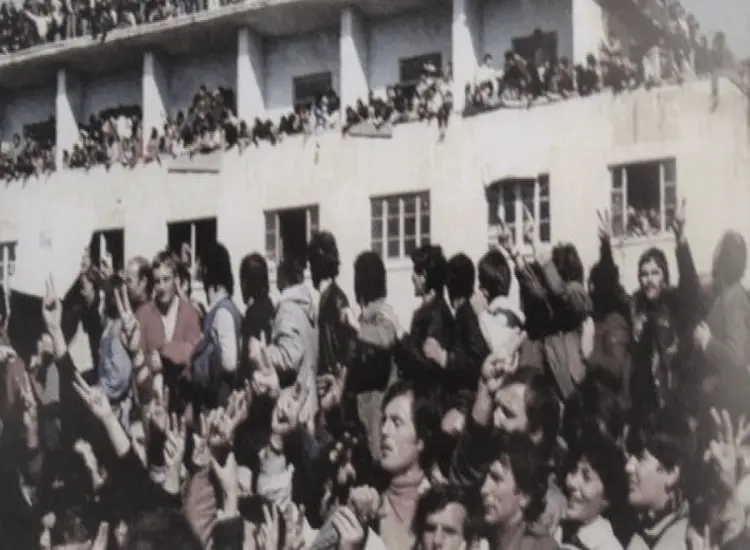
The first days of December. That day, the couple had just arrived by train in the capital. Blerina had a seminar on school issues. Naturally, Arbër could not leave her alone. They were walking toward the center where the hall for the seminar was located. An unusual movement began on the street. Young men and women, men and women were seen running somewhere. Arbër and Blerina were stunned. Where were they running? They stopped a young man walking near them and asked him.
“To Student City,” he replied. “It started!”
“What started?”
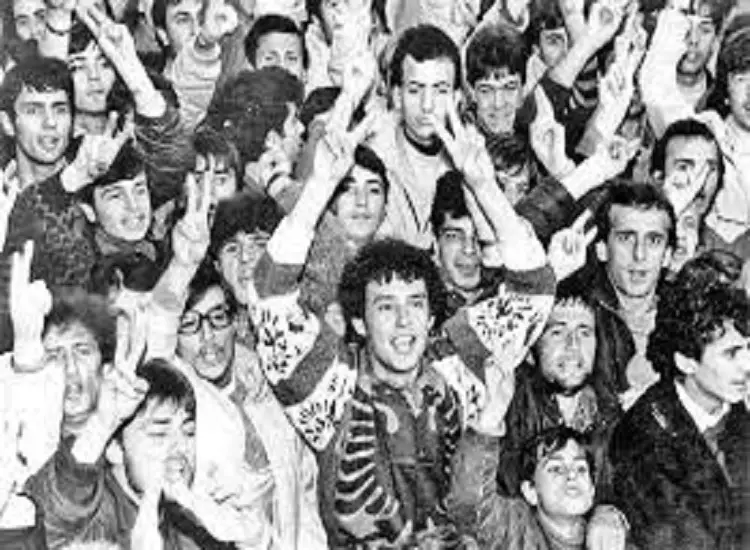
The young man did not answer. He had flown off. Instinctively, they also headed towards the place indicated by the young man. They completely forgot about the seminar. The closer they got, the more the crowd rushing to arrive increased. Enthusiastic shouts thundered:
“We want Albania like all of Europe!”
“Did our day really come?” Arbër asked himself.
Blerina heard him and asked:
“What did you say?”
“Do you hear them? These are the days of the great overthrow.”
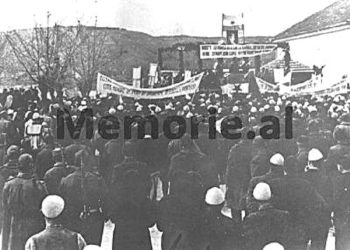
Finally, they arrived. The square was completely filled with people shouting and cheering. Finally, one of the students of the capital’s university climbed onto the stand erected for the occasion. He began to speak. The essence of his speech was an ultimatum addressed to the government to accept political pluralism, to make Albania like the rest of Europe. His words were barely heard over the endless, numerous cheers. At the conclusion of his speech, he emphasized:
“We are for the multi-party system and we will stand until our victory for this system. Freedom, democracy!”
And the crowd roared:
“Freedom, democracy! Freedom, democracy!”
The orators kept coming. Among them were some whom Arbër had recently heard giving interviews on foreign media, such as “Voice of America,” etc., which he listened to every day. Some of them had been high-ranking officials. This somehow caused him an awkward feeling. He expressed this to Blerina. She looked him straight in the eye and said:
“Everyone has the right to cast off the evil they held within themselves and start a new life.”
“I apologize,” he replied, “you are right.”
A man with a small beard and mustache stepped onto the podium. Strangely, Arbër thought he looked like a familiar face.
“Do you know him?” Blerina asked.
“His face seems familiar, but I can’t quite identify him.”
“It’s Resuli’s son.”
“Resuli’s son? He grew a mustache and a beard?”
“Yes.”
“He graduated in political science. He replaced his father, who retired. He was the Operative of the Security who tortured and condemned dozens of people, including…”
“When did he become a democrat?!”
The orators continued to change. A man took the floor. He began to speak in a language that captivated the entire crowd. The more he lectured, the more the crowd became ecstatic.
“Oh, God,” cried Arbër.
“What’s wrong?” asked Blerina.
“Mersini,” stammered Arbër.
Meanwhile, the orator had begun to speak:
“Dear students and citizens of the capital! Allow me to greet you on behalf of all the politically persecuted of Albania, of those who even sacrificed their lives for this sacred day. We are on your side, we are with you!”
And he continued to lecture and lecture.
“Oh, God,” Arbër cried again, “what am I seeing?”
“What?” asked Blerina, not understanding?
“He is the ‘rat of the cells,’ who ruined many people’s lives.”
The figure of Xhavit flashed before his eyes, tied to the electric pole where he drew his last breath.
“Let’s go,” he said.
They left. When they reached the main square of the capital, he heard a voice: “Arbër.” He turned his head. Standing before him was Doctor Istrefi. They embraced. Arbër introduced him to Blerina.
“My wife,” and turning to the doctor, he continued: “Doctor Istrefi, one of the saviors of many lives in prison.”
“Arbër talked about you constantly,” said Blerina, shaking his hand.
“Don’t forget your dignified stance either, honored lady!” he replied. “Where are you going?”
“To the train station. Tonight we are returning to our city.”
“You can’t go anywhere tonight; you are invited to my place for dinner.”
Meanwhile, evening was approaching. Arbër tried to justify himself, pretending that work awaited him in his city and that he absolutely had to leave, so they needed to hurry to catch the last train. But the doctor’s insistence forced him to accept.
The doctor’s family consisted of his wife and son, with his wife and a three-year-old daughter. When the doctor was arrested, he had been married for two years, and his wife had just given birth. Thus, the son, like Arbër, grew up only under the care of his mother and without the presence of his father. Nevertheless, he did not lack education and morals.
These were instilled in his soul by his mother, who sacrificed everything for him. He finished high school, but the path to higher education was closed. After his father was released, he married a girl who worked in his enterprise, with whom he fell in love. As a result of the marriage, a daughter was born, who became the joy of the house.
“Wife,” the doctor spoke as soon as they entered the house, “prepare us a good dinner, but first, bring the bottle of rakia and the glasses, as we men will have a glass.”
The conversations were endless. They recalled the terrible time they had spent in the darkness of the prisons, or the horrors of the camps. They remembered many of their mutual friends, who had closed their eyes far from their relatives and who had no grave where two drops of tears could be shed. But they also talked about today and the great movement that had broken out.
They spoke about the movement but also about its protagonists. Among them were many distinguished personalities of the country, who were worth following, but there were also political charlatans, who had committed every evil imaginable and now emerged as advocates of freedom and democracy.
“Did you hear Resuli’s son,” Arbër began, “he replaced his father, a director in the Ministry of Internal Affairs, and today he lectures on freedom and democracy. From whom is he demanding it? Could it be from himself? Has he forgotten that his father tortured hundreds of people, one of whom was me?!”
“Calm down, Arbër,” the doctor spoke. “Time will eliminate the thorns that grow along the way.”
“But did you hear Mersini,” Arbër continued, “he even spoke on behalf of the politically persecuted. Which persecuted? Perhaps Xhavit?!”
“Let’s turn on the TV, it’s time for the TV news magazine,” the doctor said, trying to change the subject.
The television news anchor was talking about a meeting that the party and state leader had organized with the protest leaders. At that moment, the student who opened the manifestation had the floor. He was a brave boy. Without batting an eyelid, he was throwing it in the leader’s face. The leader tried with cunning to lower the tone of the conversation, but it was useless. Among those present, they also distinguished the figures of Mersini and Resuli’s son. That evening they stayed up talking until midnight.
***
Finally, the first opposition party was created. The first pluralist elections were also held. But the hyenas of the past craved blood. This blood was spilled in the northern city of the country, just after the first pluralist elections were held. Four martyrs fell. Why? Simply because they were protesting the stealing of votes. Simply because they dared to challenge the dictatorship. An entire state rose up.
A general strike encompassed the entire country. Associations for Human Rights and Freedoms were established, and among them, the one for former Political Persecutees and Prisoners of the communist regime. The dictator’s monument, located in the center of the capital, was also torn down.
In this context, Arbër continued in his city. He had a deep worry he sought to resolve as soon as possible. He wanted to find the place where his father’s remains had been discarded. He wanted a grave where he could place a bunch of flowers. He raised the issue with the Association. The Association approached the Directorate of Internal Affairs, asking for the location of the executions. The Directorate remained silent. It did not dare to respond.
Arbër decided to meet Resuli. Surely, he knew where his father’s remains were, and now that he had positioned himself on the side of the opposition, his conscience must have reflected. He set off with Blerina towards the capital. She met her uncle and asked him for a meeting between Arbër and him. Resuli accepted. Arbër presented his request. He asked him to show him where his father’s remains were. Resuli remained silent for a few minutes, deep in thought. It seemed he was considering whether he should tell him or not. Finally, the wickedness in his conscience triumphed.
“I don’t know anything,” he said.
“How do you not know? Were you not his investigator when he passed away?” Arbër asked him.
“I don’t know anything,” Resuli repeated.
Events unfolded one after the other. A year after the first elections, the campaign for the second pluralist elections began. The Association proposed Arbër’s candidacy to the first opposition party. At the conference of this party, for the election of candidates for the Albanian Parliament, Arbër also spoke.
He spoke calmly about a truly democratic state, about a Western state, just as those who had opposed the totalitarian system had dreamed, giving even their lives for this day. The other candidate also spoke, a former functionary of the overthrown system. He cursed and swore ceaselessly against communism. Finally, the votes were cast. The former functionary emerged victorious.
The Election Day arrived. The opposition party became the governing party. A new administration began its work. Arbër was appointed director of an institution that oversaw the former Political Persecutees and Prisoners. Another member of the leadership of the Association of former Political Persecutees was appointed head of the Directorate of Internal Affairs, or Police Commissariat, as it was called by the new designation. He searched the Directorate’s archives but found no documents regarding Sokoli’s case. Blerina suggested they go to the archive of the Ministry of Internal Affairs.
They went. The director was a young man who had been appointed just those days. He received them with great courtesy. Finally, they found the sketch of the burial site. The city had three burial places for those executed and those who died in prison. One at its entrance, one on the outskirts, and one on the road leading out of the city. Sokoli’s remains were on the road at the city’s exit.
The Association decided to begin the excavations. A group of eleven people had also been executed in that place. According to the sketch, Sokoli’s remains were about ten meters away from the pit where the others were. They were located precisely beneath a bridge that had been built by the Italian invaders, who intended to build a road. The excavation began. They worked with great care. It felt as if they might injure those remains. Finally, they uncovered them. Near them was a medallion. Arbër took it. It was the medallion he had won upon completing his studies in France and which his fellow prisoner had placed in his jacket.
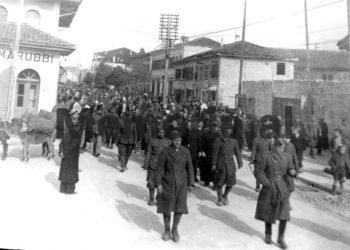
The martyrs’ remains were placed in the city’s mosque. All were of the Muslim faith. After two days, the burial ceremony took place. The participation was extraordinary. Leading the procession was the car with the victims’ coffins. Following them were the family members and the rest of the citizens. Also participating were the Chairman of the National Association of former Political Persecutees and Prisoners, as well as representatives from the governing party. The Chairman of the Muslim Community had also come, as well as Doctor Istrefi, who was now appointed director of a directorate in the Ministry of Health.
Numerous speeches were held. The Chairman of the Muslim Community spoke, as did the Chairman of the National Association, the representative of the governing party, Doctor Istrefi, and the young man who had brought Sokoli’s letter to the family and who had come especially for this occasion. The ceremony was closed by the chairman of the City Branch Association. Sokoli’s coffin was placed near Afërdita’s grave, while the coffins of the eleven executed were placed in a common grave. Numerous wreaths adorned their graves. Memorie.al