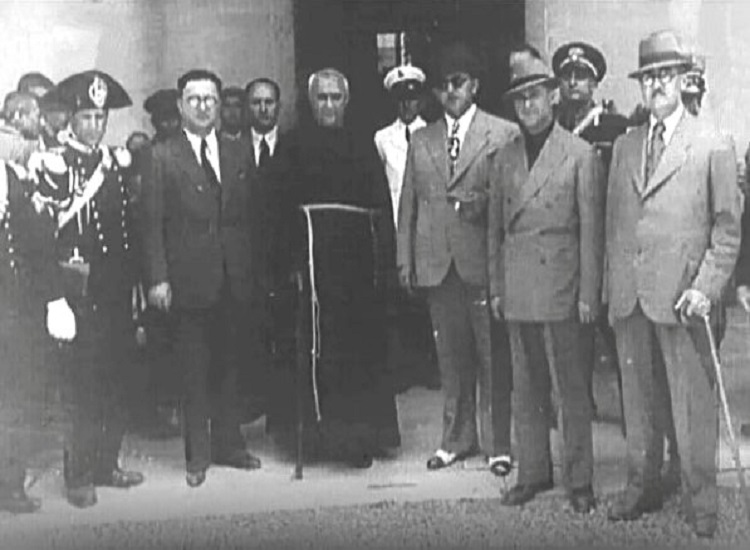

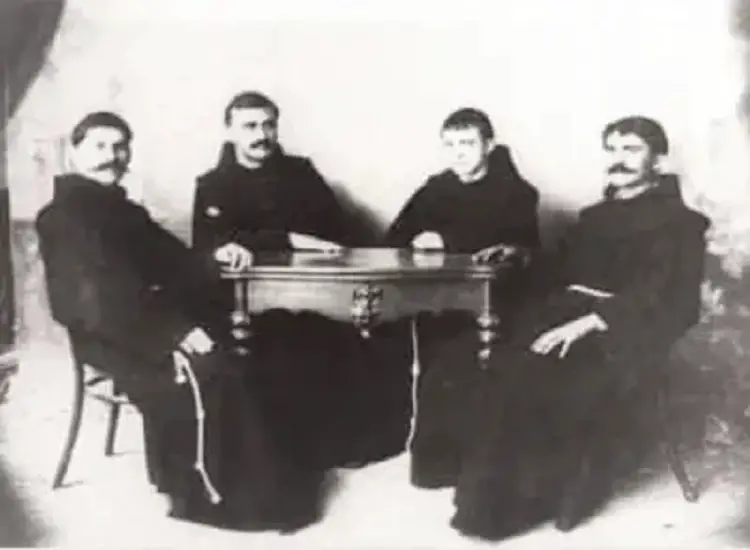

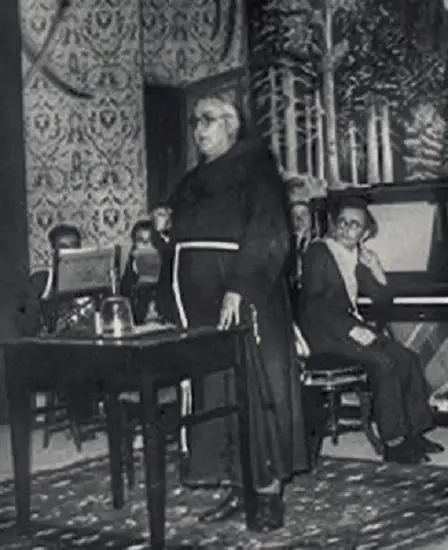
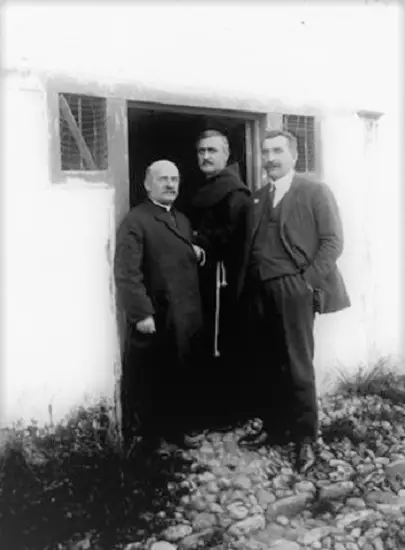
Memorie.al /At Gjergj Fishta issued his warning about the internal danger in his writing titled “The Internal Danger” in the famous Franciscan magazine of the early last century, “Hylli i Dritës” (The Light of Day), No. 1, of the year 1921. Although the article was written 98 years ago, the relevance of the words and the warning of At Gjergj Fishta, directed to the political class of that time, about the internal danger that threatened Albania and Albanians, currently and unfortunately sounds relevant, like a war cry that rings even today for Albanians and the political authorities of both states – Albania and Kosovo, almost a century later. At Gjergj Fishta knew well the physiognomy of the Albanian.
He did not spare his words and did not write to secure political support from the governmental and state authorities of the occasion or time, nor for personal or political interests, nor did he intend with his writings to entertain, “The Lords and Knights of Princely Courts,” as At Viktor Volaj once expressed in a note, a lesson also for today’s Albanian media. Fishta considered that the “internal danger” came to the nation, not from “internal enemies,” as the communist regime used to label its political opponents.
No, for At Gjergj Fishta, the internal danger for Albania and for Albanians were; “the vagabonds, the bums, the ruffians, these people, these microbes of the nation,” as he called them, who; “today can hope to enter the offices of the Albanian state and receive, moreover, gold salaries.” Above all, with this warning as well as with all his writings – regardless of what today’s pseudo-historians and nostalgics of Enver think about him and his work – At Gjergj Fishta always aimed to protect the interests of the Albanian nation and to advance its image and its heroic and noble spirit in the world.
The Friar of the mountains warned Albanians about what he considered dangers threatening the Albanian nation from internal and external enemies. Although for “modern” Albanians and for today’s political class, both in Tirana and Pristina, At Gjergj Fishta may be considered very distant and inconsequential for today’s Albanian history and current affairs, I tell them, you are wrong.
In the eyes of impartial observers, Fishta’s thoughts and warning are as relevant today as they were almost a century ago, as it seems that, unfortunately, a century later, nothing has changed in this regard.
Especially when considering the current situation in Albania and Kosovo, including political infighting and the struggle for power, corruption, drugs, various traffics, the protection of personal and family interests in state affairs and businesses by those in power, and other things that historically, do not present today’s Albanian political class in the best possible light, whether in Albania or in Kosovo.
Unfortunately, Albanians have not learned at all from the mistakes of the past, including the historical period and troubles about which Gjergj Fishta wrote, almost a century ago.
“The Albanian people speak a language entirely their own… therefore it cannot be denied that all those who speak Albanian are Albanian nationals; and for this reason, the Albanian state will extend geographically, to where the Albanian language reaches.” (At Gjergj Fishta)
Personal and party interests today are destroying the internal social harmony of the Albanian world and are encouraging the nation’s enemies to fish in troubled Albanian waters, whenever they see a favorable opportunity and the door open for realizing their diabolical goals against Albanian interests.
The current political situation in Albania, especially on the eve of the June elections, and the fragile internal and external situation of Kosovo, requires from those who wish the Albanian nation well, and especially from those who today hold the fate of the nation in their hands, to heed the century-old warning of At Gjergj Fishta:
Beware of the internal danger! The pronounced social differences in the political and economic field, where a small segment of society that controls politics and the economy is favored over others – especially in a poor society like the Albanian world – pose a risk to the future of Albanians, not only within Albanian territories but also in relations with others.
However, with internal political and economic harmony, internal and external threats to the national interests of Albanians, no matter how serious they may be, could be more easily faced with the unification of Albanians around a common platform of national interests that must stand above all other political and economic interests.
In the warning about the internal danger by At Gjergj Fishta, in the famous Franciscan magazine, “Hylli i Dritës” (The Light of Day), of 1921, the Poet of the Nation, with his historical perspective, writes; “before the achievement of independence, Albanians were oppressed under a yoke of five centuries of slavery, deceived by foreigners, betrayed by the powerful, until Albanians had even lost hope of ever seeing their free and independent homeland; and therefore the vast majority of them were neither hot nor cold, when we told them there was an Albania.
But, behold, time has proven us right. Today Albania has its own government, its own parliament, has an army, finance, moreover has a line of borders legally recognized by the Civilized Powers: all these things that prove to us that Albania exists, and that it is free and independent.”
Fishta wrote that; “our ideal regarding the independence and freedom of the Albanian nation was realized,” adding that; “the Albanian state was born,” but at the same time poses the question: “But well: does it live? Does the Albanian nation grow?” He states that, right away, there didn’t seem to be any immediate external threat to the new independent Albania, but warns that to extinguish the new life of independence of the new Albanian state, the danger did not necessarily have to come from outside.
“Many times that danger comes by ripening and, by clouding up inside the tissues upon which life bubbles. Those poisoned microbes, which fester inside the blood of a lymphatic, are one by one as dangerous for a person’s life as a bullet, or a bullet that pierces through his body…!”
Therefore, Fishta calls out that; “We, therefore, like all those who have Albania at heart and know what true liberty is, what homeland is, must gather our wits together on a matter of such importance and not be lulled into an unreasonable optimism, striking the country and the people with words of enthusiasm.
The nation must not be deceived; it is a sin to deceive the nation! The nation’s eyes must be opened, and they must be opened in time, when it is seen that its life is in danger, so that in time it may take those measures that the place and reason advise it to use to save its life.” Fishta warns, as he puts it, with the words of the ancients that; “sickness must be confronted from the beginning, because later on the cure will be hard to find.”
“It is not enough that Albania has been made; we must maintain it,” Fishta warned and continues; “if we want to see what danger may threaten the homeland from within… according to the principles of the ethics of civilized peoples, we must look at the internal nature of the authority and the rules according to which state finances should be used, and then separate the most dangerous element for authority and finances…”.
Fishta views those he calls “rulers” of the state, be they “princes, chieftains, pashas or beys,” not as the privileged ones of society with privileges, rights, and wealth, compared to simple people, but as equal to all others, because “the blood of all men is one.” Consequently, he warns in the article in “Hylli i Dritës,” that;
“The day, therefore, that a ruler of the state begins to use state authority, not for the benefit of the entire state, but for personal purposes, or for the interest of any caste in the state, whose goal has no connection with easing human existence on earth and with his individual and collective improvement, that day the destruction of that state begins, and the ruler becomes the deadly microbe of his own nation, without the need for the enemy from outside to waste bullets on it…!”
“Albanians! The homeland is not maintained with trinkets and chatter, but with sacrifice and work,” – warns Gjergj Fishta and asserts that; “the most dangerous element or, better to say, the greatest danger to Albania, are the vagabonds: those Albanians who, unable to ever form a sound thought in their own mind, are incapable of putting two lines together without error; who started clinging to the homeland firstly, or since the time they were doing who knows what far from their ancestors and, no doubt remains…!
Ruffian people, frivolous people with no kindness or good manners, with no valuable education, who all their lives were unable to lay down any property, to nail down any foundation, to raise any house, to start any work, to keep any friend, but always with a suitcase in hand, wild in mind, corrupt in speech, perverted in deed; where they are planted, they do not harvest; where they fall, they do not rise; except, like headless flies, from dock to dock, village to village, city to city, everywhere picking up some new vice, everywhere leaving some new folly for Albania…!”
“…Behold, then, who are the greatest danger to Albania: the vagabonds, the bums, the ruffians. Yet, despite this, these people, these microbes of the nation, not only have the face and the nerve to ask, but today they can even hope to enter the offices of the Albanian state and receive, moreover, gold salaries.
But really, will our merchant have to inhale the miasmas of alleys and backstreets, will our plowman have to hold his head in his hands along difficult paths, just to feed and maintain these despicable people? And where are we, oh God? Has the meaning of manhood truly been forgotten in this land, that such base people are to be fed with the sweat – with the blood – of the Albanian nation…?
“Albanians! Either the vagabonds out of work and out of Albania, or otherwise we have dealt with them harshly and gently,” concludes the message and warning of At Gjergj Fishta, in 1921. Unfortunately, Fishta’s warning was not heeded in his time, nor later.
But it is worth it today, almost 100 years later, that this war cry be heard by today’s “rulers” throughout Albanian lands, as a call for unity with the aim of avoiding the repetition of the history of the past 100 years of Albanians, so that, as At Gjergj Fishta said, the “sickness” of internal danger is confronted from the beginning, before it is too late. / Memorie.al