

From SAMI REPISHTI
Part Twenty‑Three
Sami Repishti: – “In Albania, the communist crime of the past has neither been documented nor punished, there has been no ‘spiritual purge,’ no conscious confession and denunciation of the ordinary communist criminals!” –
‘Under the Shadow of Rozafa’
Memorie.al – During the 1930s and 1940s of the last century, as the unstoppable torrent of fascism and communism descended upon Europe, sooner or later upon the entire world, “fate” also seized the Albanian nation by the throat. Like all young people, I too found myself at a crossroads where a stance had to be taken, even at the risk of one’s life. Then I said “no” to the dictatorship, and took the path that had no end, a sailor on a vast, shoreless sea. The rebellious act that nearly killed me simultaneously set me free. I am an eyewitness to life in the fascist and communist hell in Albania, not as a “politician,” a “personality” of Albanian macro‑politics, but as a student, as a young man who became aware of my role, in that time and that place, out of love for my homeland and the desire for freedom; simply, as a young man with a strong sensibility, faithful to myself, to a life of dignity.
Continued from the previous issue
XX
With the arrival of June, the medical examination began for the prisoners who were to be sent to the labor camp. Fear had taken hold of the prison, because this time the extermination camp of Vloçisht, Maliq, was mentioned. The “veterans” had recounted in detail the life and work in that camp. Just the name Vloçisht terrified them: hard work in mud, torture, hunger and executions, or beatings with clubs. In this threatening atmosphere, lists were drawn up that included almost all the prisoners, except for rooms 2 and 10, where the incurably ill were kept. The smell of death blew through every window of the prison, and hopes of returning six months later had almost died. Even the young were frightened; the experience of Beden was still very fresh.
One June day, early in the morning, we were roused by the shouts of the guards as they began reading the names of all those who were to leave for the camp. Then, the order was given to gather all our rags and go out into the outer courtyard. The loading of the trucks began, with the prisoners chained together. Seated in the square, packed like sardines in a box, the guards tied us with ropes in groups of six. For each truck, there were four guards with submachine guns and clubs.
Around the vehicles were guards with Jeeps or motorcycles with machine guns. Finally, we set off! The journey to Korça would last more than twelve hours. Without bread, without water, without the possibility to relieve ourselves, under the hot June sun and the clubs of the guards who were enjoying themselves, more than five hundred prisoners endured one of the hardest days of their imprisonment. No one spoke.
Every request was answered with a club blow to the head. Every complaint was a groan that tore your soul, but with no effect. This merciless oppression against us was not because the communists feared any counteraction from us. We were broken! The absolute seizure of power by the red rulers had laid the foundations of a deeply rooted self‑confidence in their minds, strengthened every day more and more by a favorable external political conjuncture. The red rulers spoke with the certainty of a pharaoh inheriting the thousand‑year‑old cult of the monarch, sovereign and master of the life of the subjugated masses.
The oppression we suffered day and night had other roots: it arose from the need to erase the traces of the blood and crime committed, practically since the founding of the “Party,” which continued hopelessly, incessantly, every day, every hour, every minute. The prisoners of the forced labor camps were the mirror reflecting the monstrous acts of the regime, and for the red executioners they constituted a living, moving, speaking indictment, capable of creating even through silence, a turmoil in the perpetrator’s conscience, and causing within him that inevitable duel, that unavoidable clash, that long, unstoppable, perpetual process that slowly and surely gnaws like a worm in a tree, consuming the marrow of life and disturbing the peace of the heart.
The bestial fury with which our guards threw themselves upon the victims was the meaningful expression of their need to free themselves from a burden they could not bear on their backs, from a suffering they could not endure, from a pressure they could not withstand and sought to escape. Like an alcoholic into alcohol, they found a deceptive escape in crime, in a stripping away of human qualities, especially of thought; and by turning into animals, they easily accepted submission to the only undisputed master of their being: the bestial destructive instinct! On the first day, we were divided into brigades and placed in two‑story barracks, in long rows, like cattle stables. Again, the roof was made of sheet metal, and the walls of swamp reeds.
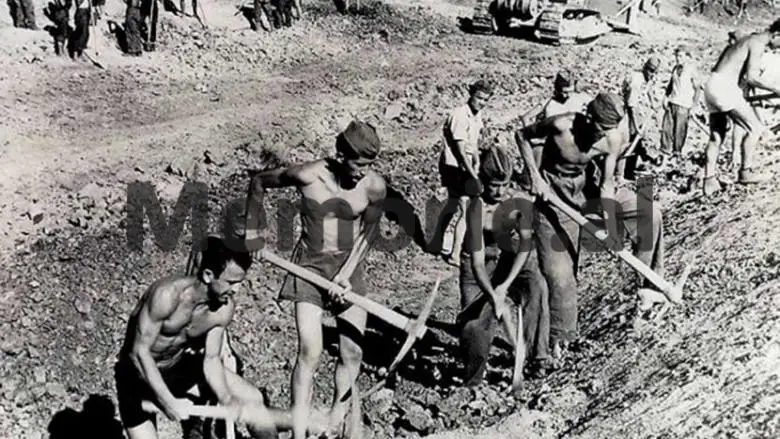
During the summer, the heat took our breath away, while in the cold months, the wind froze our bones. The work was heavy, but especially hard. In the absence of excavators, we were forced to dig the first drainage canals. Immersed in cold water up to our waists from the morning, we fell victim to leeches that attached themselves to our bodies and sucked our blood. At first, we didn’t know how to deal with them. A local peasant advised us to remove them with soap. The filthy insect would slide off and fall to the ground. The cold water brought on body chills. We began digging in shifts. When one person went to the bank to warm up, he was replaced by another. This method continued until the water began to flow, and the flooded areas emerged.
The work in Maliq aimed at draining the plain and creating a new riverbed for the Devoll River, which at some points was seventy‑five meters wide. The digging was hard, the soil mostly compressed marsh mud, and the harsh treatment by the police, punishments without bread, and spending nights in cold cells made it unbearable. Constantly followed, I found no escape from the guard, or the courage to resist. For consolation, I contented myself with internal dialogue: “I warm my frozen hands with the steam of my breath, and you beat me with a stick, because, you say, I’m wasting time. I wrap a rag around my neck to protect myself from the cold wind that freezes me to the marrow, and you throw stones at me, because, you say, I’m resting. I try to protect myself from the water in the ditch where I work, and you throw mud at me to soak even the shirt on my back, because, you say, I’m avoiding the work the people demand. I shiver from the frost that the wet rags and the wind of the Maliq plain make unbearable, and you grab me by the scruff of the neck and throw me into the cell surrounded by barbed wire: spend the night here, you say, because you didn’t meet the quota. And when in the morning, half dead, my comrades help me to walk, then you, monster with a human face, find the opportunity to vent your fury again like an avalanche of snow, what ‘Mother Party’ taught you: to beat, and beat mercilessly, until your arm tires, the arm of a foolish young man. I look you straight in your distorted face, worse than the heart in my chest, and you understand me. For a moment, a ray of hope is born. But you, grinning with joy: ‘I won’t kill you,’ you inform me; ‘you still have to pay for your crimes!’ Then, my eyes darken and my ears constantly ring with ‘your crimes, your crimes, your crimes, your crimes…’!”
In the new riverbed of the Devoll, the height of the escarpment was great and far from the excavation siting. The long lines of wheelbarrows, filled with mud, climbed like ground flies on a threshing floor, made a semicircle, emptied the soil at the highest point, and descended again near the canal, where the next wheelbarrow, loaded full, was waiting. Like a horse on a threshing floor, the prisoner went round and round for ten hours a day, without rest, except for the lunch hour, when we received a ladle of bulgur wheat or boiled potatoes without oil. In the evening, we were given a ladle of tea, and in the morning, boiled bulgur again. Hunger was universal. Some had lost their human appearance; they looked like moving corpses. A peasant from Librazhd underwent such a marked change of face that he took on the features of a beast. His large, full teeth protruded from a mouth with short lips that never closed. His neck stretched forward from his back hunched by fatigue. The fingers of his hands were half‑clenched like claws awaiting prey, his legs barely supported him, like those of a prematurely aged old man, and especially his eyes, oh his eyes, that looked straight ahead without any direction, lost, motionless, as large as two bright glass spheres, but expressionless, and yet they said everything…! Nevertheless, in that body that was wasting away from lack of food and overwhelming fatigue, the eyes seemed to accuse: “What am I? A work animal, a stray dog, or a human?!” – Get in line with the others, pig! – the guard shouted from behind.
It was the voice of Officer Karrabec, whom we knew well, because he had burned a prisoner’s eye with a cigarette. – “What were you, pig?” – he asked the prisoner one day. – “Armen came to Albania,” – the victim replied.
– “An enemy who came to Albania? Oh, son of a pig,” – the guard raged, and without a second thought, he put his lit cigarette in his eye. The victim let out a piercing scream, and with a voice full of hatred, he said: – “O, Aristidh Karrabeci! I may even forget God, but never your face and your name”! The stone‑hearted idiot stood there speechless, motionless, like a statue, and left without a word.
News came from Shkodra that two former Security officers who had undergone a crisis of conscience and disclosed Security secrets had been sentenced to death and fifteen years in prison, respectively. The medieval custom in Europe and in the palaces of Oriental satraps, of committing crimes by mute people or by agents destined to disappear like the crime committed, was being adopted in our country as well by the “Albanian” Security. Only thus could the extraordinarily harsh measure against the young deserter be explained. Crime is born, develops, and is covered in darkness!
August 1949. From Greek territory came the rumble of artillery. In the morning, an order from the camp command forced us to stay inside the barracks. Curiosity grew as the noise approached. The frightened guards told us that an offensive of the Greek army was underway against the communist forces of EAM, which were supplied at night by the Albanian government. Through the holes in the reed walls and the small windows, every night we saw long columns of military trucks, each with a single light on, passing along the foot of Mount Podgorje and heading towards Bilisht. The next day, we received orders to prepare to leave the camp. The fighting continued all day.
The rumble of Greek artillery and the sound of aerial bombardment were very close, as if on Albanian soil. At night, on the mountains of Vishti and Gramoz, the fires of the army were visible, and the explosions of aerial bombs were heard. On the third day, the noise of battle ceased. By order of the directorate, all the prisoners gathered in the camp square. A political conference. The director explained to us how the “Greek Monarcho‑Fascists” were provoking the Republic of Albania, “but our forces repelled them successfully.” No one spoke. Total silence. Then, he declared in a loud voice: “Perhaps you were expecting your liberation from the Monarcho‑Fascist forces,” and he began to laugh heartily. No one spoke.
The camp life and the work in the canals of Maliq continued uninterrupted, unchanged. From sunrise to sunset, nearly two thousand prisoners, political and ordinary, worked with shovels and wheelbarrows in back‑breaking labor, under the whip of the camp‑prison guards. Most of them performed their “service” with pleasure. The daily quota for each squad, company, and brigade had to be fulfilled. Punishment was isolation in a tin cell, without bread, without water, without a bed. The night in Maliq was cold even during the summer, and our clothes were light. The monotony of camp life and the work imposed upon us were enough to drive us to the brink of madness: day and night, night and day, like Chinese torture.
The insults, beatings, punishments, immense fatigue, and especially the feeling of humiliation that tormented us every moment, weakened us greatly. Everyone fought for survival, if only to not give satisfaction to the executioner waiting with open mouth for our collapse. How was it possible that the red guards embraced the implementation of the camp “rules” as the sole purpose of their lives? How could the emptiness of their being, their pettiness, their drive towards the annihilation of everything that deserves the name “human,” go so far?! Human! O noble creature, so much abandoned into the hands of a thoughtless world, and us into the mercy of lifeless matter!
I met Uncle Vata from Dukagjin, sixty years old, always thoughtful, smoking a pipe mostly empty due to lack of tobacco. He had drawn me in from the beginning when he came to prison, accused of sheltering escaped “criminals.” During severe torture, he had consistently denied the accusation. A cunning officer, who had understood the depth of the old man’s faith in God, exploited it in the most Machiavellian way, bringing a wooden cross with Christ nailed to it. – “Now,” he said to Uncle Vata. – “Swear before Christ that you told the truth, that you did not shelter the fugitives.” The old highlander was left speechless.
And then. – “No,” he replied. “I will not swear.” – “Then you admit the accusation,” the officer said, “and you will be sentenced.” When I asked the devout old man why he hadn’t continued to deny, he replied: “I couldn’t lie to Christ, man…! Where would I go without Christ”?! And after thinking a bit, he added: “And now, whenever I make a mistake, I tell myself: lucky Vata, Christ knows you well, Christ forgives you! And I don’t worry”!
On his unshaven face, the sadness of the old man was clearly visible, who in his chest harbored the impetuous heart of a youth that was no more. His legs and arms had failed him, life had tired him! I looked at Uncle Vata and thought about the perennial victims of our three‑thousand‑year‑old country. The ignorant villagers, the ideal material for oppression, hard work and suffering, had not changed, nor had the oppressor changed, his animal instinct, his arm that struck mercilessly at the bent back.
The red internationalist five‑pointed star was no better than the Turkish‑style baggy trousers, or the Slavic, Greek, Roman iron heel. The suffering that enveloped us proved me right. All around, the redness of blood shed without guilt bore the stamp of oppression, terror, and death, the inseparable companion of the red star that caused it. I looked at Uncle Vata, and before me appeared the highlanders who had lived for thousands of years in the same place, tireless workers, against the wild nature and miserly land that gave them birth, raised them, and swallowed them without leaving any other trace but the friction of their bare feet, or with leather opinga, left on the rock that served as a path, as a pavement, as a step, as a pillow, as the only resting place—hard, unyielding, rough, and yet comfortable, certainly loved by grandfather and father and son and…grandson, who has begun to walk!
It was this simplicity of their life and speech, a sincerity that fascinated me, which contained the essence of human wisdom in this abyss into which we had fallen. “Communists, man! What else can you expect from them?” The division was complete, irreparable, and eternal! At this culminating point of the antagonism between two worlds, the confrontation between the defined terms of two diametrically opposed, death‑marked stances, presented itself in its simplest form, the epitome of punishment without compromise, without conditions. Here one found the spiritual nobility of a highlander, face to face with the inhuman baseness of the red guard; the spirit of brotherhood cultivated for centuries by one, face to face with the scientifically cultivated crime of the other; the besa, honor, manliness, and hospitality of Uncle Vata, face to face with the treachery and deceit of the Security interrogating officer and of Karrabec…!
What could be more sublime, more inspiring than such an attitude, that of a simple highlander, that strengthened my conviction in the inherent nobility of human beings, and especially of our highlanders, unstained by the events of centuries, and the filthy feet of the century‑long conquerors? “Uncle Vata! In this dark pit we have fallen into, your simplicity serves as a light‑giving candle on the difficult path of honor that must be followed, for those who wish to remain faithful to them. Because, as long as you obey only the voice of your conscience, and the tradition that strengthens it, you will be a free man… and the day you forget it, you will cease to be who you are, and will end up as a modern slave”! Human, o noble creature, so much abandoned into the hands of a thoughtless world!
In October, the rainy days began as well. In Maliq, we experienced the difficulties that mud creates for those who work and live in that area. Walking was slow, our feet stuck in the mud that clung like bread dough, and often it pulled the shoe off the foot, forcing one to walk barefoot. The shovel would load up, barely lift, and not empty. Transporting with a wheelbarrow was even worse; the mud wouldn’t separate without being shoveled off. The work became so difficult that no one met the daily quota anymore. The internal guards grew wilder, cursed, threw stones, and when nothing worked, they attacked the brigade stuck in the mud with clubs. Meanwhile, the canal had to be finished before November. On sunny days, we started early and returned to camp late. The pace of work increased, and so did the number of beatings. Punishments without bread and water created long lines of hungry, broken prisoners.
With the arrival of frequent rains, the work site filled with water which, little by little, also reached our camp. Unable to work, we stayed locked in the barracks. When food and bread were distributed, we would take off our shoes and, barefoot in the water and mud, line up shivering. The cold wind of the Devoll blew. Our torn clothes no longer kept out the rain. The enraged guards beat us with clubs. It was hell on earth, a situation where few thought of anything else but a piece of bread and a ladle of soup, without a word, without any reaction, except for the rubbing of frozen hands and moving to warm ice‑cold feet in the water and mud. The situation worsened even more with the breakdown of internal order. The guards did not move around much. The camp had turned into a jungle.
The ordinary prisoners took advantage of the absence of guards and began looting wherever they could, especially among the elderly who could not defend themselves from attacks. Young men with criminal tendencies would approach our bunks and snatch with astonishing speed anything they saw: bread, food, clothes, shoes, even the bunk with its covers if the prisoner wasn’t there to stop them. This forced us to organize into groups and arm ourselves with pieces of wood and leather belts, to protect each other inside the barracks and outside in the bread lines. A big problem was the uncovered latrine. Cared for in the most primitive way, we were forced to walk carefully on planks covered with slippery mud.
Filthy beyond measure, because no one cleaned them, the latrines became a real danger. The prisoners began to relieve themselves outside in the yard, in front of the barracks, and finally, even inside the barracks corridors. The risk of an epidemic like cholera or typhus increased every day. Unable to work, the camp command decided to return us to our respective prisons. Again, the trucks loaded with the moving corpses that we were, chained and tied with ropes, ragged, covered in mud, half dead from fatigue, hunger, and cold. For more than twelve hours, under the clubs of the bloodthirsty guards, our backs blackened from the unceasing sticks, and from the kicks and punches of the enraged “red dogs.” / Memorie.al
To be continued in the next issue