
By SAMI REPISHTI
Part Twenty-Eight
Sami Repishti: – In Albania, the communist crime of the past has not been documented and punished, no “spiritual cleansing” has been done, no conscious confession and denunciation of ordinary communist criminals! –
‘Under the Shadow of Rozafa’
Memorie.al / During the 1930s and 1940s of the last century, with the unstoppable downpour of fascism and communism over Europe, sooner or later over the whole world, “fate” also grabbed the Albanian nation by the throat. Like all young people, I too found myself at a crossroads where a stance had to be taken, even at the risk of life. Then I said “no” to dictatorship, I took the path that had no end, a sailor on the wide sea without shores. The rebellious act that almost killed me liberated me at the same time. I am an eyewitness to life in the fascist and communist hell in Albania, not as a “politician,” a “personality” of Albanian macro-politics, but as a student, as a young man who became aware of my role, in that time and in that place, out of love for the homeland and the desire for freedom; simply, as a young man with a marked sensibility, faithful to myself, to a life with dignity.
Continued from the previous issue
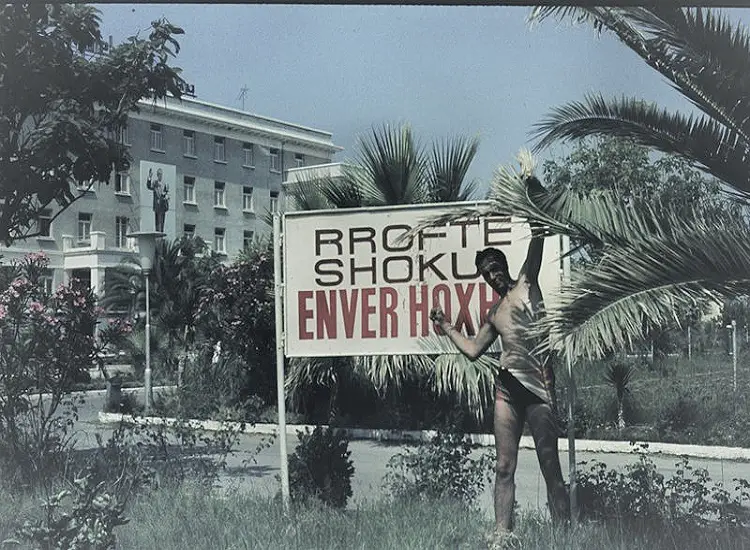
The kindness of the driver from Korçë touched my heart. Accustomed to mockery and humiliations for many long years, the behavior of this simple man, on the first day out of prison, seemed to restore my faith in the good side of human beings, seemed to melt the ice of cynicism that I had accumulated for ten consecutive years. In front of me, on a building, stood the large portrait of the little dictator, Enver Hoxha.
Confronting this Asian satrap, who fully enjoyed his role, aroused in me all the hatred for the man and his destructive work. He was the little man who cruelly killed a great moment of national history. He was the criminal who strangled in the cradle the inspiring days of the glory of the heroic war against foreign invaders, with mass killings, prisons, and endless internments.
He was the adventurer who extinguished with bullets and medieval torture the enthusiasm of a youth burning for heroism in the war for freedom and for a better Albanian society. He was the one sold to the devil, who betrayed the hopes and aspirations of an entire people for freedom, independence, and democratization, with the shameful submission to foreigners who despised us! A taxi stopped in front of me. – “Shkodër”? – he asked. – “Yes,” – I replied. – “Do you have money to pay”? – “How much is the ticket”? – “Two hundred lekë”! – “Good”! – I called out, pleased that I had enough money for the journey.
Along the way I understood that the driver, a young boy, came from my neighborhood. The long time in prison had taken its toll; a new generation, unknown to me, had grown up in my city. The passing of years had cut me off from the city’s society. I felt half a stranger, and formed the first idea of the difficulty of my integration into a social body that was, to a large extent, unknown to me.
Traffic was light, the car flew. At the entrance to the city, the majestic silhouette of Rozafa Castle appeared. A flood of memories covered me, and the longing for my Rozafa brought tears to my eyes. The driver looked at me and asked: – “How many years did you spend in prison? – “Ten”! – I replied. He said nothing at all. When we arrived at the street leading to my house, I was shocked by the miserable state of the neighborhood and the surrounding houses: aged, neglected, as if they had remained deserted, like “houses without men.”
In this spiritual state, I got out of the car, paid the driver who kept honking incessantly, put the rags over my shoulder, and headed towards the two-hundred-year-old traditional door of my ancestors’ house, where my family lived.
XXVII
Hastened by the driver’s noise, my mother and sister came running out to the threshold of the door. Without saying a word, they threw themselves into my arms. I lowered the rags to the ground, opened my arms and embraced the two dearest creatures, who could not stop crying and huddled like two frightened birds on my chest. I kissed my mother’s and sister’s heads, unable to hold back my tears, and spent a few moments in that indescribable emotional state, but in complete happiness.
I was extremely moved by this display of endless love, which I had not known for ten years. My elderly mother would not let me go. My sister would lift her head and, with tearful eyes, look at me as if she did not believe that I was there, beside her, on the threshold of the house I had left many years before. Then, gently stroking my hand: “Come inside,” she said, “you must be tired.” Meanwhile, the neighbors approached.
Some congratulated me on my release; others whom I did not know looked at me curiously. When I entered the house, my sister informed me that they lived in one ground-floor room and that the rest of the house was occupied by tenants placed there by the “government.” That was the first expression that prepared me for other unpleasant news. I was not shocked! I was living completely in the sea of joy that covered me with my return to the family and the meeting with my relatives. I knew well their sufferings; of course, there was also the other part, when people suffer in silence and in darkness.
But neither my mother, nor my sister, nor I wanted to begin the stories of life under oppression. The contempt and misery we had gone through. In the room I entered, there was no furniture. Only three beds, a table, a few chairs, and the “minder,” a sofa where they spent the day. I sat down, and again the wave of embraces and tears that flowed non-stop began, this time away from the eyes of the world. The three of us were free to release our emotions, free to shed tears without fear.
We were alone; three unfortunates caught in the all-powerful net of a situation that did not allow hope for a better day. At least now we were together, and together we would sail the troubled waters of life under communism that awaited us. Together, suffering feels less! From their gaze, I clearly understood that my physical condition had shocked them.
With my skin darkened from working in the sun, with torn and muddy clothes, and with the rags gathered in a bundle, I had no way to hide this misery. I tried to talk and smile constantly. They were pleased. I began to ask about the others. They told me that my brother was in military service, that my sisters were “all fine,” and with that I was assured that there were no other prisoners in the family, and that my escaped brother was living…!
Not much time passed; I dictated in their controlled gestures something serious that troubled them. I took my mother next to me, put my arm over her shoulder, and in a low voice asked: “Tell me, mother, do you have any bad news to give me? Speak openly, please… tell me, what is tormenting you inside”…?! She thought a little, lowered her head. My sister also lowered her eyes. Then, in a trembling voice, my mother said: “We have no bread… we have no ration tickets… and my sister cannot find work”…! At first, I did not understand.
Then my sister explained that bread was given with ration tickets only to those who worked, and that they had refused her any kind of work that was not manual labor, mainly in construction…! My sister’s story found me unprepared for such an unjust and painful situation. Immediately, my mind went to my work in the camp, especially loading and unloading cement. The idea that my young sister would be forced to work with a pickaxe, carrying stones and bricks on construction sites, inside or outside the city, shocked me so much that I was left speechless…!
They had lowered their heads. I was silent. Just a few minutes after the joy of being released from prison and reunited with my family, I found myself in a hopeless, threatening situation. Three persecuted people by a ruthless regime, we sat head to head, hungry, frightened, and isolated. I could not find expressions that comforted, or words that gave courage, to these two wretched beings.
Of course, I had not “dreamed” of a normal situation in my family, persecuted step by step; nevertheless, even the deepest suspicion had not created the idea of such an oppressive and humiliating state. Little by little, I began to recover from this experience that crushed me like a stone crusher, and which within minutes opened up the horizon of the world that awaited me outside, now that I was a “free citizen.” – “How have you lived”? – I carefully asked my mother.
– “I receive the bread ration because I have a son in the army,” – she replied, and added in a low voice; – “when I have money to buy it.”
My sister had fixed her eyes on the floor and did not speak, but I understood that she suffered from a sense of guilt because she did not work and did not secure bread for herself and her mother. – “But when you have no bread”? – I continued with the persistence of one who scratches a wound that draws blood. – “We go to sleep hungry, – added my mother. – Sometimes my sisters bring us a loaf of bread…”! I remembered that I still had the thousand lekë I had received the day before. – “I have money, – I said. – Buy bread for tonight. Tomorrow I will look for work. Slowly, we will sort ourselves out…”! They did not speak. I stood up, took the money out of my pocket, gave it to my mother, and embraced her again, giving her courage and the assurance that, with my work, we would live “like everyone else”!
She embraced me without speaking. After washing and changing clothes, I sat back down on the sofa, and without speaking, watched these two miserable creatures going back and forth, trying to prepare a meal for me. Unbelievable! My money, earned in that hell, was being spent to bring a ray of light into the gloomy house. Sitting next to each other, we enjoyed together the first dinner with the family, after ten years of forced separation. My mother could not believe her eyes; she kept one hand on mine, without speaking.
My sister tried to keep the conversation lively. I answered willingly, did everything possible not to show scenes of life in prison and camp. Later, the visits of sisters and cousins began. Others, out of fear, did not come at all. After the initial greetings, they all expressed their surprise at my “good” health, and I answered that I was happy that everyone was well and grown up. They smiled. But everyone was aware of this farce that was being played, the only one allowed in such circumstances.
At nightfall, in the clean bed made for me, and with the washed clothes I put on, I felt myself “another person,” in “another world,” which I had forgotten for a long time. I embraced my mother and sister, wished them good night, and with the joy of a child, covered my head with the white sheet that smelled… of soap! The smell of soap! Ah, the smell of soap! An indescribable pleasure covered me; I began to breathe deeply and fill my lungs with this smell that I had forgotten for many long years.
Cleanliness, an impossible “luxury” in prisons and camps, was returning to my life. I was extremely pleased. It seemed to me that the past was beginning to melt away with the new experience in the bosom of the family, and strangely, from the cleansing that “soap” provided me, an antidote to the filth imposed by circumstances. Even such a simple comfort as washing with soap gained immense proportions after a long loss. Despite the simplicity of the event, I was filled with joy. In this spiritual state, I fell into a deep sleep, without any worry about the next day full of surprises…!
I got up early, concerned with finding work. Dressed simply, I wished my mother and sister a good day with a warm embrace, and headed towards the Employment Office. The young lad did not recognize me when I gave him my name. But after the question: “Where did you work before”? and my answer: “I was released from prison yesterday,” he, without thinking much, ordered me: “To the Construction Enterprise.” I took a piece of paper certifying that I was seeking work, and without another word, I left. In the “enterprise” there was another “employment office,” run by a rude, arrogant, sadistic fellow from Peshkopia.
As soon as he took the “letter,” he looked at me with two eyes that clearly showed his hatred for an “enemy of the people,” muttered some dirty words under his breath, and addressed me like a “chief bey”: “Go to the stadium…! There you will work on the first shift”! I left without speaking. Pleased that I had found a job, which meant bread with ration tickets for me and my family, I walked quickly to start work as soon as possible. At the stadium, I found the “supervisor,” who knew me well – a former footballer – I handed him the work authorization, and when he asked me what profession I had, I answered simply: “Manual laborer”! He looked at me without speaking, but with an attitude that killed me inside.
Dressed in old clothes and shoes that were not mine, darkened by the scorching summer sun, thin in body with hair cut short, he who knew me as a student showed a contempt that I did not know how to explain. I broke the reigning silence: “I am ready to do any manual work”! I told him. “I need the bread ration ticket…! I was released from prison yesterday”! He interrupted me: “I know, I know,” he said, “I don’t care who you are…! Here you will work like everyone else…”! And after thinking a bit, he added: “You will clean the running track of weeds…! Don’t use the pickaxe, because the track stones will be damaged… work by hand…! Start here and continue forward…”!
– “Yes,” I replied. And worried about the ration ticket, I asked: “When can I get the ticket”? – “At lunchtime…! Come to the office, I’ll give you the certificate…”! he replied. I started working on my knees, because the grass roots on the track had to be pulled by hand. It was impossible, but I did not object. I worked with my head down. At lunch, I went to the office, got the certificate and headed home, handed the letter to my mother, telling her that we were entitled to two rations, and returned to work without lunch, for fear of being late on the first day. I continued working until five in the afternoon.
What impressed me was the absence of other workers at the stadium. I was the only one working under the scorching July sun, kneeling, at an absurd job. Every now and then the “supervisor” would check the work done and the piles of collected grass, sigh, and without saying anything at all, leave. I understood that I was being surveilled. This work lasted five days, without any result; the grass would not be cleared by hand, and I did not dare point out the absurdity of this activity. I was working for my daily bread and was ready to work for that piece of bread even in hell…!
On Sunday, I was surprised by the large number of visitors who congratulated me on my release from prison. Most were friends released before me. Some were young people who wanted to meet me, and clearly sympathized with my anti-government stance, without saying it publicly. This mass of young people revived the enthusiasm of my youth years and strengthened even more my faith in the cause I defended. The silent expression of solidarity among the oppressed and persecuted, alive, strong, dynamic and deeply human made me feel proud. The fire of freedom was lit and fed with loyalty in the hearts of this rebellious youth!
During the farewell at the house door, as per custom, one of the young men handed me a small envelope. “It’s from Lili”! he told me. I did not answer. I returned shaken by the memories of the past, which had given me a thousand hours of happiness and caused pain from an offensive behavior at the same time. “Lili” I said to myself, “what does she want from me today”? I opened the letter immediately and understood that the feelings of my deep love for that creature I adored during my youth years were still strong. I was not disappointed!
After ten years of insults and sufferings, Lili was the first person who addressed me with passion and who appreciated me as a “human being.” “I will never forget,” she wrote, “how good you were, how kind and how different from the others…”! I understood that Lili was not happy! In the second week, I was assigned to work on draining the lands of the Zootechnical Center. With my long experience in the canals of Maliq, Beden and Myzeqe, this work came relatively easy to me, and the “norm” was smaller than in the camps. This allowed me to exceed it and secure better income. In the new canals, only “enemy elements,” “kulaks,” and former political prisoners like me worked. The harsh sufferings had taught me to be careful, to speak as little as possible, and never “politics.”
During these days, I strengthened my conviction that I had been transferred from a small prison to a large prison: the fear of speaking with comrades, the assigned work that had to be completed, the incessant control by “Sigurimi” elements who constantly circulated around us, and by “party members” who among us directed the work, as well as the isolation from the world, because tired from work, one had no strength left to visit others – all this was dizzying. Within a few days, I was transformed into a work robot that moved its arms like a mechanism, fulfilled the norm, returned home exhausted, cleaned up, ate dinner in silence, and went to bed to sleep a dreamless sleep…! / Memorie.al
To be continued in the next issue