Memorie.al / The murder of Nako Spiru is among the first mysterious killings of the communist dictatorship to be labeled as a “suicide.” Crucified by Enver Hoxha as an anti-Slav for daring to declare that “Albania could build its own economy even without the help of Tito’s Yugoslavia,” Nako Spiru allegedly chose the path of self-poisoning (gunshot), leaving behind an open indictment of the short-sighted policy of the Albanian Communist Party (ACP), which had become a satellite of Belgrade.
How did Nako Spiru actually die, and what was the political leadership’s reaction? How did communist propaganda treat his contribution during the National Liberation War, and what stance did it take regarding the fatal act of suicide? This is one of the first killings of the communist era that was closed with the word “suicide.”
Mehmet Shehu, who waited in the hospital hall for the fate of his dying comrade, Nako Spiru, would eventually meet a similar fate himself, as the practice of murder among the communist leaders of Tirana would, over the years, be covered by the softened, non-political concept of suicide. Between 1947 and 1981, almost nothing would change, except for the refinement of cunning tactics. On the morning of November 22, 1947, the country’s only daily newspaper, “Bashkimi” (Unity), announced the “accidental” death of Minister Nako Spiru, caused by “playing with a firearm.”
Until that moment, the heated conflict within the top communist leadership was unknown to the public. Nako Spiru had realized the economic ruin Albania was suffering at the hands of the Yugoslavs and had opposed the continuation of enslaving agreements with them – though, ironically, he was the one who had signed them on behalf of the Albanian government.
The moment for the unification of currencies between Albania and Yugoslavia had arrived, while the Albanian market was being depleted daily by Yugoslav plunder. In the Politburo meeting of May 29, 1947, it was stated that the unified currency would take effect in June; however, Nako Spiru raised several questions, criticizing the signed agreement and showing opposition to its implementation.
In the Yugoslav Crosshairs
The Yugoslavs realized that the first Albanian voice of opposition had to be silenced. In June 1947, the Yugoslav Communist Party, through Savo Zlatić, accused the ACP of harboring a crystallized “anti-Yugoslav second line.” No one in the leadership represented this “line” other than Nako Spiru and his supporters, who held no high-ranking positions. The conflict escalated in the following months.
On November 8, 1947, the Yugoslav leadership leveled another accusation against the ACP, criticizing specific elements and sectors where bilateral relations were failing. The Yugoslav leadership raised concerns that two political lines had formed within the ACP, one of which was anti-Yugoslav. The primary targets were Nako Spiru, Fadil Paçrami, and others.
Ten days later, the Politburo took up the issue of Nako Spiru’s “anti-Yugoslavism,” following intense discussions between Savo Zlatić, Enver Hoxha, and Koçi Xoxe from November 6–18. During the meeting, Koçi Xoxe claimed the foundation of relations between the two countries had been damaged in economic and military matters. Both Nako Spiru and Mehmet Shehu were accused of being anti-Yugoslav.
Circumstances of the Death
Assaulted from all sides, Spiru asked for five days to prepare a response. He was given no more than 24 hours. During the day, he attempted to seek support from the Soviets, but they were uninterested. As the 24-hour deadline was expiring on November 20, 1947, Nako Spiru was struck by a bullet to the heart. He did not die instantly. Present at the scene were the Deputy Minister of Internal Affairs and Director of State Security (Sigurimi), Nesti Kerenxhi.
Measures were taken to ensure no one entered the hospital – not even his wife – until the killing was finalized. A witness, Dh.Sh., then a typist, had seen the entire scene, but the person tasked with the killing failed to finish him immediately due to sheer panic. This was not without reason; he had been assigned the task against his will, merely “performing his duty to the Party.”
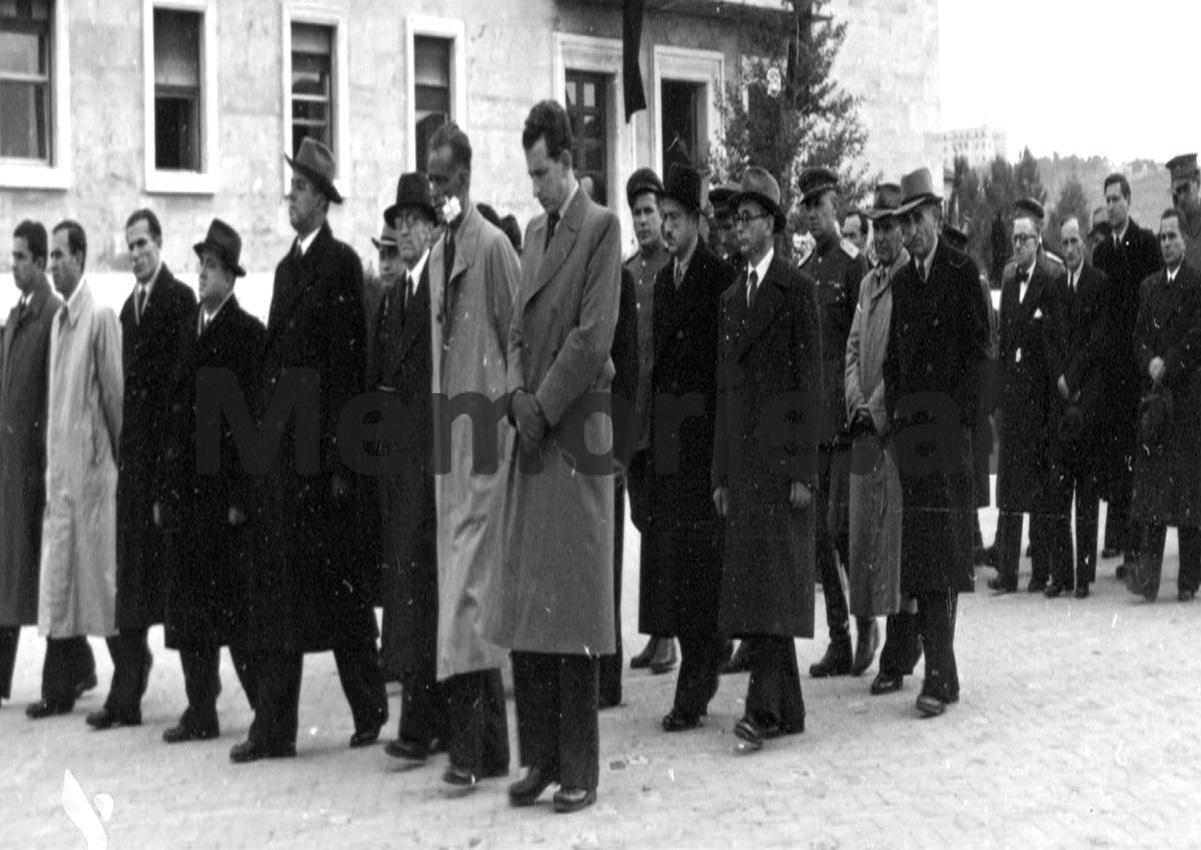
Nako Spiru’s body was laid in state in the People’s Assembly hall. Everything seemed forced and insincere. The animosity toward Spiru did not end there; in early 1948, the leadership continued to denounce him. At the funeral, the Vice President of the Planning Commission, Kiço Ngjela, stated that an “unfortunate accident” had taken their comrade’s life. Spiro Koleka spoke on behalf of the government and Ramiz Alia on behalf of the youth.
Reports from Moscow and Belgrade
Albania’s Ambassador to Moscow, Mihal Prifti, wrote to Tirana on November 30 regarding a conversation with a Soviet official named Petrov. Petrov noted that Moscow had received three conflicting telegrams from Tirana: one saying Spiru was shot in the arm, another in the leg, and a third elsewhere. Petrov told Prifti confidentially: “Regardless of how Nako’s death occurred, it doesn’t matter to us. It is enough that Enver and Koçi implement the correct Party line.”
Archives in Belgrade reveal that Yugoslavia dictated not only the actions but also the funeral ceremony. Enver Hoxha was in constant contact with them regarding how to proceed. On November 21, 1947, Savo Zlatić informed Yugoslav Interior Minister Aleksandar Ranković that “Nako Spiru killed himself while playing with a revolver.” Zlatić asked Ranković – pseudonym “Marko” – whether the death should be treated as a suicide or an accident and whether Enver Hoxha should attend the funeral, even questioning Hoxha’s legitimacy in Albania.
The 8th Plenum and the “Confirmation” of the Murder
The events peaked during the 8th Plenum of the Central Committee (Feb 26 – March 27, 1948). Nako Spiru’s “hostile work” was condemned. He was accused of working to sever “brotherly” ties with Yugoslavia and sabotaging the customs union. The report claimed Spiru had stated that by signing the economic agreement, he had “signed away Albania.”
Mehmet Shehu was labeled as Spiru’s “factionist collaborator” in the military for quarreling with Yugoslav Chief of Staff Koča Popović regarding the unification of the two armies. Enver Hoxha argued that the “alliance with Yugoslavia was one of the greatest victories” and that Spiru’s desire for economic independence was “isolationism.” Hoxha labeled Spiru’s wife, Liri Belishova, as well as Mehmet Shehu and Fadil Paçrami, as “dangerous people.”
Other leaders followed suit: Manush Myftiu called Spiru a “chauvinist,” Bedri Spahiu called him a “son of the bourgeoisie,” and Beqir Balluku labeled him an “agent.” Koçi Xoxe insisted that only Yugoslavia could help Albania and that “all matters will move toward unification.” On March 17, 1948, Hoxha sent a letter to Tito insisting on a “Federation” between the two countries.
Testimonies of Those Who Surveilled Him
Years later, Nesti Kerenxhi – a key figure in the organization of the event – provided testimony. On November 19, 1947, Koçi Xoxe ordered Kerenxhi and Pandi Kristo to watch Spiru’s house. The next day, Kerenxhi followed Spiru in a car driven by Lefter Lakrori. After hearing the shots, Kerenxhi and Lakrori entered Spiru’s office, took him to the hospital, and searched his pockets.
Despite the surrounding mystery, the primary survivors of the era never dared to admit that Spiru was murdered, remaining faithful to the “suicide” narrative until the end of their lives. No autopsy was ever filed in the Ministry of Interior archives. During Koçi Xoxe’s trial in 1949, Xoxe repeatedly stated that the surveillance and tracking of Nako Spiru were done solely under the orders of Enver Hoxha. / Memorie.al