By Shkëlqim Abazi
Part sixty-seven
S P A Ç I
The Graveyard of the Living
Tirana, 2018
(My memories and those of others)
Memorie.al / Now in old age, I feel obliged to confess my truth, just as I lived it. To speak of the modest men who never boasted of their deeds, and of others whose mouths the regime shut and buried in unmarked graves. In no case do I presume to usurp the monopoly on truth or to claim laurels for an event where I was only accidentally present, even though I desperately tried to help my friends, who tactfully and kindly avoided me: “Brother, open your eyes… don’t get involved… you only have two months and a little left!” A worry that clung to me like an amulet from the morning of May 21, 22, and 23, 1974, and even followed me in the following months until I was released. Nevertheless, everything I saw and heard those three days, I would not want to take to the grave.
“Take a bath and get dressed, be ready!” Tomçe handed me a pile of clothes. “Try them on; we don’t know if they’ll fit!”
At the showers, Bajram Hoxha was waiting with a cauldron of warm water.
“Why are you late, boy? Hurry, the guards might call you!” He stepped outside the stall. I washed, dressed, and came out.
“Mashallah! May the evil eye spare you?” Bajram rubbed his eyes and muttered a prayer under his breath.
“What’s come over you, Bame?” Zakja teased from the top of the stairs.
“I’m warding off the jinx so no one casts an evil eye on him!” Bajram replied, gathering the prison rags.
“Well, well, well, you’ve turned into a groom!” Zakja threw his arms around my neck and hugged me so hard I lost my breath. “May it be a thing of the past, son, and May you have the best of luck!” His eyes grew moist, and he began to sniffle. “O Great Allah, protect your sons!” He sat on the first step with his head in his hands.
“Stay strong, Zake! We’re taking him to the barber!” Bej Xhelal appeared out of nowhere, took my arm, and led me toward the shack of the Mallakastra “Hundaç” (the big-nosed barber), while singing a Colonja folk song: “O groom, where are you heading like this…?”
We stormed the barber’s door. For the first time, he shaved me without me having to wait in line. He even rounded off my hair – though he had buzzed it to zero two weeks prior – and splashed me with lavender from a flask he produced from who-knows-where. Then he gave me a playful slap on the back of the head:
“May it be behind you, and have a safe journey!” After all these years, I thanked him and shook his hand.
Outside, we almost collided with Rroku’s escort – five or six highlanders were leading him to be “decorated” by the barber. I say decorated because, compared to me, Rroku had hair at least three or four centimeters long. The privilege of being a brigadier, of course! We greeted each other and parted. When I returned to the room, Tomor was stuffing something into a suitcase.
“What’s this?” I asked, stunned.
“My suitcase. A souvenir from me, but more importantly, for the road – you never know!”
“The bag Ahmet Islami brought is enough. I don’t have much to take.”
“Take both! I’ve tucked in a couple of garments for my old lady.” He insisted: “And put on these shoes Esat brought!” He handed me a cardboard box.
When I put on the socks, my feet slid into the shoes easily, but as soon as I tied the laces, it felt as if a vise had clamped onto my soles. For five years, I had worn only tires-rubber sandals (opinga) or rubber boots; my feet had spread and my toes were deformed. Now, in real shoes, even my toenails ached.
“Eat something; you don’t know when you’ll get another turn,” Tomçe handed me the morning soup.
“I’m not hungry.” In truth, I didn’t want to swallow that filth that had lived in my gut for five years.
“Fine, I’ll put some biscuits in your bag!” He tucked in two boxes.
“Keep them; I’ll manage somehow.” I didn’t want to deprive him of his meager rations.
When I was sure I had packed everything I intended to take, I sat on the edge of the bed, on the rolled-up bedding that would now change owners – I was gifting it to Ladi, the friend I was sentenced with, who still had five years left.
“Get up, it’s time!” Tomor took the bag and suitcase and went out to the square.
There, I was surrounded by friends who had come off the night shift. They accompanied me near the corrugated iron gate, where Malo warned us to be ready, as we could be released at any moment. In front of the canteen, I joined Rroku, while our fellow sufferers formed a circle around us.
Only at that moment did I truly believe I was being released. I became conscious of it; my tongue went dry, and a knot formed in my throat as a flood of tears flowed involuntarily. I sobbed; the parting was so heavy that I found it impossible to control myself. When I saw the same thing happening to these hardened men, who had weathered so many storms, I broke down into heavy weeping.
We spent about half an hour like this until the herald called again – this time for good – because from the upper square, the clerk and two policemen were signaling us. With the suitcase in one hand and the sports bag in the other, I crossed the Iron Gate, surrounded by friends who patted my back and encouraged me to face the challenges of the world beyond the wire. At the top of the dirt stairs, I stopped and fixed my eyes on my friends one last time; as I waved, I cried. I cried for the parting with them and for the uncertainty that awaited me beyond the double barbed-wire fences.
After five years, that cursed gate opened, and I stepped into the free world – but I didn’t feel free yet, because someone barked over my shoulder:
“Where do you think you’re going, you?”
I turned and saw Ndrec Bardhoçi and Preng Rrapi. My God, will I never be rid of this man?
I remembered September 23, 1970, when I first stepped there and my back was flayed by his lash.
It seems I’m facing a cruel joke; they will arrest me again, just like they did to Kadri Thaçi from Kukës, who was handcuffed “in the name of the people” the moment he stepped outside the prison territory!
Nevertheless, I followed Rroku with a trembling heart. I entered the shack used for checking food brought by relatives.
“This is a big door to enter, but a mouse hole to leave! No one passes here without my check!” Preng fixed his mole-like eyes on me. I waited in silence until they finished with Rroku.
“Undress! What are you waiting for?” Preng ordered.
I took off my shoes, unbuttoned my pants and shirt, and stood in my vest and underwear.
“Naked, you!” he screamed.
“What could he be hiding under his linen, man?” the other intervened.
“Ndreca, only I know this lowly enemy!” Preng made a disgusting grimace.
“I’ve finished my sentence, Comrade Policeman!” I interrupted him on purpose.
He raised his head over the suitcase lid and looked at me as if he wanted to tear me apart: “Even if you’ve finished your sentence, I am not your ‘comrade’!” But he seemed to regret it because he added: “I’ll show you who your comrade is when you come back here a second time!” Sweat poured off him from the exertion until his shirt was soaked.
“May I never see your faces again, nor this place!” I retorted, emboldened.
I was now convinced he couldn’t do anything to me – at least for the moment, I was outside the barbed wire.
“We aren’t dying for the sight of your face either, but this is where you belong!” He turned to Rroku: “Go on, you; now I have business with this one!”
But Rroku sat on the bench by the door, eyes fixed on the window.
The empty suitcase and bag lay on the concrete, while my belongings were on the rough planks of a crooked table, where Ndreca formally pushed them to the other end. But this procedure didn’t please Prenga; he returned to them, picking out some relics and wood carvings: two frames made of straw and a pair of pyrographed clogs for a bride by Master Hilë Pashuku, a tobacco box with an eagle, and a wooden spoon stylized as a goat’s head by maestro Eshref Zajmi. He turned them over and over, looking for any subversive sign. In the end, he seemed to like them because he put one down, took the second, then the third, returning to the first again. Who knows how long it would have lasted if an officer hadn’t shouted from the window:
“Preng, don’t delay us! I’m stuck here, and the truck is leaving me!”
“Commander, this one is very dangerous!” Prenga replied, burying his head back in the clothes. “And this suit?” He held up a prison uniform. “What do you need this for?”
“I need it where I’m going!” I replied. In truth, I kept it as a relic, which is now in the persecution pavilion of the National Museum, where I donated it in 1995. After setting aside the tobacco box and the spoon – the most precious gifts from master Zajmi – he shoved them into a shelf on the far side of the window and spat:
“These aren’t allowed out. Put the rest in the suitcase and get out of here!”
Though he deprived me of those sacred objects, I said nothing; my protest would change nothing. Near the shack, the accountant was waiting with a sheet in his hand.
“Sign here!” He flattened the register on a wooden board. Rroku signed, took his sum, and made way for me.
“A… A… A-ba-zi, right?” the officer stuttered through his teeth, digging through a pile of papers.
“Yes, sir!” I confirmed.
“Abazi, son of Myslim, right?”
“Yes!”
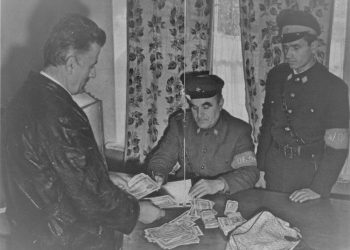
“Man, you only have 578 lek and a few cents!” He folded the paper and looked at me strangely.
I stared at him, thinking that with that much money, I’d be stranded on the road, but he noticed my hesitation and added:
“These are ‘new’ lek, comrade!” and he counted them onto the table.
The light was blocked by a soldier with two envelopes. He handed one to me and the other to Rroku:
“Today is Friday. On Monday at ten o’clock, you will report to your respective Branches – you in Berat and you in Shkodra. Any unjustified delay will carry criminal responsibility. You understand, I assume?”
We nodded and put the envelopes in our pockets. I took the suitcase and bag and left that cursed office, followed by Rroku with his bedding on his back and a sack dragging behind him. After a few meters, a woman in a highlander’s xhubleta and two young men rushed toward us – surely Rroku’s wife and two sons. Rroku dropped his load and embraced his family, who, after greeting me as well, helped us throw our belongings onto the back of a Skoda truck.
I climbed up over the tire, and what did I see? The truck was full of pyrite mineral, over which some cement bags had been spread! The sun was scorching now, and steam rose from the truck bed. Not five minutes later, a stout man of about forty came out of the shack with a paper in his hand—the cargo policeman, it seemed. He opened the door and stuck it to the windshield, then climbed onto the back and laid out a black board across two hooks behind the cabin.
“These seats are taken! Only two can sit here; the others on those bags if they want, otherwise, get off!” It was the driver, panting and smelling of sweat. I flattened my suitcase on the mineral and sat on it.
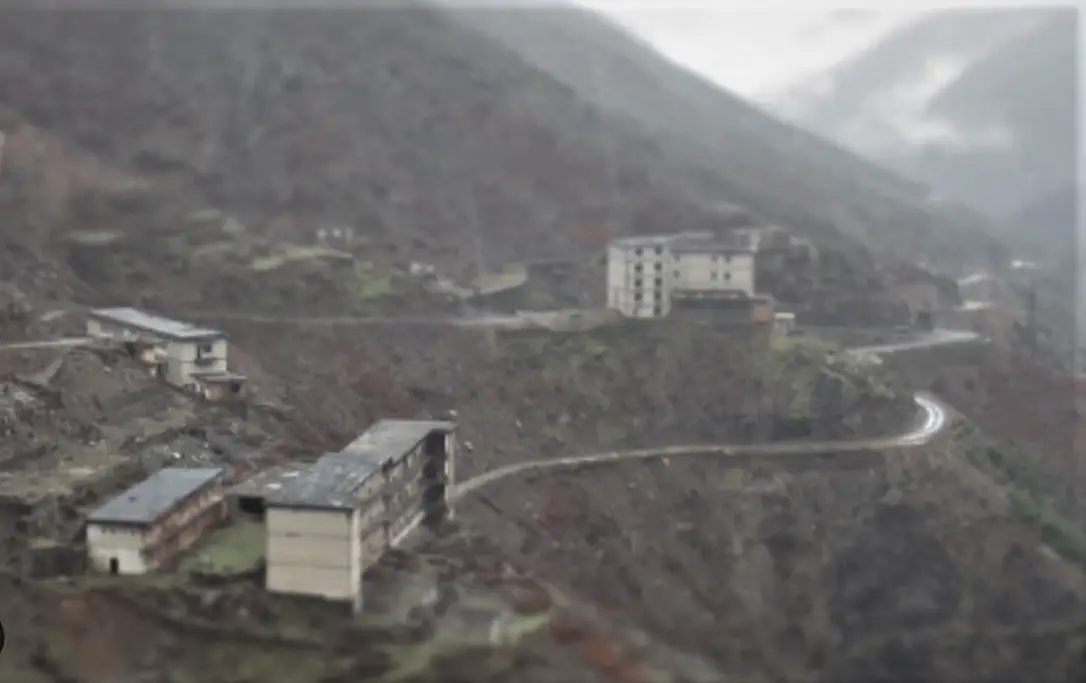
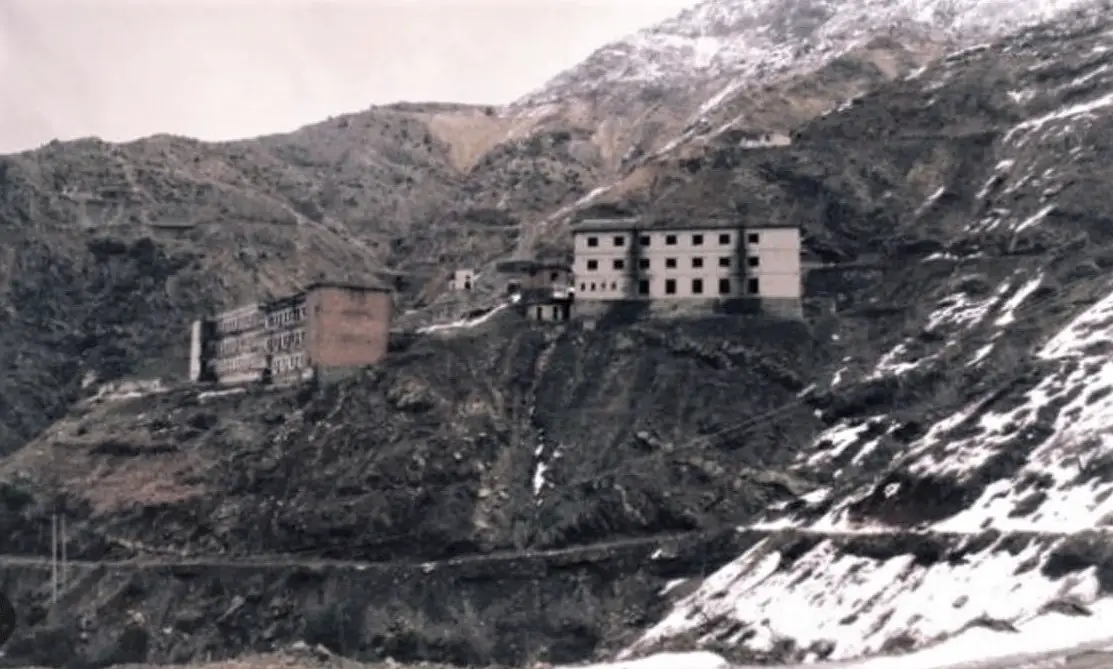
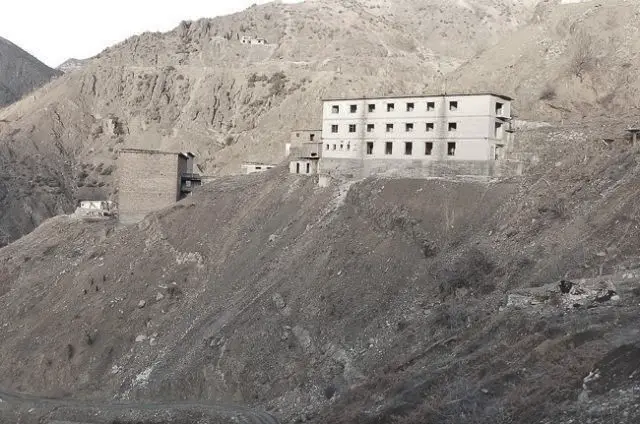
From that vantage point, a distorted view of the terrain where I had spent three years unfolded: the place looked like a pit with the camp as a grave. On the roll-call terrace, tiny brown figures were moving, waving white caps:
The brothers of my ideal, the comrades of yesterday’s suffering and tomorrow’s troubles! At that moment, I understood the ordinary criminals when they mocked: “We made a grave for the enemies!” As I waved my shirt like a flag, the caps flew into the air.
Suddenly, three or four military men headed toward us from the command offices. Three got into the cabin; the fourth jumped onto the truck bed. The engine groaned, the truck took the descent of the Gurth-Spaç funnel, and the camp vanished from sight. Only the bowl of the sky and the searing sun remained.
We swam through reddish dust until we reached the turn, where a sudden gust of wind cleared the view. When I turned my head, my gaze drifted over the mining hills and lost itself deep in the mountains of Munella and Kalimash. The silhouettes on the terrace looked like ants.
As it cleared the gorge, the truck slowed, taking zigzags that cut through the hill and dropped steeply toward the stream in the valley of Spaç village. Those few hundred meters could be traveled faster on foot than on that rattling machine that creaked at every turn. Unlike the mines, the slopes here were covered in trees and shrubs. My eyes could see across the Fan River to the hills of Reps. A stream from the plateau descended into a side channel, perhaps leading to a grinding mill.
The bend at the bottom of the hill was called “Spaç Road,” but I didn’t see the village. Right there, the driver stopped, stuck his head out the window, and shouted:
“Hurry, we have a long road, friend!”
From the bushes emerged a couple with a child of two or three. They climbed up and sat beside me.
“Can you hold this child for a bit, soldier? We’re cramped.” The shaved head and young age must have misled the Mirdita man into thinking I was a soldier on leave, and he plopped the child onto my knees.
O God, how beautiful this blonde, green-eyed boy is – like an angel welcoming me to the free world! The angel hesitated for a moment, fixed his large eyes on me, and gave me an innocent smile that sent me to the seventh heaven. It felt as if the saints of Mirdita had placed a cherub in my lap!
I thank you, Lord, for granting me this precious gift!
“Mark, do you know who this ‘soldier’ is? He just got released from prison, man! He’s a sworn enemy!” Preng Rrapi intervened, unasked.
The Mirdita woman snatched the child from my hands instantly and pressed him to her chest, as if protecting him from a hawk.
“You must guard the children from the enemy, comrade!” continued the cold-hearted policeman’s sermon.
I wanted to tear him apart, but I remained silent. I understood the woman; she was protecting her offspring with a mother’s right. With a quick glance, I saw the horror on her face and that of her husband, who pressed against her to form a protective shield between him and the child. I waited for Rroku to send some message, but he was staring intently into the void, as if exploring outer space.
The entrance into the “Hell of Corpses” felt extremely hostile. So far, there was no sign of humanity. The people we encountered looked at us like UFOs – if they didn’t hate us, they despised us, as if we were infected by a plague that threatened to contaminate the environment.
I had been so thrilled I almost forgot where I came from when they placed that child on my knees, but the joy didn’t last. He was snatched away as if from the claws of a rabid beast.
After that insulting slight, Esat Kala’s words thundered in my brain: “Son, keep your eyes open. The ‘Hell of Corpses’ is worse than the ‘Enemies’ Grave’! In the ‘Grave,’ no one despises you… but in ‘Hell,’ you must remain silent even when the snake bites you!”
I glanced at my fellow travelers. A shadow of sadness, like a mournful mask, hung over their thin, sallow faces. Perhaps the mirage was an effect of the road dust, but I became convinced of it when I saw them panting from the heat or anxiety, silent as fish before a funeral.
Truly, the ‘Hell of Corpses’ is worse than the ‘Enemies’ Grave’! I returned my gaze to the landscape – a panorama of Mirdita gloom. On both slopes, the leaves of trees and shrubs hung under the weight of yellow dust, losing their color and mimicking the cypresses that circle cemeteries, while those present emitted darkness as if attending a burial.
After some zigzags, we reached a riverbed that resembled a stream with green, algae-filled puddles. After crossing a bridge, we came out on the left side of the valley, on a road full of potholes and pebbles. The truck jumped and shook, partly from the weight of the pyrite and partly from the tires. It crawled like a snail.
Somewhere we passed a “Zil” truck covered in a military tarp, which kicked up a cloud of smoke and forced our Skoda to tuck into a pocket by the stream to make way, but mostly to protect us from the dust. When the cloud cleared, we were covered in powder and dripping with grime.
This misty veil smothered the child. As the mother tried to calm him, he coughed incessantly and began to wail, throwing himself from his father’s knees onto mine, struggling as if having a seizure. I reached into my pocket instinctively and found a candy from the treats in the camp. I peeled the paper and handed it to him. He grabbed it and swallowed it with an innocent smile, while the mother stood open-mouthed, unable to react. This scene lasted less than a minute, but it caught Preng Rrapi’s eye, and he banged on the metal of the cabin:
“Stop it, man! The smoke is killing us!” – An outburst that meant either the dust or our presence; the devil only knew.
The driver stopped near a spring under the shade of a pine tree. He opened the door, and the officers approached the spring, inviting us to refresh ourselves too. We jumped down and began to wash, but we were so covered in dust that the sludge muddied the water in the trough. As I cooled off, the child fixed his eyes on me strangely, stammering some words he couldn’t quite articulate, or perhaps they were drowned out by the gurgling of the spring./Memorie.al