
-The history of the Russian community in Albania, from the period of Ahmet Zogu, until the present day-
Memorie.al / For a Russian, Albania is one of the most mysterious countries in Europe, which is often associated with the war in Kosovo, the Albanian mafia, the “Albanian language,” but not with the real Albania. In Russia, few people truly imagine what kind of country it is. The Republic of Albania is located in the west of the Balkan Peninsula and is among the poorest countries in Europe. At the same time, Albanians are one of the oldest nations in Europe, with a continuous history of more than two millennia, living on their land and speaking their mother tongue throughout all this time. Long before the founding of Rome and the Trojan War, Albanians arrived in the Balkan Peninsula, becoming perhaps the first Indo-Europeans in Europe. They repelled the campaigns of Alexander the Great’s army and only after long wars became part of the Roman Empire, surviving it without losing their language and culture.
After the fall of the Roman Empire, Albania became part of Byzantium, and then these lands were part of the Bulgarian kingdom, the Serbian kingdom, the Republic of Venice, and Epirus. In 1389, at the Battle of Kosovo, the united forces of the Serbs and Albanians were defeated by a new enemy – the Turks, but Albania became part of the Ottoman Empire only at the end of the 15th century. At the same time, the Sublime Porte was forced to make concessions: Albanians served in the Turkish army on a voluntary basis, had benefits, and trade privileges. On the other hand, it was precisely during the years of Turkish rule that Islam spread in Albania.
As part of the Ottoman Empire, Albanians were usually called Arnauts (the “Bolshaya” and “Malaya Arnautskaya” streets in Odessa, praised by Ilf and Petrov, are named after them). The inhabitants of Albania themselves in the middle Ages called their country “Arbër”, and themselves “Arbër”. At the end of the 18th century, the ethnonym “shqiptarë” was replaced by a new one – “shkiptarë” (meaning; “those who speak clearly, understandably”). According to another version, “Shqipëria” in translation means “Land of Eagles” and the Albanians themselves consider themselves descendants of mountain eagles. This self-name has remained even today.
Quite strangely, but for more than a thousand years of history of the Russian and Albanian peoples, the trace of Russia in Albania is found only in the 20th century. This is mainly due to the fact that Albania became an independent state only in the early 1920s. In June 1924, a bourgeois-democratic revolution took place in Albania, the head of the feudal-landowning group, Prime Minister Ahmet Bey Zogu, was expelled from the country and the government of the Orthodox Bishop, Theofan (Fan) Stilian Noli, and arrived, with his administration paradoxically oriented toward the communist Soviet Union.
It was precisely in 1924 that the fates of Russia and Albania intertwined for the first time. After the arrival to power of the Red Bishop in Albania, a Soviet mission immediately went to the country’s capital, Tirana, headed by the former socialist revolutionary who entered the service of the Bolsheviks in 1920, one of the first Soviet informants, Officer Arkady Anatolyevich Krakovetsky.
The Moscow emissary officially announced the goal of his mission in Albania: to establish a communist regime in the country and to make Tirana the center of Bolshevism in the Balkans. From Albania, Krakovetsky planned to develop propaganda and the “export of revolution” to neighboring countries. However, such plans were not destined to be realized; the efforts to reform the most backward countries in Europe using communist methods failed. The Noli government’s policy in the country was becoming less popular every day.
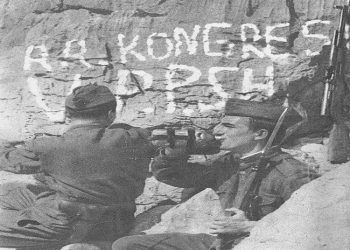
Under these conditions, Ahmet Zogu, who was in political asylum in the former Yugoslavia of that time, decided to take revenge. Planning a coup d’état, the former prime minister began to form a military contingent. For this purpose, on the border of the Kingdom of Serbs, Croats, and Slovenes (SHS), volunteer Albanian detachments were created, consisting mainly of the Mati Albanian tribes, which were subject to Zogu. But for the organization of an artillery battery and a machine-gun battalion, under a contract for a three-month period, Russian emigrants were invited who had combat experience and lived in the Kingdom of SHS.
An interesting fact is that relations with Albania among Russian emigrants did not develop easily from the beginning. As early as the end of 1921, thousands of former White Army fighters, joining the Serbian border service, came into conflict with Albanian bandits and smugglers who terrorized the local population. Despite the fact that the Albanian part of the Serbian border was considered the most dangerous in its entire length, the Russian border guards quickly turned it into a fairly quiet zone and made crossing the Serbian border a deadly occupation for Albanians.
I must say that Russians have been disliked in Albania since the time of the Russo-Turkish wars, in which Albanians fought for Turkey, and they hated Serbia literally for the border service. However, this did not prevent Ahmet Zogu from recruiting White Russian military personnel, as better professionals in the Balkans could hardly be found. With the recommendation of the Serbian side, the commander of the Russian detachment was appointed Colonel of the Russian army in the Serbian service, M. Miklashevsky. The detachment consisted of 102 people, including 15 officers.
One of the members of the detachment later spoke about the motives that pushed the White Russian emigrants to register in Ahmet Zogu’s forces: an army paid in gold (and not “kerenks”) was supposed to bring Ahmet Bey to power! How could I not be immediately interested in such a thing? In the last days of December 1924, the operation began. The main, decisive battle, in which the Russian detachment took an active part, was the battle for the city of Peshkopi, where the defense headquarters and the reserves of Noli’s army were located. Moreover, the main striking force, which completely finished the task, was precisely the Russians.
After the occupation of Peshkopi and a short rest for Ahmet Zogu’s unit in the vanguard, with the same Russian detachment, they launched the attack on the capital of Albania. Noli’s demoralized troops were able to offer little resistance. On December 24, a Russian detachment led by Zogu entered Tirana.
After the proclamation of Albania as a republic and Ahmet Bey Zogu as its first president, the Russian detachment continued its service but was disbanded in 1926. Its ranks were offered a lifetime pension in the amount of the salary received, but on the condition of staying in the country. At first, many members of the detachment took advantage of this favorable offer – thus the Russian diaspora appeared in the country for the first time. In truth, it did not last long: gradually, referring to the monotony of life, the White Russian emigrants began to leave Albania. By the beginning of 1939, only 19 people remained from the former company.
Meanwhile, in April 1939, Albania was occupied by fascist Italy, and in 1943 (after the capitulation of Italy) by Nazi Germany, and under these conditions, the fate of the “Russian Albanians” developed in different ways. Some remained loyal to Zogu and went to partisan detachments that fought against the Italians and the communists at the same time. Others, after the takeover of Albania by Italy, entered the Italian army, in which they fought on the Eastern Front against the Soviet Union.
Later, fate scattered the members of the Russian detachment throughout the world, but there were also those who remained in Albania after the war, retired, or were transferred to the civil service. Although it was very difficult for the former White Guardists to adapt to the new Albanian conditions, the fact is that after the end of the Second World War, Albania entered a new historical era. In the autumn of 1944, the National Liberation Army of Albania, led by the communists, liberated the entire country from the occupiers.
On November 29, 1944, the Communist Party (later the Party of Labour), headed by Enver Hoxha, came to power in the country. In 1946, Albania was proclaimed a People’s Republic. Relying on the political, military, and economic support of the Union of Soviet Socialist Republics, the Albanian leadership under the chairmanship of Hoxha set out toward building socialism. And again the fates of Russia and Albania crossed.
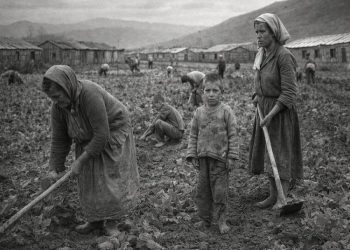
The Soviet Union actively helped backward agrarian Albania in creating a socialist economy. Hundreds of Soviet civilian and military specialists were sent to Albania to help the people in a brotherly way. A wide cultural and student exchange unfolded: thousands of Albanians (mainly men) went to study in the USSR.
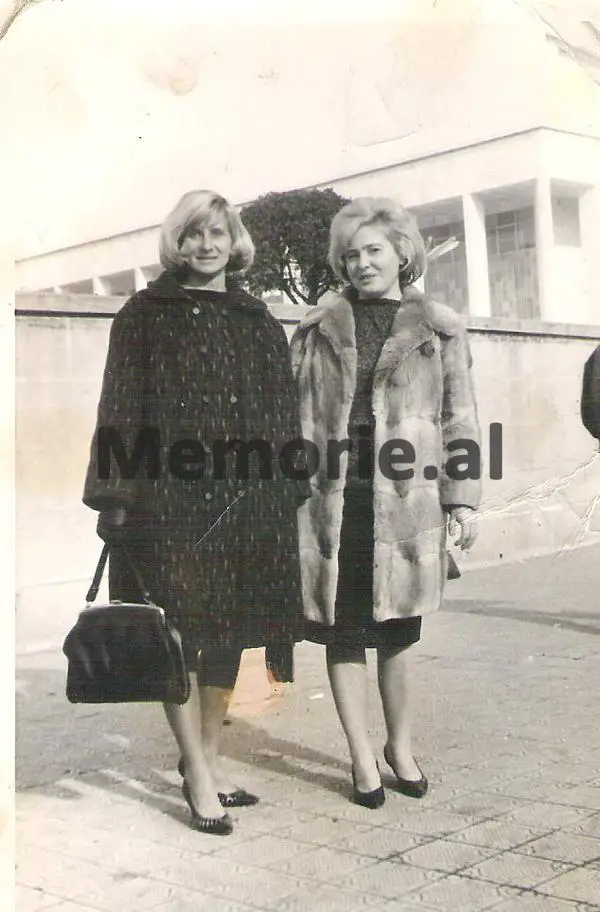
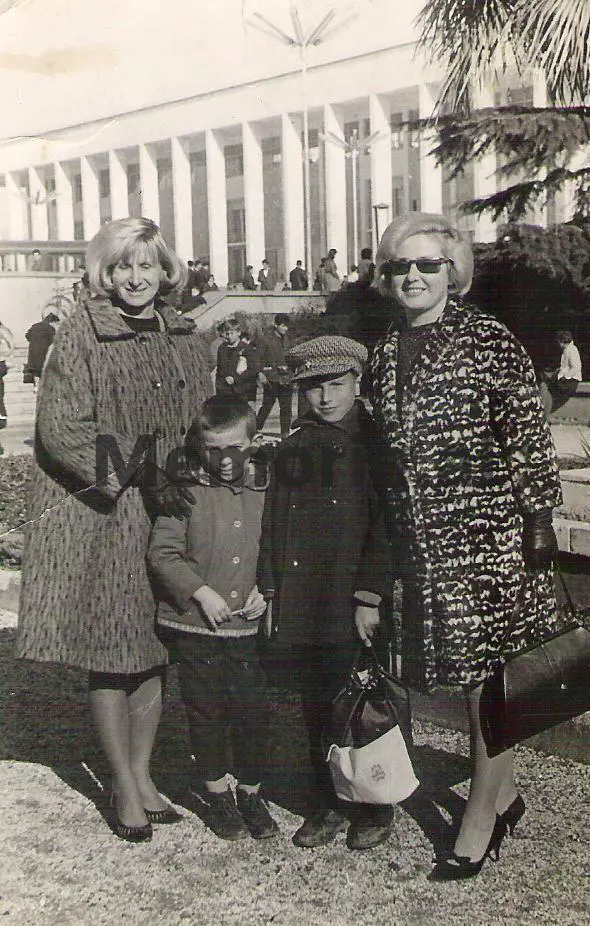
The Russian language became mandatory in school and the attitude towards Russians has never been so positive in the history of Albania. According to statistics available in the Central State Archive of Albania, in the period from 1947 to 1961, about four hundred mixed marriages were registered between Albanian men and Russian women. Most of the Russian women moved permanently with their husbands to Albania.
In fact, only from that moment can one speak of the emergence of a full Russian diaspora in Albania. It is characteristic that many of the Soviet citizens made a great contribution to the development of the Albanian economy and culture. For example, Luiza Evgenievna Papajani (maiden name Melnikova) in the 1950s led a group of Soviet lawyers who created from scratch the first Forensic Medicine Laboratory in Albania. She also became the first Russian announcer on Albanian Radio Tirana.
Our other compatriot, Taisia Uzlova, played a major role in the development of eye medicine (Ophthalmology) in Albania; now the only eye surgery center in the country that uses Fedorov’s technology is named after “Uzlova”. Another Soviet citizen who lived for nearly fifty years with her husband in Albania, Nina Mula, is the mother of the famous opera singer Inva Mula, famous throughout Europe and beyond.
The “honeymoon” of Soviet-Albanian friendship did not last long. In the late 1950s and early 1960s, the situation began to change. The Albanian leadership, headed by Enver Hoxha, painfully accepted Nikita Khrushchev’s criticism of the cult of personality of Joseph Vissarionovich Stalin, as well as the normalization of relations between the USSR and Yugoslavia, which Tirana considered a source of threat to itself. Albania moved toward a rapprochement with China, with which the USSR, for its part, worsened relations, and in Tirana, they began to criticize the course of official Moscow.
In 1961, the Soviet leadership responded to this criticism by withdrawing its advisors and specialists from Albania. In November 1961, Moscow and Tirana exchanged heavy attacks, after which the Soviet Union withdrew its ambassador from Albania and severed diplomatic relations with it. The USSR urgently began the removal of Soviet citizens in Albania, abandoning all property. Since 1962, Albania has become the most closed and isolated country in Europe.
However, for various reasons, about fifty Russian women remained with their husbands in Albania, being completely cut off from their homeland. Furthermore, all those who had studied in the Soviet Union, as well as their families, were declared spies and agents by the Albanian authorities. Many of them were imprisoned (and served fifteen or twenty years), were sent to hard labor, or were interned in the remote mountainous areas of Albania.
“Any correspondence was forbidden, it was impossible to make a phone call, it was impossible to move from one city to another, because there is only one road and there are checkpoints everywhere, up around the mountains. All of us (Russian women – A.N.) completely lost contact with our country, we found ourselves isolated from the world and from our relatives. And in such conditions, I had to survive, raise children, hope for better times,” recalls Luiza E. Papajani.
Today in Albania there are about twenty Russian women of that generation. The rest either died or emigrated to Italy, Greece, and Germany with their families in the nineties. Those who remained took a second citizenship – Russian. The Albanian government, by the way, promised to pay monetary compensation to the Russian women for the suffering they endured in political prisons and internments.
In general, today the Russian-speaking diaspora, in more than three million inhabitants in Albania, has only about 300 people; for the most part, these are Russian citizens who have married Albanians in the last fifteen years. The position of our compatriots can hardly be called cloudless. Thus, in the country, there is not even a courtyard of the Russian Orthodox Church; there is not a single temple where worship would be performed in Church Slavonic!
There are also problems with learning the Russian language. Although after 1962 it continued to be studied in school for almost another 15 years, the number of Russian-speaking residents of Albania today is small: about 20 thousand people; moreover, since 1990, this number has decreased by 2.5 times. Traditional admirers and conductors of Russian culture and language in the country are Albanians who studied before the break of Soviet-Albanian diplomatic relations in the Soviet Union.
There are up to 2000 such activists throughout the country. In Albania, the Russian language is taught at the “Asim Vokshi” School of Foreign Languages, where 50 people study it. The Russian language is also studied in 7 universities in Albania (including the Russian Language Department of the Faculty of Foreign Languages of the University of Tirana), where about 40 students learn it.
Despite the difficult situation of the Russian diaspora in Albania, positive aspects that have appeared recently can also be observed. Thus, on February 17, 2007, in the Albanian city of Korça, the opening of the Year of the Russian Language in Albania took place. The choice of location was not accidental: Korça is known for its deep spiritual and cultural traditions, historical monuments of Orthodox culture, the richest collection of icons in the local historical museum; a significant number of Albanian intellectuals live here.
For a long time in Korça, there has been great interest and respect for Russian culture and language, there is a branch of the “Albania-Russia” Friendship Society, a “Moscow” club in the city, our compatriots live there. At the beginning of 2007, the Russian ambassador to Albania, A. L. Prishchepov, presented the Central City Library in Korça with a selection of more than 30 volumes of Russian classical literature, received from the “Moscow House of Compatriots”.
This step by the Russian embassy received a wide response in Albania – the book presentation ceremony was broadcast on local television and repeated continuously in news announcements. Activities related to the Year of the Russian Language in Albania continued in the capital Tirana, as well as in other cities of the country. Thus, there are hopes for an improvement in the situation of the Russian diaspora in Albania. Which, of course, cannot but be joyful…? Memorie.al