
By Gjet Ndoj
Part Three
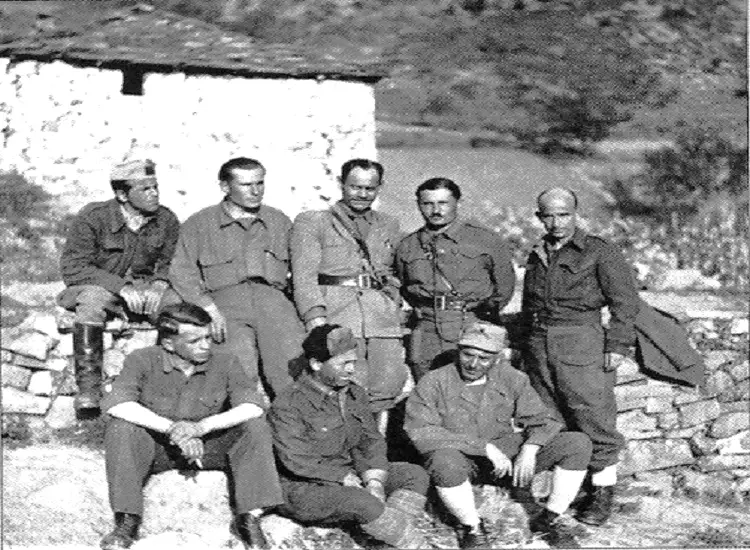
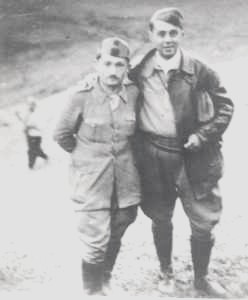
Memorie.al / Gjin Marku was born on June 2, 1918 (in documents, it is recorded two years later, 1920), in the village of Baz, into a family with a name in that region. When Gjin’s father, Pjetër Marku, died, the latter’s friend, Hysen Selmani, as well as his close companion (byrazer), Abaz Kupi, took 9-year-old Gjini and sent him to Tirana, to the “Orphanage” (Strehën Vorfënore). Here, Gjini received his first primary and five-year education. In the years 1932-1936, Gjin Marku finished the “Harry Fultz” Technical High School in Tirana and later in Kavajë (only two months), in the Agriculture branch. After finishing school, he was appointed agronomist in the Korça district. In 1945, after the war, Gjini, like many other war leaders, was appointed to pursue studies in the military field in the Soviet Union. He was among the few students from Albania who attended the “Voroshilov” Academy in Moscow.
Continued from the previous issue
Alarm in Tirana
Also, archival documents clearly show that Albania was projected to be part of the Soviet communist system of Eastern Europe, where the representative and emissary of this project in Albania was fixed as Enver Hoxha, from the time the Communist Party of Albania (PKSH) was founded (1941). In all the documents we have seen, we could not find a single document expressing Enver’s interest in the combat situation between our forces and the enemy-fascist forces, the losses or victories at the front, the condition of our forces and the deployment of enemy forces, etc., etc., but his constant pre-occupation with removing the Balli [Balli Kombëtar] and other nationalist forces from the front of the fight against fascism was his main pre-occupation.
Enver’s Letters
A letter that Enver sends to Gjin Marku and Kareman Ylli on September 26, 1943, is one of the documents expressing his spirit and purpose during the war, but also the aggravation of his relationship with Gjin Marku, the tendency to bring under control all the activity of the main war leaders and to “subdue” them: “…to comrades Gjin Marku and Karaman Ylli, Berat…. Regarding keeping the Central Committee informed by you, this has become a bad sickness that has been going on for over a year. The point is not for you to leave us two-three months without news…!
It is unnecessary to repeat to you once more that work cannot continue this way, but we assure you that this will be the last time we have tolerated such a thing, and if repeated, we will take measures, which will not be to your honor as communists and as leaders…! We note with regret that in an eight-page report made by two responsible comrades and leaders of work in the entire Berat district, a report addressed to the Central Committee of the Party, we do not find a single line about the organizational state of the Party.
The work in Berat is a great mystery to us. Being in such a situation, the Central Committee of the Party does not know how to help it on the ground, does not know how to lead this organization. If you take the Party’s work with so little seriousness and consider keeping the Central Committee informed as unnecessary, then the whole matter changes… it’s not a random mistake…! In your city, there exist two powers, one is that of Balli and the other is yours.
This should not exist. We cannot tolerate that Balli sets up its own power alongside yours; you must not allow duality in this matter. Therefore, you must definitely fight this power and only yours should be recognized; it must be fought by every means, with propaganda, with rallies, speaking openly in broad conferences about what Balli is and its people, one by one… starting from Abaz Ermenji, down to Fazlli Frashëri.
There is no unity with Balli…! Comrades, the establishment of power is no joke, and if we do not know how to act properly from the very first days, we can be sure that we will encounter great obstacles later on. The Councils must be the sole power… Do not think that now Berat is liberated and we are allowed to make some concessions. Concessions, more than ever, are a great harm to us.
The military command must always act by striking the enemy and always using its force to help the stability of the power and its strengthening. Today, more than ever, you must purge the vile elements and enemies of the people and the Party…! The Staff has asked you for many things, but you give no answer.
Reporting the fight against Isa Toska or disarming the Italian army is one thing; reporting and being concerned about the organizational issues of the Army is another thing. This second point has not even crossed your mind to report to the Staff, and we expect this from the commissar of that group, comrade Gjin. You have written about the issue of the elements you must send to the Brigade, about the mobilization of the Kuçova workers, about their arming, while about sending them to the place that was assigned to you, you do not write to us at all.
You have not understood the importance of these matters, and their non-implementation or negligence destroys all our plans… Communists must be in the ranks of the war, we have always said this, but war is not always at the barrel of a gun; it is also in the organization of power and the army…! The situations that are being created are in our favor, we just need to be able to dominate these situations. The Balli Kombëtar is being discredited day by day, day by day we gain the ground that they lose, and these gains do not come by themselves, but with effort…
It’s not enough to tell the people that Balli is nothing special; through our propaganda work, the people themselves must see that Balli really is nothing…. Dear comrades Gjin and Karaman. We are convinced that regarding what we wrote to you, you will act as we tell you above, and soon, both you and we will have good results. In the opposite case, we will be very displeased with you. Many regards to the Central Committee of the Party, (‘Shpati’)”.
The New Conflict Between Enver and Gjin Marku, Regarding the “Pact” with the Germans
After the departure of the Italians, the Hitlerite forces came to Berat. The “Antonio Gramsci” detachment is created. Enver accuses the general of an “agreement” with the Germans. He again levels accusations against him.
The last conflict, related to the military actions between our forces and the Italian fascist military forces and their “tools,” the ballist-inspired band of Isa Toska, had brought about the complete rout of this band, which ended in late August and early September 1943. This moment also marked the last battle with the Italians, as on September 8, 1943, fascist Italy unconditionally surrendered from World War II. This led to the withdrawal of Italian military troops. Consequently, their withdrawal from the Berat military base, one of the largest centers of that time in the whole country.
The main partisan fighting formations of the Berat District, which were among the best prepared, had been incorporated about two weeks earlier into the 1st Assault Brigade in the Korça District. While the other forces, tired from frequent battles from June–July in Përmet-Kuqar, in August in Mallakastër, and finally in the battle for the rout of Isa Toska’s band, found it necessary to have a short time to recover and gradually reorganize.
The Arrival of the Germans in Berat
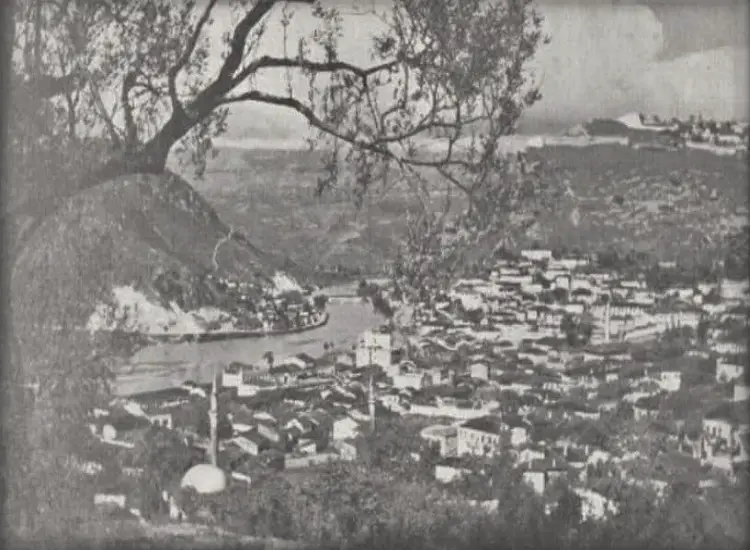
In the new situation, the partisans settled in the Berat base, where the “endless” warehouses filled with food served to supply them with armaments, clothing, etc. Some of the warehouses were taken by the ballist forces of Abaz Ermenji and Ali Këlcyra.
At this time, shortly after the Italian army had withdrawn following its surrender, a German military unit, with motorized vehicles and a number of fighter planes called “Stukas,” was installed in Kuçovë, very close to Berat. Even these forces, in this situation, were “not hindered” by the partisans from occasionally obtaining food supplies in Berat, which had been “emptied” by the Italians.
While in an account given by Gjin Marku himself regarding that situation, he testifies as follows: “…In September 1943, the Italians surrendered and we partisans took power in that city. The Germans, when they came, did not fight us, but went and settled in a strategic point outside Berat. They said they had no intention of fighting Albanians, whoever they might be, but wanted to secure the roads for the army that was scattered everywhere, towards Greece and Yugoslavia. They came to Berat for trade and left us free, as they did not fight us.
This seemed good to us, because the People’s Power was established for the first time in a city of Albania and no one was against it. Much later, this event came to be investigated in various staffs; considered a scandal and not a victory. At this time, I received a letter from the Partisan Staff ordering an attack on the Germans. We prepared the attack against the Germans (mid-November 1943), but we lost Berat, which they took, and we went back to the mountain to continue the fight…”!
Reasons for the Temporary Pact
This silent “peace” existed and was in favor of the partisan forces, for several reasons: The first reason relates to the fact that the partisan forces, few in number, but especially very unequal in combat logistics compared to the new enemy, could not in any way confront the German army at that moment.
Secondly, under these conditions, confronting the German Nazis would bring severe consequences for the population of Berat, particularly for the city of Berat, for its unique ethno-cultural and architectural values, etc.
The third reason relates to the need the partisan forces had for a short time to reorganize, to be supplied, but as veteran witnesses say: “We benefited a lot, taking endless goods (food, armaments, clothing, etc.) and transporting materials deep into Skrapar for the people and to strengthen our logistics in service of the long battles that awaited us in the future with the German Nazis.”
Enver’s Accusations; “Compromise with the Germans”!
Enver Hoxha uses this situation as an opportunity to sideline Gjin Marku from the high leadership of the Communist Party, calling the situation a “compromise and collaboration with the Germans” and Gjin Marku the main responsible party. In a circular we are presenting, it seems Enver exploits this moment as suitable to “humble” Gjin Marku: “The compromise with the Germans is one of the worst things any Party district committee could have done. Anything could have been expected, but such an act could never have been expected from you. These are the consequences of breaking ties with the Central Committee.
This compromise of yours with the Germans will be one of the discussion points at the next Central Committee meeting. The circular sent to you must be worked on with the greatest care in the District Committee, with the participation of all its members, as well as comrade Gjin Marku, who must be summoned specifically for this matter. Comradely greetings! For the Central Committee. ‘Shpati’.”
In fact, Enver himself knew that in that situation, the best possible thing was done, but “creating the idea of compromise with the Germans” would serve him as the best tool and way to fight and eliminate a “rival” according to him, who, for the sake of truth, until that time, Gjin Marku had a reputation and fame that worried Enver. Skënder Malindi and other former comrades-in-arms of Gjin Marku recall and testify:
“Gjini was removed from the main leadership of the Communist Party of Albania (PKSH), because Enver saw in this man a person with a reputation and great support not only from the partisans, but also from the people of Skrapar, Gorë-Opar, Gramsh, Berat, Përmet, Lushnjë, Fier and beyond.” According to him, “Gjin Marku until this time had more name recognition than Enver and would be an obstacle to Enver’s career in the future.”
The Peace Lasted Only Two Months
Nevertheless, Gjin Marku, even after these accusations, remained the main leader of the Berat District until the liberation of the country. On September 20, Gjin Marku formed the “Margarita Tutulani” youth battalion, and also helped in the formation of a battalion composed of Italian soldiers who remained in Albania and who, of their own will, sided with the anti-fascist forces led by Gjin Marku and were named the “Antonio Gramsci Battalion.” A little later, the situation changed.
In October, the partisans drove out the Balli forces with Ali Këlcyra and Abaz Ermenji. This was done within the framework of the PKSH’s opposing spirit to the decisions of the “Mukje Agreement,” which, among other things, considered the PKSH in an equal position with the Balli Kombëtar, which was unrealistic. For over a month, the Communist Party had issued a circular calling for an uncompromising war against both the occupier and Balli, and other “collaborationist” forces.
After these changes, the creation of new partisan formations, and the expulsion of the ballist forces from the Berat “base,” on November 15, 1943, the Germans began their attack on our forces deployed in Berat. In their attack, the Germans used “Stukas” planes, tanks, and artillery against our forces. / Memorie.al
To be continued in the next issue