


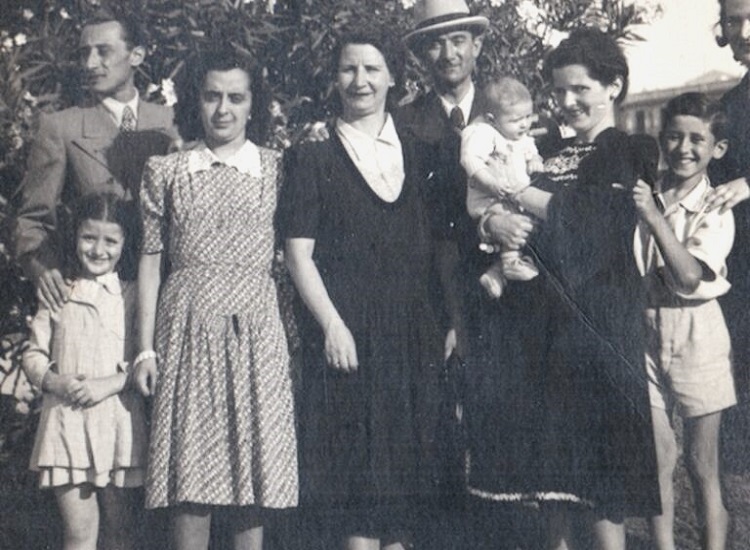
By Adela Kolea
Part Three
Memorie.al / Mr. Antonio woke up very early, like every morning. He was, regardless, the second member of the family to wake up so early: the first was his wife, Mrs. Maria, who would begin the breakfast preparation. Since their family was accustomed to consuming sweets prepared by the hands of the lady of the house for breakfast, she herself took care that the awakening of her husband and children would find the table set with typical fresh sweets, fruit juice, and jam. The warm milk mixed with coffee released its aroma throughout the entire house, an aroma that, mixed in the air with that of the sweets fresh out of the oven, turned the awakening of this family into a true joy.
Continues from the previous issue
Moles, as is known, live and feed in darkness, and they find it difficult to reach the upper layers of the earth’s surface – coming from the filthiest and deepest wells – if they do not find the right strategy. Well, the sensation that he was encountering another “mole” was created for Giulio in this factory, where he had been transferred a short time ago. His colleague, with whom he shared the same office, had been – among other things – a brother-in-arms during the War with one of the most brutal exponents of the government in power.
Well, this time, they were not looking for “black gold.” This time, the fate of all those who, in the Albania of that time, had made the greatest mistake of their lives was turning black: that of being intellectuals, moreover with dissident leanings.
Not only that: if someone, like Giulio, was also married to an Italian woman, although he was to some extent aware of the consequences regarding this, life would have reserved for him surprises that were not pleasant at all.
That White Shirt
That morning, Anna had woken up at dawn. All night she had seen strange dreams. They were the premonitions and perceptions that reached her constantly lately, which prevented her from having a peaceful sleep. After glancing at the children, who were sleeping peacefully in their room near the parents’ room, she went down to the kitchen to prepare breakfast for herself and her husband, Giulio, who had to leave quickly for Durrës, where he had been working recently.
He had dressed and prepared very quickly, without forgetting to wear a beautiful white shirt. It was among his favorites, that shirt. They had brought it to him from Naples and it fit him so beautifully. During the consumption of breakfast, they exchanged few words, but those few words were mostly instructions from Anna to her husband to be careful.
The care to which Anna referred was related to his position at the workplace: due to the fact that he was married to an Italian woman and that lately, for this, he was being looked at askance. In this aspect, provocations for Giulio had not been lacking. He had always faced them with his head held high and with the intelligence and maturity that characterized him.
Lately, some signals had arrived which had begun to cause the ground under Giulio’s feet to shake. Something important and quite terrifying was being fabricated, and Giulio had warned his wife. This was not only to help her find herself prepared for any kind of event, but also to plead with her to continue moving forward, ‘with’ or ‘without’ Giulio himself, to face the weight of the family and the children—something which, until those moments, they had always shared together.
They embraced and Giulio left, followed by the eyes of Anna, who waved her hand to her husband until the car in which he was traveling disappeared from the dust of the road, and the distance between them became greater and greater.
The smell of the sea in Durrës penetrated the car windows and spread inside. The fresh breeze seemed the same as what Giulio felt even when he was in Naples, at his wife’s home, becoming in this way a conductor of longing. It spread the nostalgia of a place that, in their youth, had given them much. And not only that, it transmitted a kind of sadness that, at that moment, was completely unusual. For Giulio, it was more common for the sea breeze to become a source of tranquility, peace, inspiration, and joy.
But that morning Giulio, together with the sea breeze, was also inhaling some particles of heavy, suffocating air. Of an icy air that was freezing his heart.
It had been coming for a short time, since the destruction of Albanian-Yugoslav relations, and the dictator had set to work for the reinforcement of his absolute power. Such a reinforcement had as its initial phase the war against political opponents. These opponents—some truly existing, and others placed in the circle of persons about whom it was only suspected or assumed to be such due to having certain compromising data in their biography—became “dangerous” persons for the country.
Giulio, although he knew this cursed list quite well and to some extent had always been conscious that he himself was part of it, did not want to accept or believe it until the end. Lately, his colleague, the one with whom he was sharing the same office, had become very invasive, sticking his nose more and more into Giulio’s affairs. Under the justification of confidence on a ‘friendly’ level, he was asking excessive questions, which were causing Giulio distress.
Not because he did not know how to answer him, as he truly deserved and with cold-bloodedness, but for another fact: that of the perception of danger and the creation of the impression that this person had not been sent to that office to share the profession of economist with Giulio, but to give his contribution to the trap they were weaving for him.
In fact, his colleague did everything possible to sabotage Giulio’s accurate and responsible work. He did what he could to complicate matters for him, and moreover, by interfering in issues that belonged exclusively to Giulio’s competencies.
But he did not stop there: he proved so cunning (or rather, that is how he had been instructed or ordered) as to get involved and participate himself in a project entrusted to their office, which initially should have been followed only by Giulio—a project that, surprisingly, would have resulted in a ‘sabotage.’
Naturally, an arrest warrant was issued for both colleagues. Giulio saw his life change entirely after this brutal encounter with so-called “justice.” That day, in the factory courtyard, the shadow of the military ‘Jeep’—that so infamous vehicle—caused all the employees to freeze in their tracks. Both colleagues got in, bound in handcuffs, as if they were criminals.
For Giulio, if ‘crime’ could be called the preparation and serious dedication to duty, correctness, or professionalism, all of this turned into an anxiety from which he hoped to wake up as soon as possible and for the truth to be revealed soon. For the proper clarifications to be made that on his part, no guilt, no mistake, and even less, no sabotage had existed.
But he became convinced more than ever of something that, until those moments, he had always desired to push away as a thought: that from the fact that he had taken an Italian citizen as a wife, who was sharing her life with him in such an Albania as the one they were experiencing at that time, this would turn into a quickly materialized danger, it would turn into a storm that would rush mercilessly upon him and his family.
In the trial—a theatrical farce—of the two colleagues, after initially speaking of a punishment no less than execution, their respective sentences were always unjustly determined, which for Giulio, surprisingly, resulted much heavier: life imprisonment. A little later, as usually happens in tragi-comic situations, the finale was surprising. The sentence was reduced in the following manner:
Giulio’s colleague stayed in prison for only a few months and was granted freedom. For Giulio, they had “mercy” and reduced his sentence as well, but he was denied personal freedom, not for two months, nor for two years: the years in which Giulio served his sentence were an important part of his life, of that life that they were slowly and painfully destroying: these years were a full 20.
Great was the indignation, numerous the pain and disappointment for what they called “people’s justice.” It could be called in unlimited ways or terminologies, except for “justice of the people.” They themselves were part of those people. Giulio even more so, but Anna also now felt herself as an integral part of those people—hospitable, loyal—but who, unfortunately, were being led with an iron fist by a few who were doing everything possible to eliminate all of that suffering Albania’s most valuable sons and intellectuals.
The radical change even in Anna’s own life, from one suffering to another—with her husband in prison, with parents and relatives in Italy whom she could not meet, herself young in age and with children trapped in Albania—forced her to turn back in her memory:
“The distance from my country is so short! It would be enough for me to approach the seashore to be able to feel the pleasant smell of the waters arriving from my parts, which surely will relieve me of any sensation of distance from my loved ones. And anyway, whenever the longing for them grips me with insistence, I will run towards them and they, at the same time, will be able to come and meet me whenever they wish.”
And later, in 1944, Giulio’s words: “Anna, I am forced as a husband and as a father of a family to ask you to think well, but also quickly, about the fact of what we will do next with our lives: where we will decide to continue living, in Albania or in your country, in Italy, because here, I have the suspicion that the situation will become excessively complicated.”
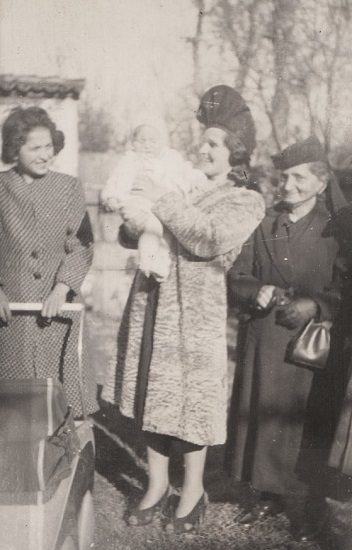
Anna, with tears in her eyes, made the most delicate and important decision of their lives: that of choosing to live in Albania. That morning it was cold, colder than ever. Wrapped in her wool coat, with the hat on her head which she never parted with because it was a gift from her father, Anna found herself in front of a building that inspired fear, that made chills grip you.
It would never have crossed her mind that one day in her life, she would come and approach such a building. She would never have thought that in such a hell, her beloved Giulio would be ‘halted.’ That day, they were not allowed to see each other.
But one of the guards, with a terrifying appearance, called Anna because he was to hand over some of Giulio’s personal belongings, all gathered in a cardboard box. She took that box in her hands, trembling all over, and left there quickly. At home, the children were waiting for her. In fact, before stopping to talk to them, Anna entered her room and with the strength that was gradually abandoning her, she opened the box.
Her eyes immediately stopped on a torn, white piece of cloth. It was Giulio’s white shirt, his favorite shirt, the one Anna had ironed for him that morning and that he had worn exactly on the day of his arrest. On the sleeve of the shirt, with his blood, Giulio had written a message for his wife: “Sono innocente”, “I am innocent”. But Anna, of this, was more than convinced…!/Memorie.al