By SAMI REPISHTI
Part Eight
Sami Repishti: – “In Albania, the communist crimes of the past have not been documented or punished; no ‘spiritual cleansing’ has taken place, nor has there been a conscious confession and denunciation of ordinary communist criminals!” –
‘Under the Shadow of Rozafa’
Memorie.al / During the 1930s and 40s of the last century, with the descent of the unstoppable fascist and communist storm over Europe, and later over the entire world, “fate” took the Albanian nation by the throat as well. Like all youth, I found myself at a crossroads where a stand had to be taken, even at the risk of one’s life. At that time, I said “no” to the dictatorship and took the road that had no end, a sailor in a vast sea without shores. The rebel act that almost killed me simultaneously liberated me. I am an eyewitness to life in the fascist and communist hell in Albania, not as a “politician” or a “personality” of Albanian macro politics, but as a student, as a young man who became conscious of his role in that time and place, out of love for the fatherland and the desire for freedom; simply as a young man with a heightened sensitivity, faithful to himself and to a life with dignity.
Continued from the previous issue
With the capitulation of Italy, the country was occupied by Nazi Germany. The new enemy was fiercer and more organized. The political manipulations of the “capital” continued but remained limited within the framework of a few “outdated” cliques of politicians. The struggle against the new occupier suffered temporary fluctuations. However, great damage was caused by the “neutral” stance of the “right-wing” forces and their inactivity. Others, ready to serve the “government,” took the path of collaboration. To their credit, the “communists” and their supporters remained the representatives of active resistance against the Germans. These undesirable developments ensured a temporary calm in the country but were paid for with a heavy price later. International politics, where our country had placed its hopes for the future, dictated an uncompromising war against the Nazis.
Europe was burning under their feet. The thesis that “the country must be preserved” from war and destruction was called defeatist and collaborationist. It was the time for supreme sacrifice, not of a group, but of an entire people. The “communists” exploited this situation even more after the arrival of Yugoslav emissaries in our country and the start of allied aid from the Allied Mediterranean Command. At this decisive moment, they won the support of allied diplomacy. The political frictions and contradictions in the country, and the determination of the “communists” to seize absolute power by force and control it without reserve, created the conditions for a civil war – incited also by the Nazis – which devastated half of Albania. The division took on regional tones, and the continuous clashes were clearly a dark prelude to the country’s future after the occupier’s departure.
I found myself in a very difficult moral and political position. I had no doubt that my country belonged in the ranks of the freedom fighters, where many of my “comrades” were. Yet I was simultaneously convinced that the path of my “comrades” was deeply mistaken, that it had anti-national tones – to which I was very sensitive – and that their concept for the future of Albanian society was too “theoretical,” vague, and based on a spirit of hatred for everyone and everything that did not unreservedly accept their views. The communists shared a common trait in their stance: they were all steeped in a spirit of hatred which, like leaven in bread, gave flavor to all their actions, thoughts, and words. This dilemma, unsolvable for me, threw me into an inner retreat, into silence, passivity, and self-isolation.
As the days passed, things became even harder due to my family’s economic situation, which tormented me endlessly. Several times I risked my life on trading trips, carrying goods for merchants who were too afraid to leave the city. But bread was needed at home, and here I had found a means. Near my house lived a widow, a mother of three children. She was still young, beautiful, very poor, and without any help. Despite her stoic stance, extreme poverty forced her to beg for alms at the doors of the city’s shops.
Before long, she became the object of the lowest slanders from those who “desired” her unsuccessfully. It was her body they sought and did not get. It was the ultimate humiliation they “offered”! One day, I realized she had become a “shelter base for the partisans.” After a long and bitter experience in the heartless city, she had decided to join elements that convinced her that she was “something of value,” a useful being for the “revolution” which, for her, meant “a life with dignity” – a new life where the world would not despise, mock, or humiliate her as it did in her heartless city…!
She was promised a world of work and honest sweat, where she would secure bread for herself and her children, a world where she would be in the company of “others” like her. What could counter the enthusiasm of this wretched being who revolted and who, with her innocence, erupted against the undeserved humiliation in her heartless city? The hope for “bread, peace, and freedom!” covered the cries of her hungry children and the vile insults that accompanied her in her heartless city, pushing her onto the path of revolutionary action in search of solidarity with “others” like her. For the first time in her life, she had found the courage to win inner freedom, the only victory that matters!
Every day brought something new. In the chaos of the city, many young people were infatuated with a life of luxury, secured by large profits in trade and various speculations. Many young women were caught in the vortex of the city that no longer slept. Unbelievable carelessness had become the norm for many fellow citizens who wished to know nothing but the pleasures of their debauched lives. In this chaos also lived a vast mass of the population who struggled to meet the most basic daily needs.
The unrestrained rise in prices by speculators and the lack of steady employment had created a large class of underemployed or unemployed people. Especially damaged were the city’s craftsmen, who were competing with large quantities of imported industrial items of poor quality. This was also true for state administration employees, who ended up as a group of corrupt elements. Schools functioned more as gathering places for children than as educational centers.
Crime rose, criminals increased, especially on the city streets during the night hours. It was total insecurity! Outside this chaos were the elements organized in the resistance ranks. They worked with a program and acted with speed. By virtue of a series of assassinations against “enemy” officials, they created an atmosphere of fear in the city, which gave them the upper hand in making decisions concerning the lives of citizens. Without credible political leadership and without an effective administration, the task of maintaining order was entrusted to a force of bashibozuks (irregulars), servants financed by the Nazi occupier.
Their brutality was shown in massacres against communists, a stance viewed with great contempt by the city’s population. From Southern Albania, the news was ominous! A civil war was raging everywhere between communists and Ballists (members of Balli Kombëtar). The brutality of the clashes had reached inhuman proportions: torture, mass massacres, the burning of houses and entire villages by Albanians against Albanians, and by Nazis against everyone. With the formation of a “Provisional Government” in Berat in May 1944, the balance in favor of the communists was complete.
The presence of allied representatives gave it a formal, almost official character. Many of us welcomed this development and nurtured the hope that a great turning point was now possible. The “comrades” I met in the underground were intoxicated by this unexpected success. The political future of the country was theirs! Nevertheless, a spirit of insecurity about this future had gripped the population. The closer the communist victory became, the greater the fear they spread.
It was clear that they would be the only political force in the country. The elements leading them did not comfort the local population, nor did they serve as a guarantee for a normal, civilized regime. My city was even more concerned by the number of Yugoslav “partisans” who had infiltrated the National Liberation Movement in our city and the commanding positions they had taken. Given the past of Albanian-Serbian and Montenegrin relations, their presence in Shkodër inspired doubt and fear.
On a summer evening, as I was returning home, a tall man approached me, with a large mustache and his head wrapped like our highlanders. He placed his hand on my shoulder and greeted me. I stopped! I didn’t recognize him until he smiled. It was my neighbor, a former elementary school pupil who had not continued secondary studies for economic reasons. We embraced. I hadn’t seen him for more than a year, but I knew he was “in the mountains” with the partisans. I asked about his health. He told me he would spend the night with his parents. “I want to get cleaned up!” he told me in a friendly tone.
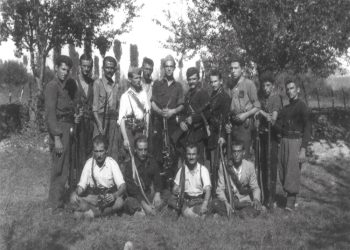
Without stopping, we continued the conversation, which immediately turned to “politics.” He told me about the organization of guerrilla units, the drills, and the preparation to attack the city. There was a contagious enthusiasm in his words and voice, as if he wanted to pass it on to me. I listened to everything with curiosity. But when we parted, he shocked me with an expression that came unexpectedly. I wished him “Good night!” He replied with a somewhat arrogant tone: “We are preparing to enter the city…! We are sharpening the knives…! Good night!” I remained frozen on the spot. I wasn’t sure I had heard correctly. Nor did I fully understand the purpose of his words.
Little by little, I recovered, and within me, all the discussions I had with my friends after leaving the “group” were renewed. The “harsh struggle, with blood or without blood,” which the communists repeated so many times to me and others, began to make sense, to take a more concrete form. The knife – the weapon of massacre and terror – was mentioned without any restraint! For whom were the knives being sharpened?! For me, for the “collaborators,” for the “opponents”?! I took the final steps to enter my house, but it felt as if my legs could no longer carry me.
My neighbor, a friend of twenty years, was warning me of the beginning of a new era in our country. I wasn’t so much afraid for myself. But among our friends, there were many who bravely opposed the “Movement” and remained faithful to “national” ideals, as we had learned in school. For them, the future was terrifying, and I smelled the scent of blood brought by the partisan comrade’s warning. The knife divided comrade from comrade! I spent a sleepless night.
My relations with “comrades,” especially the discussions we had held, began to take on a life of their own, as if step by step they were rising into a new building, unknown until then, the contours of which were clearly visible. The fundamental element I had noticed in them, and which troubled me so much – hatred – was now taking on new dimensions, a new meaning, as the blood and soul of the movement and the revolution being prepared. I began to see more clearly the nature of the communist system, kneaded with hatred and the consequences that would follow.
I saw myself and my society as powerless, defenseless creatures in the path of the only road where the hurricane of revenge would pass, unable to leave, unprepared to resist. In my memory, readings of the early medieval invasions were renewed – the fall of Rome and its civilization: long columns of barbarians, armed with iron and fire, vengeful, would pass through the city streets before a terrified population. Was this our promising future?
In the morning, I visited the family of Zyhdi, my “underground” cousin, and asked to make contact with him. I met him in a “shelter base,” not far from our houses. Despite the unfriendly parting a few months earlier, I loved him with all my heart. He had grown up in a family with a stable economy. He hadn’t needed to work to secure bread for himself or his family. He read a lot and had the quality of thinking with cold blood. His involvement in the “Movement” was done with full consciousness and desire.
He had concluded that “communism” was the only path offered to a young revolutionary, especially in those days when “fascism” was being fought, and he had embraced it, at least intellectually. This tendency had changed him more and more every day. From an ideology and a philosophical concept of economic and social development, a focused and determined life perspective had been created. He viewed the lightning news arriving during the day with such complete certainty and conviction that I felt envious.
Such a position, taken definitively, which looked the future straight in the eye without caring for the life unfolding on both sides of the equation, gave him a sense of satisfaction and liberation from doubts…! He lived only with the nervous urge caused by the anticipation of the day of victory, the day of fulfilling his dreams of a full life in a perfect society, the dawn of the new day that would be born…! When I entered the ground-floor room, my cousin embraced me with great affection. I was filled with joy.
After the last confrontation, when I no longer recognized my cousin, I had doubts that he had grown cold toward me forever. I found the opposite! His health was not bad, although he had lost weight. He was dressed in clothes and shoes as if preparing to go out. Underground life has its own rules. In his belt, he carried a loaded revolver that didn’t suit him at all. A bit tired and pale, he had formed two black circles around his eyes behind his glasses. It looked as if he was reading or working a lot with pencil and paper. I didn’t ask him. He himself explained to me that, lately, his reading was more limited.
Half-jokingly, I said: “More selective.” “As you wish!” he replied. But the conversation was taking a good turn, and it led us to the topic of reading: formation from books, or information for a formation, according to our abilities. I was aware of the nature of his previous readings. Books we called “realist,” mostly novels with social content from world literature: Balzac, London, Steinbeck, Gorky, etc.
He understood Italian well, and books in this European language were numerous. Alongside them, he also read Marxist materials and a series of translations, mostly in pamphlets taken from the Soviet arsenal. This was the source of his “revolutionary” ideas, which he had embraced with passion. But in the conversation that unfolded, from the tone of his voice, I understood from the beginning that a selection process had begun and that my cousin had become more discriminating in accepting or rejecting ideas offered by the material read. Not a word about the “dictatorship of the proletariat,” “world revolution,” the “final victory of the working class,” or the “new world” promised by the war against capitalist countries….!
He had maintained faith in the victory of the “National Liberation War” and the justice of the social cause he embraced. He spoke with conviction about the reforms he predicted would be made in our country. But this time, he didn’t have that initial, complete certainty that everything would develop according to the designated plan. I found in him a great need to speak! Sitting next to each other, our voices could not be heard. The lady of the house, who opened the door several times to look in, saw two happy cousins engaged in a quiet dialogue, smiled, and closed the door again. He was afraid to speak openly! He often used the expression “between us,” showing a special pleasure and a great desire to understand the internal transformations he had undergone which, one by one, were coming out without him being able to control them.
When I asked if he discussed this with others, he replied: “No! I have no comrades!” He was lonely. He explained to me that the nature of the work he did was a routine that was driving him crazier every day. The same thoughts, the same phraseology, simple compositions that appealed to emotions and not logic, with a propagandistic, repetitive, and persistent vocabulary for use among uneducated elements…! “I don’t have the opportunity to read for myself the books I want; only what I find here and there… most of them I have read several times and find nothing new.” He thought for a minute and continued: “What surprises me is that I don’t like them… as before.
My intellectual formation has suffered from a lack of criticism which I didn’t have at that time,” he told me, “and which is now being born as a strong, dominant need, putting my deepest convictions on trial….!” – Do you express these doubts with others? – I asked. – No! – he replied, and looking me straight in the eye, added – I live in an atmosphere that does not allow doubt, much less open criticism. My comrades are unprepared to examine with a critical eye the path we have taken. They obey and act. “Others” must think for them. Who are these “others”?!
He told me that in the successive educational conferences; only the speaker “preaches” endlessly – a message, a suggestion, and an order: “The Party, comrades, has foreseen everything!” No one asks, much less discusses. Only approvals, praises, and promises….! “I am tired,” – he told me, – “I am tired!” I asked him if he had thought of leaving this “War” and retreating home into his own inner world. “No,” – he said, – “I consider it a weakness! Now we are engaged in war… maybe later… after the victory… I will try so that I too may win my independence…! Not today!”
I put my arm around his shoulders, and we sat like that for a few minutes, like two brothers crushed by fate. – Did you hear about the new government in Berat? – he asked me. – Yes! – I replied, – it seems that the victory of your Movement is now certain…! – We will take power, – he said, – the problem is how long we will hold it…! In our Movement, there are many elements who do not approve of the leading role of the Communist Party…! I don’t know how events will unfold! I fear what I see and hear today around me…! Everywhere there is a spirit of brutality that troubles me…! There is open talk about the need for a “political purging”…!
I have the impression that there are “plans” and “lists” for implementation after the victory…! Everyone is enthusiastic, and in such an atmosphere, we might face great and difficult surprises…”! He thought for a while and asked: – What’s new in the international arena? I told him the latest news from the BBC in London, as well as news coming from Southern Albania and Kosovo: battles, massacres by Albanians and by Nazis. He interrupted me: “I have met Yugoslav ‘instructors.’ They are better prepared. Our comrades are clearly inferior and never contest the statements of their ‘colleagues.’ They have the problem of Mihailović, but they are convinced they will destroy him. They are troubled by the alliance with the Anglo-Americans, but they are closely linked with the Soviets and have unshakable faith in the superiority of the Red Army….!”
– What is being said about Albania… about Kosovo? – I asked. – Albania is their small ally, and they consider it a country where the proletarian revolution must win uncontested. For this, they are determined to help us…! About Kosovo?! It isn’t spoken of at all…! I reminded him of our previous discussions and my insistence on solving the “national” problem as the goal of our war. He smiled: “I was convinced that internationalism would solve our ‘national’ problems. Now I doubt it…! I fear our country is entering the sphere of a political game that far exceeds its borders…! I fear the policy of the Great Powers…! Once again, we are not independent….!” Memorie.al
To be continued in the next issue