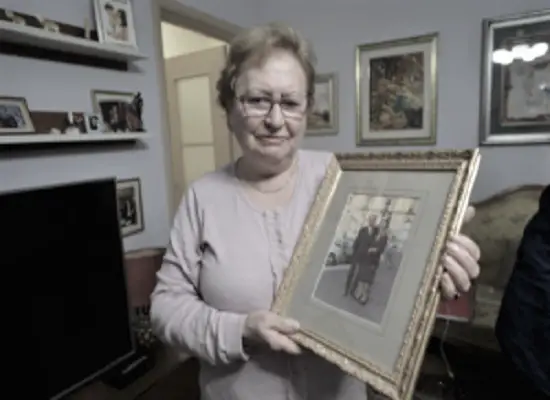



– The rare testimony of Valbona Çoku Mirakaj, daughter of Mentor Çoku, former President of the Islamic Community of Western Europe, who in February 1992, hosted for dinner in Trieste, the three new leaders of post-communist Albania: Fatos Nano, Aleksandër Meksi and Sali Berisha-
Memorie.al / Only 16 years old, Valbona Çoku Mirakaj remembers well the car that came to take him away. The State Security officers were following the child of their political opponent, Mentor Çoku, in order to deport him to the Lushnje camp, for his father’s disobedience. The regime had separated Valbona from her mother and father from a very young age. So, she was sent to a barracks where men without families were sent. Even the camp soldiers felt sorry for such a lonely girl, so Valbona was allowed to join another family living in the camp. She worked long hours in the fields, and remembers not even holding an umbrella before she had to carry heavy work tools. Her stay in this camp was so long that she met her husband there, with whom she gave birth to 3 children (again during her stay in the camp), while she lived in fear that her children would also have the same fate as her. Valbona’s father, Mentor Çoku, was a personality and activist of the Albanian anti-communist diaspora, (just like his father and uncle Pal Bibë Mirakaj and Kolë Bibë Mirakaj) and the communist regime of Albania of Enver Hoxha had put a reward for his murder.
In November 1944, Mentor escaped from Albania to Italy, when Valbona was still a newborn baby. At the same time, her mother became very ill and left the country in search of specialized medical treatment in Corfu, Greece, leaving behind Valbona, her mother and brother.
Afterwards, Valbona’s mother was extremely saddened when she realized that she could not return, as during her stay in Corfu, Albania’s borders were closed and would not be opened again for the next 47 years. This led to the separation of the family, and Valbona would never see her mother again.
Valbona was reunited with her father, after 30 years, but it was too late for her mother – a woman who was filled with the pain of separation.
Now, married and with children, Valbona says that it is important to talk about the injustices done to her generation, even if people are shocked by the cruelty of these acts…!
In this regard, Valbona says:
“When I turned 16, I had just finished my third year of high school and one day, I was told that I would be interned in Lushnje. I thought I was mistaken for someone else, although I knew my parents’ story well; but I thought they would be following more important people and not a child. They sent me to a camp in a village in Lushnje. There were several villages in Lushnje, they were more like farm sectors rather than villages, which had been turned into internment camps. I was sent to a place where my father had been and put in a barracks where single men without families were sent. It was horrible. I was completely alone. Calling it a barracks is a joke. It was like a huge warehouse of singles. The families were in other barracks, I was very shy but when I saw myself in that place I was terrified.
I was so scared that I approached an officer and asked him if I could join a family. Surprisingly, he felt sorry for me. He had never seen such a case, that a single girl was exiled. There were usually mothers with their children because the fathers were sent to prison, but a daughter to be exiled alone? Never. So he told me that I could only join a family if they would accept me.
I asked an older mother who had 3 grown daughters if I could stay with them. She said yes and shared her bed with me.
Two barracks had 20 families. You could hear the other person breathing on the other side of the wall. The day started with an appeal.
We all lined up. Then we went through the fields. One day you will harvest wheat. One day you will dig a canal. Someday you will work the land. Someday you will harvest corn. Thus, mainly farm work. The tools were very heavy duty. I dragged them along. The first year, I went to school because I had to finish my matura. They allowed me to go to Lushnje. The only condition was that I came back for dinner. We worked regularly every day. Very hard work.
There are no words that can describe the true horror of those conditions. We got married in the camp (with husband Sokol) and our children, all three, were born there in the camp. Life became even more difficult because we had to raise children in those conditions. While the children were growing up, a great sadness filled you inside, because you thought that they too would have the same fate as you. In 1990, a law was passed that all Albanians should have a passport, because passports did not exist then. So we went to the Home Affairs Office and the policeman there told me that I couldn’t get a passport. In the newspaper, it was written that persons with criminal cases and those of military age could not be provided with passports. I told the policeman that I was neither in the army nor had I committed any crime.
My father, Mentor Choku, lived in Rome and he was the President of the Islamic Union of Western Europe, so he had a certain social position. The policeman asked me why my father could not do anything for us, although he was such an important person. To put it more precisely, he said: “How come not even a small stone moves for you”?! So I left there and said to myself that I won’t be able to meet him and came home crying. At that time, the policemen started taking money. Sokol paid $600 for our passports; mine and my son. It was 1991. My father was in Rome, the president of the Islamic Union. I left my daughters with my husband and took my son with me.
Many people ask me how it was to meet my father after 47 years. Even after 47 years, I recognized my father’s face, which was like a light to me. It was the only thing I could see among the crowd of people. We entered the house. He sat outside, and let me go in alone. He had placed a photo of my mother in front of the entrance of the house and a bouquet of flowers with a text that said: “Welcome home, my lady of the house.”
My mother died in 1988 and I never saw her again. She died depressed with an only child whom she could not meet and even worse she was in an internment camp. She blamed herself for this. My meeting with my father was an extraordinary thing, even unimaginable, because among other things, through him, I somehow managed to meet my mother as well. It has been a special story, a sad story.
When we lived in the internment camp, I had a picture of my mother and father that I carried with me all the time. I thought: ‘Woe to you, how do you live without me’. I did not see the miserable situation in which I found myself. Especially after I gave birth to children…!
Today I have two children in Italy; youngest daughter and son. My heart breaks every time they leave here, so I try and imagine how my parents lived without ever seeing me.
Today’s generation, i.e. those who have not managed to live that regime and the many vicissitudes that we have gone through in an endless ordeal of suffering and misery, are shocked by the things that happened back then. They don’t even believe that they are true when they hear these things.
What you are writing in this interview that we are doing together is necessary and has a lot of value, as people need to learn the true effect of communism in our country. Today’s young people, as I told them, cannot understand, cannot perceive the fact that you can be imprisoned for years, simply because you were listening to a banned song or a banned book. The truth must be told as it happened. These things should be studied in schools because only people our age know this and we end up talking only to people who have been through these things themselves who know what happened.
Our conversations and testimonies should be heard by young people who have not experienced these things. All these things seem like fantasy to today’s youth. But this is a reality that needs to be written”, says Valbona Çoku Mirakaj, 78 years old, at the end of her conversation. She was born on October 19, 1944 in Tirana where she lives with her husband, Sokol.
This was a brief history of Valbona Çoku Mirakaj, daughter of Mentor Çoku, who, apart from his anti-communist and religious activities as head of the Islamic Community of Western Europe, is the only person who brought together three of Albania’s main political leaders post-communist, since in February 1992, he had Fatos Nano, Aleksandër Meks and Sali Berisha for lunch. Memorie.al