
By Eugene Merlika
– THE CONQUEST TWIN –
(Homage to the “People’s Artist”, Vaçe Zela, on her 70th birthday)
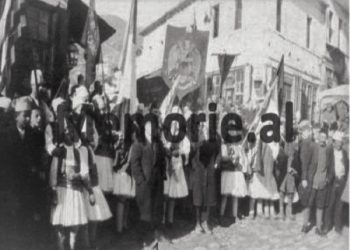
Memorie.al/In the long and arduous journey of peoples, in what is called history; there are days that resemble stations, crossroads, where unusual events determine the direction that those communities of people, who speak the same language, will follow in the future. In the history of Albanians, such a day was April 7, 1939, a day that changed the course of events of a people that, for almost five hundred years, dreamed of independence. When this came it brought a trauma as painful as captivity, the separation of the brothers from the paternal hearth and the fall of half of them into other captivity.
The desperate efforts of a handful of people, aware of the extremely difficult mission of creating, strengthening the functioning of a state surrounded by the predatory greed of its neighbors, supported by the greats of Europe, would be put to an end by the establishment of an act of strongly desired by a playboy of Italian politics, who was lucky enough to marry the dictator’s daughter and hold the position of foreign minister.
April 7, 1939, with the landing of Italian troops in Albanian ports, was the beginning of an era of foreign invasions that lasted a short time, but which resulted in a local tyranny, from whose multifarious clutches we are still unable to completely break free today. But that date was also an ordinary day, in which people worked, talked, fell in love, studied, dreamed of a future, and gave birth to children…! It was the ordinary life of ordinary people, those who perceive historical events late, when they materially affect them.
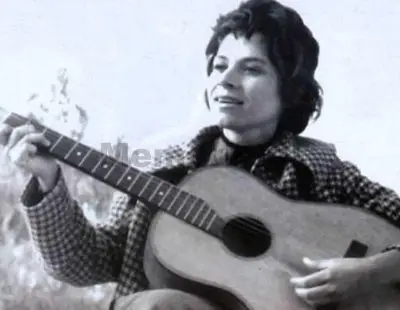
On that day, among the many children born in Albanian-speaking lands, in the lush Lushnje on the edge of the Tërbufi marsh, in a well-known family, a girl was born. The girl was named Vaçe and had a child undisturbed by the ebbs and flows of the political life of her country. From a young age, she was known for her cheerful character and great desire to sing and dance.
In the small town where she was born, she quickly became known for her tendencies and was sent to study at the artistic high school “Jordan Misja” in Tirana. Since there were no “biography” problems, that talented girl was lined up in the group of young artists who would represent Albania at the International Youth Festival in Moscow in 1956.
It was the first encounter of the 17-year-old female artist with the foreign world, a temporary break from the rigid rules that existed in the cultural environment of her country, an encounter that left a mark on the subconscious of the young artist and gave an impetus to the path of its further.
Little by little, the new Vaçja became known at the national level, as a result of her participation in the city’s variety show and her performances throughout Albania. So in 1961, she retired from Estrada e Ushtari, from where she began her artistic career in the capital that took her in a few years, to the top of the Olympus of light Albanian music, for a long time.
I think it is too much to talk about her successes in that field, about the prizes won, about her indisputable popularity, about her extraordinary help in the interpretation of the light and popular Albanian song, about the high technical level and the warmth of a voice that, for every fan of the music of those years, was the il non plus ultra of vocal mastery.
On this important anniversary of the magical musky singer, I like to point out some aspects of the character and personality of Vaçe Zela, for a long time not highlighted publicly. Vaçja grew up in Lushnje in the 1950s, a city that since 1954 had become the main center of internment for Albania.
Savra and Pluku were the sectors in which most of the internees in this district were settled. The younger ones went to the city schools, including the gymnasium opened in 1956. Others worked, mainly in construction, often in the city, while the majority worked in agriculture.
The instructions from the highest levels of communist power were for these people to live in a ghetto and always be seen as “enemies”. There were many citizens of Lushnja who tried to implement those instructions, but there were also those who did not take them into account in their lives.
Vaçe Zela was one of the second. Near her house were the city hospital, and the young singer spent hours in conversations with interned girls, admitted to the hospital.
Courtesy was a feature of her character, but it became even more visible in relationships with boys and girls from the “inverted” classes. This was certainly not seen favorably by the defenders of order, but the singer never preached communist “morality” about the infamous class war.
I knew Vaça early when I was going to high school and she was a leader of pioneers and a singer in Estrada e Lushnje. Later she went up the ladder of success, while I went down the racial difference of the “class war”!
On the rare occasions that we would see each other, she never turned her head away, did not avoid the meeting, and did not spare her kind words. He tried to encourage me to face a life that resembled a dark tunnel where no light could be seen. Understanding, solidarity, pain were felt in her words.
She always remained loving, honest, and open with people, she valued them by their personal qualities and not by their last name; she did not know how to hate as per the prescriptions of the party or state security. It is a merit that elevates the figure, if you keep in mind that it was about a public figure of the first rank, at a time when the pressure of the state in the direction of depersonalization was extreme and the consequences of resistance, almost always, very bitter.
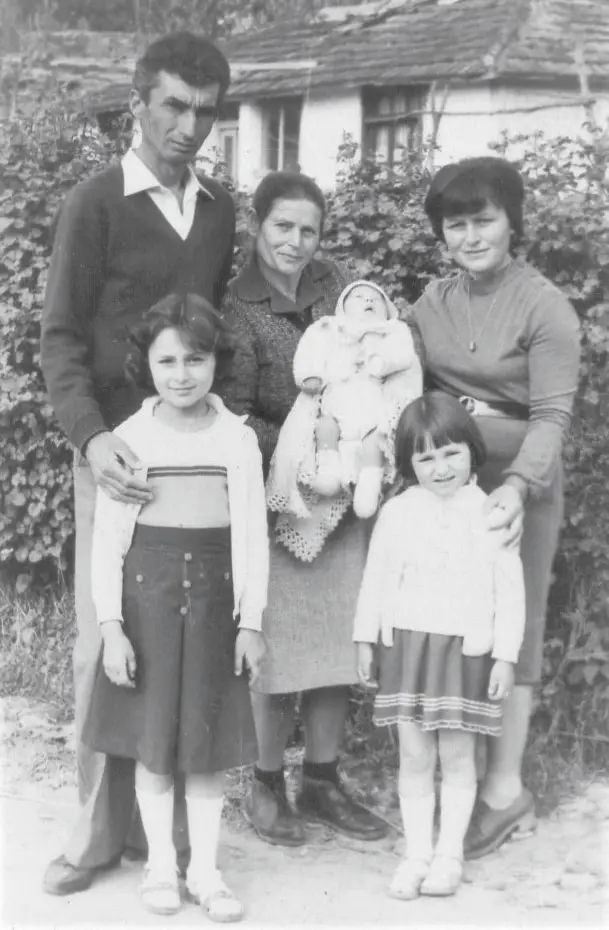
She would show this side of her personality more forcefully in the creation of her family, in the respect of her love, in the decision to join a man who was not part of the “good biographies” that you had for mother, a foreign woman, who had done military service in a labor department. The famous singer fell in love with this man and that feeling stayed with their times and vicissitudes until today.
Vaçe Zela remained the open-minded girl by owning the stages of Albanian song festivals, being honored by an entire nation, and representing her country with dignity on foreign stages. She didn’t covet political and social positions, she didn’t become a deputy, she didn’t even become a communist, she remained an Albanian who loved her country and served it with her voice, with the aesthetic pleasure she gave her compatriots.
It has been years since she left the stage, but her songs are still present in the memory of people of her generation and occupy an important place in the artistic wealth of our people. The image of the singer and her voice, at different stages of her artistic life, remains alive in our memory, as it has been a part of our spiritual food, even though many of the lyrics of the songs she sang bore the stamp of her time them, because it could not be otherwise.
Time makes its choices, throws into the basket the pseudo values inspired by the interests of the moment, of power, of transitory ideologies, but preserves and elevates the universal values that have as their central axis man, his spiritual world, his eternal tendencies and aspirations. Many songs sung by our great artist meet these requirements, so I am sure they will have a long life.
On this anniversary of her birth, all her compatriots who remember her with respect and kindness wish the “Queen of Albanian song” a long life, extending their congratulations to her noble husband and their rare daughter.
The apartment where the Rodiqi family lives today in Basel, Switzerland, is somewhat special. It has an exit to a garden, in which various flowers are planted. It is an environment that brings to mind the singer of the nation the flowers of the scenes through which her life passed, that life that had begun on a black Friday, on April 7, 1939. Memorie.al
April 2009