By Skifter Këlliçi
(Reflections on the trial against Themistokli Gërmenji and his shooting on November 9, 1917)
Memorie.al/ November of this year coincide with the 105th anniversary of the death sentence of the great patriot, Themistokli Gërmenji, who was “Activist of the national and democratic movement before and after the Independence of Albania…”! He collaborated with the government of Ismail Qemali in Vlora, in 1913 -1914 and performed important tasks in the state administration”, (Albanian Encyclopedic Dictionary, volume 1, page 764, 2008).
Although a period of more than a century has passed, the reasons according to which, based on the data of SURETE (Syrte-Security of the French Army), the Military Court of the Eastern Army Headquarters based in Thessaloniki, during the First World War (1914-918), took the decision to shoot Germenj, as an Austro-Hungarian agent. And this happened when a few days ago, General Sarraj, the commander-in-chief of this army, in a special ceremony decorated Themistocles for “Special merits of bravery, in the fight against the Austro-Hungarian forces.”
But what were these accusations that led to such a sudden, so lightning-fast, and so cruel decision, from which Gërmenji, from France’s precious loyalist, was transformed by the high French military, into its hated enemy, to the point where his life was taken away?
All these conjectures must come to light and will be confirmed, when the file of the military trial against him is opened. However, as the well-known scholar Aurel Plasari points out, in an article “The truth of the execution of Themistokli Gërmenji by the French”, published in the newspaper “Tema”, on February 16, 2016, the “mysterious” file of the trial is preserved so jealous of the French state”. He further notes the following quotation of Prof. Muhin Çami from his book “Albanians and the French in Korça, (1916-20):
Even now… we can say that we do not have the complete documentation…! We lack e.g. the acts of Themistokli’s trial, the search for which has been in the center of attention of Albanian scholars, but still without the desired results. “Their absence is a significant gap.” (page 72).
However, in this dossier, based on my published works and research, I will try to argue the diabolical ways that the French Army Security, SURETE, (Syrte), used against our prominent patriot, Themistokli Germenji, to defeat him. , to bring him to his knees and then to annihilate him.
In December 1973, then a journalist at TVSH, together with a film crew I happened to be in Korça, to make a television report. Among the symbolic images of this city, we chose the monument of Themistokli Gërmenji (work of the famous sculptor, Odhise Paskali), erected in 1932, with the help of the patriotic citizens of Korça.
A giant man, with his coat unbuttoned, his arms crossed behind his back, a face with pronounced features, where a thick mustache stands out, eyes focused somewhere on the horizon, with a persevering look, this is what that giant monument of this great patriotism, an inseparable part of the history of Albania.
I looked at the statue of Themistocles and it seemed to me that his gaze penetrated beyond the horizon, as if to say not only to Albanians, but to history: “Never forget! I was neither sold nor bought”!
Excited by these thoughts, I decided to visit Themistocles’s house, where his wife, Evdhoksia, lived with his film crew.
Recalling the shooting
A typical Korça house, a large staircase, behind it a middle one and in front of a large room, with a high ceiling, with mindere covered with shelves, pillows, a table in the corner, on the walls photo of Themistokli, among which also photo of him with Evdoxina and their only daughter, Elçen.
Evdoxia welcomes us warmly, especially since she is used to meeting with journalists, writers, scholars. It is the living mirror of the husband. While she is confessing, I am reminded of Çerçiz Topulli, Isa Boletini, Bajram Curri, Avni Rustemi…! How close these figures are to each other, how similar! … All treacherously killed: Çerçiz and Isai, by the Montenegrin chauvinists, Bajrami and Avniu, by the shooting in the back of Zog’s men.
Themistokli also had this luck, but this time he was shot by… .
“I was horrified when they gave me the mandate that Themistolius had been killed by the French,” Evdhoxia began to tell us.
Saying these words, her face darkened.
– All the anger and rage, – she continued, – I wanted to know for what reason they had doubled my husband, so I asked to meet with the Chief of Security of the French Army in Korça. He greeted me and told me, ostensibly with regret that; Themistokliu was shot according to reliable evidence. “Tell me this evidence,” I did not scream at the height of my pain. He promised me, but these proofs were never told to me.
She was silent a bit and added:
-Themistokli forced the French to leave Korça alone, to have its own government, only with Albanians. And when they saw that things were going their way, they defended me more than they thought they would, to get rid of him forever, they invented the way he supposedly took and gave to the Austro-Hungarians, who were their opponents in the First World War.
Motivated by this story of Themistocles’s wife, I have since considered writing a story or a novel. But this would happen later, when I would read the study of the historian Muhin Çami, “On the sentence of Themistokli Gërmenji and his execution” and especially the book “Themistokli Gërmenji”, by the
Researcher Pirro Tako, two of my early friends. Then I would not write a story or a novel, but the novel entitled “White-handed killer” (1991).
Who was Themistokli Gërmenji?
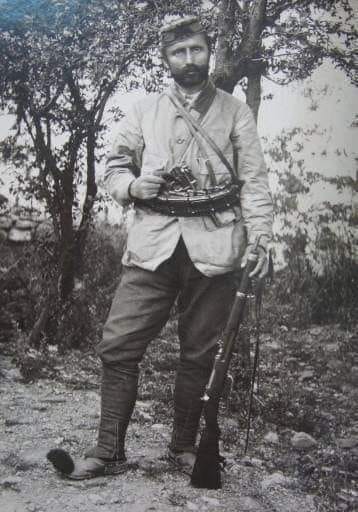
Born in Korça in 1871, the young man was forced to emigrate to Romania, where he became associated with the patriotic societies “Drita” and “Dituria”. He then continued his patriotic activity in Korça, Monastir and later created a group of fighters operating in the suburbs of Korça against the Turkish invaders.
After Korça was occupied by the Greek armed forces, he was put in the service of Ismail Qemali’s government in Vlora. In 1914 he went to Romania and then to Bulgaria, where he published the magazine “Biblioteka, the voice of Albania”, in which he posed important problems that arose in Albania after the Declaration of Independence, especially when a part of the rich feudal lords was playing negative role in the national issue.
His patriotic activity reached its peak in 1916-‘17, when he returned to Albania. There he immediately started organizing the armed war for the liberation of the province of Korça and all of southern Albania from the Greek invaders. We thus come to the moments that mark the last and brightest period of his patriotic activity, which closed so tragically, a period that constitutes the purpose of this dossier.
An invader is replaced by another, but…!
During the First World War, Albania became a battlefield between the military forces of the Entente (France, Russia, Italy, England and then the USA…), and the Central Powers (Germany, Austria-Hungary, and Bulgaria). Vlora, Gjirokastra, with their surroundings, were occupied by Italy, Northern Albania, up to the borders of Elbasan and Pogradec, by the armies of the Central Powers, and the province of Korça by the French armies.
Along with them, in the spring of 1916, the forces of Venizelos’ Greek army joined forces, which opposed King Constantine and his partisans, who demanded that Greece remain neutral in this war.
As a result, Venizelos was stationed in May of that year in Thessaloniki, where the general command of the Eastern Army, commanded by General Sarraj, was located. Beside him stood Esat Pasha Toptani with a group of Kachaks, ostensibly as an ally, with the desire that after the end of the War, of course, as was predicted, with the victory of the Entente, to return with the help of the French at the helm of the Albanian state.
Meanwhile, Venizelos created the government of the “National Defense”, which aimed to realize the ambitious goals of the Greek chauvinist circles to realize the great dream of “Vorio Epirus”. These were the aims of King Constantine, to whom Germany, in turn, had promised southern Albania.
Themistokli Gërmenji together with Sali Butka, another great patriot, concluded that; from the Central Powers, nothing good awaited them. And this, if only for the fact that the German-Austrians, “instead of accepting his request for the establishment of an Albanian administration in Cologne, allowed the deployment of Greek gangs of Papagjeorgji, Dakas and Karvun there”. (Pirro Tako, “Themistokli Germenji”, page 223).
However, when the forces of the Eastern Army appeared in Fushë e Korçës, Themistokliu felt relieved. The chances of victory in World War II, apparently, were leaning towards the Entente.
As the German-Bulgarian armies did not have sufficient forces to fight against the French forces of the Eastern Army, they were forced to withdraw from the province of Korça, without entering the fighting. Meanwhile, Themistokliu decided to surround Korça, supported by Sali Butka’s gangs.
Under these conditions, the command of the French army realized that the Albanians wanted to be free and independent, that they did not accept any Greek government, whether Venizelist or royal, which aimed to keep under their rule Korça with its provinces, that they were also against Italian intervention. Finally, they also wanted a democratic regime and refused to obey Esat Pasha. Under these conditions they were ready to reach an agreement with the French, if they maintained order and ensured the independence of the Albanians.
However, the French, judging that they had an advantage over the Albanian forces, decided to go to war with their gangs, which they called gangs. However, in the face of them, the Franco-Venizelist forces commanded by Colonel Burnazel were badly defeated by Themistocles’s troops, supported by those of Sali Butka.
In these circumstances, seeing that the French army would have a hard time with these agile and dangerous formations of the aforementioned Albanian leaders, General Sarraj, the commander-in-chief of the Eastern Army, saw fit to support the Albanians’ desire for self-government. This is how the military goals could be achieved: To cover with as little expense as possible the defense of Korça and its surroundings, from where there was no longer any danger, focusing the fight only against the German-Austro-Bulgarian armies.
Consequently, after the defeat of Burnazel, Sarraji decided to send Colonel Dakoen as commander of the Korça region. By his order, the Venizelist prefect Argillopoulos was dismissed. This paved the way for reaching an agreement with the Albanian leaders according to the principle: “Try to make the Albanians your own.”This is what our interests demand until the end of the war.” (P. Tako “Themistokli Gërmenji”, page 234).
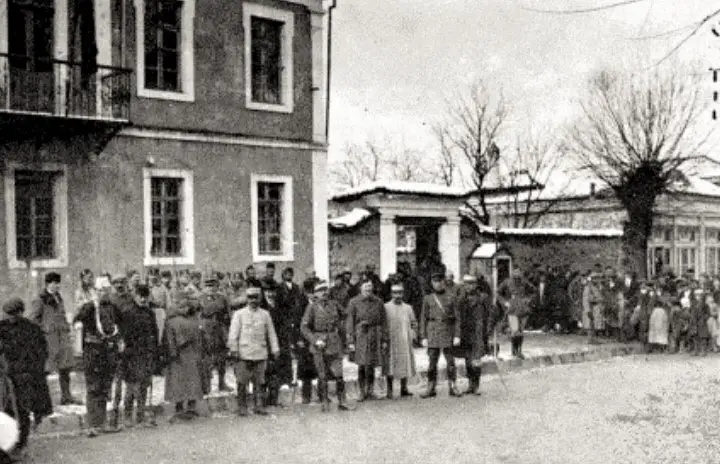
Dakoeni arrived in Korça on November 21, 1916. After four days, Themistokliu and his family, accompanied by 120 fighters of his platoon, entered Korça, where they were greeted with applause by the people who filled the streets and from there presented themselves in the prefecture, where met with Dakoen. (According to the magazine “Rilindja”, Korça, 1935-36, no. 3-4).
In his memoir “Six months of the history of Albania” (Six mois d’histoire de l’Albanie “, Paris 1930, page 14), quoted by Muin Çami, in his study above, Dakoeni describes it as follows Themistokliu: “With a sincere and sincere face, tall in body, with a manly attitude, perfect behavior, dressed in a hunter suit, Themistokliu made the best impression on me. He basically told me: “I have no reason to be hostile to the French and I have not been against you. I call Greek chauvinists our worst enemies. “I am with those who guarantee the freedom of my motherland.”
The next day, on November 24, Themistokli addressed a call to the people of Korça, who, although coming from the Bulgarian occupation zone, had faith in him who was neither sold, nor bought, nor lied to, and therefore worshiped he was unlimited and sincere. (“Gazeta e Korçës”, July 20, 1929). In the end, Themistocles called on the leaders of the detachments not to use weapons against the French army, implying that unlike the Central Powers, France did not pursue occupation goals against our country and that at the end of the war its armies would leave. In other words, he stressed that “… the power was common and coincided with the interests of both parties. (P. Tako “Themistokli Gërmenji”, page 239).
But unfortunately, as we will see later, this would not happen…! Memorie.al