
By Nazmi Berisha (Dyzi)
Part Nine
Memorie.al /publishes the unknown story of Nazmi Berisha, originally from the village of Llap in the Municipality of Podujeva, Kosovo. Lured by the propaganda of the communist regime and Radio Tirana’s programs about “socialist prosperity,” as well as to escape the Ranković-style methods of the Titoist regime, he decided to flee in 1960. He arrived in Albania by swimming across the Buna River in the extreme cold of that harsh winter. Nazmi Berisha’s rare testimonies recount how he was received in the motherland, where border soldiers and officers of the Shkodra district, after binding him with wire, sent him to the Department of Internal Affairs (Dega e Brendshme). There, for 24 hours, they did not even give him bread to eat, before sending him to the town of Shijak, which served as the “Filtering Center” for Kosovar emigrants.
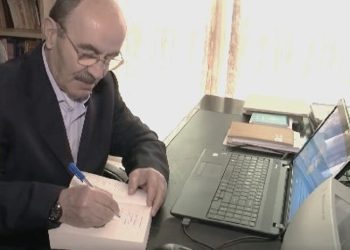
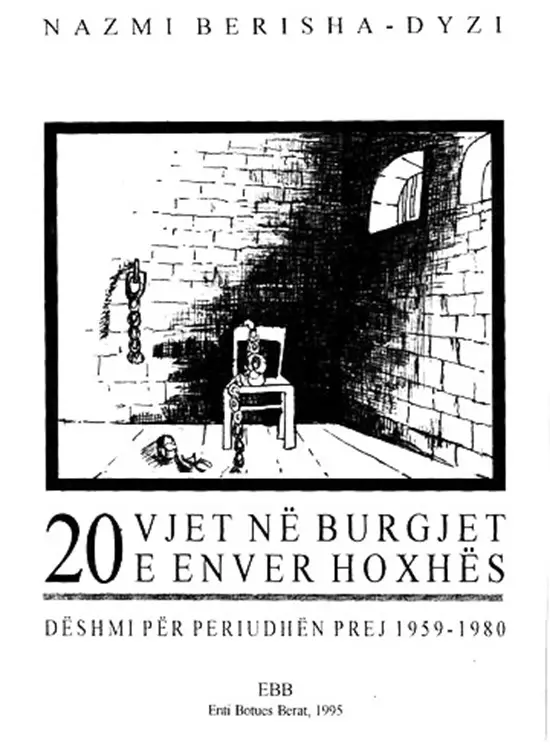
The entire adventure of the 20-year-old boy from Kosovo, whom the State Sigurimi accused of being a UDB agent sent on a secret mission by Čedo Topalović (the head of UDB for Kosovo) to meet with Rear Admiral of the Naval Fleet, Teme Sejko. It details the inhuman tortures inflicted upon him in the Departments of Internal Affairs in Lushnje, Kruja, Tirana, etc., where they kept him isolated and demanded he become a Sigurimi collaborator by acting as a witness against his fellow compatriots from Kosovo. His refusal led to him spending a full 20 years in the prisons of Enver Hoxha’s communist regime. For years, Nazmi Berisha has lived in Sweden, and the writings published by Memorie.al are selected from his book, “20 Years in Enver Hoxha’s Prisons,” published by the “UEGEN” Publishing House, Berat, 1995.
Continued from the previous issue…
Terror
At the New Prison of Tirana, for the third time
The prison van moved slowly, noisy and always sparking suspicious questions. Hysen and I rightly suspected that they had decided to liquidate us inconspicuously somewhere on the road. But nothing happened. It was more of a self-inflicted terror. However, in Lushnje, the van picked up two ordinary convicts who had assaulted a woman; they knew well where they were headed – toward the New Prison in Tirana. Aside from our thoughts, which were constantly being crushed throughout the journey, there was nothing else to note.
At the New Prison of Tirana (my third time there), we would stay for three days. The usual search. The room – a dormitory with 100 political prisoners. It was truly something transitional, surely a stop before moving to another prison. I met Qamil Hajdini, the poet, and later I was introduced to Muharrem Shala. He was the symbol of terror. If you wanted to learn how terror was sown, grown, and harvested, it was enough to know this man – now old, distressed, and exhausted, but never hopeless.
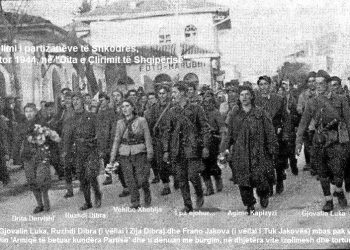
During the National Liberation War (Anti-Fascist War), Muharrem and his brother, Kadriu – born in Peja and having come to Albania – had been an important base, recognized even by Enver Hoxha and Mehmet Shehu as patriots and partisans. Muharrem worked as a private tailor in Tirana, while Kadriu was a minor official. In the 1950s, the Party decided to liquidate CIA bases in Albania. For this purpose, the State Sigurimi worked with a morbid imagination. Halim Xhelo (Koçiu) once explained it all to me; he didn’t let the Sigurimi down, as he led a “Resistance Group” into the mountains. They would visit houses that were against the Hoxha dictatorship and invite people to join them, promising that help from the West would arrive soon. Some joined, some did not report them, and thus many were caught in the sieve of the “Resistance Group.”
Muharrem and Kadriu were arrested as if they had been members of the group, although they had never heard of it. Both were sentenced and were to serve their time in the infamous Gjirokastra Prison. There were also 40 other Kosovars in that prison, including Ajvaz Bajrami from Dimosh of Llap, who was one of only two to survive. The graves of the others are still unknown. The horrors of that prison are beyond words. On one of those God-given days, with his soul at the tip of his nose, Kadri Shala stood at the barred window and let out a cry:
“O people, I am Kadri Shala with my brother, Muharrem. I am a prisoner in your Gjirokastra Castle. Tell the people about this!” That call was successful. People heard. Some who knew them came forward. Thus, their family came to visit. Later, both were sent to Vlora Prison. The family was certainly struggling for food and sold everything they had. One day, the prison commander suddenly came to them, as if to resolve great dilemmas.
“Choose – one of you will be released. I have the order and I am communicating it to you.” Both answered in unison that they were [unjustly] sentenced and would both serve their senseless terms. Neither was guilty. “Then you, Muharrem, work as a tailor in the prison,” the director proposed. Why? To humiliate him? Muharrem was horrified, thinking it was a provocation. In prison, everyone was equal. Thus, in the presence of the other prisoners, Muharrem struck the commander with a slap. Meanwhile, surprisingly, the commander proved to be a mature man.
“Listen, Muharrem Shala, for this humiliation you caused me, I have the power to kill you on the spot and not regret it at all – even be rewarded for it. But I know you well; I know you gave much to the War, I know you are patriots and brave men, so to hell with my pride. You are forgiven for what you did.”
Caught off guard by the unexpected turn of events, Muharrem accepted the work as a tailor. It was truly an event worth noting – two men of character.
And here I find Muharrem again in the Tirana Prison in 1980. Another 10 years for “agitation and propaganda.” Poor Kadri had not lasted long; he had died. However, he had left a final word: “I regret that I am dying without seeing Enver and Mehmet dead.” This was the soul’s cry of who knows how many prisoners. Before his arrest in 1979, Muharrem worked as a tailor in Tirana. He was waiting, like us, to be sent to another prison.
What did that man, that family, fight for? Why?
Certainly not to become victims of savage communist terror. Nevertheless, that brave old man had hope. Hope that his relatives in Kosovo would know where he was, hope for another life, hope for freedom. After three days, we traveled in the same prison van toward Burrel. This could be understood by intuition, although we were so crushed by the savage terror of a single minute, of a story, of a life – by the terror of the air and the word – nonetheless, with the long hope still flickering in our chests.
The Final Days
At Burrel Prison, the third and final time
How was I to know that those were truly the final days? I had no confidence that the State Sigurimi would sit idle, even though the first wisps of Western winds were beginning to blow. We were isolated from life and could not see the catastrophe into which the Albanian economy was sinking. After that victory in Ballsh, though a Pyrrhic one, my mind dwelled on nothing but possible traps. But regardless, I encouraged myself that I was not alone; I was with Hysen Bukoshi, and he had shown proof of bravery and loyalty.
I often thought that in Albanian prisons, those who suffered a double sentence were we Kosovars – innocent, desperate, disillusioned, and caught suddenly in the world’s most challenging trap: patriotism.
We passed the search and questioning without incident; we found old acquaintances (Jovica Cervenko, Hashim Toplica, Selim Xhakaj, and Idriz Zeqiri), asked about the younger ones, sensed the conditions and changes – and there, inevitably, the high policy of the state was noticeable. A person, wherever they may be, instinctively understands the state’s policy, its condition, its illnesses, its whirlpools, its winds – and even from a handful of soil, is able to perform an autopsy on it.
I remember Fezliu from Çaber of Mitrovica, Kosovo, sentenced to 10 years in his second prison term, having fled illegally in the 60s. His masterpiece had been in the Ballsh prison – a revolt that was not easily swallowed: he stuffed the microphones that broadcast the voice of the reader of Enver Hoxha’s works. Wasn’t it Hoxha who had put him in prison without a shred of guilt, and now hypocritically pierced his ears with those written nonsense? Could I ever deliver the dying wish he left for me to take to Kosovo to inform his family? No one could think in those days what might happen tomorrow when the unexpected was the king of the day.
I hoped to meet the writer Kapllan Resuli one day. I knew he was in Burrel, but at that time, discipline was harshly tightened, further limiting the “freedom” of the prisoners; each room was let out separately, the large room had been partitioned and turned into a kitchen, and communication between rooms had become extremely difficult. Idriz Zeqiri had put me in touch with Kapllan Resuli through the barber, who had “broken” [the rules] because of the money Kapllan received from his brother in the West. Through Idriz, I learned that Kapllan’s life was threatened in the solitary cell and by the tortures inflicted upon him. Through the barber, Kapllan sent me some photos of his brothers and their children. He instructed me that as soon as I returned, I should carry out what was necessary – my duties.
As soon as I returned! It was becoming an obsession, a sickness. They don’t say for nothing that a person often falls into the lap of madness right in their final days. In another room was Sytki Hoxha. His request was that his remains be returned to Kosovo. At least to be free in death. He was immensely saddened but a very morally strong man. On the other side was Tefik Dednica from Leshkoshiq, Pristina district. He had come to Albania in 1957 and was sent to Çerma, then to Lushnje where he was employed. However, a cousin of his, with whom he had fled to Albania, had escaped from Fier back to Yugoslavia.
Precisely for this reason, they imprisoned Tefik and accused him of wanting to escape with his cousin. Plus, they accused him of theft and assault. A false accusation, of course. 21 years in prison. Merciless torture. Would I be able, if I were released, to go to his family and tell them everything? I don’t know. I would hear this story as well during my final days in Enver Hoxha’s prisons. One more comrade. One more suffering, an unbearable pain.
In Çerma for the third and final time
My release was escorted by a policeman with a Russian automatic rifle and a pistol. Burrel – Durrës – Lushnje. We entered the Lushnje Department (Dega) together. The policeman gave the officer a sealed envelope and said a few words. It felt to me as if that envelope was my shroud. And I was moving inside it. Sarcasm came to the tip of my tongue, but by now we were used to burying our ideas and beautiful things.
Near evening, they took me by truck to Çerma, to the very same room where I had been five years prior. Thus, I could not rejoice in my release from prison, because this was my new internment. As instructed, the next morning I presented myself at the Lushnje Department of Internal Affairs. The officer waiting for me was Zalo Mejdani from Lushnja. According to the rules, I was given 200 new leks and told to start work the next day.
“No, I want to go to the Yugoslav embassy in Tirana. I will request my return to Yugoslavia, of which I am a citizen.”
In truth, I had received notice that there would be no obstacles from the Yugoslav side. I showed the family’s letter to the officer. Zalo Mejdani could not act on his own. He went into several offices and told me to return whenever I wanted.
After a few days, I went to the Yugoslav embassy where they gave me a ten-day visa. I was overjoyed, but it did not last long. A new anxiety circled me like a hawk. Where would I go, through rivers and streams? What would happen to me in Yugoslavia! I knew that my father had served a year in prison because of me.
According to the rules, I went to the Ministry of Internal Affairs to legalize the visa, but they took it and never returned it. Another grief. My God! What is happening to the common man? “We know when to let you go.” This was a threatening response. Thus, I took the road back to Çerma. Neither in heaven nor on earth! I waited through those ten days of calamity, but nothing. I cut off the hopes of my black fate. I tried to find strength within myself to do something, not to sit idly, not to fall prey to some new process, which surely loomed invisibly over me.
My life, and naturally my visa, walked on the edge of a knife. Everything was in the hands of the police and was conveyed through their thick and somewhat cynical smiles. My blind fate. But hope – was hope dying within me?
Around the end of September, they informed me that I should report to the Ministry of Internal Affairs of Albania to collect my visa. My return to Yugoslavia had been approved. After agony, there are no crumbs of joy left. Thus, meanwhile, another anxiety began: would the Yugoslavs approve the ten-day permit from the Ministry? Yes. They did not hinder me. An unfortunate person is crushed like a fly, without a drop of mercy – treated like a fly even when going to offices. O God! A classic cry of the misery of mourning, of pain: the cry of a living hope. Instantly, my joy returned. And I saw people not as they were, but as I wanted them to be. For me, this joy, though paid for dearly like no other, was something human that somewhat warmed my tortured, desperate, and badly wounded soul.
I returned to Çerma where they told me I would be allowed to leave on the final day. O God! What is happening? All the dark hours seem to have gone mad for me. I gathered my belongings and we stayed in a hotel in Lushnje to be near the Department. One way or another, they wanted my time to expire. But by now, I was used to the betrayals of the State Sigurimi. Those at the Department had taken my visa, and although I could have left on foot, I still had to act with caution. The prisons of Albania had gifted me 20 years of greater age and maturity.
On October 8, 1980, they found a random vehicle for me traveling to Kukës. They bought me some clothes and sent me off. They tailored my new suit. They gave me the visa and, along with the driver – who was surely one of theirs – we went to Kukës at 12 o’clock at night. The driver told me he had to hand me over to the Kukës Department. So it was done. The Department took me to the hotel. The next day I reported to the Department, as always, according to instructions. Every minute felt like a month. An unbearable wait. The civilian officer and his “Volga” did not delay long. He took me, likewise without delay, to the border point. At the Albanian checkpoint, I stayed until 11 o’clock in the morning. A strict and minute search. Then, an officer escorted me to the vicinity of the border. A vivid procedure. Strong chills of insecurity and a new terror ran down my spine.
Amazement hung between my being and the space around me, which was narrowing like a vise. The border – an invisible line, an unfindable will of security. The border – a common loss. The border – a frightening, mortal fever. Endless questions. Now I was on the other side. I had crossed the Golgotha. And hope was alive./Memorie.al