From Ali Samil
-Poetess Nafije Abidi, victim of the political purges undertaken by Stalin in the Soviet Union, lost her life in the prisons of Azerbaijan, where she died after being arrested together with her husband-
Memorie.al / A poetess of half-Albanian origin from Ioannina, Nafije Abidi (Nafie Tefik Tanur), for the love of the Azerbaijani writer Emin Abidi, left her higher studies in Literature in Istanbul and followed him to Baku (Azerbaijan), where she suffered persecution from the Soviet KGB, being accused of anti-communism along with him. But while her husband was executed by firing squad, her fate remains a mystery, because the end she met in the prisons of Azerbaijan during the communist years is unknown. Her story is told by the Azerbaijani writer and publicist Ali Samil, who deals with the stories of dissidents who suffered in Azerbaijani prisons, as a continuation of writings about the life history of Albanians who have given their modest contribution to Azerbaijani society.
Signatures in some writings, stories, and poems of Nafije Abidi are found only in publications from 1927, and if I had not been closely involved with the life and work of Emin Abidi, they would not have caught my attention. When I was studying at university (1969–1973), anyone who had known Emin Abidi (Azerbaijani writer, publicist, and anti-communist) said that when he was studying in Istanbul, he got married and returned to Baku with his wife.
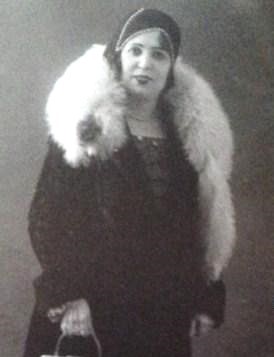
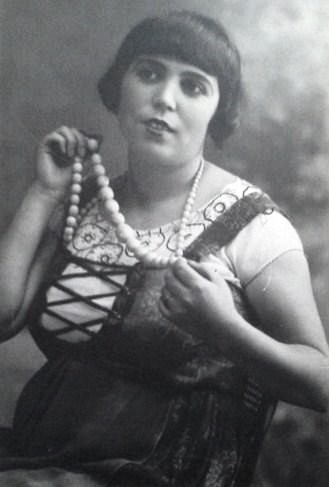
From the memories of acquaintances, it is learned that his wife, who came from a wealthy family, had talent in poetry. From members of the Abidi family, I obtained two photographs of her, showing a beautiful and elegant lady. With Emin’s imprisonment, his wife Nafija was also imprisoned, but while it is known that the KGB executed Emin, her fate is unknown; she was imprisoned by the infamous secret service in Azerbaijan.
Stories and poems published in Turkish in Baku and Tbilisi under the signature of Nafije Abidi were not enough to learn the truth about the Albanian-Turkish woman. Questions such as where and when she was born, her father’s name, her maiden name, her poetic work before coming to Baku, afterward, what Nafije Abidi did, etc., had not found answers. Even in 1997, on the Turkish radio program “Voice of Azerbaijan”, the editorial director, Sejfedin Altajll, gave me the book “For Independence”, and when I read the poem by Nafije Shyqyri, “Brother’s Love”, I did not think it could have been written by Nafije Abidi.
Only in 1998, while preparing an article for the writer Emin Abidi on the occasion of the 100th anniversary of his birth, during research in the KGB archives, I managed to learn about his work and that of his wife Nafije, and the above questions after nearly 30 years were answered within 2-3 hours.
I learned that Nafije’s parents were named Shyqyri and Zyhra. In the poem “Brother’s Love” in the book “Hope for Independence”, I understood that the author Emin Abidi, under another signature, under the name Gyltekin Bey, was speaking about Nafije Abidi. The poem “Brother’s Love” begins with the dedication “To the national poet of Azerbaijan”, by Gyltekin Bey, on January 15, 1925. Its subject and elements are very similar to Gyltekin’s poems:
“The warm wind blows in the East / On the green fields of the Caucasus / The last memory of love that is in my soul / Believe me, my heart burns in its depths / Feeling trembles in my voice / A deep love in my voice / You alone are not in that beloved place / And I pray to God, oh blessed land.”
From information from 1903, it is learned that Nafija was Albanian on her mother’s side, Zyra, originally from Ioannina, which, after the division of the Ottoman Empire, remained in Greece, and the family immigrated to Istanbul. After her father’s death at a young age, Zyra Tefik Tanur left, so we find Nafije’s maiden name in documents as Nafie Tefik Tanur.
At the age of 7, Nafije Tefik Tanur attended the “Xhamllëk” Lyceum in Istanbul, which she completed at the age of 18. After attending a one-year pedagogy course, she entered the Faculty of History and Literature at Istanbul University, where she met Emin Abidi. The date of their marriage is not found, but on the back of a photo, written by her, it says: “To my dear mother, after marriage, your daughter, and 1341” (according to the new calendar, 1923). So Nafija was accepted to Istanbul University in 1922 and married Emin Abidi in 1923.
Emin Abid Mytealib oglu Ahmedov (Abidi), originally from Hysejnkullu Khan, was born in Baku in 1898 into a family of stonecutters. His older brother, Aliabbas Müznib, was known as a poet, journalist, researcher, and publisher. His mother, Reyhan Adnan, was occupied with preparing news for “Mekteb”, “İrşad”, and “Dirilik”, and wrote short stories, poems, scientific articles, and journalistic pieces. After finishing high school and the tensions of the First World War between Russia and the Ottoman Empire, Emin Abidi worked as an editor for his brother Müznib’s magazines.
The creation of the Republic of Azerbaijan in 1918 gave him the opportunity to study, as in 1921; the Scientific Commissariat of Azerbaijan gave him a scholarship of $35 per month to study at university in the Faculty of Literature and History in Istanbul, where, as requested, he wrote the work: “History of the Literature of the Turks of Azerbaijan”.
Working in the archives of Gazvin, Vienna, Budapest, and Istanbul, besides studying and collecting materials for the history of Turkish literature, he actively participated in social life. Interested in political events, while a student in Istanbul, Emin Abidi met several times with the leader of Azerbaijan, Mehmet Emin Resulzade.
He contributed to the discovery of the muhajirs, and publications of various poems and articles stand out in the magazine “New Caucasus”, where he published under other names, such as Gyltekin Bey. In the work “Traces of the Independence War in Azerbaijani Literature”, E. Xhaferoglu writes: “The strength and power of Gyltekin Bey’s poems are among the best poems ever created, still mentioned among the population of Istanbul, and they speak well of him.” Emin Abidi finished his studies in 1926 and returned to Baku with his wife, Nafija, who left behind her higher education.
After the overthrow of the People’s Republic of Azerbaijan, the Bolsheviks killed some of the national cadres, exiled others to Siberia, while others left the country. Emin Abidi and Nafija remained on the sidelines, as seen in documents from the KGB archives. The head of the Political Bureau of Azerbaijan, Nevruz Rizajev, and the Central Committee of the Communist Party, in a secret letter from the secretariat on May 15, 1929, created a “purge” commission that removed patriotic professors from education and put spies in their place. It was advised that the “purges” be directed especially against teachers of Turkish literature, geography, and sociology; their transfer to special schools was applied, and group imprisonments began.
Emin Abidi did not remain outside the “purge” either. He was sent to work in Agdash, where he published many articles in the press, but from 1930 onwards, he encountered obstacles to publication. Nafije Adibi, disturbed by this persecution, returned to Turkey. In 1934, through the intervention of Ali Nazim, Emin Abidi started working at the Academy of Sciences, and at that time, the hypothesis arises that Nafija returned to Baku. Her passport shows that on February 20, 1935, she had a visa from 1923 to come to Azerbaijan, on August 2 a visa to return to Turkey, and also on August 14 to return to Baku.
Be that as it may, her questioning by the KGB shows interestingly Nafije’s trip to Ankara, to the Ministry of Finance. While the reason for her trip: “As an only daughter, my father asked me to see my mother immediately, who was ill,” she explains the purpose of the trip. Also interesting is her presence at the house of Nuri Bey, consul of the Turkish Republic in Baku.
In the secret documents found in the KGB archives, during her questioning, the fact that her mother came to Baku in 1930 is mentioned. Then Bedrije Hanëmi, the wife of the Turkish consul in Baku, called Nafije to her house. But if her mother had been ill, she would not have been able to come to Baku in the 1930s. The meetings in Baku were interrupted, and Nafija did not go to visit her sick mother.
When reading the documents about Nafije’s interrogation regarding her comings and goings from Turkey to Baku, the way visas were obtained remains of interest, and one understands that in 1935, it was difficult to obtain a visa for persons wishing to come from Turkey to Azerbaijan. Nafija claims that Abdyl Halik Renda, a several-time member of the parliament in Turkey, helped her get a visa, but someone spoke and her application was discovered in Moscow, at the Commissariat of Foreign Affairs.
There, the names of Nafije Shyqyri Ahmedova’s maternal relatives are given, such as Tefik Tanur, chief accountant at the Railway Office in Turkey, and her brothers, Ismail Tanur, who worked at the Agricultural Bank in the city of Ayvalık, and Qamil Tanur, as an accountant. Equally interesting is the fact that her mother, Zyraja, a housewife, did translations. From the procedure of Nafije’s interrogation by the KGB, the guilt of espionage against her is set aside, and it is understood that among the relatives, the one most questioned about was Abdyl Halik Renda.
After coming to Baku for the second time, Nafija lived quietly for two years, and Emin Abidi came there from Agdam, where together with Ali Nazmi, he prepared for publication his three-volume scientific works and also published articles of a high scientific level. In recognition of the scientific work, studies, published and unpublished works of Emin Abidi, his dissertation and scientific works, the presidency of the Academy of Sciences of Azerbaijan proposed that he be given the title “Candidate of Sciences”.
But in 1936, in Azerbaijan, as everywhere in the USSR, imprisonments resumed. In May 1937, Emin Abidi was dismissed from the Academy of Sciences and went as a teacher to the Kyrdemir region, Karakojunllu. In 1938, he was imprisoned as an anti-communist and sent to the Ismail region. His house was taken, his brother Aliabaz Müznib, a national poet, was imprisoned, while relatives and acquaintances turned their backs out of fear.
Nafija, left alone, tried to return to Turkey. Hoping to get a visa in Batumi, she went to the Turkish consulate, but was imprisoned as soon as she left it, on August 11, 1938, under Article 58/6, of the barbarism of the USSR for espionage, after an order that had been issued long before. She was arrested, and from her was taken a red watch with number 165920, diamond earrings, two red rings, and some other clothing.
Nafije Abidi’s interrogation did not go calmly, because the passport with her photograph when she was beautiful and young became a problem. In prison, after tortures and sufferings, within a short time Nafija was unrecognizable; moreover, unable to endure, she lost her mind; while the doctor who treated her discovered that she also suffered from a heart condition.
Her questioning began in August 1938, by the assistant of the Commissariat of Internal Affairs of Azerbaijan and the prosecutor Kurbanov. On April 28, 1939, he writes: “Having carefully considered the nature of the collected facts speaking against Nafije Shyqyri Ahmedova (Ahmet), I consider it impossible to send her to trial for interrogation. For this reason, I agree to send her case to a special council under the USSR XDK (Ministry of Labour of the Union of Soviet Socialist Republics).” The note about her sentence, unaccompanied by her duty, rank, or even her father’s name, was with this sentence: “Nafije Shyqyri Ahmedova, as a very dangerous element, is to be hidden in prison for improvement. The prison term is calculated from August 11, 1938.”
Emin Abidi was executed by firing squad at 21:30 on October 21, 1938. No more news was heard about him. While regarding his wife, Nafije, acquaintances are not clear whether she returned to Turkey after imprisonment. Here everything remains a mystery. Did she indeed return to Turkey? When and what did she do afterwards? Did she have any socio-political activity? Are any of her poems published? These and many other questions remain unanswered. When the literary exhibition of Azerbaijan was created from scratch, Nafije Abidi’s passport attracted attention among the exponents who had been in communist prisons. Memorie.al