From Andreas Zeger
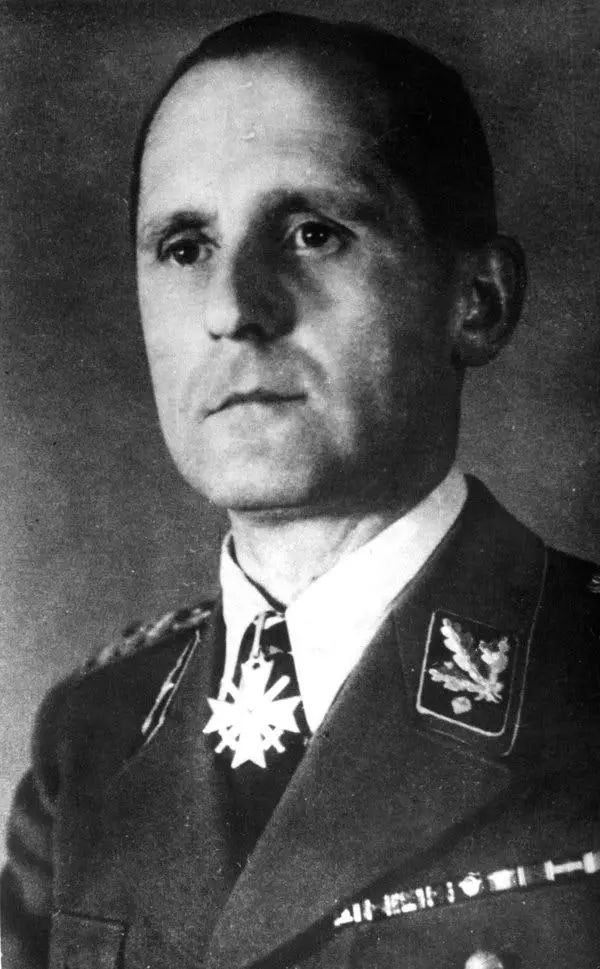
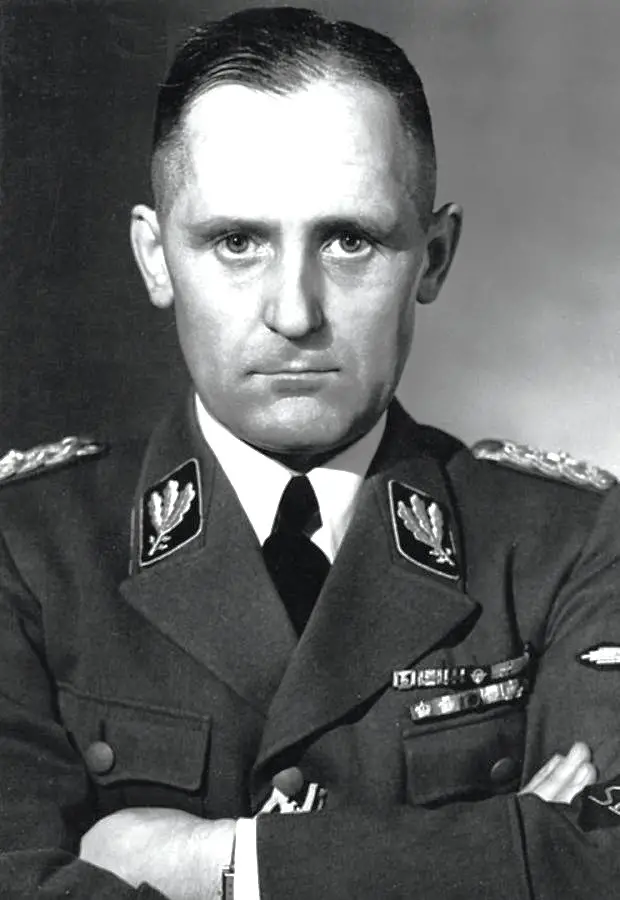
Memorie.al / The aura of mystery that surrounded the former Gestapo chief throughout his life was the reason why there was much media speculation after the end of the war about Müller’s whereabouts. Publications regarding the head of Department IV of the RSHA appeared whenever at least some traces of his presence were discovered anywhere. Great attention was drawn in 1964 by a report by Peter Stehle, published in the illustrated magazine “Stern”, in which the author tried to prove that Müller was in Albania, under the special protection of Dictator Enver Hoxha. The infiltration of Sophie Müller’s apartment in Munich by two Israeli agents on November 6, 1967, caused a new flood of press reports. The two agents were looking for evidence of Müller’s contact with the family. Ten days later, the arrest of a 62-year-old street vendor in Panama was made known, which was mistaken for the former Gestapo chief, Heinrich Müller.
The arrest was mistaken and caused massive publications. Since 1961, new speculations about Heinrich Müller’s whereabouts have appeared. Only a few journalists, against the backdrop of today’s events, put the topic of the search for Müller in the foreground. An exception was a series of articles by Günther Schlichting, published in “Welt am Sonntag” in 1963. In the first of seven articles, Schlichting asked: “Who knows this man”? Describing the last week of the war, when Müller was in the Reich Chancellery, the author tried to reconstruct possible escape routes to Austria and Italy. In the end, he could have moved with the help of people involved in organizing escapes to South America.
Based only on assumptions, a series of articles did not bring any new facts to shed light on this mysterious case. However, Schlichting was one of the few journalists who became acquainted with the case of the senior official Heinrich Müller in more detail. In 1992, an interview appeared in Latin America with the alleged pilot of the former Gestapo chief, who said that Müller, in 1982, was living in South America. Focus suggested in a 1995 article that Müller was brought in 1956 by Czech agents from South America to Prague and later transferred to Moscow. At the request of the public prosecutor’s office, Heinrich Müller’s grave was opened on September 25 and 27, 1963. The Institute of Forensic Medicine in Berlin, Professor Gerhard Rommeney, accurately determined that the bones found belong to six different persons.
The “Frankfurter Allgemeine Zeitung” reported the exhumation immediately after the grave was opened, even before the expert’s final conclusion. At the beginning of October, as the “Süddeutsche Zeitung” wrote, it was established that the bones belong to at least three persons. In addition, scientists found a skull that was not suitable in size and age for Heinrich Müller. The lower jaw found in the grave did not match the upper jaw, as reported by “Welt am Sonntag”. After the publication of the forensic report in the Frankfurter Rundschau, parts of the investigation material came out. They said that it was impossible to state categorically that the found bones of the lower leg and ankle belonged to Müller, but the possibility that these bones were part of the Gestapo chief’s skeleton is not excluded.
In the “Süddeutsche Zeitung”, there were suggestions that the grave had been opened earlier. “Reinische Post” reported that initially the bones of several young people were found, but during a deeper excavation of the grave, the already mentioned parts of the skeleton were discovered, which were sent for examination. The shoulder strap that ended up in the grave could have been from the uniform of an SS Gruppenführer. “Tagesspiegel” concluded in its Berlin publication that a fictitious burial of Müller had been ruled out; this is proven by the examination data. In the end, the skeletal parts found could neither be final proof that Müller was buried here, nor a refutation of this fact.
Spiegel used the exhumation as an opportunity for a detailed presentation of the material on the Müller case. The entire article, in detail, was the result of a thorough investigation. Thus, for example, there is no evidence for the claim that Müller, due to his external appearance, was not well-disposed towards the Reich criminal director, Arthur Nebe. On the contrary, Müller and Nebe maintained friendly relations for a long time. Nebe was one of several colleagues at work whom the Gestapo chief called friends. The author took the position that Müller’s traces were lost in April 1945. On the instructions of the central department of justice in Ludwigsburg, witnesses were questioned who unanimously declared that Müller was in the Führer’s bunker in the early morning of May 2, 1945.
The magazine “Stern” reported on Müller’s alleged stay in Albania, causing numerous reactions in 1964. The magazine reported that Müller allegedly worked from 1945 to 1955 in Moscow, under the leadership of Stalin, the head of the secret intelligence department Beria, and Prime Minister Malenkov, and from 1955 to 1956 in Bucharest. At the end of 1956, Müller, according to the publication, under the name Abedin Beqir Nakoshiri, became a citizen of Albania.
According to Peter Stehle, he ran the “Political Detection” department in the Albanian intelligence service. The author further stated that an engineer from a group of shipbuilding advisors from the GDR drew his attention to “Müller from the Gestapo”. This specialist, whose name is not mentioned, discovered the true identity of one of the Albanian intelligence advisors who was resting at one of the residences on the coast of Durrës.
Simon Wiesenthal, speaking in the “Frankfurter Rundschau”, said that without a doubt, if Müller is alive, he is in the Eastern Bloc. He considers it impossible that Müller is in Albania. In the magazine “Stern” in February 1964, doubt was expressed that Müller appeared in South America on April 21, 1964. The messages from the author of this publication are unreliable and poorly documented. Müller was neither an SS Obergruppenführer nor an SS general. From 1941, he held the rank of SS Gruppenführer and Lieutenant General of Police. The claim that Müller’s secretaries in Berlin were his lovers is also unsubstantiated. Müller’s long-time companion, Anna S., knew him for a long time, the two families were friends, and she never worked as his secretary.
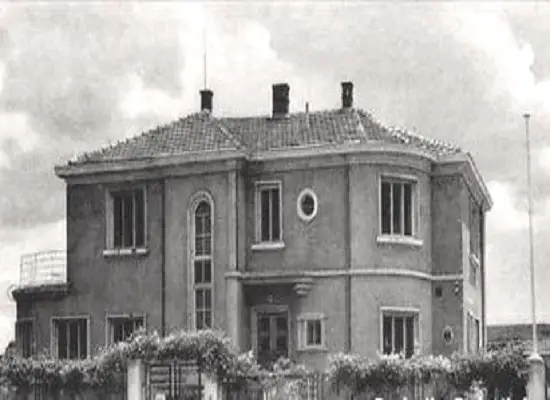
The data from the first article in “Stern” cannot be verified due to the lack of witness names. The witness mentioned in the second article, Karl Rudolf Hartz, was questioned at the Ludwigsburg justice headquarters. In all likelihood, his testimony was unreliable because it was not printed in the department’s final report and was not corroborated by other witnesses. In 1967, speculation that Müller, now retired, was living in the Albanian capital aroused renewed interest in the investigation. “Neue Ruhrzeitung” reported, citing the “Schwäbische Donauzeitung” published in Ulm, that Müller is in Tirana, in the villa of the university library director Mihal Hanxhari.
As a witness, the newspaper named Helmut Lill, an assistant during the escape, who, while in Italy, organized the “trip” of the Gestapo chief, under the name Gjergj Kovaçi, in 1949. For his services, he received about 400,000 lire in cash and revealed the information he knew under pressure from his wife. The persons who paid him and other details of the escape are not known. After the war, rumors about Müller’s whereabouts were also reflected in popular scientific literature, as evidenced by the reprinted special series: “An Illustrated History of the Resistance Movement in Germany and Europe”, which claims that Müller ran the communist secret service of the Albanian Sigurimi. On the night of November 3, 1967, two “armed” burglars, with a radio and camera, entered Frau Müller’s apartment in Munich, hoping to find evidence of the former Gestapo chief’s presence there.
Neighbors saw them, called the police, and they were caught. During questioning, it turned out that these were not ordinary burglars, but employees of the Israeli government. The first reactions in the press appeared on November 6. In the publications of the “Süddeutsche Zeitung”, it could be read that Müller’s wife, who lived at the address: Munich-Paseng, Munzinger Weg 4, was in the hospital at the time of the break-in. The political police launched an investigation into the case, because from the search of the arrested persons, they concluded that they were members of a “secret organization” operating in Israel. The Munich “Abendzeitung” did not need much effort to reveal the names of these secret agents. They were Baruch Shur (39) from Tel Aviv and Daniel Gordon (38) from Haifa.
A Munich doctor issued an arrest warrant for the two Israeli government officials, and lawyer Rolf Bossi took over the defense of the two. The Israeli diplomatic mission authorized a lawyer to conduct the defense. He told the press that their work style and the equipment they used showed that they were amateurs. Even Simon Wiesenthal made a public statement about the failed break-in. “They behaved terribly,” Wiesenthal told “Munich Abendzeitung”. He then explained to the tabloid press the new circumstances uncovered in the Heinrich Müller case, which he had already reported to the central department of justice in Ludwigsburg. Wiesenthal proceeded from the fact that Müller managed to escape from Berlin in 1945. He expressed doubts about his presence in Egypt and the existence of a contact in Munich.
In this regard, the newspaper tried to establish a connection between the “traces” found by Wiesenthal and the attempted break-in undertaken by the Israelis. During questioning, the arrested persons admitted that they had not acted on the instructions of the secret intelligence service, but according to their own considerations. After the Israeli Consulate General in Bad Godesberg was informed, the diplomatic mission was ready to pay a deposit of 15,000 DM per person. In the newspaper “Neue Zürcher Zeitung”, a representative of the Bavarian Ministry of Justice hinted at diplomatic disputes between Germany and Israel. It was also reported that the two Israelis were arrested on charges of participating in a criminal secret society, violating the inviolability of the home, and the law on foreigners.
The report in Abendzeitung went beyond the assumptions of the Bavarian lawyers. The editor sharply criticized the actions of the two Israelis, calling them a flagrant violation of the sovereignty of the Federal Republic. Neither sympathy for the victims nor understanding of Israel’s current problems can justify the crime committed. An article in the far-right “Deutschen National Zeitung” drew a parallel with the Eichmann case. Since 1961, Heinrich Müller had been wanted by the Berlin public prosecutor’s office with an arrest warrant already issued. For this reason, the best lawyer in Berlin, Spitzer, was interested in the arrested Israelis.
During one of the interrogations, one of the “thieves” let it slip that the action was not planned only by them. They had undertaken to carry out this task for one of the interested groups. After the interrogation, Spitzer expressed a desire to cooperate more closely with the Israeli authorities. Three weeks after the events, a Munich court sentenced the Israeli citizens Baruch Schur and Daniel Gordon to three months in prison for violating the inviolability of the home. They did not serve this sentence. According to a message from the “Neue Zürcher Zeitung”, the two Israelis returned to their country a few days after the verdict. Lawyers ordered the reduction of the prison term and the deportation of the Israelis from Munich prison.
In November 1967, the events surrounding the case of the Gestapo chief, Heinrich Müller, which caused a stormy reaction in the press, took a different turn. “Hamburger Abendblatt” mentioned on November 16 the arrest in Panama of a man suspected of being a “war criminal” by Müller. A man resembling the former Gestapo chief was arrested in Panama City, at the request of a Belgian, following an arrest warrant issued by German authorities. At that time, officials of the Berlin public prosecutor’s office were in Panama to check the double identity of the arrested person.
The Belgian informant, before contacting the German authorities, asked a graphologist to give him an opinion. An expert compared the handwriting on a document written by Müller with the handwriting of a man living in Panama and concluded that the two documents were undoubtedly written by the same hand. The Belgian also included numerous photographs of the alleged SS Gruppenführer, which showed an extraordinary resemblance to the Gestapo chief. In any case, Müller’s wife recognized her husband in the photographs, and a former friend found similarities only in one of the photographs shown to her. The Berlin newspaper “Tagesspiegel” talks about how the testimony was assessed differently in the press.
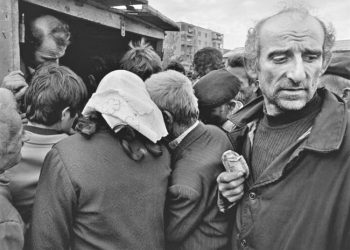
The newspaper wrote that Müller’s former wife, after seeing the photos, said: “Yes, it could be him.” “Bildzeitung” explains in more detail Müller’s long-time lover. The Berlin prosecutors were so confident in this case that they submitted a request to the Federal Ministry of Justice for the extradition of the arrested person in Panama, even though his identification was delayed. The Panamanian secret police presented to the public a few days later a man whose passport was issued in the name of Francis Willard Keith, born February 21, 1906, in Web City, Missouri. Keith sold sausages and cosmetics. The Panamanian passport for foreigners shows that he arrived in Panama on September 10, 1959.
“Frankfurter Rundschau” had the first doubts that Keith was the wanted Gestapo chief. The head of the Panamanian secret police, despite the similarities, did not believe that the arrested person was really the “war criminal” Müller. And Sophia Müller, the wife of the SS Gruppenführer, began to doubt this. The man from Panama had thicker hair than Müller at the end of the war. The investigations of the German public prosecutor’s office were hampered by the lack of fingerprints of the Gestapo chief. Despite the difficulties and doubts that arose, there was much evidence, for example, a message from the Federal Ministry of Justice that the arrested person was indeed Heinrich Müller.
As in all other cases of criminal prosecution of National Socialist war criminals, Simon Wiesenthal’s opinion was asked again this time. The head of the Jewish archive in Vienna said, however: “I think you have got the wrong man.” Wiesenthal’s suspicion was reinforced by information received from the Panamanian police. The diary kept by the suspect and witness statements confirmed that Willard Keith was already working in Panama in the early 1940s.
The police chief took as key evidence the fingerprints of the arrested person, taken from the known Francis Willard Keith, who worked in the Panama Canal Zone from May 20, 1942, to December 31, 1942. The investigation into the Keith case was officially closed by the German side after he was examined by two German experts. The experts found that there were no similarities. So Keith did not have the scars that Müller had after his appendix operation, nor did he have a tattoo indicating his blood group. The investigation into Heinrich Müller, which began in 1958, continues to this day. Memorie.al