Memorie.al / Those who have experienced the emotions of a long journey know well what happens when you have only one day left before you take off. But Doctor Selam Shkurti couldn’t care less about all that. They don’t say it for nothing: “stubborn as a Golëmi.” “Listen, don’t embarrass me in front of Alizoti’s sons, they want to meet you for a coffee. Leave everything else; they’re waiting for you at Kullat.” – That’s what the Doctor said and hung up. Remembering all those errands I had left unfinished, I grumbled. “Now Selam too, giving me an ultimatum”! My travel suitcases are still open on the sofa. He’s not to blame; I created this comfort for myself.
I have never refused him. We are bound by an old friendship – not just a circle of friendship, but comrades since childhood, classmates in high school, then both working in Gjirokastër and later in Tirana; until a few years ago when I ended up in Canada. I used to tell him jokingly: “Everything else is fine, but even the brides are from the same city, Selam”?!
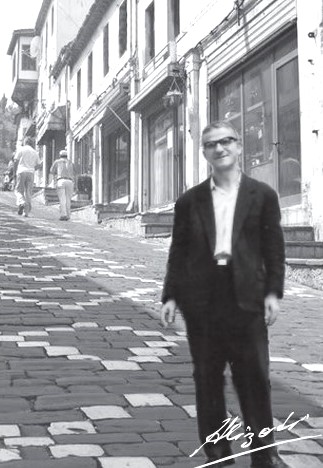
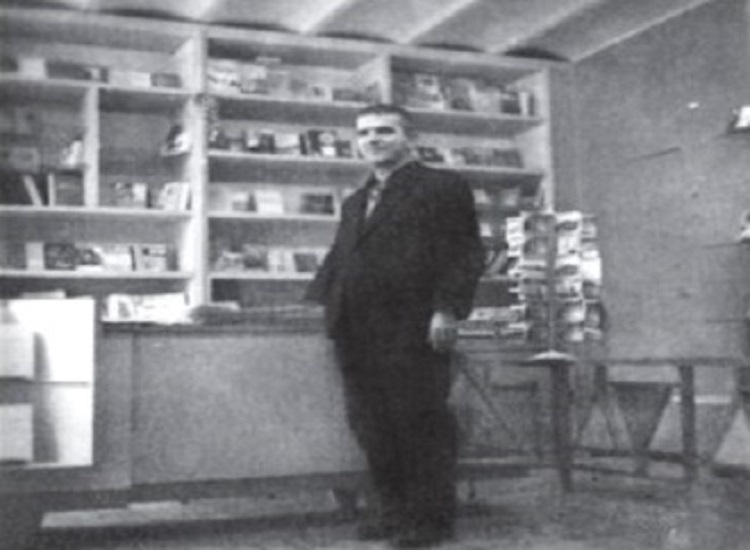
I rushed to get there on time. I owed great debts to the bookseller Alizot Emiri. Even though he has been gone for more than three decades, I can never erase him from my memory. When I was young, he nurtured my love for books, choosing them for me as if I were one of his own children. The first to arrive was Imja, the architect, with his daughter Klodia, whom I was seeing for the first time. The name Ibrahim Emiri, or Imja, as Selam’s close friends in Gjirokastër called him, has been deeply engraved in my memory since high school. Later I got to know him personally.
Not only Doctor Selam, but also the people of Përmet where he had worked, spoke of him only with praise. When we were in high school in Gjirokastër, I could never forget Selam’s “hammer.” “Imja told me so, Ibrahimi is the best in the class, he’s excellent in math,… yesterday I was at Imja’s house…! He has all those books…! Do you know who their father is? Alizoti, the one who has that bookshop down at the Market Pass…? You can’t imagine what a wonderful family they are!… But I don’t know… there’s something in their biography.” Biography!? Oh God, that’s the word that terrified and frightened me excessively in that period. My family in the village was considered to have a “shadow in their biography,” while Selam’s did not. He slept soundly. That stigmatized word had apparently sprouted even in the city, I thought.
“Maybe they had something to do with Zog’s government,” I told Selam. He never answered me, until I learned the truth from the biographical books written about the Gentleman by his sons. The Gentleman had been sentenced for agitation and propaganda against the people’s power. Even though we turned the conversation back to books, that word “biography” was like throwing ice water on the discussion that had begun so pleasantly. Selam knew my weak point: books.
Together, when we had just learned to read and write, we built our “library” from the planks of an old chest. I couldn’t believe my ears, and I was also envious of how Selam could have as a friend a city dweller and even more, a high school student with books at home, while I, even if I had a classmate from the city, he was originally from Kurvelesh – for a gun you might guess, but for books, you could never find one at his house.
When I entered Alizoti’s bookshop for the first time, I felt that I too had one more “right” because I was with Selam. I dared one day to tell the Gentleman what connected me to Selam. He looked me straight in the eye and said: “So you’re from Golëmi too, you’ve come down to the city, don’t think we Gjirokastrians will come to guard your sheep”?! Then he became serious and addressed me as if I were a grown man: “Selam is a close friend of my son.” That’s what I wanted, that’s what I was waiting for. “What book do you want?”
The Gentleman had won me over. I took courage and “as a friend” I said, “The Damned Daughter.” He laughed without taking the cigarette from his lips and said: “That book is a bit too soon for you, but I don’t think we get it anymore; you can find it in the city library, if you find it, friend of Vangjeli, the director.” At that moment I didn’t understand the Gentleman’s words, but later I learned that book had been removed from circulation. “But I have another even better one,” – he rummaged on the bottom shelf, placed a thick book on the counter – “here, this American one. It was written by a famous author, Theodore Dreiser. When World War II ended, poor Dreiser died too, but he left behind much beautiful work.”
We villagers are distrustful. Especially city people, we don’t trust them easily. When I saw the price and the size of the book, I thought: “He’s sticking it to me; it must have remained unsold and he’s pawning it off on me.” Nevertheless, I took it. I started reading it lazily. But the more pages I turned, the more ashamed I felt for what I had thought about the Gentleman. Before me unfolded another world, America, different relationships, but brutal; an ambitious boy, Clyde, and a simple factory girl, Roberta, but pure, humane, kindness itself. In the end, both died. A sad love story…! I returned to the bookshop after a week. I thanked the Gentleman warmly.
– “I know you liked the novel I chose for you. What other nonsense?” – he asked, looking me straight in the eye.
– “I’ll leave it to you.” – He quickly chose a much smaller book than the first. – “This one is titled ‘Little Jerry,’ but it was written by a great French writer. Written by the great Alphonse Daudet, this book is his autobiography.” I devoured Daudet in two days. The sweet style, the simplicity and grandeur of this author amazed me, especially the descriptions of nature and the village.
Then he recommended other writers: Maupassant, Stendhal, Balzac, Hugo, Remarque, Petro Marko, Flaubert, Zweig, etc. But my pocket couldn’t keep up, and I lessened my visits to the bookshop. Once I asked him for books by a Russian author, and he told me in an advisory but also reproachful tone: “Finish these French ones I’m giving you first, then we’ll see; forget about your Soviets.”
For four years in a row, with Spiro Deda from Zagoria, I was desk-mate, classmate, and roommate in the dormitory. Spirua was known as a literary figure because he had published a poem in the newspaper “Pionieri” back in 7th grade when his mother died giving birth to his sister. Books bound us more closely together. What we read, we shared with each other. When spring came, we would “escape” from the dorm room and climb up to the cafeteria terrace. We’d spread out blankets; get some biscuits and a jug of milk from the kitchen. That was our “cocktail.”
The assistant cook, Antigoni Kutra, gave us those things, of course “without permission” from the cook. And the latter, Uncle Kiço, a wonderful man, was Spiro’s father. We talked about writers, films, characters, and the descriptions of events we read. Spirua also had his “head” at Alizoti’s. – “Tell me, brother, how is it possible that the Gentleman knows the subjects of the books he has in the shop? Does he have time to read them all”?! – I asked once. – “Yes, I’ve been impressed too; he’s talked to me about a book before I bought it, and when I read it, it was exactly as the Gentleman had told me.”
– “But how is that possible”?!
We had no answer. It was an enigma. Finally we decided that the Gentleman did diagonal reading. I don’t know if Spirua invented that word “diagonal” himself to escape my suspicious questions, or if he had heard it somewhere?! But we didn’t know anything else. The Gentleman read in foreign languages, Italian and French.
After I finished high school, on a hot July day, I was heading to the cinema ticket booth when I heard a voice coming from the customers at Rrapi’s café:
– “You, Golëmas, come here, the Doctor is looking for you”! – It was the Gentleman’s voice; at that hour he was having coffee with Doctor Vasili i Madh. Shyly, uncertain, I turned towards their table. The Doctor, a large, well-built man, made room for me kindly, asked me about my studies, about the books I read, and what I intended to become. Then he said: “You’re from Ismail Golëmi’s village,” – he didn’t wait for an answer, but continued – “I had him as a friend, he was a wise and clever man. We used to go hunting together around the hills of Derven.”
“Oh, trouble,” I said to myself, “Ismail Golëmi was shot by the Party as an enemy, and this man here, in the shade of the plane tree in broad daylight, tells me he was a good man”! I turned my eyes to the Gentleman, but he was lighting a cigarette and was so focused on that trick that you’d think he hadn’t heard anything. – “Ah, Gentleman, do you know that I have a ‘shadow in my biography’!? Gather the Doctor; he’s gone out of his mind. And now, when I’m waiting to go to higher education, he tells me these things!? Tell him, what is all this nonsense”?! – These were the thoughts running through my mind as I stood in front of Imja and his daughter Klodia, who wanted to know as much as possible about her grandfather.
Soon Alizoti’s second son, Engineer Shpëtimi, arrived. Dynamic, explosive, and uninhibited in conversation. He resembles his father in character, especially with those witticisms on the tip of his tongue, but I don’t think he’s as calculating as the Gentleman. Maybe I don’t know him well. He let loose his first volley: “We sent you the book for free, you think we Gjirokastrians give things for free and you don’t write two words about your impressions”!? I threw a pleading look at Ibrahim, with whom I maintain correspondence on Facebook: “I wrote to Imja by message.”
Ibrahim nodded and I felt relieved, but Shpëtimi didn’t stop. – “You sent it to Imja? Why don’t you just admit we’ve got you cornered?” – The three of us laughed, Klodiana more so, even though her father was charged with fault. We were inside the atmosphere of the Emiri family. To lighten things a bit, I said: “Imja takes after Galua, (that was their uncle), he’s wise and calm, not like this fidget”! – “Well, now I won’t call you brother Ibrahim, but Uncle Ibrahim,” said Shpëtimi “very seriously.” Klodia’s gurgling laugh made customers at a couple of tables further away turn their heads toward us.
Just like the Gentleman, I also knew Galua well, the driver of the First Secretary of Gjirokastër. When I was a journalist for the local press, Galua, on the Secretary’s orders, would take me in the car to go “into the field where high yields of wheat and corn were being achieved.” During long meetings, Galua would go down to the Gentleman’s shop and in a corner of the bookshop, leaning against the wooden railings, read only the fourth page of “Zëri i Popullit.” Customers were rare, and the Gentleman would ask Galua from the head of the shop: “Hey, Galua, what does the press say”? – “China has issued warning 3144 to America.”
– “Come on, it seems like yesterday it was warning 3142, how did it get to 44, or do you count them in pairs”?!
– “No, no, they made two warnings in one day. Apparently one was in the morning and the other in the evening. The Americans haven’t withdrawn from the Vietnam war, neither with the morning one nor with the evening one.”
But one day the editor-in-chief of the newspaper gathered us in his office and told us that; “there are vendors who keep goods reserved for friends.” He mentioned the butcher, the cheese seller, and the Gentleman. This news affected me too. I was one of those for whom the Gentleman kept the literary newspaper “Drita” and all the new books. How could I let him know?
I returned to the shop and half-jokingly said: “Gentleman, you’re on the list of those who reserve goods.” – He could have said to me: “Get out of my shop; you’re one of those I reserve for”! But no. He turned dark in the face, lost his calm. It was the first time I saw him like that. – “Don’t scare me with such nonsense. Do you see these cobblestones of Gjirokastër? If your feet slip, you’ll never recover…! You’ll end up in the gutter, he must have told you”! – said Ibrahimi, continuing the Gentleman’s thought. He was right. His sons knew very well the mechanism of their father’s thinking. – “Reproachful, but also benevolent,” – said Shpëtimi, coming to his defense. The next day, worried that I was losing a precious friend, regretful, I returned to the bookshop. The Gentleman received me as usual, as if nothing had happened between us.
“You were right,” he told me, “that problem at the Party Committee was raised by an instructor who knows nothing about books.” – I was relieved. “Well, good, but how did you resolve it”? – “I told them that the great Lenin himself said that no one should be punished for stealing books; I don’t steal them, I told them, I don’t keep them for my friends, but I reserve them for friends of books. I can’t give books and newspapers to those who want to wrap cheese and tomatoes with them.” “Unbelievable, lucky Gentleman, he’s got them cornered,” I thought, contemplating him with admiration. But that advice about feet slipping on the cobblestones of Gjirokastër, I took to heart; I never forgot it, in fact I even told Doctor Selam about it some time ago.
Another time I noticed that the two brothers-in-law were no longer exchanging jokes and witticisms. Galua would approach the counter and the conversation was tense. I heard them talking about the sons. It stung my soul. Surely that terrifying word “biography” had cut off their path. The Gentleman was going from one committee to another. In the two volumes, “Alizot Emiri, the Man, the Bookseller and the Noble Spirit,” so beautifully bound, you find the drama of this family, Gjirokastrian from generation to generation, patriotic, but anathematized by the cruel theory of class struggle.
Alizoti’s sons have done research work showing their survival, but also the humor that had made the Gentleman so popular. Willingly or not, this sympathy and respect enveloped him in armor impenetrable by the communist regime. I couldn’t fully understand in those years how, in a stone house in the “Palorto” neighborhood, these wonderful boys were raised with difficulty, models for any time and period. In that short meeting, Shpëtimi gave me his book “Memories with a Smile on the Lips,” it is his life filled with humorous episodes. A book with salt and pepper. They don’t say it for nothing: “a chip off the old block.”
There’s nothing you can say to them; they have humor in their blood. It flows spontaneously like the water of Viroi. In my travel bag heading to Canada, I added a special gift: this book full of humor, color, and life. I am proud to be their friend. The second book about the Gentleman closes with an expression from me: “Unforgettable. The great Alizot Emiri. May his soul be light, just as he spread the light of knowledge and joy throughout his life”! It seemed too little to me; I still hadn’t repaid my debt to the Gentleman. As a sign of gratitude for the love he nurtured in me for books, even this much that I have written now, I think, is insufficient. / Memorie.al
Canada, February 2017