
The Guardian, June 16, 2008
– “The Paper Man”: The life and death of a footballer –
Memorie.al / As Austria prepare to play Germany tomorrow, Robin Stummer reports on the mystery surrounding the pre-war death of Matthias Sindelar, one of the world’s greatest footballers. Did the Gestapo kill him, did he commit suicide, or was it simply an accident?! A few seconds of film footage and spicy newsreels, a handful of brittle press articles, a street name, and finally, a grave like all the others. Such is the scant legacy of Matthias Sindelar – one of the greatest footballers in the world, the “Pelé of the pre-war years,” a sporting genius who not only ushered the game of football into the modern era but also completely snubbed Hitler during his rise. Many believe that the Austrian striker’s contempt for the Nazis would cost him his life. But has Austria underestimated the talent of Matthias Sindelar?!
In a small country not exactly overflowing with world-class sports heroes or high-profile anti-fascist martyrs, for this reason, Sindelar’s absence from Austria’s official past and present is somewhat strange. No statues, no stadium name, no posters.
No football academy bears his name; there has been no film, no exhibition, no plaque, and no new investigation into his suspicious death! A recent poll in Austria confirmed Sindelar as the country’s greatest sports star, yet football fans in the country, during the Euro 2008 competition, struggle to find any remaining trace of him.
It is an omission that even some Austrians, long accustomed to institutionalized oddity, find astonishing. “It’s a remarkable absence, an enigma, but also a real shame,” says Austrian football historian Dr. Erich Krenslehner, shrugging his shoulders. “For a huge star like Sindelar to have no memorial at all is very strange, a mystery…”?!
So why is a nation so adept at glorifying Mozart, Strauss, and Haydn, yet so incapable of embracing and honoring the memory of its greatest sportsman?!
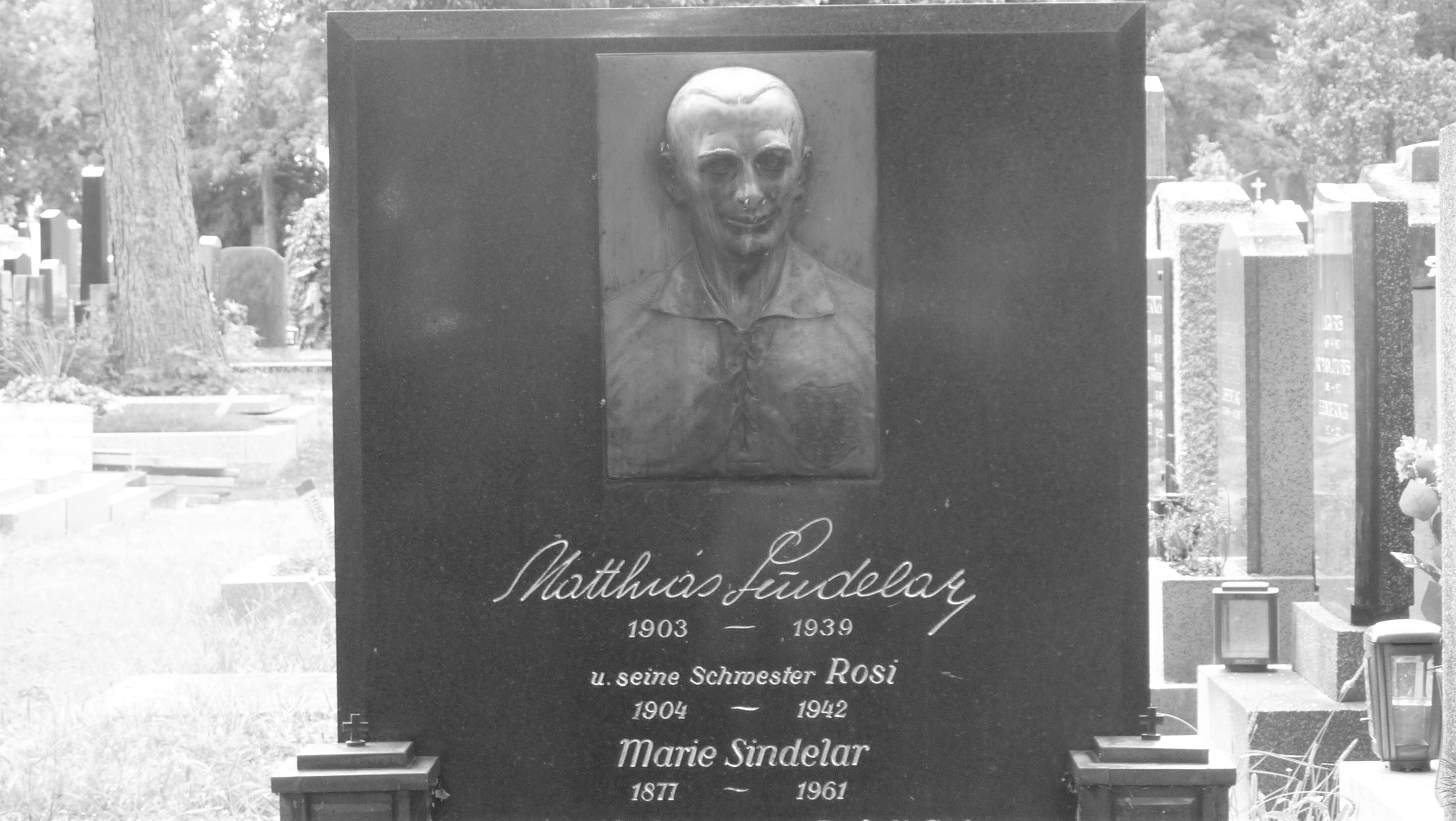
A bronze ball placed atop the marble slab on Sindelar’s grave in Vienna’s ‘Zentralfriedhof’ cemetery. His gentle face cast in bronze – the high forehead, receding hair, made of bright green metal, gazes from the headstone, between the dates 1903-1939. On the metallic green face, seven decades of rain have left dark streaks, from the hairline to the neck, looking like a ghost’s sweat after a match. There are no flowers!
Euro 2008 co-host Austria started the competition ranked 92nd in the world, but for the best part of a decade and within living memory, Austria was, alongside England, the most feared team in football. And they had their star player, none other than Sindelar.
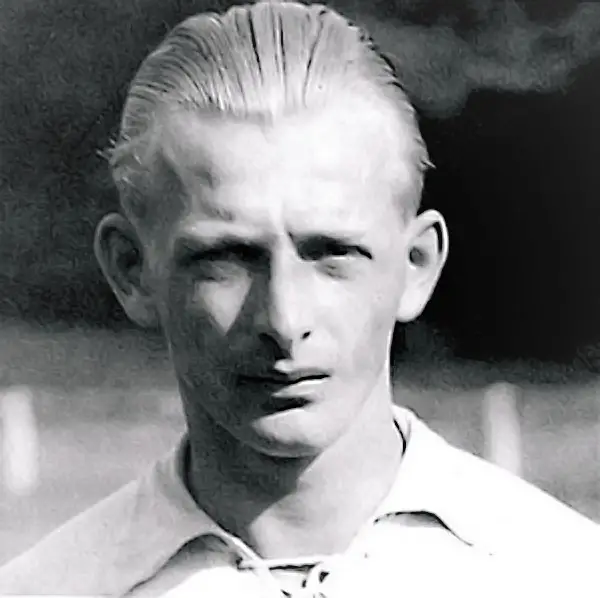
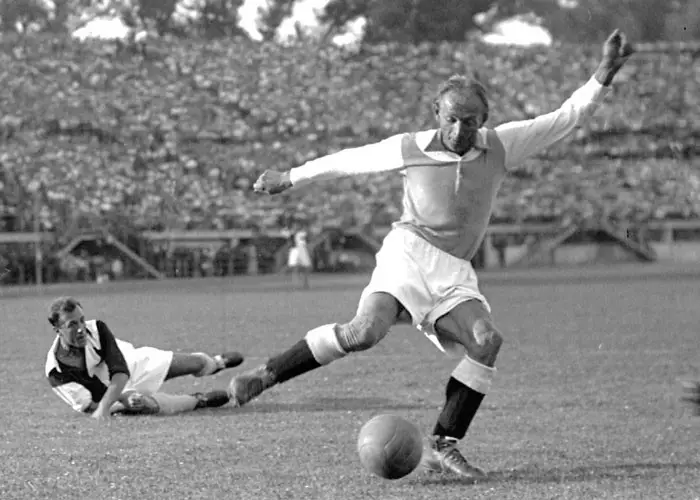
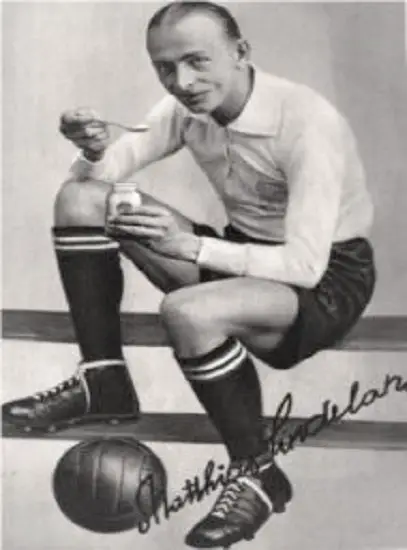
Matthias Sindelar was a Viennese whirlwind of speed and grace, an almost extraordinarily talented player who waltzed with strange ease around opponents. Sportswriters and commentators dubbed Sindelar, ‘Die Papierne’ – ‘The Paper Man,’ who floated across the pitch.
But for the Czech, Hungarian, and Polish factory workers, the dilettantes, and the bourgeoisie of the coffeehouse societies, many of them Jews, who flocked to see him play for his club, FK Austria Wien, he was their ‘Sindi’. And Sindi simply played his game like no one else.
Sindelar was a ‘new’ Viennese. His parents were Catholics from Moravia, now in the Czech Republic. He spoke the indistinct Viennese dialect, growing up in the poor suburb of Favoriten, a stronghold of the socialist left.
“In his speech, in his manner, he was an ordinary Viennese person,” recalls Franz Schwarz, the son of the president of FK Austria Wien from the ’20s and ’30s and now in his nineties, one of the few living people who met Sindelar, adding: “He had something very special in his talent; he was truly exceptional.”
Starting in the spring of 1931, with a 5-0 thrashing of Scotland, which at the time was one of Europe’s most revered teams, the white-and-reds would remain unbeaten for the next 20 international matches, putting 11 goals past the German goalkeeper in two games, without conceding any. All of Europe’s top teams were defeated. In December 1932, the team now called the ‘Wunderteam’ was ready to face the most powerful force in the world: England.
A crowd of 60,000 filled Stamford Bridge, while an even larger crowd gathered at Vienna’s Heldenplatz to listen to radio commentary. But the ‘Wunderteam’ lost 4-3. The British press hailed the newcomers: “The English team was lucky to win.” That was the verdict of the Manchester Guardian. “There could not be the slightest doubt that the (Austrian) team was superior. It was a victory and nothing more,” said The Times. “And it was by no means won easily.”
By the summer of 1934, Austria had won or drawn 28 out of 31 matches, although they were narrowly defeated in the World Cup semi-finals, losing 1-0 in Milan to the hosts and eventual winners, Italy. But Sindelar’s fame had even spread to the United States.
Sindi had started earning large sums of money; he spent it wearing expensive suits and driving luxury cars, gambling, and going out with…! The ‘Wunderteam,’ despite the World Cup loss, seemed unstoppable, but this was Europe in the 1930s.
Nazi ideologues liked international football. It was friendly to mass propaganda. And there was the prospect of inevitable victory. And after victory, a collective triumph of national sporting will. The problem was that the team of Nazi Germany was, at best, mediocre. But the Führer’s sports advisors had a plan.
One of the first acts of the new Nazi government in Austria, established after the Anschluss in March 1938, was the dissolution of the country’s professional football association. Jewish sports clubs were declared illegal, grounds were confiscated, players were banned, and club officials were dismissed.
Many fled abroad. Others fatally stayed. Austria would become the Ostmark, a province of the Reich. The national football team, which had qualified for that summer’s World Cup in France, would be annexed, the name ‘Austria’ would disappear, and players would be ‘invited’ to join the German squad.
Many players and officials acquiesced to the takeover, and some were enthusiastic, active supporters, but Sindelar, apparently, had his own ideas.
FK Austria Wien dismissed many directors, players, and officials because they were Jewish or suspected of being Jewish; among them was the club’s long-serving president, Dr. Michel Schwarz.
Those who survived the purges were instructed not to speak with dismissed colleagues. Sindelar refused. “The new club president has forbidden us from talking to you,” he told the highly respected Schwarz, shortly before the ousted president fled abroad, “but I will always speak with you, Herr Doctor.”
On April 3, 1938, a few weeks after the Nazis annexed Austria, the ‘Wunderteam’ took to the field for the last time against Germany. The match, at Vienna’s Prater Stadium (now known as Ernst Happel Stadium), was billed by the Nazi sports authorities as a ‘reunification’ derby, a 90-minute celebration of German brotherhood. It turned out to be one of the most extraordinary matches ever played.
Nazi propagandists ordered that the exhibition game should end in a draw. Sindelar, it is said, requested that his team be allowed to wear their traditional jerseys, not a new ‘non-national Nazi’ jersey, and that for this their final match, they would be known as ‘Austria’. The Nazis agreed.
The ‘Wunderteam’ spent the first half of the match trying not to score. Sindelar and Karl Sesta acted dumb, initially allowing the Germans to dictate play. The game’s numerous fouls continued into the second half. But around 70 minutes in, something snapped. Sindi struck the ball past the German goalkeeper into the bottom right corner of the net. The crowd erupted. Nazi officials watched in disbelief, as shortly after, Sesta blasted the ball from 45 meters into the German goal. Two-nil. At the match’s conclusion, the crowd of fans was wild, while, according to one account, Sindi ran towards the Nazi dignitaries and club officials and began dancing the waltz, all alone, smiling at them.
Ten months later he died…!
Sindelar’s final year was strange. Even as Vienna faced brutal violence and the ‘legal’ seizure of property from Jewish citizens, Sindelar apparently maintained close and public friendships with them.
Several times he was ‘requested,’ reportedly at the highest level, to join and train with the German National Socialist sports organization (fully Nazi). Again he refused, although eight former Austria players played for the German team that lost in the first round of the 1938 World Cup.
Was Sindelar aware, committing suicide, or was he simply playing another losing game? This time, fading quickly under the new order, it would have been easy to seek work abroad, as he had influential friends in English football. But his next move would be an unpredictable twist, equal to his on-field acrobatics!
In the summer of 1938, Sindelar, though in his mid-thirties, was still one of the best players in the world. He bought an old café, somewhere on a corner street with no competitors, and turned his back on football. The café’s previous owner, a Jewish acquaintance of Sindelar’s named Leopold Drill, was going bankrupt, as one of the many ‘legalized thefts’ occurring throughout the city due to Nazi intervention. The player reportedly stepped in with a cash offer to buy the business, an amount much smaller than the sum offered by the local Nazi party bureaucrats.
The deal was done. Sindi slicked back his hair and quietly served beer and coffee to his old comrades. The Gestapo kept the café under surveillance, noting that its new owner was friendly with all customers, including Jews. About half the clientele were Jews, the Gestapo estimated, and consequently, he was denounced to the relevant Nazi bodies, based on the fact that Sindi was ‘unacceptable’ to the Nazi party.
So, on January 23, 1939, a friend, worried he hadn’t seen Sindelar for some time, forced his way into his apartment on Annagasse, in the city center. He found Sindelar dead in bed. Beside him was his latest girlfriend, who remained unconscious for a few more hours. Sindelar was only 36 years old.
The police investigation concluded that the couple had died from carbon monoxide poisoning. It was discovered that the chimney flue was blocked, and poor maintenance was blamed. Few believed the official version.
More than 20,000 people attended Sindi’s funeral, which was, in a way, Vienna’s first and last gathering against the Nazis. But in other respects, it was nothing more than a farewell to a local hero. This ambiguity is at the heart of Sindelar’s story, a Viennese trait then and now.
The classic British film “The Third Man,” filmed partly amidst the bombed-out sites of the Austrian capital nearly a decade after the player’s death, brilliantly captured the city’s mood and manners: shadows, secrets, and whispers. The whispering and mystery continue.
Some facts about Sindelar are intertwined with rumors that still circulate in Vienna. Take the police report on his death, “lost in the war,” says the Austrian national archive. No, difficult to find for reading there, say some historians.
Or Sindelar’s café was bought by the Austrian football star at a fair price to help its fleeing Jewish owner, say some others. No, “stolen” by an opportunist like Sindelar for a fraction of its true value, say others!
Or the player’s death was clearly murder, many others believe. No, it was suicide; argue some, an act of despair over Austria’s fate, a theory popular among the left-leaning coffeehouse literati who idolized him. Or a gangland hit related to the Viennese star’s supposedly large gambling debts. Or murder at the hands of his girlfriend, who then poisoned her. Or a Gestapo killing to prevent Sindelar from embarrassing the Reich by fleeing abroad. Or, it was simply an accident.
And regarding Sindelar himself, Vienna’s rumor mills continue to churn.
“He was actually Jewish and not Catholic, but kept it secret,” has been written recently. “Only one percent of him could see how things were going,” said another. The building that once housed Sindelar’s café was quietly demolished a few years later.
In the few seconds of footage of the footballer, a brief glimpse of Sindi is expressed as a delicate, intuitive player with a kind face, which is undoubtedly everything. And a face that, for whatever reason, is all that survives of “The Paper Man.” Memorie.al
Translated by Sarah Molla