By Ali Buzra
Part Twenty-Eight
– LIFE UNDER PRESSURE AND SUFFERING –
(ASSESSMENTS, COMMENTS, NARRATIVES)
Memorie.al / At the request and wish of the author, Ali Buzra, as his first editor and reader, I will briefly share with you what I experienced in this encounter with this book, which is his second (after the book “Gizaveshi në vite”) and which naturally continues to develop his writing style. The sincerity and frankness of the narrative, the simple and unmodified language, the accuracy and precision of the episodes, or the absence of a subsequent, intentional, elaborative imagination or its non-utilization, I believe have served the author positively. He comes to the reader in his original form, inviting us to at least get to know unknown human fates and pains, whether by chance or not, leaving us to reflect as a starting point for raising awareness towards a catharsis so necessary for the Albanian conscience.
Bedri Kaza
Continued from the previous issue
In Qarrishtë, in the month of April, it was still cold, and I had gotten chilled outside. We all sat around the large low table, about 20 people. After we all sat down, Mefail glanced at everyone, seeing how we had taken our places, and stopped his gaze on me. I was the only child there. “That boy will come here to me,” he said, and gestured with his finger, telling me, “come!” I got up and sat next to him. We were all sitting cross-legged, one behind the other. It wasn’t difficult for us to sit like that, as we also sat that way in our homes.
At that time, in our villages, tables for eating weren’t known, but only the low sofra [a low dining tray/table]. The large tray was a bit far from me, and I could barely reach it with the wooden spoon I was holding. Apparently, he knew this and that’s why he took me next to him. Laughing, he pulled the tray closer to me, saying; “the rest of you can reach, this old man and this little one need more service.” I felt a bit ashamed, but hunger had taken over me, and meanwhile, he urged me to eat. Everything had a special taste, but especially the gjiza (fresh cottage cheese) made with butter, which was served first, was wonderful. I wouldn’t have wanted any other dish besides that, but I felt shy to say so.
When people stopped eating, one of those present, according to custom, would move the bowl or tray, while he continued eating, politely telling them; “don’t move it, you come from far away and are tired, you should eat.” At the end, a bowl of honey was placed. “You’ll finish this one for me,” he said. He was truly very generous and hospitable. I have never forgotten that delicious lunch, at the generous *sofra* of Mefail Biçaku in Qarrishtë.
When I came home, my father asked me where I had been for lunch. I told him in detail. My father listened attentively, but didn’t tell me anything about him having been imprisoned; only that he was an old friend of ours. The ’70s-’80s, as I have described in other chapters, were the most “active” for the dictatorial regime. The wave of arrests swept the entire country. The family of Mefail Biçaku would not be left in peace again. In 1978, they arrested his second son, Burhan, a simple, hardworking, and righteous man.
In the brigade where he worked, without any ill intent, he told a dream he had seen during the night: As if he went to Greece on a white horse and saw Athens, which, he recounted, was a very beautiful city. Burhan was 48 years old at that time, had a bunch of children at home, whom he supported with great difficulty only through his work in the cooperative. They held him for several months in investigation, just like his father 15 years earlier, under pressure and some of the most brutal tortures. They brought him to trial, where six witnesses, manipulated by the Sigurimi (State Security), testified about the “hostile dream.”
He was sentenced to 7 years in prison, which he served in Ballsh. Family members who went occasionally to visit him recount the terrible conditions of the Ballsh camp. The scorching heat there took dozens of prisoners’ lives. In 1982, he benefited from an amnesty and was released after serving only four years. He came back to his family, but he was already ill. His health condition, despite the care shown by his family, did not improve. He passed away nine months later, at the age of 51. In the multitude of communist political trials, this was also a case where a man is punished, even for the dreams he sees at night in his sleep.
In my book, it is not possible to present or describe all the cases of arrests for political motives in the eight respective villages, as I have mainly described the most typical cases, for which I was able to obtain testimony from the individuals themselves or their relatives. I apologize for those cases, which are not few, but which I personally was unable to contact. It remains a task for the future, not only mine, but also for other history writers from the respective villages to reflect them.
– THE DESCENDANTS OF THE MUZAKAJ UNDER DICTATORSHIP –
7.1 The Muzhaqi Clan, an early history spanning years and centuries. Offshoots of the Muzhaqi clan make history.
The Muzhaqi clan is thought to have its origins in the Muzakaj family. This noble feudal family, strengthened and consolidated in the 13th-15th centuries, was distinguished for its resistance against the Angevin invaders of Naples, against the establishment of Serbian rule, and later against the Ottoman Turks. Junt and Teodor II Muzaka participated with their forces in the Battle of Kosovo in 1389. Teodor Koron and Gjin Muzaka took part in the League of Lezhë in 1444. The latter was a close collaborator of Skanderbeg.
Their family also produced chroniclers such as Gjon Muzaka, whose chronicle provides data on Albanian medieval history, especially for the period of Ottoman rule. Gjon Muzaka’s “Memoria” is considered an important document written by a contemporary of Skanderbeg. After the wars led by Gjergj Kastriot Skanderbeg, like many other feudal families, the Muzakaj settled in Naples; meanwhile, those who remained here, or offshoots of this family who returned to their former properties, stayed in Berat, Myzeqe, Elbasan, etc.
In the writings of scholars Lazër and Josef Radi, interesting data are given on the origin of the Muzhaqi clan. Thus, from the oral traditions of the elders of Vilan, it appears that all the bearers of this surname; in Elbasan, Gurshpatë, Rrfshe (likely a typo for Rafje?), Fushë-Buall, etc., are branches of the same clan. According to some recent interviews regarding this clan, the first of the family lived in Berat and had properties in Lushnjë. Then it is said they moved to the Kavajë area, and from there they came to Labinot. Here, according to testimonies, there were three brothers: Ahmeti, Qerimi, and Limi. From data obtained from the elder, Sheme Muzhaqi, it appears that Ahmet’s son, Hasani, along with two brothers, settled in Polis i Vogël (Little Polis).
Vilan is located in the mountainous area of Polis. It is distinguished for its climate, waters, and vegetation, very suitable for livestock farming. Until around the middle of the 19th century, in the years 1840-1850, this mountainous territory served as a stopover and breeding ground for livestock in the summer season, where residents of some surrounding villages set up their summer sheepfolds. Approximately around this time, maybe around the year 1870-’80, Hasan Muzhaqi, together with his two brothers, Zenun and Dule, went up to Vilan with their families and decided to live there. For this purpose, Hasan bought land, expanding the territories and converting some pastures into grain-producing lands.
After him, Hysen Muzhaqi, a distant cousin of his, also went there. At the beginning of the 20th century, the descendants of Hasan Muzhaqi became seven households, while Hysen Muzhaqi became three. The settlement in Vilan began to expand again. A family from the Tanushi clan also came there, from the village of Polis Qendër. Hasan Muzhaqi had seven sons: Sherif, Sadik, Mehmet, Musa, Rexhep, Azis, and Qazim. In Vilan, the family’s economy grew significantly, increasing livestock. The number of small livestock heads could have been over two thousand.
The agricultural and livestock work was done by the men of the house, but they also kept servants. The women of Vilan were masters of dairy processing. They also worked wool, making carpets, and cut and sewed traditional clothing for men and women. Hasan Muzhaqi, who was called “Hasan Aga” or “Hasanai,” was and remained a leading figure in the Polis area. He was known as an intelligent, prudent, loyal man and a leader of regional assemblies, playing an important role in connecting the region with the governments of the time.
From oral sources, it was said that Hasan Muzhaqi presided over the Polis region, while Osman Çota presided over Çermenika. Hasan Muzhaqi is mentioned as an important figure of the anti-Ottoman resistance, on the eve of the Declaration of Independence. During his activity in the interest of the national cause, he collaborated with the Blloshmi family in Bërzeshtë, which is historically known for its distinguished patriotic and freedom-loving activity during the period of Ottoman rule and after. Songs have also been sung about Hasan Muzhaqi, highlighting his figure as the leader of the Polis region in the war against the invader.
The Song of Hasan Agë Muzhaqi:
“Ku e bëre ferk, o/ për herë të parë/ Dede bej, o Stavovar/ Openo polit te Hasan-ai/ Dede bej o Stavovar/ Për një kosaxhi, u vranë dy xhandar/ Ky Sherif Muzhaqi qenka kumanar/ Dede bej, o Statovar/ S’pate pamur trima, trima polisar”. *(Translator’s Note: This is a folk song; a direct translation would lose its poetic form and historical context. The following is a rough meaning: “Where did you make your first stand, o / Dede bey, o Stavovar / They open the regions to Hasan-ai / Dede bey o Stavovar / For a yogurt-maker, two gendarmes were killed / This Sherif Muzhaqi is a godfather / Dede bey, o Statovar / You haven’t seen brave men, brave Polisar men.”)
This event refers to the years when Hasan Muzhaqi was imprisoned by the Ottoman authorities, while his sons went into hiding. They, in collaboration with Shaban Blloshmi, ambushed Turkish garrisons. The latter went up to Polis and killed a servant of the Muzhaqis who was mowing. In the fighting between the Ottoman garrison, commanded by Dede bey Starova, and the Muzhaqis led by Hasan’s son, Sherif Muzhaqi, two officers, whom the song calls gendarmes, were killed and another was wounded.
The Muzhaqi clan was in a blood feud with the Zharri and Cekani clans for some time, but this did not last long. In all three aforementioned clans, there were wise and noble men who found bridges of reconciliation, and later formed friendships, taking bribes from one another. In the family tree of Hasan Muzhaqi, 35 sons were born. Thus, Sherifi, his eldest son, had 7 sons, Mehmeti 7, Sadiku 7, Musai 4, Rexhepi 2, Azisi 4, and Qazimi 4 sons.
On the eve of the Fascist invasion, the number of males in their families, including parents, reached 41, most of who, after the liberation of the country, were imprisoned, killed, and persecuted by the communist regime. And this is no coincidence. Now a known and repeated case, we will see that this clan too, with its early roots and traditions, will experience, will find itself in the same situations.
2 Nezir Muzhaqi, one of the main figures in Polis and beyond. His formation and role.
One of the main figures in Polis, and not only there, during the period of the Anti-Fascist War, was Nezir Muzhaqi. Neziri was born in Vilan in 1917, into the large Muzhaqi family. He was the second son of Mehmet Muzhaqi and Hatixhe. In 1924-’25, he started primary school in Elbasan, staying at the home of Qerim Muzhaqi. Afterwards, he attended the Korça Lyceum, which he finished with excellent results.
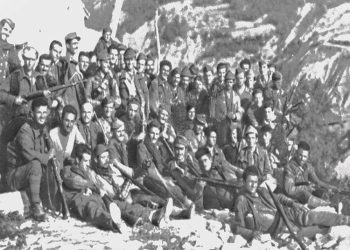
In 1940, he was in France for studies, but due to the war, he did not complete them. He returned to his homeland, participating in the anti-fascist resistance. He was a participant in the anti-fascist demonstration in Korça, where it is said he was wounded. Neziri began organizing his own guerrilla band (çeta) around mid-1942. His band consisted mainly of peasants from Polis, but also from Labinot, Shushicë, etc., reaching about 60 fighters.
After the Balli Kombëtar organization was created, he, like many other nationalists, joined it within the framework of the anti-fascist war. From the information we have, both from contemporaries and from documentary data, it appears that his band, as well as Neziri himself, served the fight against the Italian fascists and the protection of the Polis area from reprisals. Nezir Muzhaqi had friendships with Abaz Ermenji, who had been his professor, with Kadri Hoxha, Sami Baholli, etc.
Like many other patriotic intellectuals of the time, he had reservations about the Albanian Communist Party, seeing it as a dangerous factor for the homeland and the nation. However, he never entered into armed conflict with the partisan forces led by the latter, despite their provocations and looting actions in Vilan and Polis. In the summer of 1943, Neziri participated in the effort of Mirakë, against the Italian fascist forces.
In August of that year, he organized the attack on the Italian forces at the Babja barracks, routing them, and seized weapons and ammunition depots. At the end of August, or beginning of September 1943, he was the one who averted a possible armed conflict with the partisan forces of the First Assault Brigade. This happened after Mehmet Shehu, the commander of the First Brigade, coming from Sopot towards Mirakë, passed with his partisan forces through Polis, significantly damaging the peasants’ crops. They released their pack animals during the night into the planted fields, and also forcibly took goods from their homes.
This was not a spontaneous provocation, but because Polis was an area associated with Balli. That night, Neziri was not at home. When he came back the next morning and was informed about the devastation done to the peasants’ crops, as well as their looting by the partisan army, he confronted the Brigade at Qafë Dardhë in Gurshpatë, at a place called “Stani i Poçit” (Poçi’s Fold), and stopped it. He told Mehmet Shehu that it was not good to commit fratricide, because they were supposed to be fighting against Italy, not amongst themselves, and that they had damaged produce and taken goods by force.
He knew that at his own house, partisans had taken whatever they found; nevertheless, he told Mehmet Shehu that he would allow them to pass and that as far as Mirakë, they were under his protection (besë). Thus, to avoid the conflict ignited by the partisan forces with the residents of Polis, who were very irritated by the looting actions, Neziri allowed them to pass, telling them that if it were repeated, they would not tolerate them anymore. Mehmet Shehu, known for his vengeful and violent actions, would not forget this “insult” made to him by the Polisar men.
After the breakdown of the Mukje Agreement, and with the start of the war between opposing forces in Albania, Nezir Muzhaqi did not get involved in the fight against the German forces. He, like many other intellectuals of the time, being conscious of the communist danger in Albania, and convinced of the temporary stay of the Germans in the country, connected with the Regency government in Tirana. After the liberation of the country, the communist dictatorship was established in Albania.
In 1948, an agreement was about to be signed between the Albanian Government and the Yugoslav one, for the inclusion of Albania within the Balkan Federation, headed by Yugoslavia. For our good fortune, the disagreements between the Communist Party of the Soviet Union and the Yugoslav Communist Party in 1948 had reached their peak. In these difficult moments for Albania, Stalin sent a letter to all communist parties in the region, criticizing the Yugoslav Communist Party and accusing it of having deviated from the Marxist-Leninist line.
This letter also reached the Albanian Communist Party. Enver Hoxha, who received support from the Soviet Union, in the circumstances created, broke off relations with the Yugoslavs, securing personal power, while the danger of unification with Yugoslavia was eliminated. This was not a merit of the Communist Party and the Albanian Government, but happened more due to the divergences between the Communist Party of the Soviet Union and the Yugoslav one, which made it possible for Albania to escape the clutches of the latter.
Meanwhile, there has never been, and is not, any fact to prove that Nezir Muzhaqi collaborated with the Germans to the detriment of national interests. On the contrary, there are examples and testimonies proving that he, and Ali Cekani, a Balli commander in the village of Gurshpatë, helped and saved the lives of partisans. Nezir Muzhaqi himself mediated for the release of two people from Labinot who had been arrested. In June 1944, he went as guarantor and Demir Lulja, Makbule Baholli, and Qemal Zaimi, who were being held under arrest, were released by the Operational Command of the Gendarmerie.
At the beginning of 1944, Dhimitër Shuteriqi was ill in the “Druni” neighborhood in Kala. The neighborhood was surrounded and under control. Dhimitër’s mother went to Ali Cekani, who had an office in Elbasan, and asked him for help to save her son. The latter asked Nezir to make his rescue possible. Nezir himself, considering the risk, entered Shuteriqi’s house, took him, and dressed in peasant clothes, they got him out of the house and placed him in a car. Together with Ali Cekani and seven Balli Polisar soldiers, they accompanied him to Mirakë.
Along the way, at a checkpoint, they were stopped, and everyone was ordered out of the car. Neziri, who was following behind in another car, intervened, telling the checkpoint guards that there was no need to search the Ballists. Thus, they took him to a friend of his in Polis, where he stayed until he recovered. Dozens of times he went to the Operational Command to release people from Mokra, Bërzeshta, etc., who had been captured during the German Operation of June 1944. / Memorie.al