Part Twenty-Two
Excerpts from the book: ‘ALIZOT EMIRI – The Man, the Library, and Noble Wit’
A FEW WORDS AS AN INTRODUCTION
Memorie.al / When we, Alizot’s children, used to tell “Zotia’s” (Alizot’s) stories in joyful social gatherings, we were often asked: “Have you written them down? No? What a shame, they will be lost…! Who should do it?” And we felt increasingly guilty. If it had to be done, we were the ones who should do it. But could we write them?! “Not everyone who knows how to read and write can write books,” Zotia used to say whenever he flipped through poorly written books. When we, his children, discussed this “obligation” – the Book – we naturally felt our inability to fulfill it. It wasn’t a job for us! By Zotia’s “measuring stick,” we were incapable of writing this book.
Continued from the previous issue…
POSTCARDS
It was the era of postcards. Zotia sent many New Year’s greetings. He made sure not to forget any friend or companion, to never remain “in debt.” Besides simple joyful wishes, he crafted many greetings with entirely unique formulations – full of teases, allusions, and double meanings – but always with humor and a “pre-paid response” that was sure to follow.
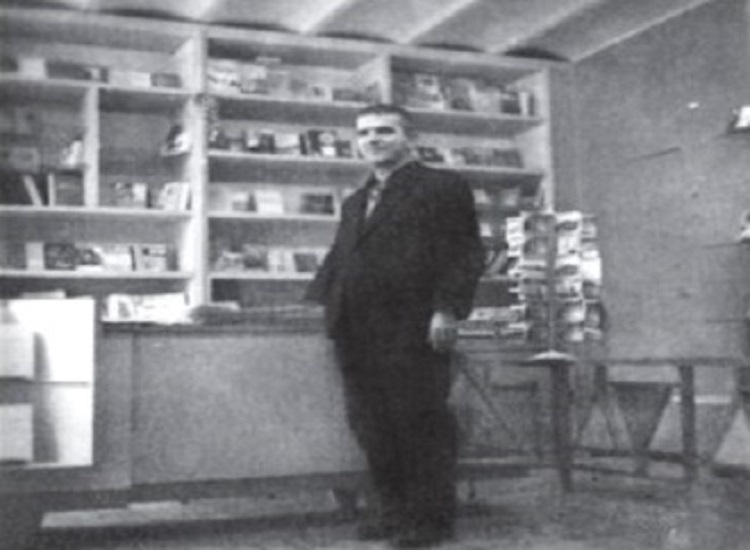
After the New Year, once the postcards reached their destinations, the “counter-attacks” would begin. The “paybacks” arrived, which Zotia eagerly awaited; the thank-yous came, and those “captured” by Zotia’s postcards would arrive “alive” straight to the bookstore and force him out for coffee…! The teasing continued, they laughed from the soul, and in those moments, Zotia felt happy. He often left me in the bookstore when he went for coffee with friends, so I could fill in and keep it open.
Zotia’s postcards must have been an archive of Gjirokastra wit. Naturally, we didn’t have the cards Zotia sent, but at home, we had the ones sent to him. Countless ones. In many of them, the text was a response to Alizot’s original messages. There was so much gratitude in those texts, so many memories, love, and emotion – and humor was never lacking. A large portion of them were written in Italian.
We looked with curiosity at the addresses: Naples, Rome, Milan, Venice, Turin, Genoa, Bologna, Bari, Brindisi, Padua, and Palermo… from all over Italy. We knew that between 1938 and 1943, Zotia traveled constantly to Italy for trade. We kept those postcards until the 1960s. They were in the cellar (katoqi) of our house in “Palorto.” We couldn’t keep them. We destroyed them upon Zotia’s order during a period when he believed they were planning to imprison him again. He thought they would raid our house, just like the first time. There were hundreds of postcards.
We remembered the postcards in the 1990s, when we needed a point of contact in the West. We needed the addresses. Zotia had passed away in 1983. Anyway…!
The Donkey Postcard
I was small when Dr. Vasili the Elder sent him a postcard depicting a donkey’s head. On the back, he had written a very serious greeting. Of course, the Doctor had taken measures so that when the postcard reached Zotia at the bookstore, several of their friends would be there to enjoy his immediate reaction.
The postcard arrived in an envelope. Zotia opened it, took out the card, saw the donkey’s head filling the entire frame, smiled, turned it over, recognized the Doctor’s handwriting, and began to read… one of the friends shouted:
“Let’s see it, who sent it to you?” – and they snatched it from Zotia’s hand. They all burst out laughing. “Why would he send you a donkey’s head? This must have a meaning! The Doctor doesn’t do things without a reason. He’s giving credit where it’s due,” the bystanders continued. “This needs no explanation. It’s clear. Postcards transmit certain symbolisms. For example, young people of marriageable age are sent cards showing a couple kissing or exchanging rings. Thus, a card is chosen to fit the person it is addressed to – to resemble who they are today or represent their future.”
“But what symbolism does a large donkey’s head represent when directed at a person?” one of the Doctor’s friends asked loudly, making sure Alizot heard. “Oh boy, things are taking a bad turn,” Zotia thought, “I shouldn’t let them continue like this.”
“Ah, you’ll find out soon enough,” Zotia interrupted their game, which was being staged by the Doctor, “as soon as the Doctor opens the postcard I sent him by mail. Thank goodness you’re here, so you can tell him not to tear it up, and if possible, come back here together with him.”
The next day, they came to the bookstore with the Doctor. They had received Zotia’s card, which he had sent to the hospital that night. They were laughing even before entering. The text was read again in everyone’s presence:
“I thank you from the bottom of my heart, Doctor, for remembering to send me a copy of your latest photograph. It cured my longing for you! You came out very well, very natural, as you truly are. I’d rather see your photo than you. But you made me worry; you looked a bit thin. Don’t skimp on the grass, I’ve told you! Hugs, Alizoti.”
They laughed loudly and, as usual, went out to “sip” their daily coffee. Zotia told them how he had hand-delivered the card to the hospital at night.
“But the donkey postcard, the Doctor’s one – why did you display it on the bookstore shelf in the most visible spot?”
“I’m not over the longing yet! Besides, many people ask me about it. ‘What is this?’ they say. ‘He’s my close friend,’ I tell them. They laugh, they don’t believe it! Strange, right?!”
Like the Pope of Rome
One New Year, they sent him a postcard featuring a photomontage. They had taken a photo of the Pope in the Vatican Cathedral and replaced the Pope’s head with Zotia’s head. Thus, Alizot appeared to be the Pope of Rome. Zotia kept this card at the counter and showed it to all his friends.
“Look what they’ve done to me! If they had made me a Hoxha (Muslim priest), fine, I’d accept it. But they’ve even changed my religion without asking?!” I used to help Zotia regularly in the shop. His friends would tease me, show me the photo, and ask: “Do you recognize your father? Where was he here? Look at how he’s dressed…!”
Zotia went around trying to find out who did it. The card had no return address. He suspected the photographers of Gjirokastra, the brothers Jorgo and Filip Vito, who had their studio just ten meters from the bookstore. They were good friends of his. He sent word and asked if they had made it. They denied it, laughing at him.
“Who could have done it?!” they asked in front of Zotia. “No, we cannot produce such a photomontage…” Zotia looked at them with suspicion.
Two days later, Zotia sent a friend who was part of their circle but had good relations with the authorities. He went to the photo studio and whispered to them that a photo of the Pope with Alizot Emiri’s head was being analyzed at the Department of Internal Affairs (Dega). “I’m telling you beforehand, because they might summon you.” The brothers thanked the friend for “risking” a secret conversation to help them. As soon as he left, the photographers became very worried. They wanted nothing to do with the Dega.
“Just what we needed! We started a joke to tease Alizot and opened a dangerous door for ourselves. Now what? Did Alizot complain himself? Why didn’t he come to us instead of going straight there! No, impossible. Zotia wouldn’t want to deal with them either. Why don’t we go ask him?” And they went. Zotia was waiting for them. It was his turn for a “response”!
“Alizot, that photomontage you showed us… it ended up at the Dega.”
“I know,” Zotia replied with a worried look.
“Who took it there?” they asked.
“I did,” Zotia said calmly. “What else could I do? I thought it better to go myself than to be summoned and told: ‘Why haven’t you reported that Catholic propaganda – the Pope himself – is being promoted in a state bookstore, when religion is banned by law?'”
“Listen, I was worried that you had made it, but since you told me you had no hand in that ‘donkey business,’ I felt relieved. It must have been one of those ‘donkeys’ from Tirana, I told myself. But how could people be so thick? They couldn’t find another photo? They had to use the Pope! Didn’t they think everyone would see it? Because that’s why they did it – so many people would see it and laugh at me. Curse them. I wondered who did it, why they did it, what they wanted. What if it wasn’t a joke, but a ‘bait’ to catch ‘fish’? After all these doubts, I finally decided,” Zotia said with relief:
“Better to report it and let the person who ‘cooked’ this business lose sleep. I felt safe once you told me you didn’t do it. Now, I’m standing tall, and I can’t wait to show the photo to everyone. I’m the only Muslim to become Pope! And it had to be from Gjirokastra! They couldn’t find anyone better than me…” Alizot was joking now, his color returning to his face, while the photographers were turning pale.
“Zote, you’re in high spirits, but we haven’t slept for two days because of this.”
“Why, what happened to you? It’s easy for you,” Alizot calmed them. “They will ask you, and you will explain that you didn’t do it, just as you told me. Period, end of story.”
“No, Alizot, don’t you understand yet? We did it!” the photographers burst out impatiently, deeply worried. “We talked about it with the Doctor and…! We said we’d tease Alizot for the New Year because he’s been rattling our heads all year. We didn’t think it would roll downhill like this. Now the problem is to clarify it with the Dega so they know it was just a joke. Who can we ask to solve this?”
“Well, you rascals,” Alizot said, “why did you act so stiff when I asked you? Just know that I’ve settled my debt with you!”
“How we fell for it this time, even we don’t know… Zote, nobody can fix this better than you.”
“Yes,” Alizot sighed, “now I have to solve the world’s problems too, since I’ve settled all of mine! But on one condition: I won’t spend my life dealing with you. Promise me that from now on, you won’t do such ‘immature’ things; they are unforgivable. You are grown men,” Zotia teased.
“How will we close this business?” the photographers asked, having no appetite for Zotia’s jokes.
“To untangle this mess, it’s worth spending some money,” Alizot said heavily, “but for you, since it’s your first time and others led you astray, we’ll settle it with a coffee. Come, let’s go sip one together,” Alizot calmed them, and they went for coffee. The photographers laughed and remembered that joke for a long time in Gjirokastra.
“I Will Be Yours!”
He received a New Year’s greeting card with symbols of love but without the sender’s name. The handwriting was beautiful, a woman’s hand, and at the end, it said: “If you find out who I am, I will be yours!”
Zotia analyzed who could have written it. He didn’t discuss it with anyone because he thought his friends might have staged it. After a few days, he was convinced it wasn’t his friends’ work. He had tested them without showing the card. So, the card was from a girl. Who could it be? It was rare for girls to make such jokes in Gjirokastra at that time. A few days later, Zotia recognized the sender just by the way she greeted him as she passed the bookstore.
Zotia wanted her to come to the bookstore, where he was on his “home turf,” where humor could continue in front of the public that was always present. But no! She thought Zotia hadn’t discovered her yet and wanted to prolong Alizot’s “suffering.” Zotia was about forty at the time.
One afternoon, during the traditional stroll from “Qafa e Pazarit” to “Çerçiz Square,” the sender passed by with her sister on her arm, laughing, in front of the bookstore windows. They turned their heads, greeted Zotia warmly, and continued their walk.
“It’s them, no doubt about it, it’s clear as day!” Zotia thought. He called Ibrahimi, his eldest son, who was about ten and was in the shop, and whispered something in his ear. Ibrahimi ran from the bookstore and caught up with the two sisters, Zana and Teuta, at “Çerçiz Square.” He took them by the hand, stopped them, and recited what his father had whispered like a poem:
“Zotia sent me to give you the answer to the postcard: ‘As for whom you are, I’ve found out. As for that other thing – we’ll see!'”
They burst out laughing in the middle of the square and immediately returned to the bookstore. The banter and endless laughter continued. The circle of humor expanded with those present in the shop.
“Zote, tell me the truth, who did you think sent it? How many girls have you had in your mind these past few days?” the sender asked.
“None, I’ve been only with you all these days. Me with you and you with me! Right? Or have you sent many such cards this year and were waiting to see who would find you out first?” Zotia asked mockingly.
“No, no, Zote, I’m sorry, I only sent one to you, I swear on my mother’s head!”
“Well, why didn’t you say so,” Alizot said, “that you were in more of a state than I was! But jokes aside, let’s settle that condition you set, since I found out who you are…! Otherwise, what was the point of finding you?!”
I know the story up to this point. I don’t believe our father shamed us. Otherwise, his son, Ibrahimi, would be an accomplice too! / Memorie.al