
By Ali Buzra
Part Eleven
LIFE UNDER PRESSURE AND SUFFERING
(ASSESSMENTS, COMMENTS, NARRATIVES)
Memorie.al / At the request and wish of the author, Ali Buzra – as his editor and first reader – I will briefly share what I experienced during my encounter with this book. This is his second work (following the book “Gizaveshi through the Years”), and it naturally continues his established writing style. The sincerity and candor of the narration, the simple and unadorned language, the accuracy and precision of the episodes, and the absence of intentional post-processed fantasy have, in my opinion, served the author well. He reaches the reader in his original form, inviting us to, at the very least, recognize unknown human fates and sorrows – whether by chance or otherwise – leaving us to reflect as a beginning of awareness toward a catharsis so necessary for the Albanian conscience.
Bedri Kaza
Continued from the previous issue
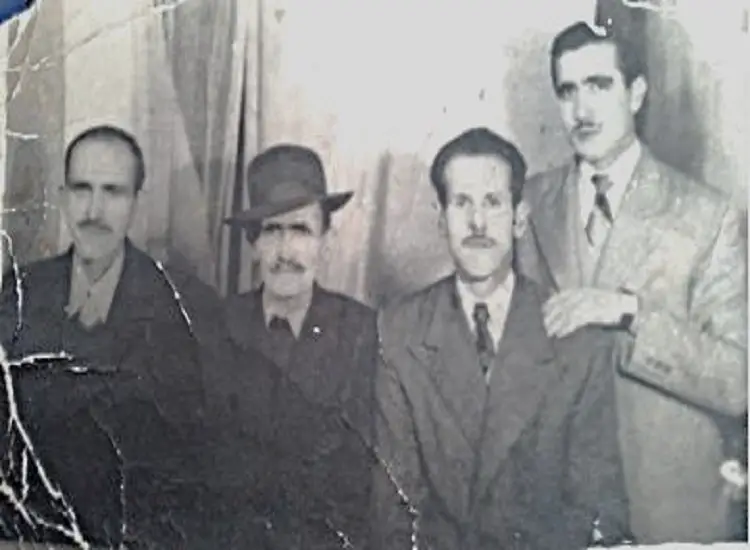
Later, Rakip Qoshi from Zgosht and Xhevdet Blloshmi from Bërzeshta joined them. Their armed group consisted of seven well-armed individuals. Initially, they were sheltered in secret and secure conspiracy within specific families in Letëm, Zgosht, Dorëz, Arrëz of Gizavesh, etc.
This did not last long, as the pursuit by the military forces of the communist state grew stronger. Subsequently, their shelters became mountain caves, under very difficult conditions. The members of his family lived throughout the entire period of the communist regime under a harsh terror.
The family’s suffering and persecution continued long after the installation of the communist regime, in macabre prisons and camps. Numerous events are linked to the suffering and persecution of this family. Here is how eyewitnesses of these events recount them: “One day, in a meadow near the center of Letëm, partisans and some village residents were dancing, celebrating the victory.
The latter were drawn into the dance, whether they wanted to be or not. On this day, Azis was in a cave above Jonuz Biçaku’s house, along with his son, Isuf. Isuf’s bride had also come there in secret with their three-year-old son, Ilir (Lirim). The father-in-law said to his son’s bride: ‘Take the boy and go, for no one has business with you.’”
He thought this because even the most ruthless occupiers he had known generally did not target women and children. And so it was done, as she could not stay there for long. After parting with them, she set off with the little boy toward Ahmet Hoxha’s house, where they were being sheltered.
Meanwhile, on the road, a villager spotted her. To ingratiate himself with the partisans, he told their commander that the woman passing by was the wife of the fugitive Isuf Biçaku. The partisan commander, ready to act, gave the order to detain her. They forced her into the middle of the meadow, and while standing there with her three-year-old son, they danced around her, singing: “We caught the enemy’s wife.”
She was a noble woman, only 22 years old, and the daughter of Selman Qoshi from the village of Zgosht. She stood there in the middle of the square, head held high and without flinching, until they allowed her to leave. But what were they? The liberators of a country, torturing an innocent woman and her infant child! I met Ilir in Tirana in August 2016. Hearing this chilling scene that he had experienced with his mother in 1945, I felt stunned.
What were this mother and son guilty of that the partisans would mock and laugh around her?! In my view, one fact is indisputable: these were the liberators who had now become the occupiers of Albania, where the responsibility lies not with the simple partisans, but with the leaders of the CPA (Communist Party of Albania), who designed and forcibly established the dictatorial system in Albania.
Given that in my two publications I have extolled the figure of Azis Biçaku – which he deserves – the question arises: Why did Azis Biçaku not surrender? The answer is very simple. Despite being unschooled, he was a skilled diplomat. He did not trust the communists, partly because they were directly linked with the Slavs – enemies not only of his family but of Albania throughout the centuries.
Many contemporaries have testified that he often spoke at the village mosque, in men’s chambers (konakë), and in assemblies (mexhlise), expressing that: “I do not want the German, but worse is the Muscovite [Moscow/Russians], who wants to bring the Serb to our dining table. If this business continues long, we will turn our weapons against him too.”
He, like many other nationalists, believed that the German presence in Albania was temporary. This was the reason he did not fight against them. What is unique about all the nationalist leaders of the area I am writing about is that they did not commit crimes. This can also be said for Azis Biçaku, whose name has been mentioned the most.
Evidence of this is the fact that since his early activity with the “Balli Kombëtar” (National Front) organization, he expressed a desire to avoid bloodshed. As noted earlier, the forces of “Balli,” led by Azis Biçaku and Isak Alla, moved through various areas – reaching as far as Bërzeshtë and Mokër – but they did not set out with the intent to fight partisan forces.
In 2013, I contacted Fez Bardhi from Letëm, who was a member of Azis’s squad. He recounted: “On the way to Bërzeshtë, we encountered partisans, but only a few shots were exchanged. Then they withdrew, and we continued our way. Hamit Dushku of ‘Balli’ was killed there, but not by the partisans. It was night, and Hamit was shot by mistake. The next day, Azis ordered him to be buried with an imam (hoxhë). An imam was found, and he was buried there. Prompted by a local,” Bardhi continued, “two houses were set on fire. Then Azis arrived from another neighborhood and ordered the fire to be extinguished. And so it was done; we extinguished the fire ourselves, which had just been started. It was wartime,” he said. “When we reached Polis, we heard gunshots, but they weren’t aiming at us. We also started firing, but not toward them. After several volleys, they called out to us, asking who we were. ‘It is I, Azis Biçaku,’ he replied. From above, we heard a voice: ‘Come, Azis, come!’ When Azis approached, he embraced their commander. It was then we realized it was Nezir Muzhaqi, the commander of the ‘Balli’ squad from Vilan.”
The issue of non-involvement in fighting partisans is also explained by the fact that if there had been combat, there would have been fatalities. There are no fatalities from Azis’s squad, nor from Zgosht. There are only two cases of combat: that of Kostenja in pursuit of the General Staff, and Qafë Drizës, when the Partisan 2nd Brigade attacked.
Some readers might ask: in my first book, “Gizaveshi through the Years,” it is written that Rexhep Hunçi was killed by Azis Biçaku in Mount Miraku. I must re-explain this event from 1947, when Azis Biçaku was a fugitive. In this context, killings in battle or combat cannot be considered crimes. Rexhep Hunçi from the village of Gizavesh was not part of the military Pursuit Forces; he was a Sigurimi (State Security) informant. At that time, I also believed the writings in the book “Silent Heroes,” which claimed Rexhep was a fervent patriot and a determined fighter for the national cause.
By a decision of the Politburo of the Central Committee of the Party of Labour of Albania in 1973, he – and many others killed in encounters with anti-communist groups – was declared a “Martyr of the Fatherland.” During the communist years, the elderly spoke about Rexhep with reservations. Being a history teacher and the chronicler of the village, I questioned the elders who knew him well. When I presented details from “Silent Heroes” about Rexhep being a brave patriot, their response was a simple: “Yes, yes,” but they provided no explanations because they feared being punished for “agitation and propaganda.”
When I was asked to write about him, I adhered to what was written in the book. Being honest with the reader, I can say that even if I had doubts, I did not have the courage to write the reality during those years of communist terror. Even if I had, it wouldn’t have been accepted; on the contrary, I would have faced consequences. After the collapse of the communist system, I obtained accurate data on his activity. The fact is that Rexhep, from late 1944 until 1947 when he was killed, tracked the movements and locations of the armed group of Azis Biçaku and Isak Alla.
There was a reason for this. During the war years, Rexhep had a conflict with Kamber Alla in Zgosht over trivial motives. His brothers, Zeq and Abdulla Hunçi, intervened to protect him and later scolded him for his improper behavior in the Alla household, where they had gone as guests. Following this event, Kamber tried to eliminate him but found no opportunity. This was why Rexhep began collaborating with the Sigurimi and the Pursuit Forces to destroy the armed group.
Azis Biçaku and the Alla brothers were aware of Rexhep Hunçi’s movements and his collaboration with the Sigurimi. I learned the details of the autumn 1947 event – when Rexhep confirmed their location and led the Pursuit Forces there – from Rexhep Vreto (known as “Red Rexhep”) from Stravaj.
“In 1981, I was working as an instructor at the district Youth Committee. Rexhep Vreto, a former soldier with the Pursuit Forces, was present at the scene. He told me: ‘Rexhep Hunçi led us to the place where they were.’”
When Azis Biçaku saw they were surrounded by the Pursuit soldiers and saw Rexhep leading them, he called out: “Even here you followed me, Rexhep Hunçi?!” Rexhep was killed in the first volleys before he could fire. Several Pursuit soldiers were killed or wounded; on the other side, Halil Alla (brother of Isak and Kamber) was wounded and did not survive. Thus, it was an armed encounter between parties, and naturally, we are not dealing with a crime here. In another paragraph, I wrote that Rexhep Hunçi was killed by Azis Biçaku; this refers to the fact that the group was led by him and he was the one who recognized Rexhep and reacted, but it could not be known precisely whose bullet hit him. Regardless, there can be no blame for this. What was Rexhep Hunçi looking for on Mount Miraku? How else would Azis Biçaku and his group receive him? One must analyze the event through facts, not passion.
The facts are that those men sheltering in mountain caves had their houses burned, their property and livestock seized, and their wives and children exiled to macabre camps. Meanwhile, Rexhep arrives with state forces to annihilate them! I do not believe anyone in Azis Biçaku’s position would have acted differently.
The second case discussed is the killing of Dalip Biçaku from the village of Kosharisht. I questioned several elders from Letëm about this. There are different versions of this killing, which was carried out by members of the fugitive group over 70 years ago. None of the anti-communist group members are alive today. However, based on my conversations, the most credible version is that Azis Biçaku did not kill him personally.
Azis and Dalip Biçaku were in-laws. Dalip had started collaborating with the Sigurimi. His house was in a strategic location for the outlaws. Azis and his companions stayed there several times but would leave to hide their tracks. On the last occasion, Dalip went to Librazhd and notified the police of their location. He undertook to deliver the group to them by sheltering them in his house. It is said that the Internal Affairs Branch promised him a squad of trained officers. Upon returning home, he contacted the fugitives in the cave and invited them for dinner.
Azis began to suspect Dalip’s behavior. During the day, he observed the house with binoculars and saw Dalip contacting the Pursuit Forces. That evening, Azis sent some members of the group while he stayed nearby for support. The aim was to clarify if the presence of the Pursuit Forces was a coincidence or a trap. Although convinced of his betrayal, Azis told them to beat him but not to kill him. After contacting him outside the house, they told Dalip that Azis wanted to be sure before they came for dinner. He told them to come, that there was no danger. They then took him by force and, in a fit of rage, killed him.
It must be considered that most fugitive groups and their prominent members were captured through betrayal by the Sigurimi. When capture was impossible, they were killed on the spot; when captured, they were tried and sentenced to death. The fugitives were well aware of this. Thus, Dalip Biçaku was killed under these circumstances. The elders I contacted told me that the Branch sergeant and soldiers were nearby but did not dare engage in combat with the fugitives. It seems the plan failed, and they were unable to organize. Indeed, it was not easy to engage in battle with those men, who were all brave and skilled with weapons. The Sigurimi forces who used Dalip Biçaku as a pawn failed to protect him.
Azis Biçaku and his group remained as fugitives for over three years, hoping for a reorganization of nationalist forces to overthrow the communist regime. During these years, Isak Alla and his brother Kamber moved several times, contacting anti-communist exponents who were being parachuted into Albania from abroad to organize a possible uprising.
The life of an outlaw in the mountains was extremely difficult. Unable to approach villages due to constant pursuit, they stayed in mountain caves, winter and summer. There were seven men, and securing food was a struggle. Occasionally, no more than two would descend at night to the village to friends for a little food. The people of Letëm and Zgosht, like everywhere in the first years after liberation, had no bread for their own children, but they shared their morsels with them and never sent them away empty-handed.
Rakip Qoshi, from the village of Zgosht, a member of Azis Biçaku’s armed group, was the only one who returned to Albania after an amnesty in the 1960s. Rakip visited our house several times for friendship in the 1970s. He talked with my father about the years as a fugitive and life in Istanbul, where he stayed with Azis and Isuf Biçaku. “On many occasions in the mountains,” he recounted, “we ate beech leaves with salt. The story of Azis Biçaku deserves to be studied and valued.”
Knowing this part of history, I will make a simple analogy: Bajram Curri fought bravely and was killed in the Dragobia cave against the forces of Ahmet Zogu, whom he opposed. Azis Biçaku and Isak Alla defended themselves by fighting like lions against the military forces of the most brutal dictatorship the history of the Albanian people has known through the centuries. They are devoted anti-communist heroes who courageously challenged the barbarian regime of communist violence and terror.
Thus, Azis Biçaku, at an advanced age and with many wounds on his body, was forced to leave his homeland and settle in Istanbul. He passed away in 1953, seen off to his final resting place by his son Isuf, and hundreds of compatriots and many friends in Turkey. / Memorie.al