
Memorie.al / “For the moment, there is no place for me in Albania. This is why I will continue to fight for the final liberation of Albania, so that the dream of our true Fathers, the Founders of the Albanian National Awakening (Rilindja), can be realized – that dream which was destroyed nearly a hundred years ago by a coup d’état masked by ‘darkness,’ to return their agents to power.”
Mr. Hajdari, could you tell us a bit about yourself, your origins, and your family?
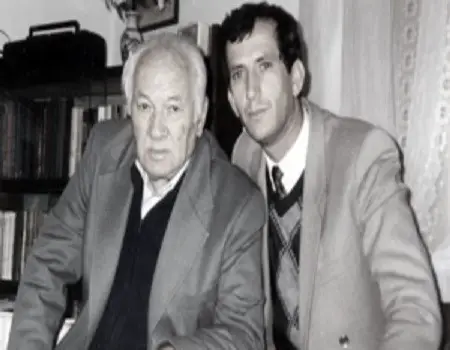
I was born in 1957, in Darsìa (Lushnje), Albania, into a family of former landowners and merchants whose assets were confiscated during Enver Hoxha’s communist dictatorship. In 1930, my family owned two shops in the center of the city of Lushnje, a car, hundreds of hectares of land, forests, and livestock. My father joined the partisan resistance when he was sixteen.
After the War, he studied in Tirana as a topographer-accountant. He worked for several years in the Civil Registry office in Lushnje, the city where my mother was also born. Nuria is a simple and generous woman. She was raised by Italian nuns who had a convent near her home. Her parents worked as farmers. I am very close to Nuria; she is always present in my work.
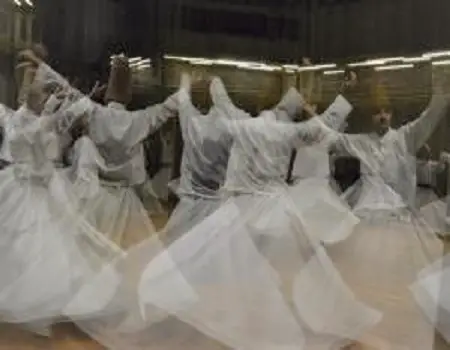
When my grandfather, Veli Hajdari, was declared a kulak, the leaders of the Communist Party decided to fire my father. My grandfather’s house was frequented by dervishes, members of the mystical Bektashi brotherhood, to which my family belonged. My father worked his whole life as a cattle herder in the communist Agricultural Cooperative, receiving at the end of the month just enough money from the state to buy daily bread.
Every morning, when he went to the fields, Nuria would put a novel in his sack along with his dinner for him to read. He was an excellent reader; he loved the Russian, French, and English classics. On winter nights, he would tell us the sagas he had read during the day. Around the fireplace, in silence, we children listened enchanted.
Often, we were moved by his storytelling in the dim candlelight, and our eyes would fill with tears. The most touching tale was the story of Anna Karenina. Once my mother, wiping her face, said to him: “Enough, Riza, with these novels, the children are upset.” But he never stopped recounting what he read during the day while tending to the oxen. Every evening, we sat around the fireplace, eagerly waiting to hear a new saga.
The rest of my life belongs to the struggles for freedom and democracy in my country, to the denunciations against the crimes of Enver Hoxha’s communist dictatorship and against the abuses and speculations of the new masked regimes; to disappointments, death threats, escapes, internments, sentences, and the silence imposed by the political and cultural mafia of Tirana. For more than twelve years, I worked various manual jobs to survive, both at home and in the West, through endless studies, travels to Africa, Asia, and the southern hemisphere, witnessing different and forgotten realities, often risking my life.
You began composing poetry at a very young age. How was this passion born?
I started writing in my first year of high school, at the age of eleven or twelve. The person who made me fall in love with poetry was my paternal grandfather, and then my father, who would recite legendary epic songs to us children before bed, such as “Muji and Halili,” “Gjergj Elez Alia,” and “Ajkuna Laments Her Son, Homer.” As for folk songs, I fell in love with them through my mother’s uncle, Selim.
When I was in high school in the city of Lushnje, I often stayed with my maternal grandparents. This was when the weather was bad and I couldn’t return to the village. At that time, I preferred to spend the night with my elderly grandparents. My grandfather loved me very much; he told my mother that I resembled him. His brother, Selim, had been a nizam (as Albanian soldiers fighting on behalf of the Sublime Porte of Istanbul were called in Turkish) during Ottoman rule in the Balkans.
He had fought in Iran and Iraq for several years. Having never married, he lived the rest of his life with the memories of his years as nizam. Every person he met, he told them about their life as soldiers in the distant deserts. His stories fascinated me greatly. Often Selim, after telling me about long journeys through deserts, forced drills, fierce battles with enemies of the Ottoman Empire, and the deaths of his fellow soldiers, would begin to sing in a beautiful voice the songs that told of all these things.
I have always carried the love for the nizam songs with me. Until one day, I decided to translate this priceless heritage of the Albanian people into Italian. The volume “I canti dei nizam” (“Këngët e nizamit”) was published in 2012 by “BESA EDITRICE.”
Who were the first authors you read, and which ones left a mark on you?
The works of authors I read during middle school and the first years of Gymnasium are: “Le Quartine” by Omar Khayyam; “The Gulistan” by Saadi Shirazi; Tolstoy’s “Anna Karenina”; Chekhov’s short stories; the texts of Pushkin, Sergei Yesenin, and Eduard Bagritsky; Lermontov’s “The Demon”; Walt Whitman’s “Leaves of Grass”; “The Neighborhoods of the World” by Yannis Ritsos; Boccaccio’s “Decameron”; Lucretius’ “De Rerum Natura”; Dante Alighieri’s “Inferno”; Galsworthy’s “The Forsyte Saga”; short stories by the Indian writer Krishan Chander; Stendhal’s “The Red and the Black”; and the poems of Heinrich Heine. These great authors, masterfully translated into Albanian, permanently marked my fate as a poet.
How did you experience the relationship with your passion, poetry, during the years of the communist regime?
The years of Enver Hoxha’s Albanian communist regime will always remain a mystery to me, and to Albanians as well. None of us knew what was happening at the heart of communist power, let alone in the internment camps and prisons. Nothing escaped the walls of the borders of the dictatorship of the proletariat. And perhaps nothing will ever be known, given that the other half of the historical truth is hidden in secret archives, already “cleansed” by the post-communist regimes of Tirana.
So, a poet like me lived between a passion for poetry and terror. When the class struggle escalated, my family was labeled an “enemy of the Communist Party,” but when the class struggle experienced a period of “pause,” we managed to live a bit more peacefully.
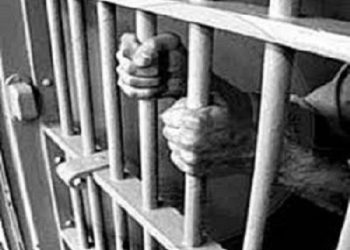
I am a living witness to many arrests: “In the name of the people, you are under arrest,” by the State Sigurimi, the regime’s Secret Political Police. After every citizen arrested, people whispered: “Who knows whose turn it is tomorrow!” Someone could end up behind bars for a “word,” a “metaphor,” or a “dream.”
I had a classmate in high school, Jozef Radi, the son of the intellectual Lazër Radi, a former persecuted politician who lived in the Savër internment camp in Lushnje. From time to time, in front of my high school, military wagons loaded with deported men, women, and children would pass. They came from all parts of the country to spend the rest of their lives in the concentration camps of my city. Meanwhile, vans with windows blocked by bars carried political prisoners.
It was the reading of the classics that “saved” me and, at the same time, softened my consciousness as a poet during the dark times of Albanian history. While the barren and mystical landscape of my hilly province of Darsìa gave me some solace in my youth.
When did you decide to leave Albania, and what were the reasons that led to this choice?
In the winter of 1991, I was one of the founders of the branches of the Democratic Party and the Republican Party in the city of Lushnje – opposition parties – and I was elected branch secretary for the Republicans in the aforementioned city. I am a co-founder of the opposition weekly “Ora e Fjalës.” Later, in the general elections of 1992, I ran as a candidate for parliament on the Republican Party lists, but I was not elected.
During my intense activity as a politician and opposition journalist, I publicly and repeatedly denounced the crimes, abuses, economic and cultural corruption, as well as the speculations of the old nomenclature of Enver Hoxha’s regime and the most recent post-communist phase. Also, for these reasons, after repeated threats, I was forced, in April 1992, to flee my country.
Ultimately, I realized that the so-called Albanian democratic change was nothing more than a dirty game already decided at the table. The old communist nomenclature of Enver Hoxha, with the help of “dark forces” from across the ocean, has once again taken possession of the political, economic, and cultural power of the land of eagles.
The so-called former politicians persecuted during communism, instead of founding their own party to pave the way for a radical change in administration, society, and the state, preferred to share power and plunder with their executioners. Thus, the dream of freedom, true democracy, and the sovereignty of Albania was finally killed.
What were your first years as an immigrant like?
The first years in Italy were very difficult. I was thirty-five years old and had to start from scratch. I didn’t have a cent in my pocket; before leaving Durrës, I only had the money for a one-way ticket. I had lost everything. Beaten down.
To survive, I had to work as a stable cleaner, a laborer, a factory worker, a printer’s assistant. And meanwhile, I was attending another faculty for Modern Literature at the Sapienza University of Rome, paying all the university fees, as well as rent and food.
It was the beginning of the 90s. Albania at that time was identified with prostitutes, murderers, thieves, and rapists. A poet like me had to be three times better than his Italian colleagues and those who had come from other countries. Provocative questions for me, as a man of culture and an Albanian citizen, were the order of the day. I also had to write in Albanian and Italian, as I had no Albanian readers.
I published my first poetry collections out of my own pocket. I didn’t know any Italian publishers. It took money and time to go and contact publishers in the big cities. I worked from morning and returned in the evening and could do nothing. There is a sad fact to share that happened to me in my first months in Italy. At that time, I did odd jobs as a laborer; employers sometimes paid me, sometimes not.
In the first months, I found shelter with some of my compatriots. The house where they lived had been provided by the Municipality, so they did not pay rent. These gentlemen welcomed me at first, then one day they kicked me out of the house. I asked to stay for a few more weeks to find a job that would allow me to rent a room, but nothing…! I remember knocking on doors all over town looking for work, but as soon as people heard the word “Albanian,” they closed the door, telling me: “Go away, you are thieves and criminals!”
Perhaps they were right; in the early 90s, Albanians occupied the front pages of crime news in Italian newspapers and media. Until one day, I found a job as a laborer in a small construction company. I finally managed to find shelter in a ruin that had not been inhabited for half a century, where the rent was low.
Why did you choose to live in Italy?
I chose Italy because our peoples have shared the same fate throughout history. Italy has always been the great gateway connecting Albania with the rest of Europe. And then, the Italian language and culture have always been very well-known. It should not be forgotten that Albanian literature was born in Latin.
What was your relationship with the Italian intellectual class back then, and how was the reception?
The first years for me were years of great effort, suffering, and immense existential anxiety. There was no time to be an “intellectual.” Intellectuals in Italy and abroad were the poets and writers of socialist realism from Tirana who, along with their colleagues – persecuted until yesterday during the communist regime – were appointed as cultural attachés, ambassadors, directors of the Soros Foundation, or were “sheltered” in Publishing Houses in various European countries. Those few poets like me who publicly denounced the abuses, corruption, and trafficking between the mafia and those in power were labeled “enemies of Albania.”
For me, it was about fighting day and night to survive and exist in the social reality and the new cultural context. I also had to teach myself the language and read a lot. I slept very little. I refused a subsidy offered to me by the Municipality of Frosinone at the beginning. I decided to earn my daily bread with my own hands and the sweat of my brow.
In 1993, a year after my arrival in Italy, I published my first bilingual collection, “Ombra di cane” (“Hije qeni”) with a small publisher, “Dismisuratesti.” The book was very well received by readers and critics. This was followed by “Erbamara” (“Bari i hidhët”) and “Antologjia e shiut.”
Only in the years 1995-96, with the publication of “Sassi controvento” (“Gurë kundër erës”) and winning the first prize for poetry Ekstra in Rimini, did I begin to have frequent contact with the world of literature. A year later, I won the “Eugenio Montale” prize with the collection “Corpo presente” (“Trup i pranishëm”).
In 2001, the city of Frosinone gave me the title of “Honorary Citizen” for literary merit. By the way, it is appropriate to thank some of my intellectual friends, such as the Ciociarians Amedeo Di Sora, Biagio Cacciola, Luciano Renna, and Riccardo Mastrangeli, who were close to me and provided great moral support in the first years of my Ciociarian exile.
Even though a great disappointment is perceived in your poems, Albania is always very present. What is your relationship today with Albania and Albanians?
I can say that my work is an “encyclopedia” that includes various aspects of life, existence, human mystery, and beyond. My human and literary journey, broad and complex, traverses places, peoples, languages, traditions, myths, legends, history, joys, pain, eros, and thanatos.
My relationship with Albania and Albanians comes down to contact with my birthplace, Darsìa, and my mother tongue, which unfortunately today some of my colleagues are butchering in an inhuman way – as if half a century of terror, class struggle, sentences, murders, internment camps, theft of property, the central bank, national assets, corruption, environmental disaster, drug trafficking, urban violations, and the destruction of the economy, administration, and the cultural and spiritual state were not enough.
A great universality is perceived in your poetry; this characteristic is hard to find among contemporary youth. How do you see the exponential growth of “made-in-Albania” poets?
It is too early to talk about the Albanian poetry of the youth. After the fall of Enver Hoxha’s communist regime, as in all areas of daily life, a certain confusion reigns in the poetry of the new generation. It will take decades to understand the true names and the true poetic values that will be able to resist time and be part of the nation’s literary heritage, as an integral part of Europe’s cultural memory. But I can say that the female poetry of the new generation is better than the male one.
What is the “socialist realism” you often refer to?
The so-called “socialist realism” – that is, the manifesto of party art – is an artistic and cultural method born in the Soviet Union in the 1930s. According to this “canon,” an artistic work had to have a realistic form and socialist content. In Albania, total isolation from the rest of the world and the lack of contact with the historical experiences of the European literary avant-garde made Marxism the only aesthetic principle of poetry and art. All of this followed the dictates and lines of cultural policy theorized by Marxist-Leninist doctrine, poisoned by ideology and taken as a model for a national and popular literature for Eastern countries, which, contrary to the Goethean idea, referred to a universal literature.
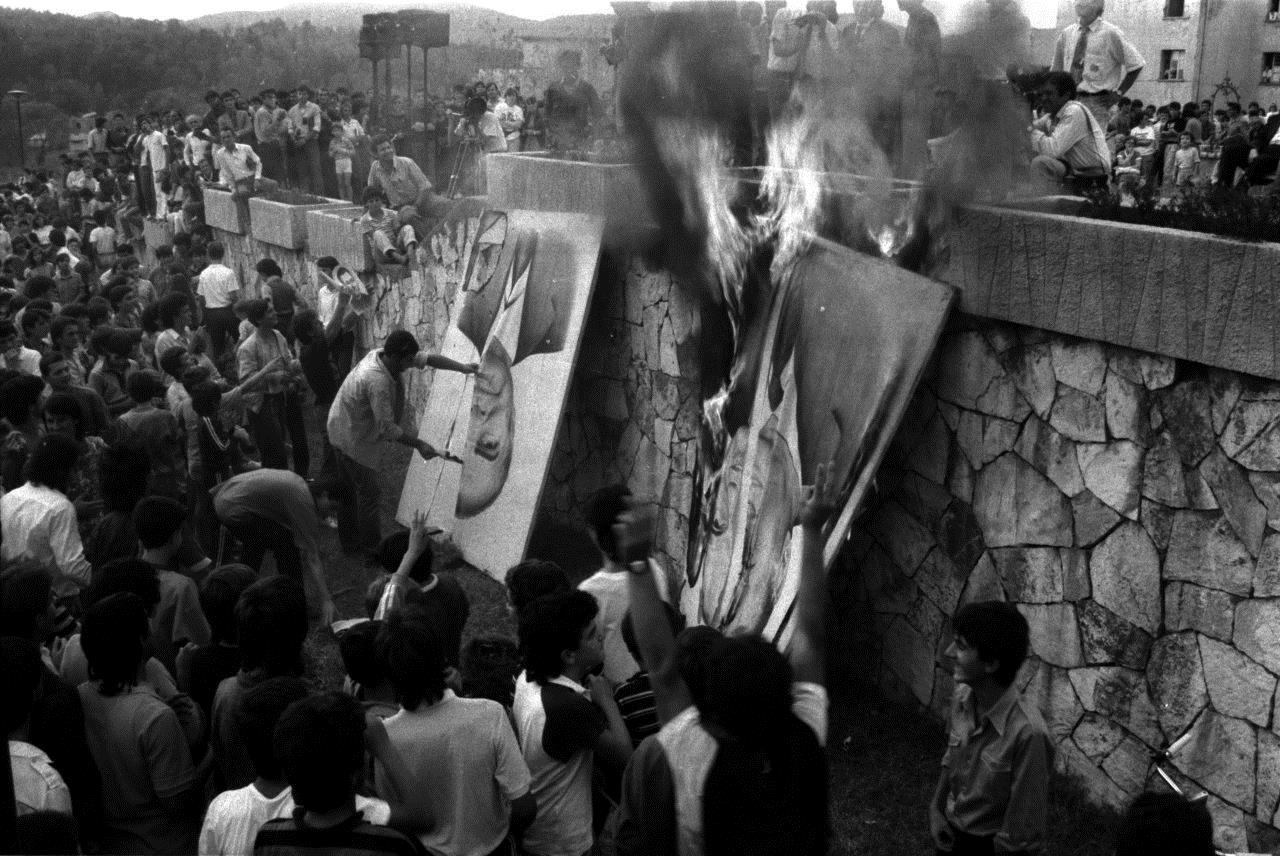
For the dictator Enver Hoxha, the writer was simply an instrument in the hands of the Party for the communist education of the people, the right hand of power: for this reason, it was said that in Albania, literature was born in 1941, with the founding of the Communist Party. In fact, those who opposed this “method” were shot, imprisoned, and sent to forced labor for life. During Enver Hoxha’s communist regime in Albania, 148 intellectuals, artists, writers, poets, politicians, philosophers, lawyers, translators, and professors of Latin and Greek were shot or died in various prisons. The last poet hanged on the gallows was Havzi Nela in 1988. Terror was a system, the principle upon which the communist dictatorship was based.
You are considered an “exiled poet” (poet mërgimtar). Do you find yourself in this definition?
Being an immigrant poet is not a limitation, but a form of globalization, as the great comparatist and writer Armando Gnisci teaches us. It means belonging to the trans-cultural avant-garde of Italian and world literature. The migrant poet teaches everyone to be immigrants, exiles, and travelers in a “mestizo civilization” in a world that is creolizing, to share fates and the future together. The future of the Italian language and literature will belong precisely to the mestizo youth, travelers, and exiles, who will give dignity to the Italian language, returning to its metaphors a thread of truth and vitality to its dormant, tired, and castrated language.
How do you experience the relationship between your mother tongue and your adopted one?
I write in both languages at the same time, so I am a “polygamous” poet. I torture myself in Albanian and write in Italian, and vice versa.
Today we live in the era of mass migrations. What do you think about this phenomenon?
Travel and migration are part of the DNA of human existence. Indeed, human history has been made by travelers. However, all this has nothing to do with today’s mass migration. This dramatic phenomenon in the third millennium is a consequence of the criminal policies of our corrupt, greedy, and warmongering politicians and rulers, who have sold themselves to “dark forces” that profit by destroying countries, economies, traditions, languages, cultures, states, and hopes for the future of humanity. The evil goal is for chaos, corruption, disappointment, permanent wars, and innocent blood among people to reign in Europe and the rest of the world. Those who denounce this situation are labeled as enemies and anti-Europeans.
Have you ever thought about returning to Albania?
Unfortunately, my Albania no longer exists; it has only changed hands. From the birth of communism until today, Albania in essence has never belonged to Albanians because, behind the communist ideology and post-communist governments, stands the political design of “dark forces,” which have never had and continue to have no interest in Albania being free and sovereign. On the other hand, their way of acting fully reflects the ancient method of “the carrot and the stick.” Let me explain: the carrot consists of money, power, positions, and ministerial-governmental offices, scholarships, jobs for oneself or the family, literary prizes, honors, honorary citizenships, etc. In short, the carrot is the price of submission that almost all politicians and pseudo-intellectuals, as well as people of culture and academics, have gladly accepted. On the other hand, the stick is the treatment reserved for true men and free intellectuals who have neither submitted nor compromised with the devilish power that moves the puppets’ strings.
For the moment, there is no place for me in Albania. This is why I will continue to fight for the final liberation of Albania, so that the dream of our true Fathers, the Founders of the Albanian National Awakening, can be realized – that dream which was destroyed nearly a hundred years ago by a coup d’état masked by “darkness,” to return their agents to power.
Some time ago, Albania lost its last great actor, Bujar Lako. Did you know each other? If so, what is your memory of him?
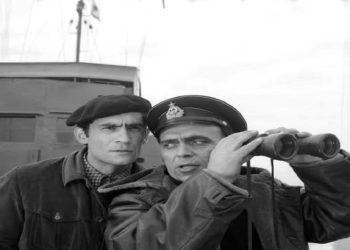
I did not know Bujar Lako personally, who was a born actor. Unfortunately, actors like him – to mention only a genius like Kadri Roshi, who was born, lived, and worked under the communist regime – were victims of their fate: they did not have the opportunity to compete with the free world. But the very fact that he was saved during the red terror was the most beautiful role he played in the cruel cinema of life.
Women. How do you perceive them, and how do you experience the female universe?
To write, experience, internal struggle, commitment, readings, travels, efforts, and daily joys are not enough; a poet also needs female readers. The more a poet “seduces” women, the more value his poetry gains. The value of a poet’s work is measured precisely by the number of female readers he seduces. The true connoisseur of poetry is not the critic, the researcher, or the academic, but the woman. Only the female reader is able to evaluate whether a poem is worth it or not. So, I experience the female universe both as a poet and as a reader of their poetry…!
How and where do you see the future for Gëzim Hajdari? And for poetry?
The future? I hope so, and if we have one, it will be poetry that wins the peace, saves humanity, and preserves memory, and not the dirty wars of the West./Memorie.al