Part Eighteen
Excerpts from the book: ‘ALIZOT EMIRI – The Man, the Library, and a Noble Soul’
A FEW WORDS AS AN INTRODUCTION
Memorie.al / Whenever we, Alizot’s children, shared “Zotja’s” (Alizot’s) stories in joyful social gatherings, people often asked: “Have you written them down? No? What a pity, they will be lost! Who should do it?” We felt increasingly guilty. If it had to be done, we were the ones to do it. But could we write them? “Not everyone who knows how to read and write can write books,” Zotja used to say whenever he held a poorly written book. Discussing this “obligation” – this Book – we naturally felt our inability to complete it. It wasn’t a task for us. By Zotja’s “yardstick,” we were incapable of writing this book.
Continued from the previous issue…
POLITICS IN THE BOOKSTORE
POVERTY
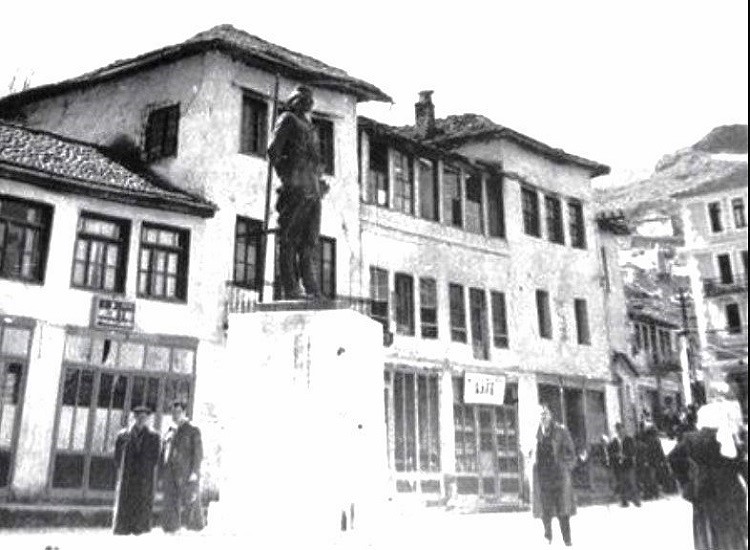
Many conversations that were held with great concern back then seem meaningless today. They were conversations born of poverty. During winter, Gjirokastër was cold, damp, and frosty. It rained incessantly. So much so, it was said that Gjirokastër ranked first in Albania for rainfall, with over 2000 mm per year. The entire Drino valley would turn black from the clouds nestled between the mountains. Beneath those heavy clouds stood the old houses, with roofs made of stone slabs, atop stone walls, beside stone cobblestones.
Roof eaves dripped at the base of the walls, and often inside them, onto the ceilings of the rooms. As if this dampness weren’t enough, it snowed many times during winter. During long cold spells, the snow would freeze. The ice on the steep streets of Gjirokastër became a serious concern and a danger to the residents.
The bookstore was freezing. No heating of any kind – typical of that era – was allowed: neither wood stoves nor charcoal braziers. They posed a fire hazard. Meanwhile, the bookstore door always remained open. Zotja would sit huddled in the corner of the shop with wet shoes. He would place “mantana” – cardboard cut in the shape of a foot – inside his shoes. The cardboard absorbed most of the moisture. Upon returning home, the cardboard inserts were removed, dried by the fire, and replaced in the wet shoes. Like everyone else, each of us had only one pair of shoes.
People would enter the bookstore and complain to Alizot about the cold. Yet, they found solace by comparing themselves to harder jobs, like the sellers of pickles or cheese, who plunged their hands into brine barrels all day when temperatures dropped to minus ten or fifteen degrees.
In this frigid atmosphere, when wet, shivering people entered, Zotja would start a conversation to warm them up:
“I know exactly what this wretched weather wants!”
“Well, tell us, Alizot!” they would ask.
“It wants a tray of steaming mumuligë (cornmeal mush) placed before you, with a bit of brine on top…” Zotja would continue.
“And with a couple of drops of olive oil,” someone else would add, as general hunger and the cold beckoned them to join in preparing this imaginary feast.
They seemed to warm up at the mere idea of eating the steaming mush, staying wide-eyed until it cooled in their mouths before swallowing it.
“And imagine having a hot pungent onion to go with it, so you can eat and weep at the same time over that poor mush!” Alizot would conclude. This proposal was welcomed by those lucky enough to be at this accidental feast, where nothing was missing, from the hot onion to the laughter over their warm, wide-awake dream.
THE PUMPKIN
The pumpkin had become our ally. It was cheap and helped us get through meals. Especially the winter pumpkin. Its pear-like shape made it easy to carry from the market to the house; it didn’t slip from your hand. You would see winter pumpkins hanging from the iron grates of windows in Gjirokastër homes, instead of flower vases.
Once, while carrying winter pumpkins home, the neighborhood women noticed us. They often sat on the sofat (stone bench) above the street, below the Tushe family house, after finishing their chores. They would take their handiwork and chat with one another. The position of the bench was perfect for people-watching. You could see the road from the “Palorto” Mosque square all the way to Zamo’s square. The road is very steep, so passersby descended carefully and ascended slowly. Thus, the women had plenty of time to watch and analyze every traveler.
Both Zotja and we children always greeted this kind, smiling women of our neighborhood.
“We are neighbors for a lifetime,” Zotja would tell us. Our families had long-standing ties, mutual love, and respect. “Neighbor for a lifetime” was like a title of nobility. Not just anyone was called that. Mere proximity of houses wasn’t enough. A neighbor for a lifetime was proven in great times of trouble. In the house of xha Sitki (Sitki Tushe), as our grandmother Aneja told us, Mufit – Zotja’s brother – used to hide while being pursued by the regimes of the time.
One day, we were climbing the steep cobblestones of “Palorto” with Zotja. We walked with our heads down; burdened by the weight of the winter pumpkins we were carrying home. As we approached the Tushe bench, we heard voices. We looked up and saw our neighbors laughing. One of them, Viko, asked mockingly:
“Zote, you’ve been carrying winter pumpkins home for days. What are you going to do with them? Are you setting up your winter provisions?”
Zotja stopped, as if to rest before answering, so he wouldn’t lose his breath from the climb.
“Aaah, Viko,” Zotja sighed, “you forced me, but I’ll tell you because I consider you sisters! Perhaps you don’t know, but we use the winter pumpkin for many purposes, which are why we buy them in bulk.”
“Uaa! But for what purposes, poor Zote? Besides pie and qahi, what else can you do with the wretched pumpkin?” the women asked curiously. As good housewives, they knew that pumpkins only served to deceive poverty and quiet the children.
“We,” Zotja said, “split the winter pumpkin into two parts. We separate the neck of the pumpkin from the bottom. We use the narrow neck like you do, for pie or qahi. But we have work for the wide part… We take out the heart without cutting the skin. Then we dry the empty bottom of the pumpkin in the sun.”
“But what do you do with the hollowed-out bottom?” the women rushed to learn some cooking trick they didn’t know.
“After it dries,” Zotja said, “we use the bottom of the pumpkin as a chamber pot when we get up at night, so we don’t break a leg or an arm trying to find the outhouse at the end of the house.”
The women burst out laughing and fled from the bench, shouting:
“May a bolt strike you, Zote, with your pumpkin and all your tricks?”
THE BARREL OF CHEESE
People “prayed” in the dairy or grocery shops almost every day. They stood in long lines until they could buy their planned ration. Zotja bought the cheese himself because Sadik Koçi, the dairy seller, would pick it for him. When there was a large crowd, he wouldn’t waste time in line. He would enter the shop, greet Sadik, and say with “seriousness”:
“Take care; roll my cheese barrel (buti) a bit, so the salt doesn’t settle at the bottom!”
“Don’t worry, I rolled it today!” Sadik would reply.
Zotja would leave peacefully. People grew curious. Those who didn’t know him would ask:
“What is this barrel?!!”
“I buy my cheese once a year,” Zotja would explain, “I buy it by the barrel, but I leave it with Sadik because we can’t look after it at home, and we come and take it bit by bit.”
Many laughed. Some were astonished. There were even those who called it an injustice that Alizot shouldn’t be forgiven for. Alizot delighted in everyone and made everyone feel delighted.
THE GUESTBOOK
He was served very poorly at a restaurant! He was traveling on the Tirana-Gjirokastër bus. The restaurants were state-owned. Passengers of inter-urban buses were transient clients and were ignored unless you knew someone on the staff. Annoyed and angry, he stood up, went to the counter, and asked for the “Guestbook” – a notebook the state left in these establishments so people could make remarks or complaints about the personnel.
The bartender gave him the book. Alizot went to his table and quickly wrote what was on his mind, still fuming. Meanwhile, the manager arrived at the counter; they stared at Zotja with resentment, not knowing how sharp his pen could be when he was revolted. He finished writing and called the waiter, who grabbed the book and brought it to the counter. The manager opened it hastily, read it, and immediately sent the waiter back to the table.
“What would you like from the manager?” the waiter asked with great friendliness. As Zotja hesitated, the waiter continued:
“You must order something, or the manager will be offended. We didn’t realize… you are such good men. May God bless you?”
Zotja’s friends at the table couldn’t understand what had happened. They only found out from Zotja, who had mocked the staff in the guestbook, and they sat wide-eyed at the sudden respect from the personnel.
While eating dessert, they read the text Zotja had written:
“We are marveled by the excellent service of the personnel of this restaurant. We express our highest appreciation. Well done!”
THE RESTAURANT WITHOUT WATER
“Waiter, a glass of water, pleases!” Zotja addressed the waiter.
Water was taken directly from the tap back then. Bottled water didn’t exist; in fact, saying water would one day come in plastic jugs would have seemed like madness. The waiter couldn’t keep up with all the clients who entered from the bus all at once and was delaying their water requests.
They were finishing their meal, and the glasses of water still hadn’t been brought.
Zotja called the waiter again. He came, expecting to collect the money.
Zotja addressed him with a friendly look and asked a question:
“Waiter, please, is you aware…?”
“Of what?” the waiter asked curiously.
“Where do they bury the people in your town who drown for a single drop of water in a restaurant?”
PLUGGING A HOLE
He was very hungry when they entered the restaurant where the Gjirokastër-Tirana bus stopped for lunch. The road from Ballsh hadn’t been built yet. They traveled from Tepelena under Salari, through Sevaster, Kota, Babica, and into Vlora via a mountain road built by the Italian army in 1916–1918 – unpaved and dusty, a journey that lasted about six hours.
As if that weren’t enough, the driver didn’t stop in Vlora but halted for lunch in Fier. They sat down and ordered; there was no time to think. The bus stop duration was limited.
The waiter arrived with a stack of plates in both hands, serving two tables at once. Everyone lowered their heads over their plates.
Zotja felt very disappointed by what he saw on his plate. He was reminded of the expression: “As small as a chicken’s dropping.” After all that exhaustion and hunger, another bit of bad luck at the restaurant. It was truly a matter of luck; you couldn’t find justice or a place to complain, plus there was no time for it. He instinctively checked his watch. The bus would leave for Tirana in half an hour. To eat it or not? Even if he ate it, his poverty of a meal wouldn’t change. He decided! He gave himself a calm look and called out:
“Waiter, please, is it possible?” The waiter had just served the next table.
“At your service!” the waiter said, turning to him. He frowned as soon as he saw the untouched plate, where it was immediately obvious it didn’t even contain half a portion. He stood over the table, angry and ready for a confrontation.
“I would beg you to give me a little help!” Zotja addressed him quite calmly and with a pleading voice.
“Certainly, how can I help you?” asked the waiter, relieved of the tension. He had frowned for nothing! The client didn’t intend to complain. He seemed quite polite.
“I will hold my head like this,” Zotja said, lowering his head and tilting it on the table to expose his ear horizontally, “and you will pour the meal, with a coffee spoon, into my ear hole. You will do me a great favor, because this way, at least, I know I’ve plugged one hole! Come on, don’t be lazy, we haven’t much time!”
The waiter couldn’t hold back his laughter; he grabbed the plate and went straight to the kitchen window. A moment later he returned with a plate filled to the brim, while the chef’s head appeared at the window, laughing loudly and following the waiter with his eyes to see whom he was bringing the overflowing plate to. / Memorie.al