Part Sixteen
Excerpts from the book: ‘ALIZOT EMIRI – The Man, the Library, and Noble Wit’
A FEW WORDS AS AN INTRODUCTION
Memorie.al / Whenever we, Alizot’s children, shared “Zotja’s” (Alizot’s) stories in joyful social settings, we were often asked: “Have you written them down? No? What a shame, they will be lost…! Who should do it?” We felt increasingly guilty. If it had to be done, we were the ones to do it. But could we write it? “Not everyone who knows how to read and write can write books,” Zotja used to say whenever he held a poorly written book in his hands. By Zotja’s “yardstick,” we felt inadequate to the task.
Continued from the previous issue
PART TWO: Humor
SCHOOL, EDUCATION & CULTURE
IF I WERE KING!
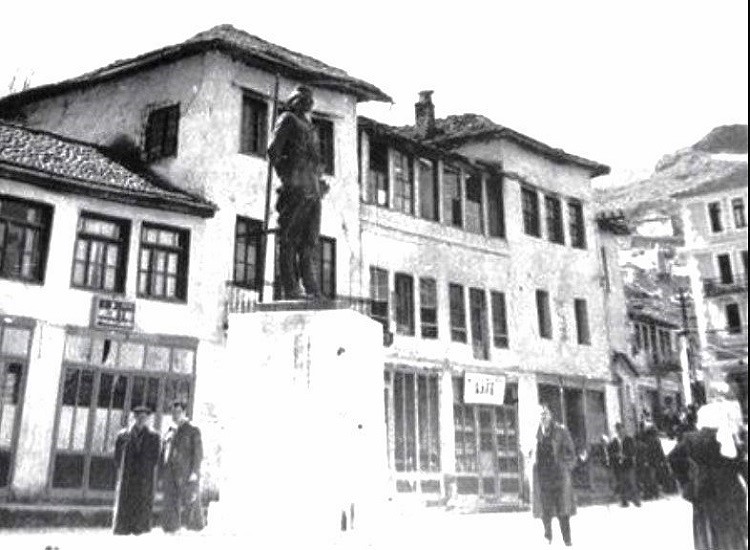
In Gjirokastra, foreign language courses – primarily French – were held for the city’s intellectuals. French was the traditional foreign language taught at the “Asim Zeneli” high school.
Foreign literature arrived at the bookstore based on orders placed through periodic catalogs. Zotja knew all his readers, especially those interested in foreign languages, and went to great lengths to secure their books.
One day, while serving several local intellectuals, he asked about their progress in French. A friend of his, who was more advanced than the others, boasted that they felt quite comfortable, had finished their methods, and were now reading literature. Zotja wanted to tease them. He knew that mastering a foreign language is a never-ending journey, especially when one realizes the daily gaps in their own “mother tongue.”
“Could you, for instance, translate a small expression from French into Albanian?” Zotja asked.
“Say it, let’s hear it,” his friend replied confidently.
“Si j’étais roi!” Zotja pronounced.
“If I were king!” the friend answered loudly and proudly.
“Then you would guard… my vineyards!” Alizoti quipped.
In Albanian, the rhyme and the shift from the high-status “King” to the humble “vineyard guard” (a common rural job) created a hilarious trap. Everyone burst out laughing at the friendly “trap.” This sparked a deeper discussion about the infinite complexity of language.
NIGHT SCHOOL
Between 1955 and 1975, the government opened “night schools” to massify education. Workers would finish their shifts and attend classes from 4:00 PM to 8:00 PM. They would return home exhausted, only to start homework for the next day.
While the system considered night school equivalent to day school, the quality was often debated. One day in the bookstore, a heated debate began about this equivalence. Some fanatics argued for total equality based on political ideology. When asked for his opinion, Zotja – who loathed conformism – said:
“I cannot be convinced that night school has the same value as day school. It seems to me the moon cannot do the sun’s job. And the sun is the sun! Even a pumpkin, which is just a pumpkin, needs three months of sun to ripen!”
EDUCATION VS. CULTURE
It sometimes happened that people with university degrees showed a lack of culture even in the most basic behaviors. In Gjirokastra, this was immediately noticed – especially inside a bookstore.
“It’s unforgivable; he is supposedly a man of culture!” someone remarked after a person entered the shop without greeting anyone.
“Ah, do not confuse things!” Zotja interrupted. “As far as I know, he has a degree in…”
“But Alizot, isn’t that enough? Does he need another faculty just to learn how to say ‘Good day’?” the locals grumbled.
Zotja continued his reasoning: “He has completed higher education, which means he is educated and has learned a profession. If he learned it well, he is a good professional, which is not a small thing. But as for culture, from what I’ve observed, it has nothing to do with him. Look at him: he enters the bookstore once a year and may or may not buy a single newspaper. A man with a degree who doesn’t read a book… I don’t know what to call him!”
The others nodded in agreement.
“But Alizot, I thought we were saying the same thing?” his interlocutor asked.
“No,” Alizoti explained. “You feel bad because you consider him a man of culture. I am saying he has an education, but no culture. Let’s look at it calmly. You spoke of behavior. We know that manners are learned at home; they are taught by a grandmother who may have never spent a day in school but possesses an inherited culture. That culture includes good manners, sweet communication, and love for people, respect, and life experience.”
He concluded: “These are the parts of culture that he lacks. And to end this talk, remember why it is called the ‘Ministry of Education and Culture.’ They are linked, yet separate. We still don’t realize that Education is only a small part of Culture.”
I heard Zotja discuss this many times. He felt sorry that some people thought a degree was the sum total of knowledge. For his generation, the French Lycée was the pinnacle of education in the city, a dream that only a few could afford. Higher education was a rarity, accessible only to those who had both the wealth and the intellect to study abroad./Memorie.al