



Part Fifteen
Excerpts from the book: ‘ALIZOT EMIRI – The Man, the Library, and Noble Wit’
A FEW WORDS AS AN INTRODUCTION
Memorie.al / Whenever we, Alizot’s children, shared “Zotja’s” (Alizot’s) stories in joyful social settings, we were often asked: “Have you written them down? No? What a shame, they will be lost…! Who should do it?” We felt increasingly guilty. If it had to be done, we were the ones to do it. But could we write it? “Not everyone who knows how to read and write can write books,” Zotja used to say whenever he held a poorly written book in his hands. Discussing this “obligation” among ourselves, we naturally felt inadequate. It wasn’t a job for us! By Zotja’s “yardstick,” we lacked the skill to write this book.
Continued from the previous issue
PART TWO: Humor
SCHOOL, EDUCATION & CULTURE
AT THE FACULTY OF ENGINEERING
It was June 1964. Zotja was in Tirana. His son, Ibrahimi, was a second-year student at the Faculty of Civil Engineering. It was exam season. Zotja lived through these periods with great tension. Back in Gjirokastra, he would pace back and forth all night in the divan (the main hall of the house) if the exam results hadn’t arrived.
Communicating from Tirana to Gjirokastra back then was no easy feat. It was done via telegram or by booking a phone call at the city’s central post office booths. This anxiety continued even when I later went to university.
Since Zotja happened to be in Tirana during those exam days, his feet led him slowly toward the central building of the University. He had never been there before. He hoped to catch his son after his physics exam. He climbed the grand, monumental external stairs, entered the ground floor, asked at information, and headed to the large hall on the second floor.
“Uncle Alizot!” someone called out. He turned his head. It was Darvin Doraci, a boy from the “Palorto” neighborhood and Ibrahimi’s classmate. They greeted each other warmly.
“Imja (as his friends called Ibrahimi) is inside taking the exam. I expect him to be out soon,” Darvin explained.
Students were moving through the corridor. Darvin signaled some of them to come over – Ibrahimi’s classmates. Among them was a female student who noticed the tension and worry on Zotja’s face – the unmistakable look of a concerned parent. A lively, loving, and quite emancipated girl, she threw her arms around Zotja to comfort her friend’s father.
“Did you come all this way just for Ibrahimi?” she asked. “You’ve come for nothing! If that’s the case, our entire tribes should be here for us! Ibrahimi is a brilliant student, the best – don’t worry! He will surely get a ten (the highest grade)!”
Zotja felt the tension melt away in the warm company of the students, especially thanks to Violeta from Durrës. He regained his composure and returned to his usual witty self.
“I thank you very much for the kind words about my son. I know him too, and truthfully, I’m not worried about the exam at all. I have another worry, which is why I came here myself.”
“Why? What is your worry regarding Imja?” Violeta asked, now feeling more familiar with him.
“Well, I’m worried he might get entangled with a girl like you, and that would make me set the house on fire!” Zotja replied with a laugh.
The faculty hall erupted with the youthful laughter of the students. Other students nearby gathered, surprised by Zotja’s natural and delightful humor. The joke spread like wildfire. From then on, all the girls would turn their heads whenever Ibrahimi walked by. What luck! His father had unintentionally made him the center of the girls’ attention. Zotja never visited me at university! But anyway, back to the faculty hall.
Violeta was the most delighted of all, as the joke carried subtle compliments about her agility, intelligence, beauty, and striking emancipation. They became well-acquainted, and Zotja would always send his regards to her through Ibrahimi. He was overjoyed whenever he heard of her excellent results and her success in family life.
THREE FIVES AND A FOUR
I had started the fifth grade in 1958 at the “Koto Hoxhi” school in the “Varosh” neighborhood. This was the transition from primary to middle school. New school, new teachers – instead of one teacher, I now had one for every subject.
Zotja valued these transitional moments and wanted us to maintain our grades. He even used a material incentive, though the morals of the time were against it.
“For every five (A) you get, you’ll get a five-lek coin!” he told me at the start of the year.
I started racking up fives, and he kept his word. I was becoming rich! I earned it with my own “sweat,” as they say. But the system of that time didn’t like the wealthy. It never smiled upon them; it waited for the chance to humble them. That chance soon came for me.
I returned from school overjoyed. On the way, I was calculating what to buy with the 19 leks Zotja owed me. That was my “earnings” for the day. I had received three fives and one four (B). If I had just one more lek, it would have been a solid twenty. I could have gotten a five on that fourth subject too, but I had made a mistake in the exercises. The fault was mine. I had plenty of time to deliberate on the road; the walk from “Varosh” to “Palorto” took nearly half an hour.
When I reached home, I found Zotja on the sofa, about to leave for work.
“Well,” he said, “how did school go today?” The standard question.
“Good,” I replied modestly. In truth, I felt like bragging.
“How good?” he asked. I thought to myself: Oh, how good that he asked! If he hadn’t, I couldn’t have brought it up myself without looking like I was after the 19 leks.
“I got three fives and a four,” I said.
“Where did you get that four, you piece of sh…?” he snapped and walked out without waiting for an answer or giving me my “check.”
I stood there at the door like a fool. I forgot to take off my sandals, and my schoolbag stayed in my hand. The only witness was the house cat, standing still and flicking its tail.
“Are you with him too?” I asked the cat. “Well, it’s not your fault; Zotja brings you food every day from Gjirokastra’s restaurants. You don’t get a four even when you scratch him!” It seemed to me the cat was the favorite in that house!
The thought stuck with me: “Unbelievable! A lousy four wiped out three fives!!!”
PARENT-TEACHER MEETINGS
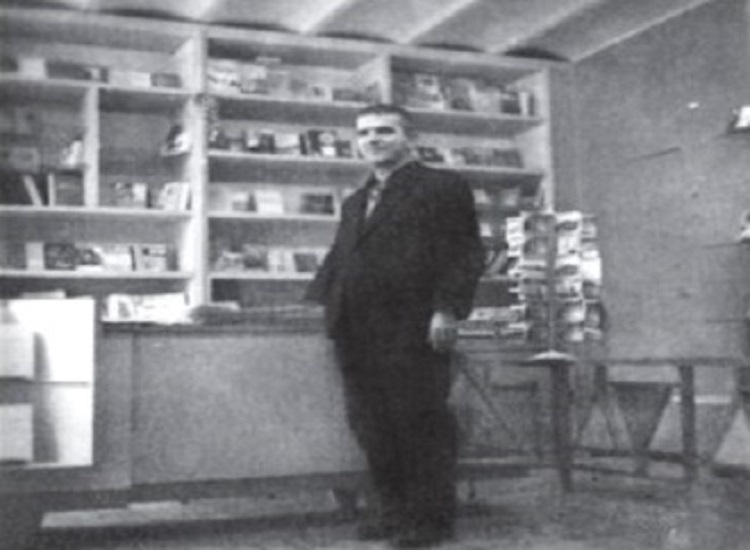
Zotja never attended the joint parent-student meetings organized by the school. My mother went. He met our teachers almost every day at the bookstore, even if they just came in to buy a newspaper. He was always informed. The truth is, all of us children had very good results.
Zotja only came once to a meeting when I was in the seventh grade. We were held at the “Asim Zeneli” high school building. Our homeroom teacher was Mr. Kiço Leka. “Presor” Kiço (as we pronounced Professor) taught us “Geography of Albania.” He made us fall in love with our country through his passionate explanations.
We knew the names of every mountain, plain, and river by heart, even though we had only ever set foot in Mashkullora, Erind, and the “airplane field” (the field across from the city). I often think of him when I meet today’s students who have traveled all over Albania but know very little about its geography.
The meeting began. The geography room was packed. When the teacher entered, everyone – parents and students – stood up. Total silence. The teacher, though younger than most parents, was humbled by their respect. He spoke about our progress, weaknesses, and future tasks, then gave the floor to the parents.
This was the purpose: collaboration between school and home. And it was no mere formality! When a parent confronted their child in front of everyone, exposing a lie told in class, no student could swallow that easily. It was heartbreaking to hear the sacrifices these parents made just so their child could come to school fed, washed, and clothed. They felt guilty for their children’s poor results. They promised to take over all household chores so the child could have more time to study. It was a time of great poverty but an even greater hunger for knowledge. The school was sacred.
Then it was Zotja’s turn. As a parent, he was in a comfortable position since the teacher had only praised me. He spoke generally to inspire all students. He compared the school of their time to ours.
“We studied by oil lamps (kandile),” Zotja said. “We had no lights. To this day, when we pick our noses, the soot from those lamps still comes out…!” Everyone laughed!
“Where did he find that comparison?!” I thought. Typical! He was teaching them a lesson: compare what your parents used to pull out of their noses with what you pull out today! Oh, father! You came straight from the bookstore, fresh from the company of the world’s greatest writers!
I told the story at home as soon as I arrived. “Father honored us at the meeting today,” I said. “Just wait until I hear my friends tomorrow: ‘Hey Pupe, how is the soot-extraction going?’ I’ll tell them we’re doing fine because the whole family is working hard at it!”
“Oh, you poor boy!” my mother cried. “Is that what you talk about at school? Why don’t you say ‘Mashallah’ (well done)? Just wait until I tell Zotja about you tonight!”/Memorie.al

![“When the camp commander, in the presence of the group accompanying him, said to the convicted journalist: ‘Why did you exchange this beautiful profession for the Spaç wagon [mine cart/labor], he [the journalist]…”/ The unknown story of January 10, 1983](https://memorie.al/wp-content/uploads/2025/10/Spaç_Prison_Mirditë_Albania_–_Buildings_2018_08-75x75.jpg)
