
The Unknown History of the Morning of October 15, 1975, when within a single day, the communist regime interned a total of 84 families from Tirana
Memorie.al / Tirana, mid-October 1975. That year, October had turned out to be gloomy, overcast, and damp. It had been raining cats and dogs for days. So much so, that it seemed as if the sky had merged with the earth, as if to foreshadow a disaster…! On the night of October 13, while the rain would not cease, at around 10:30 PM, there was a sudden knock at the door. I opened it. It was Hatixhe B., the chairwoman of the Democratic Front of the block, from Neighborhood No. 8 in Tirana.
-“I want to speak briefly with the parents,” – she stated, after the casual greeting. My father came out.
-“Tomorrow you must report at 6:00 AM sharp to the Executive Committee of the Neighborhood Council,” – Hatixhe B. announced, without elaboration.
-“For what reason?” – we asked.
-“I cannot tell you more. Good night,” – she said, and left.
None of us could put a wink of sleep in our eyes that night. Thousands of thoughts began to race through our heads. Why were they calling us?! What would happen to us tomorrow?! Why notify us so late for such an early meeting?!
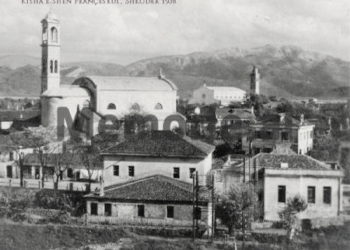
The next morning, around 5:40 AM, I left the house with my father to go toward the designated location. The road was filled with people in “canvas suits” (Sigurimi agents) who followed us and observed us step by step, from the “January 11” school (today “Edith Durham”), all the way to the Neighborhood building near the “Petro Nini Luarasi” school.
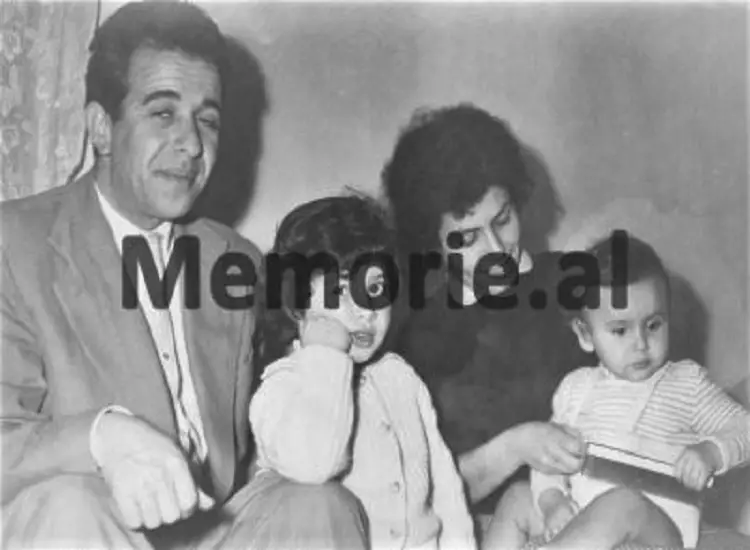
On the way, my father instructed me on what I should do if something happened to him. Having been imprisoned by the Italian fascists when he was a student in Florence in the winter of 1941, and arrested by the Nazis in the Tirana prison in the summer of 1944, it was understood that he did not rule out even a possible arrest that very October morning in Tirana.
That year had been particularly heavy for our entire family. In February and March, two uncles (Ylli and Xhevat Alibali) had been arrested for “hostile activity,” and in July, they had been sentenced to 10 years of imprisonment each.
In June, my brother, Ilir, and I had been “judged” by the youth organizations of the schools we attended and were expelled from them, “for distinct foreign manifestations of bourgeois-revisionist ideology.” This extreme and utterly unusual repressive measure against two tender youths practically placed an indelible stain and completely closed off our future.
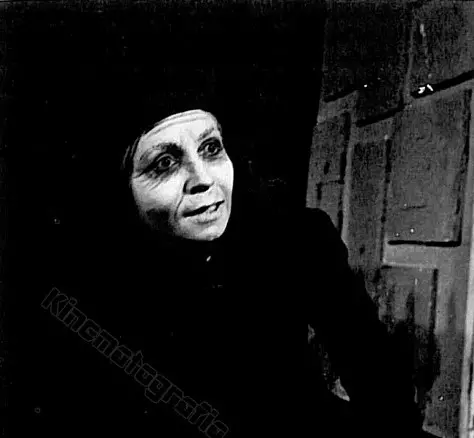
My mother, an artist at the Opera and Ballet Theater and a lead actress in a distinguished film, had been fired from her job and then suddenly forced into early retirement, while my father, for “manifestations of liberalism and lack of vigilance,” had been sent “for re-education” as a three-shift laborer in the press and stamping sector at the “Partizani” Plant.
And so, it seemed, the terror and repression were to continue further and more fiercely.
The Loss of Freedom
As we waited in silence that morning of October 14 before the Neighborhood Chairman’s office, Kozeta M., the daughter of another “enemy of the Party,” entered the hall. “Good morning,” she said, shaken, and immediately asked: “Do you know anything about why they have called us?”
Meanwhile, the Chairman’s door opened and they called my father’s name. He entered calmly and with dignity. After more than 5 minutes, which felt like centuries to me, he came out. He gestured to Kozeta M. that something not good was expected, and we walked away slowly.
On the road, he told me: “They just read to me Decision No. 5 of the Central Commission of Internment and Deportations. We are being interned for 6 months to 5 years, in the village of Labovë e Vogël, Gjirokastër. Departure from Tirana within 24 hours.”
We returned home slowly. The people in “canvas suits” were everywhere, and now that we had received the notice, they surveilled us quite openly and without any hesitation. We notified our mother and brother. The bad premonition of the night before had been proven true. We had lost our freedom.
The Confrontation
Suddenly, everything had been overturned. Now, quick decisions and steps had to be taken. Everything had to be done with care and composure. There was no other way.
First, we had to notify our grandparents and relatives. Second, we had to start packing our belongings and furniture. Third, I had to make the disconnection from school. The hope was to continue it somewhere else, in our new and unknown place of residence.
The separation from the four grandparents was the most difficult part. Coming from Shkodra and Dibra, and having supported the independence of Albania, having experienced the First World War, the Kingdom of Zog, the fascist and Nazi occupation, they found it hard to understand how, in the twilight of their lives, the communist regime could separate them while still alive from their children and grandchildren.
The other difficult part was the preparation for the long road toward the South.
“How many trucks will you need,” I remember they asked us at some point. We thought that one “Zis” would be enough.
Meanwhile, a good portion of the belongings, including the living room furniture, some books, and documents, we managed to carry for safekeeping to the house of the maternal grandfather, Faik Sharofi. Hope, who dies last, kept us alive and there remained the belief that we would return someday.
During the day, the Municipal Housing Enterprise, otherwise known as State Property, sent two employees to our apartment to close the rental contract. During the inspection of the residence, they noticed a small crack in a sink. Without hesitation, they charged us for the sink as a repayment obligation, with an amount that was not small for the time.
That bill would later be deducted from our daily wage until fully paid every 15 days, from our earnings as manual laborers in the brigade of Labovë e Vogël, of the “Muzafer Asqeri” Agricultural Enterprise in the Gjirokastër district.
I went to the school secretariat to get the transfer document. I met the deputy director, who was to sign it.
-“Where will you be transferred,” she asked me?
-“To Labovë of Gjirokastër,” I told her.
-“Oh, but that is a city,” she said to me, surely to ease or comfort me a little…!
Apparently, she was referring to Labova e Kryqit, which was divided into the Upper and the Lower. The next day, we learned for certain that, among the four Labovas of Gjirokastër, our destination was Labovë e Vogël, or that of Odrie or Zhapa, practically one of the most picturesque but also most distant and isolated villages of Gjirokastër.
That morning, I departed permanently from my school, where even though I was among the best students, only a few months earlier, I had been subjected to an unprecedented process of terrible inquisition. The origin had been a book in Italian by Freud, “Five Lectures on Psychoanalysis.” I will describe the event another time, supported also by the detailed notes I kept back then. Briefly, quite suddenly, I was accused of having wanted to translate and spread the “forbidden” book.
After countless meetings, I had even emerged as a “member of a group of youths who aimed to spread forbidden literature,” which included Zana G., of the 4th year, Ilir K., of the 2nd year, and I, who was only in my 1st year. The event caused a great echo in the Tirana of “hostile groups” that were discovered every six months. Ultimately, despite being the youngest in age, it happened that I suffered the harshest punishments and was expelled from the youth organization.
The Departure
The last night in Tirana also passed without sleep. Rain no longer fell. When it got dark, we noticed that behind the apartment door, on the stairs, stood an armed person. The loss or restriction of freedom had begun since that evening…!
Early in the morning, they notified us that the truck had arrived.
We began carrying the belongings. Meanwhile, I went up one floor, to the third floor, and knocked on the apartment of Petraq M., to return something I had borrowed from them. His wife, Ermioni, my primary school teacher, lived there too. She could not come out for the bitter moment of separation…!
We continued to load the truck. The surprise was not long in coming. There was no more room for our belongings. However, the “relevant organs” had anticipated everything. It wasn’t long before the second “Zis” arrived.
We loaded that one quickly as well.
We closed the apartment and handed over the key. We descended the stairs for the last time – those stairs we had traversed thousands of times.
It was around 7:30 AM, the time when I usually set off for school. From the entrance of the building across from us, Building No. 9, it often happened that Ilira H. and Vladimir M. would come out at the same time as me. Ilira, a brilliant student, especially in mathematics and the exact sciences, was my classmate.
She was among the few who had stood by me during the inquisitorial meetings against me at school a few months earlier. The other was also a student at “Petro Nini,” but one year above. After greeting each other, we used to walk to school together.
But these memories and encounters now belonged to the past.
As we were carrying the last belongings into the “Zis” trucks, suddenly our uncle, Faik Sharofi, an epidemiologist, arrived on a bicycle from his house on “Hoxha Tahsin” St. to say goodbye, with some medicine for my mother, who was going through a worsened health condition.
Defying everything, and with an admirable love and courage, our uncle came ostensibly to bring us something to eat during the journey, prepared by his wife. However, his arrival at those moments was a rare omen of hope, faith, bravery, and human affection. We never forgot it!
As we boarded the truck and looked for the last time at the courtyard and the building where I was born and raised, from the balcony of the third floor of the building opposite, a lady came out and waved to us. It was the well-known soprano Nina M. Another unprecedented and unforgettable gesture of courage, defiance, humanity, and civic solidarity!
In each of the two trucks, a policeman was placed, and we set off for the long road toward the deep South. They did my mother a favor: they placed her in the first truck, next to the driver. Her tears did not stop the whole way. The rest of us were in the back, together with the policeman.
Together with us, that morning of October 15, a total of 84 families said goodbye to Tirana, all interned on the same day in one of the most massive strikes of communist repression in Albania. The fates of hundreds of innocent people were suddenly overturned that October day in 1975, and their lives were radically transformed.
The next day, on October 16, while the newly interned began to face their new and unexpected lives, throughout Tirana, mass meetings were organized, where the families who had departed the day before were denounced as “enemies of the party” and the system.
My aunt, Drita H., was “invited” to assist precisely in the meeting of our former neighborhood, where the “enemy” family of her sister, Adivie, now “purged” from Tirana and settled in internment in Labovë e Vogël of Zhapa in Gjirokastër, was denounced and slandered.
The symbolism and coincidence with the dictator’s birthday could not have been more striking. And more hitting.
And Today?
After all these years, while Albanian society moves forward slowly and with clumsy feet, efforts are also being made to address the past with attention. However, very little has been done to restore dignity and compensate the broad mass of political internees of the communist regime in Albania.
In occasional debates, which not infrequently go off the rails of professional, democratic, ethical, and civic discourse in Albania, it often happens in an entirely absurd way that critical thought or thought different from the narrative of interest groups is labeled with terms and methods similar to those of the communist dictatorship…!
“When civic discourse goes off the rails, we have the Constitution as a model,” a former member of the US Supreme Court, A. Kennedy, would state more or less some time ago.
The Albanians today, unfortunately, do not have the luxury of a fundamental document similar to the American Constitution.
However, we believe they unite on one point: that all persons interned and deported through administrative routes for political reasons in Albania, from the late 1940s until the end of the 1980s, should have the difficult time of the long years of internment recognized.
While commendable work has been done for the mass of political prisoners, we reiterate that little or nothing has been done for the political internees.
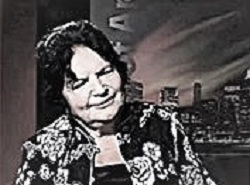
The actress in the role of “Mamica Kastrioti,” who is perhaps the only artist in the world to be interned, spent over 13 years in internment, and rightly complains that she and many others are still not recognized for the long period of lost freedom.
Perhaps an initiative by the Assembly of Albania could undertake as soon as possible to correct this unusual deficiency. This would include concrete steps for priority treatment in administration employment (or for housing) for the shrinking generation of those fit for work from the class of former political internees.
Being conscious of the difficulties in the state budget, it is of fundamental importance that the initiative in favor of former political internees in Albania – where funds from foreign foundations and NGOs could also be joined – ensures material compensation, however small and symbolic, for the long days of internment, days which cannot be returned to the former internees.
But at the very least, their freedom, limited and brutally lost, as well as their still trampled dignity, can and must be affirmed and recognized to them. Memorie.al