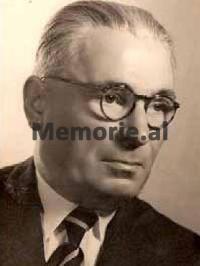

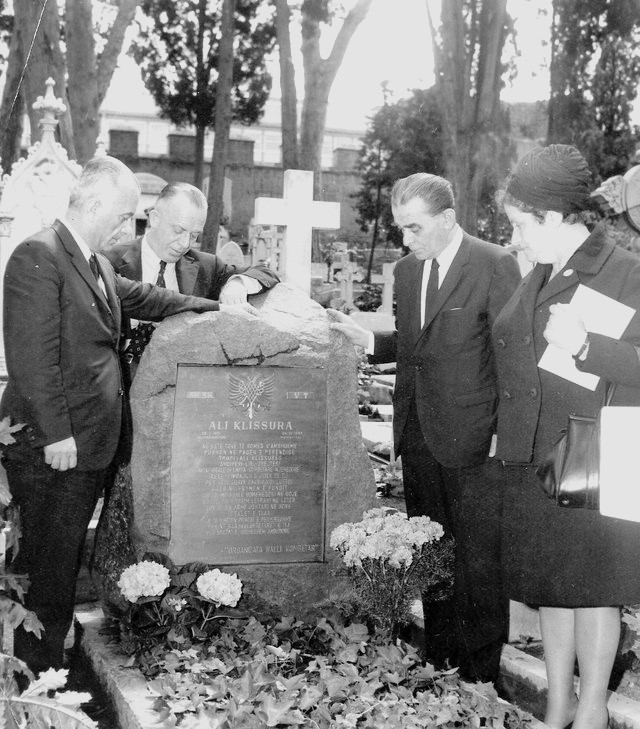
Memorie.al / Who is Ali Këlcyra? A work by historian Tanush Frashëri fulfills the purpose of viewing the figure of the patriotic democrat beyond the legends of the ALP (Party of Labour of Albania), which until yesterday had placed him in its historiography as a “traitor,” “enemy,” “collaborationist,” “monster” (bajloz), etc. He spent many years in exile; a death sentence was signed against him by the judiciary of the Monarchy; the Albanian Communist Party sought to “sell” him to the Anglo-American Allies as a war criminal; and from the day the communist dictatorship was installed until he closed his eyes abroad, in Italy in 1963 and beyond, the anti-Ali Këlcyra campaign has lingered like a shadow. Now, a work dedicated to this figure, based on archival sources and in the light of the truth, is being promoted outside of Albania.
Additionally, for him and “The Highland Lute” (Lahuta e Malcisë) by Father Gjergj Fishta -translated into English by Robert Elsie and published by “I.B. Tauris Publishers” – a reception was held in the House of Commons of the British Parliament in London. This was achieved through the cooperation of the All-Party British-Albanian Parliamentary Group with the “Centre for Albanian Studies,” directed by publicist Bejtullah Destani.
The “Çabej” Publishing House, led by Brikena Çabej, together with this Centre, has brought into Albanian the book “Ali Këlcyra, the Red-and-Black Aristocrat,” the result of several years of research by scholar Tanush Frashëri.
Ali Këlcyra was born in Këlcyrë on May 28, 1891. He received his early education in his birthplace. He attended the “Galatasaray” Lyceum in Istanbul and studied at “Mülkiye,” a higher school of political-administrative and economic sciences. With the outbreak of the First Balkan War, he returned to Këlcyrë, and the declaration of independence found him in his homeland. During the re-occupation of the South by Greek armies, he fled with other refugees (muhaxhirë) to Vlora.
On their behalf, he greeted Prince Wied and Princess Sophie, who came to visit those displaced from the occupied zones. He left his homeland and settled in San Demetrio Corone, among the Arbëreshë of Italy. In 1915, he continued his studies at the Faculty of Law in Rome, a time when he embraced the ideas of social democracy and befriended Avni Rustemi and his comrade-in-arms, Stavro Vinjau.
He returned to his homeland a year later and, together with Themistokli Gërmenji and others undertook the initiative to create Albanian national guerrilla units (çeta). In 1918, he returned again, going to Vlora where, in a secret meeting, the organization known as “National Defense” (Mbrojtja Kombëtare) was founded.
The Italian command expelled him from the territories under its administration. The National Defense Committees now aimed to organize an armed struggle against the Italians, who were present there under the guise of “protection” from the Greek armies stationed around the border.
He participated in the Congress of Lushnje, was elected to the National Assembly as a deputy for the prefecture of Gjirokastra, and in the very first session, proposed that the title “Bey” be removed from the roll call of deputies.
The “June Movement” marked his first exile from his homeland for 15 years. In 1925, the organization “BASHKOMB” was founded in Bari, where he was elected to the steering committee and served as its secretary. A year later, the political investigation court in Tirana issued a “Letter Rogatory” (Letër përdhuni) against him to be investigated on charges of “propaganda against the state, the regime, and the President of the Republic.” His death sentence and the confiscation of his property were published in the Official Gazette.
During his stay in Paris, Ali Këlcyra wrote reports on the situation in Albania and the pro-fascist policies of King Zog, writing for dailies such as “Le Quotidien,” “Le Matin,” etc. In 1939, along with Mehdi Frashëri, he was at the head of the Resistance Front, which evolved into “Albanian Nationalism, Balli Kombëtar.”
In 1944, from the podium of the “Balli Kombëtar” Congress, he once again raised the need to call upon the communists to renounce the civil war. At this moment, he proposed the idea of creating a National Front to withstand the war on two fronts.
In November of that year, he arrived in Bari with his family in a boat and surrendered along with others to the Allies. He was held in the Santa Fara camp. By academic training, Ali Këlcyra was a jurist – a jurist with political inclinations, whose views were founded upon Diderot’s “Natural Law,” Montesquieu’s historico-political treatise “The Spirit of the Laws,” and particularly Rousseau’s political treatise “The Social Contract.”
“A figure that possessed a dialectical vision for establishing democracy and the rule of law, in accordance with the political and statutory alternatives posed by his country’s practical reality,” writes Tanush Frashëri.
The author claims he came to know the real Ali Këlcyra and was magnetized by this figure, especially when he saw in him “the readiness, will, and patience to debate with his political opponents during the fratricidal war regarding the needs of the country and the people in the tragic moments they were facing (1943); and his impartiality in judging and positioning himself toward the events he writes about, in most of which he was an active participant.”
The author, Tanush Frashëri, does not hesitate to emphasize those historians of yesterday – and even those of today who are rewriting history – who became part of the anti-Ali Këlcyra campaign following the stance of the ALP, which called him a “tool of the fascists,” “traitor,” etc.
This stance toward one of the leaders of “Balli Kombëtar” had its roots in the time when the Albanian Communist Party urged the Allies in Italy to hand over the oppositionists – labeling them as collaborationists – as war criminals.
“I have tried to write without anger and with impartiality to tell the truth, for the truth offends no one, especially since; ‘He who knows the truth and tells a lie is a criminal,'” writes the author, citing Bertolt Brecht.
This historical work is based on detailed and arduous archival research in the Archives of the Italian Republic, the British archives, and of course, the Albanian archives and the Këlcyra family archival fund. / Memorie.al