
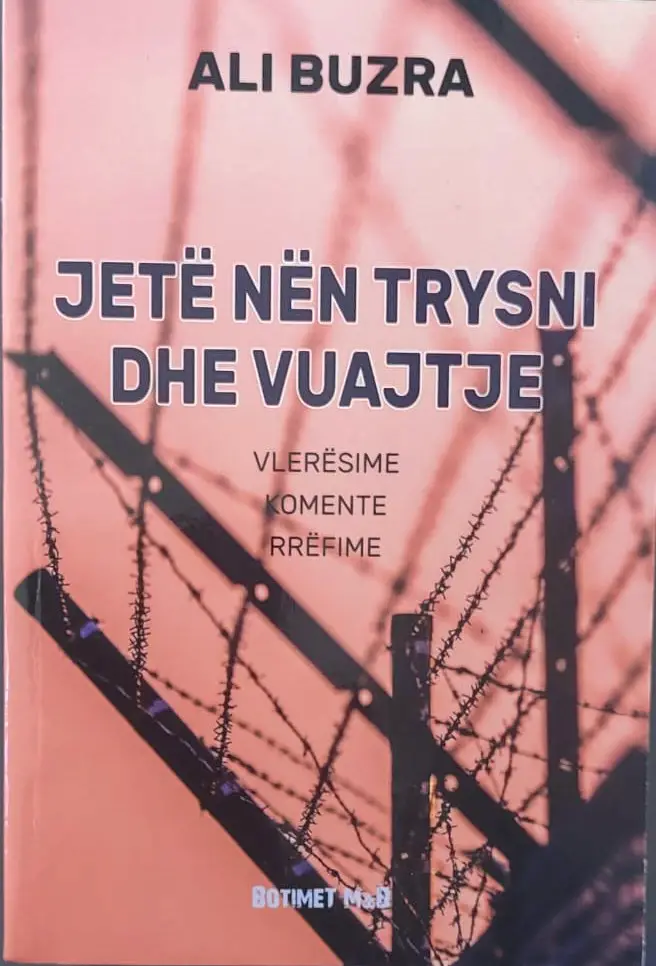
By Ali Buzra
Part One
LIFE UNDER PRESSURE AND SUFFERING
(ASSESSMENTS, COMMENTS, NARRATIONS)
Memorie.al / At the request and desire of the author, as his editor and first reader, I will briefly share with you what I experienced in this encounter with this book, which is his second (following the book “Gizaveshi through the Years”), and which naturally continues his unique writing style. The sincerity and candidness of the narration, the simple language without modifications, the precision of the episodes, and the absence of – or the refusal to exploit – a post-processed, intentional fantasy have, in my opinion, served the author positively. He comes to the reader in his original form, inviting us at the very least to recognize unknown human fates and pain, whether encountered by chance or otherwise, leaving us to reflect as a beginning of awareness toward a catharsis so necessary for the Albanian conscience.
The chilling testimonies of people – victims of a paranoia similar to those of the infamous Nazi camps, but now in the name of the “dictatorship of the proletariat” – come from the author as part of memories or direct contacts with them or their family members, involving actors both living and dead, preserved in the author’s memory over a long period.
Specifically, this book is dedicated to those families, to those people who experienced the hell of communist persecution for decades; during the Nazi-Fascist occupation, but also after the establishment of the communist regime in Albania. They were individuals, families, and entire clans who, in the name of patriotism, envisioned a free Albania but ended up in terrible communist prisons and camps.
This book, in its current form, is the result of long work in collecting information, research into books or writings on this matter, as well as direct interviews with people who individually experienced this hell or their relatives, thus becoming part of the birth and growth of this book.
The author does not aim to draw conclusions or provide final verdicts on a sharp reality that continues to be present today, but to assist even slightly in enriching this problematic issue that, surprisingly, continues to be un-unified in positions and often contradictory. (It seems that even the authors themselves could not escape indoctrination, inadvertently becoming part of the “persecution”).
In this context, this book undoubtedly constitutes a new approach in analogy with studies of the same period. Therefore, even when we may not agree with certain assessments and conclusions (derived from different sources and perspectives), let us judge the book as a valuable contribution – part of the respect for those people, for their lives and sufferings, for their resilience and stoic silence.
We all have an obligation to those clans, families, or specific persons who experienced or survived this hell, who endured suffering and kept the pain to themselves, and who waits at least to find peace as compensation for the recognition that has been missing over the years.
Bedri Kaza
General Overview of Historical-Temporal Contexts Before and During WWII in Albania
- General overview of the historical context of the period until the Fascist occupation of Albania.
The wars of the Albanian people in general, and those of the various areas of Librazhd in particular, are part of the centuries-old history of our nation. Overestimating one period over another can be seen more as passion than reality. In certain historical and political circumstances, the Albanian people have risen in armed uprising against foreign occupiers, while in unfavorable situations; they did not join the fight.
Thus, although Albanians developed a series of armed uprisings against Ottoman rule in the years 1909-1910 and 1911-1912, they did not participate in the anti-Ottoman Balkan War. Even in World War I, there was no organized nationwide resistance of the Albanian people, although Albanian territory was encroached upon and occupied by several armies of both warring blocs. During this war, Serbo-Montenegrin, Austro-Hungarian, Italian, Greek, Bulgarian, and French forces entered Albania.
This has its own reasons, which we are not analyzing in detail here, but I must emphasize that the atrocities of the occupying armies of neighboring states – such as the Serbian, Montenegrin, and Greek – remain vivid in the memory of our people, both inside and outside the state borders. On the other hand, the Austrians are not known for reprisals of this nature. Thus, in the Austro-Hungarian as well as the French occupation zones, an administration with Albanian officials was created, and Albanian schools and the national flag were allowed.
World War II occurred under different international political circumstances. The decisions of the Peace Conference after WWI were unfair. They were made in the interest of the winning powers of the Entente Bloc, mainly England and France, enabling the subsequent division of the world into spheres of influence in their favor, which sparked dissatisfaction among the losing states. On the other hand, right-wing totalitarian dictatorships were established in Europe; Fascist in Italy and Nazi in Germany, which manifested aggressive policies.
Meanwhile, in the Great Russian state, the left-wing communist totalitarian dictatorship was consolidated and strengthened. European democracies, England and France, worked to prevent the spread of communism to the West by not reacting to aggressive Fascist and Nazi policies, evaluating them as barriers against communism. They reacted only after the German attack on Poland on September 1, 1939. Fearing the encroachment upon their territories, they declared war on Germany on September 3. Meanwhile, the “great” Stalin, trumpeted as a “hero” of WWII, as early as August 1939, signed the “Non-Aggression Pact” with Germany, known as the Secret Ribbentrop-Molotov Pact, which provided for the division of Polish territory.
In this manner, the western part of Poland was occupied by the German army, while the eastern part by the Soviet army. The latter also occupied the territories of the Baltic States; Latvia, Lithuania, Estonia, and a part of Finland. When Germany advanced north by occupying Denmark and Norway, and later south into the Netherlands, Belgium, and Luxembourg, the Soviet Union occupied Bessarabia and Moldavia – territories of Romania.
Thus, the Soviet Union, led by Stalin, became part of aggressive Nazi-Fascist policies. It was only after June 22, 1941, when Hitler began the attack on Soviet Russia, that Stalin, in response, changed course, becoming part of the Allied Bloc against Nazi-Fascism.
But would the Soviet Union have joined the coalition if the Non-Aggression Pact had been maintained? It is likely that the two major dictatorial states of the time, Nazi Germany and Communist Russia, would have wanted to establish their rule in different regions of the world. Another convincing fact is that left-wing totalitarian states have constantly propagated internationalism only for demagoguery.
Even earlier, Stalin’s predecessor, Lenin, as soon as he took power by overthrowing the Provisional Government in Russia in 1917, declared withdrawal from WWI and made a peace agreement with the Germans, breaking away from the Entente Bloc allies at the very peak of the war period and throwing the people into a bloody civil war for power, with tragic consequences and nearly 5 million victims.
Nevertheless, we believe that one cannot place on the same balance the decisive and heroic struggle of the Russian people against German Nazism with the reactionary and anti-democratic policies of the Soviet leadership led by Stalin; before, during, and after WWII. It was precisely these policies that had their influence in many countries of Central and Eastern Europe and the Balkans.
Above, we presented a panoramic view of the main international situations and events before and after the start of WWII, which undoubtedly had their references and concrete impacts in Albania as well.
- The Position of Albanians and Various Political Forces Toward the Nazi-Fascist Occupation. Political Panorama of the 1939-1944 Period. The Influence of Yugoslav Representatives on the Communist Movement in Albania.
On April 7, 1939, Fascist Italy attacked and subsequently occupied Albania. England and France did not react to this occupation. As is known, the Albanian people met the Fascist occupation with deep indignation. There were several hubs of resistance in the country’s main ports. The strongest was in the port of Durrës, organized by Gendarmerie Commander Abaz Kupi, where Marine Sergeant Mujo Ulqinaku was also killed.
From the first days of April 1939, the Albanian government did not accept the demands and ultimatum of the Italian government, which led to the loss of the country’s independence. Parliament rejected them, and King Zog himself declared over Radio Tirana his position and that of the Albanian state, while simultaneously seeking international aid, but found no support. In this situation, along with the government cabinet, he left the country after the Fascist occupation.
Regarding this stance, representatives of the past system for 45 years called him a traitor who sold the country to Fascist Italy, stole the gold, etc. Today, there are many positions and controversies surrounding this fact which divide into opposing opinions. Regardless, I think that even if the path of organized and armed resistance by the Albanian army had been chosen, the occupation of the country would have occurred. Italy had attacked with 20,000 soldiers equipped with modern weaponry for the time, 300 aircraft, over 100 warships, as well as many armored vehicles.
Realistically, at that time, the Albanian state did not have the capacity or combat means to withstand such an aggression planned and organized by a power such as Fascist Italy. And what would the consequences in human and material losses have been? Therefore, this problem remains open for future discussion. It will be impartial historiography that will have its say on whether King Zog’s departure was treason or a move of the moment.
Meanwhile, almost similar situations, though slightly later, were repeated in Yugoslavia and Greece, where their governments signed capitulation to Italo-German forces. Even France, well-prepared for defensive war and one of the militarily powerful states of the time, found itself between two strikes and, on June 14, 1940, signed its capitulation, and the Germans occupied Paris.
During the years 1939-1941, armed resistance began to be organized with small groups and combat units against the occupier. Several armed bands (çeta) were formed, such as those of Myslym Peza, Safet Butka, Hysni Lepenica, Haxhi Lleshi, Abaz Kupi, Muharrem Bajraktari, etc., which organized attacks and sabotage against the occupying forces in various areas of the country. These bands were led by nationalist patriotic elements who were not communists.
With the entry of the Soviet Union into the war alongside the Allied Bloc, the latter was greatly strengthened. The Soviet state possessed immense possibilities in military equipment and human forces from which the decisive blow to Nazi Germany would come. Such an event was experienced positively, awakening the hopes of occupied countries and encouraging the expansion of communist movements in Central and Eastern Europe and the Balkans. The peoples of these countries, including the Albanians, saw in this country a “big brother,” inspiring and faith-giving.
Meanwhile, the Soviet Union and the Comintern would engage totally so that, simultaneously with the victory in the war against Nazi-Fascism, communist regimes would be installed in the liberated countries. Naturally, this policy clashed with the democratic stance of the other allied countries; England, the USA, and France, which would try to prevent the spread of communism, although the priority was the alliance for the victory of the common liberation war.
The opposing stances of the democratic countries and the Soviet Union would manifest clearly after the fall of the “Iron Bloc” and the end of WWII, which became known in history as the “Cold War” and ended with the fall of totalitarian communist regimes in the 1980s-90s.
In this chronological span of events during WWII, as in many other countries, in November 1941, the Albanian Communist Party (PKSH) was created. Representatives of the Yugoslav Communist Party (PKJ) participated in the creation of the PKSH in the capacity of Comintern envoys, staying with it throughout the war period. Dushan Mugosha and Miladin Popoviçi significantly influenced all decisions made by the PKSH, as well as in the General Staff of the National Liberation Army.
The population of Kosovo and other Albanian lands in Yugoslavia – and not only that, but also that of the central and northern regions of Albania – has over the years been the object of attack and fierce violence by Serbo-Montenegrin forces. In this specific case, where two Yugoslav emissaries – representatives of the centuries-old former occupiers of the Albanian people – stayed near, organized, and led the PKSH against a new occupier, it could not be normal or without consequences.
This connection and dependence of the PKSH on the Yugoslav party could not fail to have its influence inside and outside Albania. In this context, a part of the country’s intellectual elite and the traditional layer of Albanian nobility in the north and south of the country, who constituted the nationalist wing, saw Slavic communism as Albania’s greatest enemy and as an obstacle to national unification.
In November 1942, the Balli Kombëtar (National Front) party was created, headed by Mit’hat Frashëri, one of the prominent personalities of the time. Regarding the creation of Balli Kombëtar, there is also another reliable version: that the origin of the organization’s creation dates to April 8, 1939, where nationalist and patriotic elements, in the circumstances created, decided to form this organization as a serious reaction to the Fascist occupation of the country.
In November 1943, the Legaliteti (Legality) Party (Zogist) was created, led by Abaz Kupi, a former officer of the Albanian Kingdom and organizer of the resistance in Durrës against the Italian occupying forces. In the program of all three political groupings, the first point included the struggle against the foreign occupier.
Balli and Legaliteti envisioned an Ethnic Albania in their program, while the PKSH, being under the influence of the PKJ, did not include this in its program. The nationalist view of the war, in the political situation Albania was passing through, is clearly expressed in the report prepared by Muharrem Bajraktari in February 1944, sent to the British mission to be transmitted to Anthony Eden and Winston Churchill./ Memorie.al