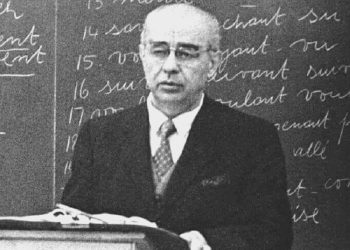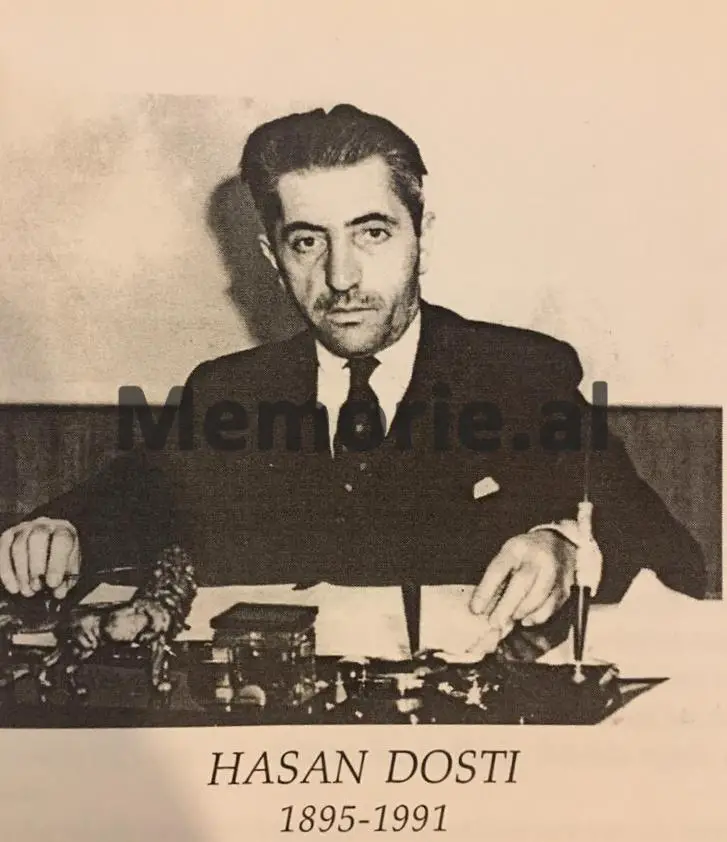



Memorie.al / Born and passed in peace and prosperity, a life naturally has its own charms. Born and passed in wars, despite great privations, it again has its own charms. Furthermore, when these wars are inspired by the divine ideal of the nation’s freedom, then a human life finds it’s most sacred meaning. Such a life is that of Hasan Dosti, otherwise called Hasan Kosova. Born in the village of Kardhiq in Gjirokastra, in 1895, Hasan would show a great love for books since childhood. His parents sent him to Janina and specifically to the well-known “Zosimea” gymnasium, where years before the Frashëri brothers had also been educated. The wide spectrum of culture that the gymnasium encompassed influenced the formation of a strong moral education in Hasan Dosti, until he closed his eyes at the age of 96.
Janina, besides that knowledge gained from the school benches, equipped little Hasan from Kardhiq with another sense as well, that of national pride. The song of the Birbilenj (the nightingales), the history of Albanian sea heroes, the proud castle of Ali Pashë Tepelena, would accompany almost all the youth of “Zosimea” during the nights, reminding them of a history as tragic as it was proud of their nation. Later, always with high marks, Hasan finishes the Turkish gymnasium. Something has begun to awaken now in the soul of the brave man from Kardhiq.
The outbreak of the First World War brought a sea of turmoil and suffering for Albanians. The tragic fragmentation of the 1913 borders, the scaled attacks of Greek andartes in the South and the ferocity of the Slavs on the banks of the Drin, further complicated the situation. If you add to this fury of the invading neighbors also the internal anarchy, you will be able to understand quite easily that Albania resembled a wooden boat, left at the mercy of dangerous waves in the middle of a turbulent ocean. Without protection, without a steersman, alone, this boat would naturally do whatever was possible to emerge from the whirlpools of the storm.
Greek andartes, meanwhile, burn more than half of the houses in Kardhiq. They were advancing towards Tepelena, watering their dream of “Vorio-Epirus” with the pure and innocent blood of Albanians. Hasan’s family, together with hundreds of other Gjirokastrian families, is forced to take the road and flee from the “scorched earth” that the Greek armies practiced on the secular Albanian territory. They settled in Vlora, where the fire of the Greek chauvinists, however, had not reached.
By now, Hasan Dosti’s life had taken another path. Intuitively, the boy from Kardhiq understood that his generation, besides bravery and knowledge, would need to be fed incessantly with feelings of honest nationalism. The friends and companions of Hasan Dosti would now be the patriotic youth of Vlora, those who organized and led the resistance against the Greeks, those who alongside their fathers wrote with blood the epic of the War of Vlora.
Seeing in Hasan’s character many virtues, the Government under the leadership of Sulejman Delvina appoints the boy from Kardhiq to the position of general secretary of the Prefecture of Gjirokastra. Here, Hasan distinguishes himself not only for honesty, but also for correctness and prudence towards some Albanian elements with pro-Greek stances.
His friends of this time are Bajo Topulli and Kolë Tromara. Together they also organize an association, the program of which dealt, among other things, with the promotion of national feeling, with the knowledge of history and traditions of all ethnic Albanian lands, with the idea of the fastest possible union of these lands into the trunk of the mother state.
It was the year 1922, when Hasan Dosti receives a scholarship from the Albanian state to study in France; by now he is mature in judgments and highly capable of understanding the current situation and the paths of changes for the future of Albania. He graduates with excellent results in the branch of Law in France and completes his studies by defending the degree of Doctor of Law. During the years of study, in French intellectual circles, he debates the trampled rights of his own people, often recalling history.
Together with other nationalists who had not reconciled with the monarchist regime, Hasan Dosti puts forward the idea of a democratic popular movement, where human freedoms would occupy the place they deserved in social life. Although the social background of Albania in the Monarchy was very dark, the ideas and activities of the nationalists in emigration did not go unnoticed.
With his arrival in Albania, Hasan realizes an old dream of his. Precisely to serve his own people, giving them (within the legal framework) the justice so denied over the years. But it must be said that to an extent the hierarchies of the then Albanian state naturally suffered from that mentality of bribes and deals.
Thus, not agreeing with the state’s stance towards the elementary rights of the individual, Hasan Dosti openly opposes some arbitrary orders. Furthermore, equipped with logic and courage, Dosti prefers to judge and publish many violations within the Court of Cassation (Diktimi) where he worked. This is the reason why the rebel Hasan Dosti is dismissed from work along with some of his colleagues in that court.
However, the ideas of nationalism would never discourage Hasan. Through them, he would henceforth be connected with brave and wise men, whose words would be carved sharply into the contours of the 30s. Together with Hysni Lepenica, Bilal Golemi, Skënder Muço, and others, in the early 30s, Dosti undertakes the creation of the organization “The Vlora Movement” (Lëvizja e Vlorës).
Besides the demands for the democratization of all Albanian aspects of the time, this organization, turning its eyes toward the West, envisioned the Republic as the most suitable regime of government in Albania. The members of this association linked this regime especially with the mentality and traditions of our people.
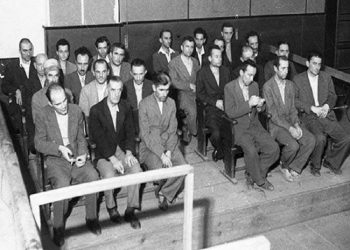
The blow that the “Vlora Movement” subsequently received showed what certain forces in Albania, supported also by high-ranking officials and military personnel of the administration, were perhaps not capable of understanding the prosperity of their nation. Furthermore, these forces saw personal interests, forgetting the major interests of the homeland. In the ranks of the convicted of this organization was undoubtedly also Hasan Dosti who, out of 15 years, suffered more than three years in prison, thanks to the periodic amnesties decreed by King Zog.
The great hour of nationalism strikes in early April of 1939. The moments in the tumbling of time carried upon their shoulders the heavy weight of tragedy and the new history of the Albanians. A recently discovered document sheds light on the true date of the creation of “Balli Kombëtar,” refuting the communist historiography that brings this day to the end of 1943. In this document, among other things, it is said: “As is known, Albania on April 7, 1939, Black Friday, was invaded by fascist Italy.
Immediately, in the second week of that month, a secret Committee was formed in Tirana under the chairmanship of the patriot Mid’hat Frashëri, baptized with the name ‘Balli Kombëtar’. The Committee drafts a program of action, which contains within the limits of possibilities a sort of resistance…! One of the founding members of the Committee was H. Dosti…”! (Magazine “Koha” Tirana, May 30, 1998 – “Hasan Dosti or the true history of ‘Balli Kombëtar'”, with author Dashnor Kaloçi).
By now the path of the patriot from Kardhiq of Gjirokastra was fully determined, as one of the leaders of “Balli Kombëtar” he is heard wherever he goes. His word has the power of judgment. His action is decisive and timely. In close friendship with Mid’hat Frashëri and Faik Quku, Hasan Dosti works for the implementation of the eight-point program of nationalism, later with some temporal corrections the program called THE DECALOGUE, as one of the most powerful calls of the time, the relevance of which still remains for us Albanians at this end of the century. Although he had studied law, the geography and ancient history of the Arbëresh/Albanians would remain a great passion until the end of his life.
During the years of the fascist occupation, alongside the duties assigned by “Balli Kombëtar,” Hasan cooperates closely with the patriot, tireless researcher, and nationalist Ahmet Gashi, and together they compile the first ethnic map of Albania. The jurists of Kosovo would also remain among Dosti’s closest companions and friends.
Mukje would be a culminating point in the life and activity of all Albanian nationalists. Convinced of a complete union of all political forces against the occupier, the nationalists sat at the negotiation table with some of the communist leaders, just like brother with brother. They did not prejudge anyone, but on the contrary, found a common language by recalling the great assemblies of the Albanian besa.
Mukje decided the creation of the Committee for the Salvation of Albania and unanimously, by all participants, Hasan Dosti was voted at the head of this Committee. The nationalists and communists of Mukje saw in Hasan Dosti not only youthful bravery and courage, but also his special ability for the cold judgment of all situations.
What happened next with Mukje is known. The friendship of the Albanian communists with the Yugoslav ones would serve as a knife in the back of the Albanian brotherhood. The blood shed from that wound even today has not stopped. The wound flows and moans. Within this moaning that never ends are the lives of thousands of Albanians taken by Slav-communist cunning.
Together with those who took the paths of exile in the autumn of 1944 was also Hasan Dosti. The Germans, during their departure, burn the distinguished nationalist’s own house in Tirana and execute his wife and brother. This would weaken the fearless brave man, but nevertheless, he feels the warmth of his generation of nationalists that resembled that fire unextinguished in the frosts of life. In the refugee camps wherever he was, Hasan would sit down to work, to write, to shed light on the truths.
Separately, for Albanian nationalism, he would find and illuminate all paths for the union of right-wing forces as the only possibility to fight communism. With the mysterious death of Mid’hat Frashëri, he would be elected at the head of the Committee “Free Albania.” This Committee became a warm nest for all exiled Albanians and a base for the fight against the communist regime.
In the function of the chairman of the Committee “Free Albania,” Dosti played a large role in unmasking the Tirana regime. It was the Radical wing of “Balli Kombëtar.” In a message broadcast on Radio London in 1950, with that manly voice of his, with hands trembling with emotion, he addressed the Albanians:
“One year of communist terror, several years of torture, bloodshed, and suffering, passed in the Albanian calendar, as in the blackest times our history has known. Even the momentum of the barbarians did not cause so many miseries upon our land, where hunger and evil fear reign from the fatal day that a group of exalted agents mortgaged Albania in the land registry of Belgrade and Moscow…”! (Speech on the BBC, 1950).
Everywhere in Italy, France, Geneva, and as far as Los Angeles, the activity of this nationalist was sensitive. His heart naturally ached because the Government of Tirana had closed his sons within [the country’s] shores, holding them hostage for the ideas and work of their father. But he does not trade for a single moment the great plight of the Motherland for the personal interests of the moment.
Thus, until his heart stopped beating in January of 1991. What did that great heart feel in its last beats? Hard to answer. But the eyes were closed with the beautiful image of democracy that was coming to Albania, where he had left his family, whom he had not seen since November of 1944, when he was forced to leave Albania! / Memorie.al