Memorie.al / Religion and beliefs in Albania were presented as a concern for the communist regime since the first post-war years. Faith in God and all religious practices did not run parallel to communist ideology. Therefore, the leaders of the regime, oriented mainly by Moscow, had periodically undertaken several interventions in government policies toward religions, and in some cases, even in the internal affairs of the communities. Enver Hoxha camouflaged his government’s interventions in religious affairs in the name of the “emancipation of the people.” By 1955, quite a few interventions had been made. But in 1955, the influence of the Soviet Union on religious matters in Albania had been quite evident.
Two documents preserved in the archival fund of the Council of Ministers at the Central State Archive reveal, in addition to Moscow’s influence and interventions, the real extent of the communist regime’s “reforms” regarding religions in our country.
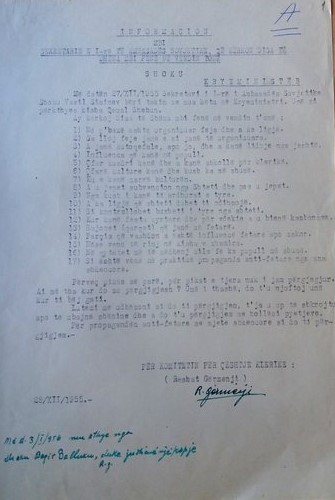
The first document, dated December 28, 1955, is a report on the visit of the First Secretary of the Soviet Embassy, Vasil Siminev, to the Prime Minister’s offices in Tirana on December 27, 1955. He sought explanations for a long series of issues related to the state of religion in Albania. Reshat Gërmenji, Chairman of the Committee for Religious Affairs, informed Prime Minister Mehmet Shehu about the list of requests and questions directed by Vasil Siminev.
He was interested in the basis on which religion was organized, whether there was a law on religions, if they were autocephalous or had foreign ties, what influence they had on the people, whether they received state subsidies, and how their budgets were controlled. He even inquired about the wearing of the veil (perçe) and exact statistics on the percentage of the population by faith in major cities.
Among the long list of questions, his interest in the “cadre” (personnel) stands out: “What cadre do they have and do they have a school for clerics?” This issue was seen by the regime from that time until the total closure of churches and mosques as the “Achilles’ heel” to minimize the strength of religious communities.
It appears this “homework” from Moscow was strictly implemented by Enver Hoxha. In 1967, before launching the final blow, Hoxha singled out the issue of religious personnel as a pillar to be dismantled; without cadres and religious education, religions in Albania would gradually move toward elimination.
Following the information on this visit, the Committee for Religious Affairs prepared a detailed report. This is the second document, which provides invaluable statistical data and reveals the regime’s tendency to interfere deeply in the internal affairs of religious communities.
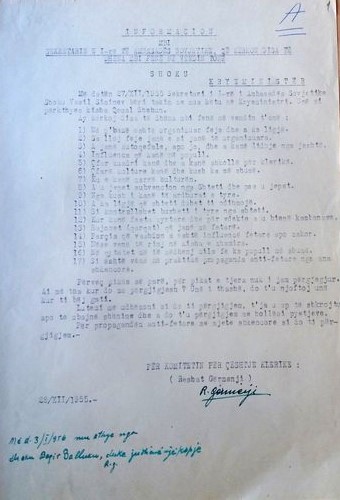
Document I
INFORMATION REGARDING THE FIRST SECRETARY OF THE SOVIET EMBASSY SEEKING DATA ON RELIGION IN OUR COUNTRY
TO: THE COMRADE PRIME MINISTER
On 27/XII/1955, the First Secretary of the Soviet Embassy, Comrade Vasil Siminev, held a meeting with me here at the Prime Ministry. Qemal Shehu served as the translator.
He requested data regarding religion in our country:
- On what basis is religion organized and is there a law?
- How many types of religions are there and how are they organized?
- Are they autocephalous or not, and do they have foreign ties?
- What influence do they have on the people?
- What cadre do they have and do they have a school for clerics?
- What is their cultural level and who has the highest?
- Where did they receive their education/culture?
- Are they given a state subsidy and why?
- From whom do they receive their income?
- Is there a law stating the state must help them?
- How is their budget controlled by the state?
- When they have official holidays or deaths, do they ring the bells?
- Which regions (districts) are the most religious?
- Is the continued wearing of the veil (perçja) a religious influence or a custom?
- Do young people go to churches and mosques?
- In the largest cities, which religion has the most followers?
- How has anti-religious propaganda been implemented from a scientific perspective?
Except for the first point, I did not answer the others. He asked, “When will you answer me?” I told him, “I will notify you when I have them ready.”
Please instruct me on how to respond: should I provide it in writing, or should they take notes, and should I answer the questions in detail? Regarding anti-religious propaganda by scientific means, how should I respond?
For the Committee on Clerical Affairs:
(Reshat Gërmenji)
28/XII/1955
On 3/I/1956, it was returned by Comrade Beqir Balluku, providing him with a copy.
Document II
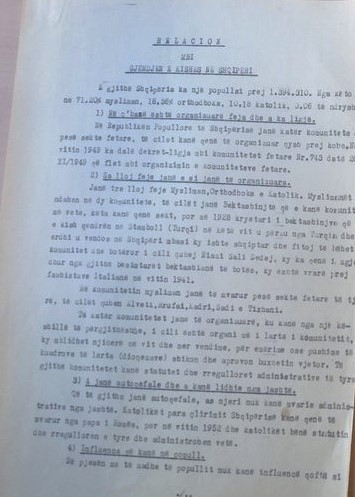
R E L A T I O N (REPORT)
ON THE STATE OF THE CHURCH IN ALBANIA
All of Albania has a population of 1,394,310. Of these, 71.20% are Muslim, 18.56% Orthodox, 10.18% Catholic, and 0.06% miscellaneous.
- On what basis is religion organized and is there laws?
In the People’s Republic of Albania, there are four communities and five religious sects. In 1949, Decree-Law No. 743 dated 26/XI/1949 was issued regarding the organization of religious communities.
- How many types of religions are there and how are they organized?
There are three types: Muslim, Orthodox, and Catholic. Muslims are divided into two communities, including the Bektashi, who have their own community. They were a sect, but in 1928, the head of the Bektashis, who was based in Istanbul, was expelled from Turkey and settled in Albania. Being Albanian, he gained the status of a world community. He was Niazi Sali Dedej, elected by Bektashi believers worldwide; he was killed by Italian fascists in 1941.
Five other religious sects are subordinate to the Muslim community: Alveti, Rrufai, Kadri, Sadi, and Tixhani. All communities have a General Council, the highest body, which meets once a year to make decisions on appointments or dismissals of high cadres and approves the annual budget.
- Are they autocephalous and do they have foreign ties?
All are autocephalous; none have administrative dependence from abroad. Before the liberation of Albania, Catholics were dependent on the Pope in Rome, but in 1952, they also created their own statute and are self-administered.
- Influence on the people.
Among the majority of the people, they have no influence, neither as a religion nor as clerics. What little influence remains is mostly among the highlanders (malësorët) who have less culture.
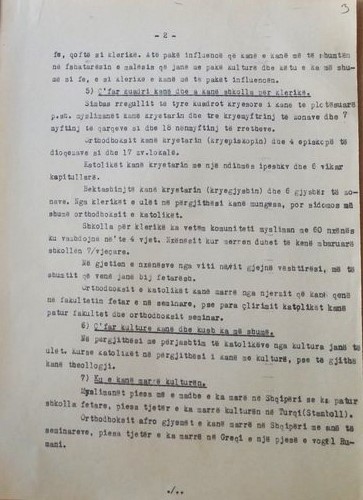
- What cadre do they have and are there schools for clerics?
Generally, the main cadres are filled (e.g., the Muslims have a chairman and three chief muftis). There are shortages among lower clerics, especially among Orthodox and Catholics.
Only the Muslim community has a school for clerics with 60 students (a 4-year course). Applicants must have completed 7-year schooling. Finding students is becoming difficult; most are children of religious parents.
- Cultural level.
Generally low, except for the Catholics. Catholics generally have a high cultural level as they all have studied theology.
- Where did they receive their education?
Muslims mostly in Albania and Turkey; Orthodox in Albania, Greece, and Romania; Catholics in Italy, Germany, and Albania. Bektashis are generally self-taught.
- State subsidies.
Subsidies have been given because they were financially tight, but these have been reduced year by year.
- Sources of income.
From small portions of land, rent from small buildings, donations from believers during holidays, and state subsidies.
- Laws on state aid.
There is no law requiring the state to help, but the decree-law states the state may eventually provide a subsidy.
- State control of the budget.
The state does not control the budget unless there are reports of theft, in which case it intervenes legally (as has happened with the Bektashi and Muslim communities).
- Bell ringing.
Bell ringing was exaggerated, sometimes all day. In 1955, it was restricted to Sundays and 10 major holidays per year. They do not ring for deaths in the cities, though it is allowed in villages.
- Most religious regions.
Shkodra, Elbasan, Durrës, Tirana, Berat, and Korça. Except for Shkodra and Elbasan, the urban populations are not very religious; the religious base is in the villages.
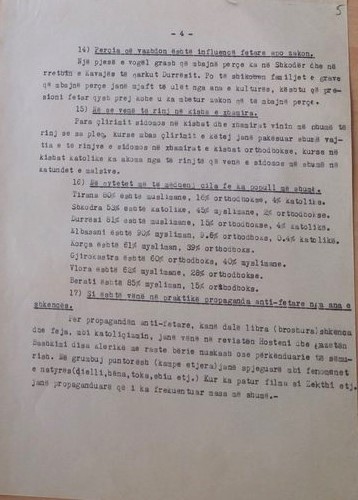
- The veil (Perçja).
A small number of women wear the veil in Shkodra and Kavaja. This is attributed to low cultural levels and religious pressure that has turned into custom.
- Youth in churches and mosques.
Attendance by youth has decreased significantly since liberation, especially in mosques and Orthodox churches. Some youth still attend Catholic churches, particularly in the highlands.
- Population by religion in major cities:
- Tirana: 80% Muslim, 16% Orthodox, 4% Catholic.
- Shkodra: 53% Catholic, 45% Muslim, 2% Orthodox.
- Durrës: 81% Muslim, 15% Orthodox, 4% Catholic.
- Elbasan: 90% Muslim, 9.6% Orthodox, 0.4% Catholic.
- Scientific anti-religious propaganda.
Brochures like “Science and Religion” have been published. The magazine Hosteni and the newspaper Bashkimi have exposed clerics involved in “superstitions” (charms/nuska). Natural phenomena (sun, moon, rain) are explained to workers’ groups to counter religious explanations. Anti-religious films like The Gadfly (Zekthi) are also promoted./Memorie.al