By Uvil Zajmi
Part One
– “Albania” vs. “Yugoslavia” 57 years ago: The duel set to the sounds of revolutionary songs and Ramiz Alia’s meeting with the team at the Army Convalescence Home in Durrës –
Memorie.al / Continuing our journey with the national football team through the “Euro ’68” Qualifiers, and toward the historic challenge of December 17, ’67, against West Germany in Tirana, our next stop is the Albania-Yugoslavia clash on May 14 of that year. This was a challenge entirely different from the one in Dortmund played a month prior: extremely delicate and demanding, not only in a sporting sense but heavily in a political one—a match that must not be lost, a condition that was strictly required. Everyone was mobilized for this, from the technical staff and players to high-ranking state officials, and even the public present in the stadium.
But how did it unfold? What was the pre-match atmosphere? How do the protagonists who stepped onto the “Qemal Stafa” pitch on that Sunday in May, over half a century ago, remember it? How does Niko Xhaçka recall those 90 minutes—the departure from Durrës directly for the match and the directive not to shake hands with the opponent? Or the Frashëri-Džajić duel, unforgettable for its time, and the revolutionary songs sung in the stadium?
A Brief History of the Encounter
This was the first meeting between the two national teams in such a major European event since the matches held in Tirana for the 1946 Balkan Cup (Albania-Yugoslavia 2-3), another a year later in Tirana (2-4), and a 0-0 draw in Belgrade on June 27, 1948, for the Central European Championship. After twenty years, such a confrontation returned to “Qemal Stafa.” From the 1946 era, only Loro Boriçi remained – the former captain of the Balkan Champion national team, now the head coach – alongside Ratko Mitić, a well-known footballer who had started in the other matches against Albania, now serving as the coach of the Yugoslav national team for this match.
There was even a friendship between them. The only event preceding this clash had been the Basketball Balkan Cup held in Tirana in December ’65 – specifically the trophy-deciding match, Albania-Yugoslavia (at the “Partizani” Sports Palace), which was played with intense rivalry and won by the Yugoslavs by four points in the final seconds.
Pre-match: A Tense Situation
The lead-up to the match began with the May 1st celebrations. The Great Physical Culture and Sports Manifestation of the capital’s youth took place at “Dinamo” stadium on May 9, attended by the main leader of communist Albania, Enver Hoxha. This was followed by preparations for the Congress of the Trade Unions of Albania. Naturally, the political situation was strained; although diplomatic relations between the two countries, severed in ’48, had been restored in ’55, the situation had not changed over the years. Moments of tension even attempted to surface during that football match.
It was a time when a “revolution” similar to the Chinese one had begun in Albania, accompanied by the intensification of the class struggle, the decision to ban religious beliefs, the fight against bureaucracy, the rotation of cadres, etc. The stadium was packed hours before the match. Tirana and all of sporting Albania awaited the game with great curiosity and impatience, hoping for a positive result. This hope stemmed from the players’ motivation, the home field, and the spectators as supporting elements, but also from the 1-1 draw against George Best’s Northern Ireland in November ’65 at “Qemal Stafa.” Statistically, this was the tenth match played by the national team in an official European competition.
After West Germany, the Lineup Changes
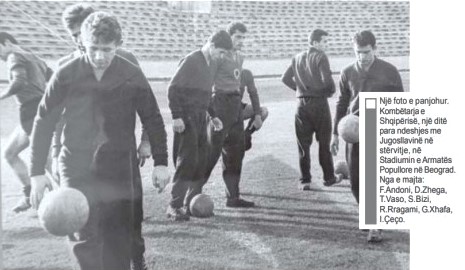
Following the match and defeat in Dortmund, upon the team’s return to Albania, the “Skanderbeg 500th Anniversary Cup” matches continued. For the match against Yugoslavia, coaches Loro Boriçi and Lym Alla kept the core of the team from “Partizani” and “17 Nëntori,” including Koço Dinella (Dinamo), Zan Rragami (Vllaznia), Todo Vaso (Skënderbeu), and Jorgaqi (Labinoti). The team gathered in Durrës, at the Convalescence Home on the beach, to prepare. However, the anti-Yugoslav lineup saw some changes: Skënder Hyka and Bahri Ishka (17 Nëntori) and Sabah Bizi (Vllaznia) were not fielded due to poor health.
Captain Lin Shllaku and Medin Zhega returned to the squad, while the surprise was the re-activation of Lorenc Vorfi, Dinamo’s right-winger and a protagonist in Balkan Cup matches – a “robust” and strong player. Alongside him, Niko Xhaçka returned to the lineup, another winger from 17 Nëntori known for his good form, tasked with stopping Fazlagić’s offensive runs. No “500th Anniversary Cup” matches were played that week, and there was no special publicity for the match in the sports pages. On the eve of the match, the situation in Group 4 (the only one with three teams out of nine groups) was: West Germany and Yugoslavia with 2 points, Albania 0 points.
Yugoslavia, a Strong Team
The Yugoslav team arrived in Albania after a 1-0 victory a week earlier against West Germany in Belgrade, where Josip Skoblar scored the winner. Their lineup featured: Pantelić, Fazlagić, Jusufi, Brnčić, Rašović, Holcer, Melić, Bečejac, Hasanagić, Skoblar, Džajić. However, for the match against Albania, coach Rajko Mitić brought in other players, changing nearly half the team: goalkeeper Pantelić (Vojvodina), Fahrudin Jusufi (Eintracht), Mustafa Hasanagić (Partizan), and Josip Skoblar (Olympique Marseille) did not come. For the Tirana match, he brought in Radnički goalkeeper Knežević (who only played for the national team in that match), Bečejac, Petar Nadoveza (Hajduk), Stjepan Lamza (Dinamo Zagreb), and Slaven Zambata, the Dinamo striker and Fairs Cup winner.
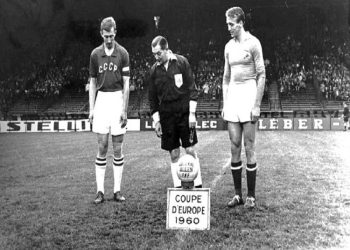
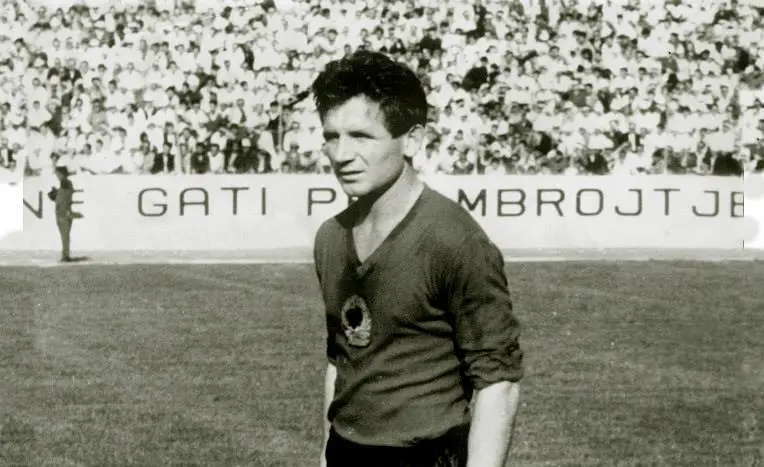
The Yugoslav team had been European runners-up in the first edition in 1960: after eliminating France 5-4 in the semi-finals (considered the greatest match in Yugoslav football history), they lost the final 2-1 to the Soviet Union. In the 1962 World Cup, they reached the semi-finals, though they failed to qualify for Euro 1964. The team featured left-winger Dragan Džajić (Red Star Belgrade), who would go on to be the top scorer at “Italy ’68” and finish third for the Ballon d’Or that season, behind George Best and Bobby Charlton.
The Match: Tropical Heat
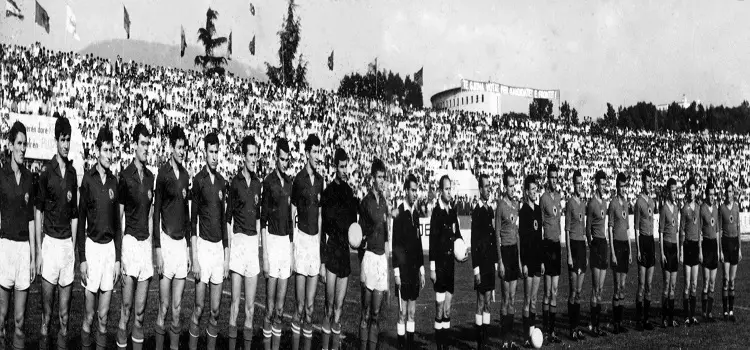
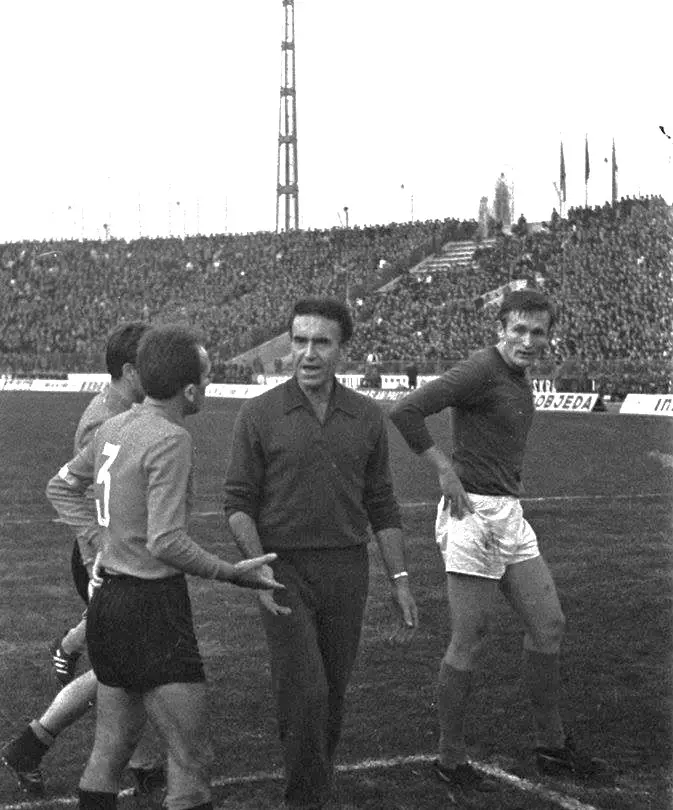
The match took place at the “Qemal Stafa” National Stadium, which was filled to capacity on the hot afternoon of Sunday, May 14, 1967. A large banner was placed in the stadium reading: “All votes for the Front candidates,” referring to elections to be held in early June. Before the start, while the teams were warming up, famous Albanian singers sang revolutionary songs on an improvised podium in the side stand to electrify the atmosphere. The loudspeakers boomed with the song: “With a pickaxe in one hand / we build the fatherland, / with a rifle in the other, / we defend our victories,” though this form of entertainment was criticized by those in the central VIP stand.
At 4:00 PM, the teams took the field with the following lineups:
ALBANIA: Mikel Janku (Partizani), Fatmir Frashëri (17 Nëntori), Teodor Vaso (Skënderbeu), Justin Kazanxhi (17 Nëntori), Ali Mema (17 Nëntori), Ramazan Rragami (Vllaznia), Lin Shllaku (Partizani), Lorenc Vorfi (Dinamo), Panajot Pano (Partizani), Mehdin Zhega (Dinamo), Niko Xhaçka (17 Nëntori).
Coach: Loro Boriçi.
YUGOSLAVIA: M. Knežević (Radnički), M. Fazlagić (FC Sarajevo), M. Brnčić (Dinamo Zagreb), V. Bečejac (Partizan Belgrade), B. Rašović (Partizan Belgrade), D. Holcer (Hajduk Split), V. Melić (Sochaux), P. Nadoveza (Hajduk Split), S. Zambata (Dinamo Zagreb), S. Lamza (Dinamo Zagreb), D. Džajić (Red Star Belgrade).
Coach: Rajko Mitić.
Referees: C. Xanthoulis (Cyprus), S. Mavrogenis, A. Kouniaides.
GOALS: Zambata 22’, 54’
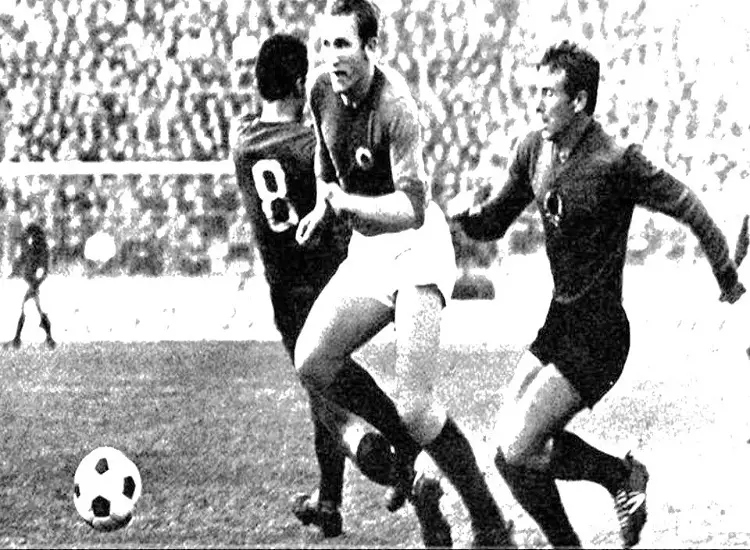
Chronicle: Although Džajić, one of the most in-form players, was expected to be the protagonist, the punishment came from a lesser-known player, Slaven Zambata. The Dinamo Zagreb striker, fielded by coach Mitić, scored twice with close-range headers following two crosses from the flanks in the 22nd and 54th minutes.
Meanwhile, the Sporti Popullor newspaper the following Tuesday (unlike the Germany match, when it wrote after two weeks!), without an author but credited to a “Volunteer Correspondent,” published an article titled: “Poor play by our representative team.” It was highly critical of the game and the performance of the national players, who disappointed the public’s interest. Only once near the end, in the 86th minute, did Zhega penetrate the box; the ball was stopped by defender Brnčić’s hand, but the referee awarded a free kick outside the area!
The match was broadcast as usual by Radio-Tirana, commentated by Anton Mazreku and Ismet Bellova, while it was also aired by the Radio-Television Experimental Center with commentary by Alfons Gurashi (as Skifter Këlliçi had been transferred to Berat for work at that time). After two matches, the standings were: Yugoslavia 4 points; West Germany 2 points; Albania 0 points. The next matches were: Oct 7, West Germany-Yugoslavia; Nov 12, Yugoslavia-Albania; and Dec 17, Albania-West Germany. In Albania, football activity resumed with the second phase of the championship, which ended with the expulsion of “17 Nëntori” and “Partizani,” leaving “Dinamo” as champions by default. But also with Mao Zedong’s Great China launching a hydrogen bomb into space – a great success for the friendly nation of Albania!
Niko Xhaçka: The Politburo told us not to even shake hands
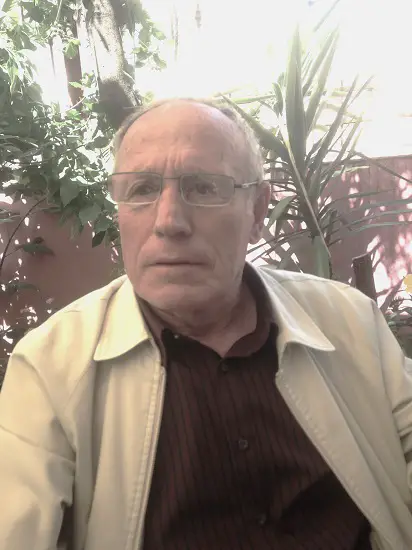
A typical fast winger and dribbler, a starter and protagonist with the number 7 for “17 Nëntori,” Niko Xhaçka returns to the challenge with Yugoslavia, in which he played with the number 11. In an exclusive interview for us, the distinguished former footballer reveals some of the poignant details of that high-tension match.
Mr. Xhaçka, why do you want to start from Rome?
Because there is a historical detail: from Germany, we arrived in Rome and the team stayed at Hotel Siracusa, near Termini station. The next morning, coach Alla and team manager Besim Fagu asked to meet Naim Kryeziu, the former Albanian national team player from the pre-1944 period who had played for Italian teams. Shortly after, they met in the hotel lobby; I was present because Lymi took me along as a winger, just as Kryeziu had played for Roma. They stayed there, and then left together. I recall some players went to watch the Lazio-Roma derby, others went to the cinema. When we returned to Tirana, the meeting with Kryeziu became a problem, as the state leaders disliked it – allegedly related to Kryeziu and Lushta not coming for the ’46 Balkan Cup.
Was it Boriçi who brought you back to the team?
After the loss to Switzerland, a directive was given to take physically stronger, more experienced players into the team, so we – who were considered young – suffered for it, only for the two matches in Switzerland and Northern Ireland. They dropped me, Vorfi, and Kasmi. But upon taking over the national team, Boriçi brought us back to the lineup, starting me in the next two challenges in Dortmund and Tirana. To this day, I don’t know how Boriçi chose me, because his mentality regarding short players was well known…! He mainly preferred tall, physically strong players.
Another loss after Germany…?!
If you look at the match in Dortmund, qualitatively, we played well and it wasn’t a defensive game. I believe there were mistakes in some tactical placements. Also, during our stay in Dortmund, we received countless telegrams that were read to us, where everyone expressed hope for a positive result, creating an abnormal psychological situation. As for the match against Yugoslavia, it was lost due to a lack of experience and few international matches, but also because of the situation – it was treated a bit more as a political encounter than a sporting one.
What was discussed regarding tactics?
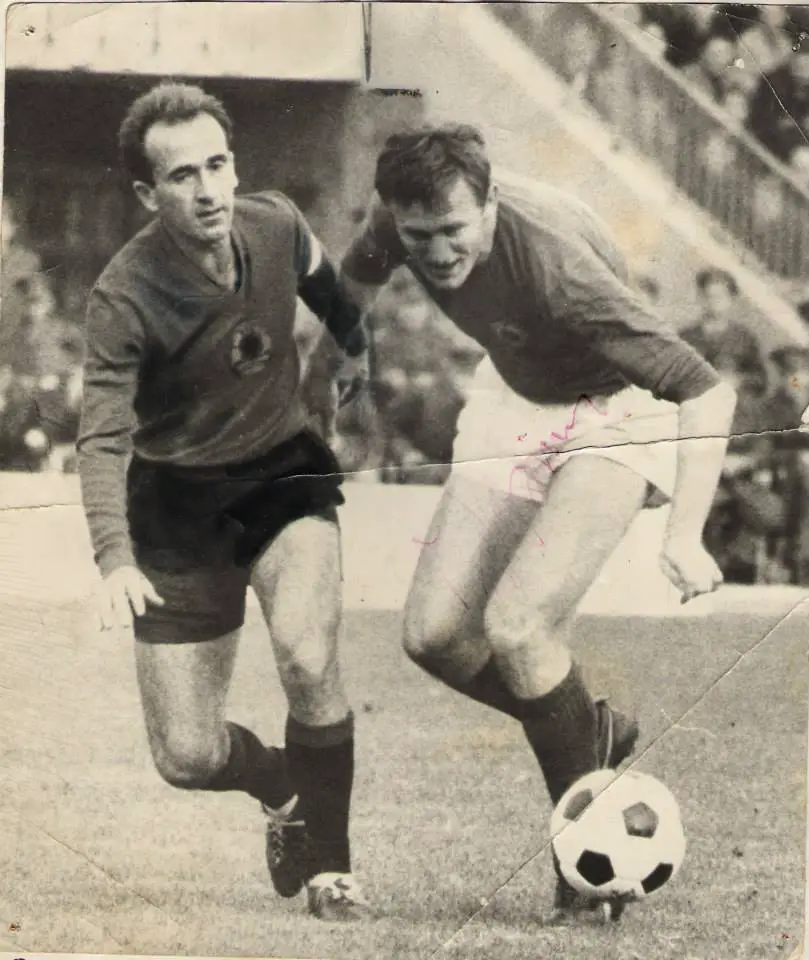
Yugoslavia was a very strong team and there was a difference between us. We were “rigid.” We didn’t even come to “Donika” a day before, as was tradition, because the team was kept away from the capital. During the analysis, after Boriçi, Zyber Konçi spoke about how the opponent played, as he had followed the Yugoslavia-Germany 1-0 match as a federation employee. We headed to the stadium directly from Durrës. I played against captain Fazlagić, a fast, physically strong player, active especially in attack. From that match, I remember the unforgettable Frashëri-Džajić duel, especially the play of the latter—a footballer whose fame had just exploded and who was sought after by prestigious European clubs.
What was the atmosphere on the eve of that match?
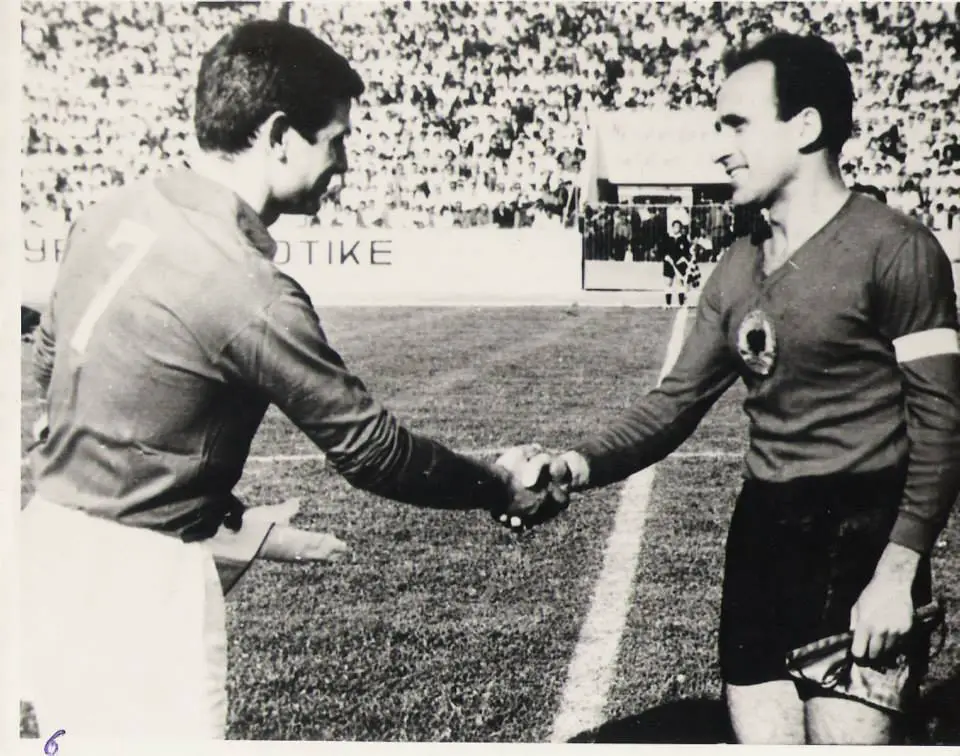
I remember that at the Army Convalescence Home in Durrës, high-ranking state leaders came to meet us systematically, up to Politburo members like Ramiz Alia. The interest was extraordinary, even because of the political relations in those years. I never forget when they advised us: “You must not have any contact with them; do not accept a handshake at the end of the match.” But when it ended, Fazlagić came toward me and extended his hand. I hesitated for a moment, glanced at the stands, and when I saw people were leaving, I greeted him by shaking his hand—but with fear. In that match, almost all state leaders were in the central stand, with the exception of Enver Hoxha and Mehmet Shehu.
Mr. Xhaçka, was this the last one for you?
Yes, because in September I was mobilized for a 6-month post-university military training in the city of Burrel. I only played for one month in the Second Division. This damaged my career, both with “17 Nëntori” and the national team, as I was in top form. Staying without playing while serving as an effective member of the Burrel Infantry Unit changed my future as a footballer. It took me a long time to regain what I had lost during that half-year without activity./Memorie.al