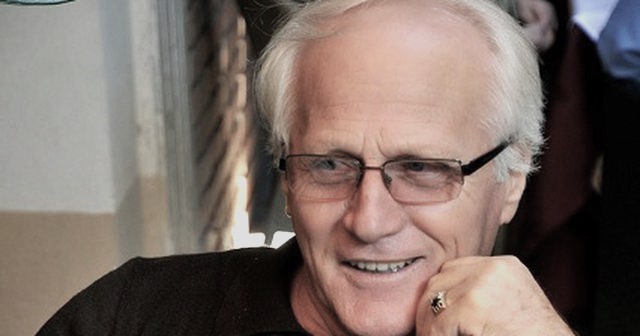
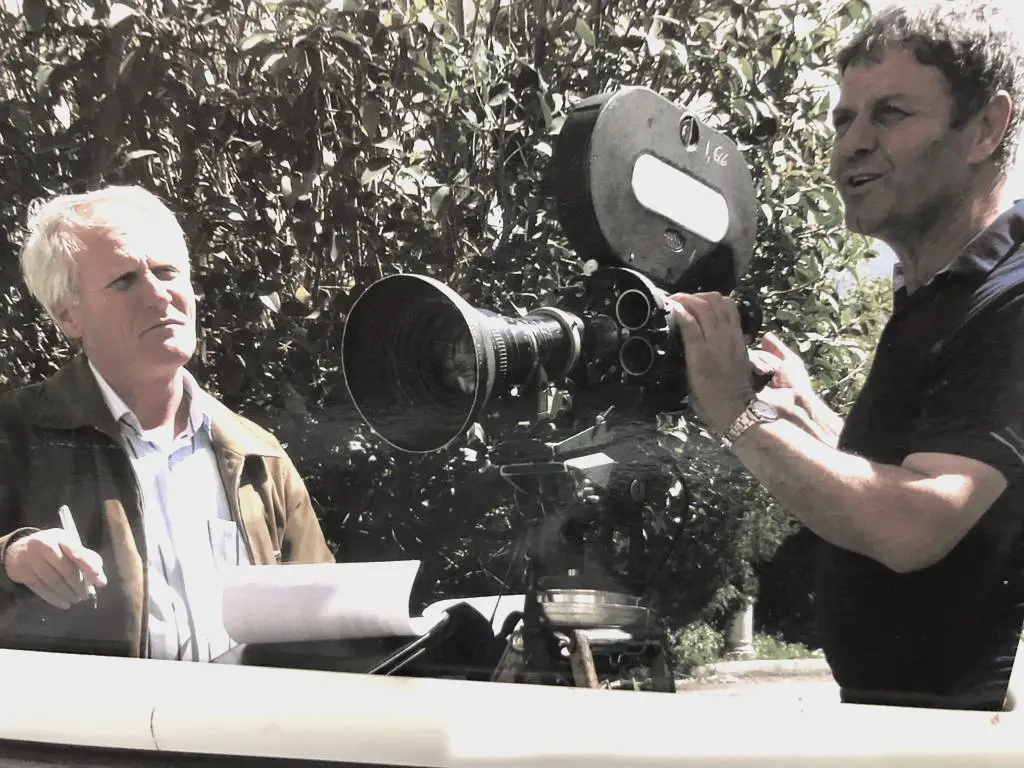
Memorie.al / With over 40 years of work in documentary film as a director and screenwriter, he likely holds a record with 150 films produced. In his youth, he was devoted to journalism, where the newspaper “Zëri i Rinisë” remained his first love, for which he almost sacrificed his education. It was Liri Lubonja who influenced the course of his life, providing parental guidance. His life as a screenwriter and director is filled with surprises, achievements, anxiety, joys, service, debates, sacrifices, difficulties, accomplishments, and hesitations, but ultimately, it was all in the name of something sacred that bears the irreplaceable name for him: FILM. Throughout all these movements and productions, he also had spontaneous meetings with former communist leaders, of whom he shares his impressions.
In conversation, he is objective, rational, and never overestimates himself, but certainly conveys concrete messages. At his current age, he declares that the magic of the documentary film has completely captured him, and he bows to this magic because he loves it madly and would not change his profession for any other in the world, no matter how much money he was offered. This is Kujtim Gjonaj, the composed man from Tepelena, who, when making documentary films, turns into a “heroic warrior” who transforms professional production into a patriotic duty.
Mr. Gjonaj, what were the passions of your youth?
My passion was journalism. I completed my studies in Language, Literature, and Journalism. In 1968, journalism was a 2-year course that took students from other branches who had a passion for literature. I have published writings since my early youth or adolescence in the newspapers of the time, such as: “Zëri i Rinisë”, “Pionieri”, “Puna”, and others.
Who encouraged you to write at that time?
It might have been an internal desire, as I was very gifted in compositions since primary school. I participated in a competition for compositions (I was in the seventh grade) with all the schools of Tirana, where I took first place. I was at the “Hoxha Tasim” 7-year school. This influenced and stimulated me to continue writing. The events of the National Liberation War remain the dearest to me. The Battle of Mezhgoran was a story told by my father about the “Hero of the People” Asim Zeneli, which I liked very much, and from that time, this love for the war was forged – a moment I still value today as the most important in this country’s history. The fact that the Albanian partisans were aligned with the Antifascist Front is a great fortune for Albania and for all the generations that followed.
Later, my first writings coincide with the “Pionieri” newspaper in the years 1964-1965. From 1966 onwards, I was heavily involved in “Zëri i Rinisë”, which was the most modern newspaper of the time, where I published stories, reportages, and sketches. At that time, we traveled on service throughout Albania. My first teachers who helped me on the beautiful path of literature were Vath Koreshi, Luan Dibra, and Zef Gurakuqi, who looked upon me with a friendly and benevolent eye. With their simplicity and high level of preparation, they inspired me and instilled that special love for writing.
What about in university? Who were the renowned journalism professors back then?
My professors were the cream of Albanian journalism and poetry. Here I can mention: Dritëro Agolli, Vangjush Gambeta, Gëzim Reso, and Skënder Begeja. Back then, a generation of professors emerged who were very, very prepared, with great knowledge and gifts that left a mark on the culture of this country. They produced students who later became just as famous, such as: Faik Ballanca, Zija Çela, Koço Kosta, Petro Lati, Floresha Haxhiu, Rami Memushaj, etc. In the field of cinematography, there was Halil Kamberi, who was a director at Kinostudio and later moved to television.
Did the leaders of that time ever visit the school when you were a student?
Back then, leaders often visited schools. Perhaps that was the party’s policy. I remember that as an outstanding student in the third grade, I was invited to the “Ali Kelmendi” Palace of Culture. Enver Hoxha himself was coming to the palace that day. It was 1953. We were eagerly waiting for him. Which child back then wouldn’t want to see or meet Enver Hoxha? For every child then, he was a genius. When he arrived, we burst into applause. We were immensely happy. It was one of my most beautiful days as an outstanding student. They gave each of us a small package. When I opened it, I found a small, black rubber ball. I was so happy! There were no balls in the shops back then; those were years of great poverty.
What was the topic of your diploma thesis?
I defended my diploma with the topic “Publicistics on Screen,” essentially my thoughts on televised publicistics. For 2-3 consecutive years with this same topic, I taught at the Faculty of Journalism after finishing my degree. I was appointed to teach this subject as an external lecturer and then as a lecturer in the postgraduate courses organized by Kinostudio. I taught this for nearly 8-9 years.
When you finished faculty, did you ask to work at Kinostudio?
My passion was to work at the “Zëri i Rinisë” newspaper, and when I was in my fourth year, the editors-in-chief were Dhimitër Verli and Liri Lubonja (the wife of Todi Lubonja). All the later journalists of “Zëri i Popullit”, “Bashkimi”, and “Drita” passed through Spiro Dede, Xhevahir Spahiu, and many others. So, at that time, I had very strong ties with “Zëri i Rinisë”. They proposed that I start working at the newspaper while I was still in my fourth year. I was overjoyed; it was a dream of mine. But Liri Lubonja – a noble woman, visionary, prepared, and correct – took a motherly stance and did not allow me to make a momentary mistake based on a fleeting passion.
She told me: “Finish your school, do it regularly, do not do it by correspondence, because they might take you as a soldier. You have time to work in the newspaper and elsewhere.” Those words, spoken with such love, changed my mind. I didn’t go as a journalist to “Zëri i Rinisë” but continued my school. When I finished my studies, several cultural institutions requested me, such as Radio-Tirana, ATSH, and Kinostudio, but the state decided I should go to Kinostudio. This came as a surprise. I didn’t want to stay at Kinostudio; I wanted to go to the newspaper because that was my greatest love.
How was the first day of work at Kinostudio?
Ah…! A beautiful moment. There were several of us who had just finished our studies and were appointed to Kinostudio. The first person to meet us was the guard of Kinostudio, an armed policeman. He greeted us with all seriousness, and after asking why we had come, he puffed out his chest, cleared his throat, and said: “This is an important institution. There is discipline. You arrive at 6:55 and leave at 3:05. That is it!” – and he directed us to the Personnel Office.
Who was the director of Kinostudio then?
It was Vaskë Aristidhi. A good and intelligent man. He had heard about my desire, so he took me aside and said: “I know you want to leave, but I tell you with conviction, you must stay here. Film is something beautiful. Stay and you will remember me.” I changed my mind and stayed. To this day, I am very grateful to that good man. If journalism is beautiful and magical, I can say that the world of film is staggering. The emotions that film gives you are immeasurable. It was a matter of pride to stay with prominent figures like Viktor Gjika, Dhimitër Anagnosti, Vath Koreshi, etc.
After 4-5 days of starting work, they told me I had to make my first “Kinoditar” (Newsreel). A Kinoditar is a type of text for a 7-minute film with various life snippets, where I had to write a script that connected them all. I wrote an emotional text. It turned out beautifully. I received my first appraisal from Viktor Gjika. I was so touched! To me, he was an idol I once dreamed of meeting, and now we were almost in the same office. At that time, he had made a name for himself with films like “Komisari i Dritës”, “Horizontet e hapura”, and had started “I teti në bronz”.
How many scripts did you write before becoming a director?
Approximately 25 scripts for documentary films and 4 scripts for feature films. For the feature films, the scripts were for “Këshilltarët”, “Ata ishin katër”, “Thirrja”, “Cirku në fshat”, and four others that could not be filmed for various reasons. My film scripts were directed by Hysen Hakani, Fehmi Oshafi, Esat Mysliu, and Xhezair Dafa.
When did you start working as a director and what was your first documentary?
I started directing very early, in 1974. My first film as a director was “U mbushën malet plot me partizanë” (The Mountains Were Filled with Partisans), about the 22nd Brigade of Peza. That year was the 30th anniversary of the liberation, and a decision was made “from above” that a film should be made for every partisan brigade. I chose the Peza brigade because as a screenwriter I had already done two others, the 6th and 7th Assault Brigades. This film was shown in the cinemas of Tirana. At that time, a documentary film was placed before the feature film. it was a success.
Was there any appraisal from the leaders of the time?
Myslym Peza saw the film, but I don’t know if he gave a statement. Our evaluation was within the collective, and there the film was well received. During the film, we had to film the song “Ç’u mbushën malet plot me partizanë,” and I made a beautiful prologue. I gave the idea of the massification of this war. I always operate with messages. The message was that the end of the war was approaching, and the mountains truly filled with partisans. This film was appraised in the annual analysis by the head of the film editorial office as the best documentary film of the year. After this, I made 7-8 other films until 1980, when I finally moved to being a documentary film director. From a feature film screenwriter, I transitioned into a documentary director.
Any episodes with Dhimitër Anagnosti and Viktor Gjika?
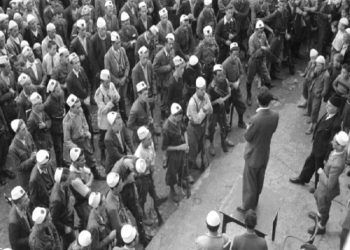
With Dhimitër Anagnosti, we had a success in 1973, when I had only been working for 3-4 years and was still young. It was a documentary film that had a great resonance, titled “Motive nga dita e diel” (Motifs from Sunday), directed by Dhimitër Anagnosti and I was the screenwriter…! It was a film within the contours of the time, with great artistic value. At the center of the film were the life, dynamics, and interpretation of a Sunday for an ordinary person in Tirana. With Viktor Gjika, we made several documentary films, mainly political ones like: “Vdekja e Enverit” (The Death of Enver), “Protesta e 1 Majit” (The May 1st Protest), but also about the leaders of the time.
When you produced political films, which leaders of the time did you meet?
I want to clarify something. I never met any leader face-to-face privately. I met them during work moments, while filming or producing. So, they were mandatory meetings, spontaneous encounters, or simply to do my duty. I cannot say they called me specifically or gave me special appointments. One of the accidental meetings was with Mehmet Shehu. We were filming the inauguration of the busts of the Frashëri brothers. Enver Hoxha was expected to arrive, and we were preparing the camera. We were checking the cables and equipment and weren’t looking at what was happening behind us. We were focused on where Enver Hoxha would arrive from.
When Enver arrived, Mehmet was behind him, adjusting his trouser belt. We were almost a few meters away from them. Immediately, Mehmet says to Enver: “They aren’t even letting us fix our trousers.” Enver laughed and replied: “Leave the boys to their work. They have their plan, just as we have our plans.” They both laughed. Another case was in 1973. The exhibition “Shqipëria Sot” (Albania Today) was being inaugurated. Great propaganda was made for that exhibition, and in fact, it was very good. You could find everything produced in Albania there, and the architecture was very modern.
There were thousands of people at the inauguration because Enver Hoxha was coming. The moment his car appeared, people started pushing us. To clear a path for Enver Hoxha, I unintentionally stepped on Mehmet Shehu’s foot. The cameraman was filming, while I was writing details of the meeting and Enver’s arrival in a notebook. Mehmet grabbed my arm and said: “Why don’t you write with shorthand (konvencione)? Don’t you realize it makes your work easier?” We shrugged. Indeed, we hadn’t learned to write with shorthand to make the work easier. “Fine, fine, continue,” he told us, “follow the Commander.”
What about the meeting with Ramiz Alia?
Another case was during the filming of a visit by Ramiz Alia to northeastern Albania, and I was with Viktor Gjika. During the meeting, we sat at a table with him. He gave directives, and we filmed and wrote. “Film the most essential things,” he told us, “your profession is difficult, but very good.” Another time, I happened to be with Muho Asllani when he was the First Secretary in Shkodra. I was moving everywhere for filming and notes. I was hard to catch. He saw me several times and said: “You are agile; come to the Party Committee tomorrow and meet me.” He thought I was a journalist from Shkodra. Smiling, I told him: “I am from Tirana.” “Ah, you spared me!” he said. We both laughed.
And Mine Guri?
I met her once when we were going to a Film Festival in Switzerland. It was 1985, just after Enver Hoxha had died. Certain liberalism had begun. It is known that the leaders of the time had privileges. On the plane, they had certain seats in the front. I was with Gavrosh Haxhihysen. As soon as Minia saw us, she said: “Come sit with us. The journey is easier with friends.” We approached. Her simplicity surprised us. The journey to Switzerland didn’t seem long at all.
Several times we labeled the leaders ourselves, because to tell the truth, they weren’t as stern or as fierce as we discuss them. But certainly, every time has its leaders, its good and bad sides. We should not judge anyone if we do not meet them, if we do not talk, if we do not sit with them. I have been abroad since 1977. My greatest desire is to travel and see different places. Even today, I enjoy moving. Movement gives me life, emotion, vision, and inspiration./Memorie.al