By Artan Fuga
Part Two
Memorie.al / From the history of Albania. Regarding this issue, it is essential to clearly distinguish two levels of analysis. That is, to distinguish between the place and functions assigned to the media by propaganda and the functions they actually performed. It cannot be said in any way that these two levels coincide, but nor can it be claimed that they do not share various common points. What is said in the press about the media and the entire social life of the country is one thing; what the press, the media, and social life represented in themselves is quite another.
Continued from the previous issue
Do true news stories circulate through media channels? The answer is affirmative: “Yes!” If true information about an event or a problem – be it internal or related to international relations – does not infringe upon the ideology of the power, the policies followed, and does not ruin the totalitarian political and institutional system (meaning it does not clash with the alignment of the MASSES around the POWER), this true information, however partial, could be transmitted by the official media. It is another matter that this true information becomes increasingly narrow as the years pass. The more the regime enters an internal economic and political crisis, and the more it becomes isolated from the outside, the more its subordinate media are deprived of the right to provide true news.
It is a different matter whether the true information transmitted is central or peripheral compared to the general trends of society. Often, information that touches the peripheries of the main events of the time is true. It is also another matter that true information is gathered in crumbs, here and there, and above all, is dressed in an ideological garb that distorts it. Finally, even the true information that is given, in fact, serves public manipulation, because through it, the regime seeks to increase the credibility of the official media of totalitarian power. Since the American war in Vietnam in the 1960s showed that the world order of the time was not based on peaceful relations, then why not provide news and information about the war in Vietnam?
Thus, the primary role of totalitarian media is not at all what is classically considered for media in general. It is not necessarily the case that they are instruments of mass information. Informing the public is a sub-function that depends, in fact, on their other priority tasks. It depends on how much it serves the alignment of the masses around power – how much it achieves mass manipulation to make the public accept developments in daily policy, the political system, and life in a society with completely truncated individual rights.
Life in internment camps for political opponents and their families is not worth being known by the public because it creates cracks in the collective consciousness and reveals the repressive aspect of the regime. Therefore, there will be no public information about it. But if the wheat production yield in an agricultural cooperative has increased, then yes, that is an event that can constitute news, because it can be used as propaganda to show the – in fact, non-existent – efficiency of the socialist economy.
The media constitute a system that resembles a giant “EGO” that functions by absorbing as external information only those news items and messages that coincide with its own internal ideological and political structures. Similarly, it acts as a system that transmits, after filtering and preserving, only that information which is in accordance with its internal structure and subjectivity. In this way, the media resemble an oversized subject that communicates only with itself the entire time – meaning with the power that owns it – thus existing in a process of social monologue.
Everything that happens, after being interpreted within the conceptual, ideological-political structures that direct the media of the time, can be processed as news, transmitted, and retransmitted without end. The rest of the information is mercilessly eliminated, without any professional remorse; it is eliminated purely and simply, left in darkness – in other words, as Spinoza would say, treated only as an “accident,” a random event not worth talking about because it carries no weight.
The point is not that this sidelining of uncomfortable information always happens intentionally. The journalist or the press leader, often entirely indoctrinated, truly thinks these news items are of no importance because they see the world through the goggles of propaganda, of which they are both authors and victims. The less the social, political, or cultural reality of the time coincides with the principles of aligning the masses with power, the more significant and larger the portion of true news that is eliminated becomes, being deprived of the opportunity to circulate in official media channels.
Reciprocally, the more the public’s orientation toward foreign, censored media increases, the more the eye-to-eye communication system works through rumors – which are a kind of mass, popular counter-information that opposes the regime’s policy of controlling communication. Official media thus have an important defensive, censoring function against undesirable true information. When we talk about mass communication, we immediately imply the use of the term MASSES. But what are these masses, in truth, in a totalitarian society?
To truly understand the content of this concept, one must accept that two unifying processes influence the meaning of the popular masses. In this case, the mass is by no means a collection of individuals differing from one another in opinions and political or ideological stances. Individuals have already left their differences behind. Each of them belongs to, or is considered to belong to, a single large INDIVIDUAL. In fact, power and its communication systems consider the mass as one single large person. Real individuals, with their different views, interests, and beliefs, are in fact excluded from mass communication.
As particular individuals, as Hegel called them, they do not appear in the spaces of public communication. Only the “abstract individual” participates in mass communication – the unified meaning that the media have for every unique person and their union into a unique mass of people. In reality, this “abstract individual” certainly does not exist. It is an imaginary product of the media directed by the propaganda in power. In fact, the media thus communicate only with themselves, because the public to which they refer – the “abstract individual” – does not exist at all. The media communicate with the shadow of themselves, with the reflection they themselves have produced; they “converse” with the popular masses as long as these are manipulated and obey the official ideology that the media themselves transmit to them.
Thus, the media communicate not with the real public, but in a void. They are therefore entirely egological: they perform a monologue; they talk to themselves or to their reflection, to the projection of themselves. They are narcissistic, recognizing nothing but themselves; they are also socially autistic, since they receive no messages from the external world except those that confirm the meaning these media have of reality.
- Monologue
- Institutional Narcissism.
- Collective Social Autism.
These are the three characteristics within which the official media realize what is called mass communication. However, besides the process described above, a second unification occurs. The mass, in the sense presented above – the “abstract individual” – is unified with the power, realizing institutionally and ideologically in the dominant political imagination a strategy for creating a global unity of the masses with the power. Thus, an absolute unique whole is created. The mass, in the sense the power takes it, communicates to the latter via official media the same political messages that the power itself has communicated to the public, which it summarizes within the concept of “mass public” or popular masses.
The power communicates to the mass those pieces of information that help it group this mass around itself. Meanwhile, the mass communicates to the power via the same official media the same reaction – a “feedback” – precisely within the conceptual framework of the strategy of this totalizing political alignment. Everything that falls outside or rises against this model cannot enter the processing and transmission of the official media. The informative messages circulating within official media, whether going from the heights of power toward society or passing from the base of society toward the peaks of political power necessarily reproduce the existing political, legal, and ideological principles and norms.
Therefore, rather than social communication, we are dealing with self-communication – a circularity of information (the mass tells the power what the power tells the mass) within a structure that does not allow true ideological and political differences in public expression, because the latter is not free at all. Everything is summarized within a unique, self-closed structure. In this way, the media appear in their primary function as a unifying propagandistic, political, and social mechanism.
Occasionally, all of this takes exaggerated forms in the media that have generally tragic, but also comic, nuances. Even people who would naturally express dissatisfaction with the regime are made to express themselves in the press and media in support of it.
We bring two cases among countless such examples:
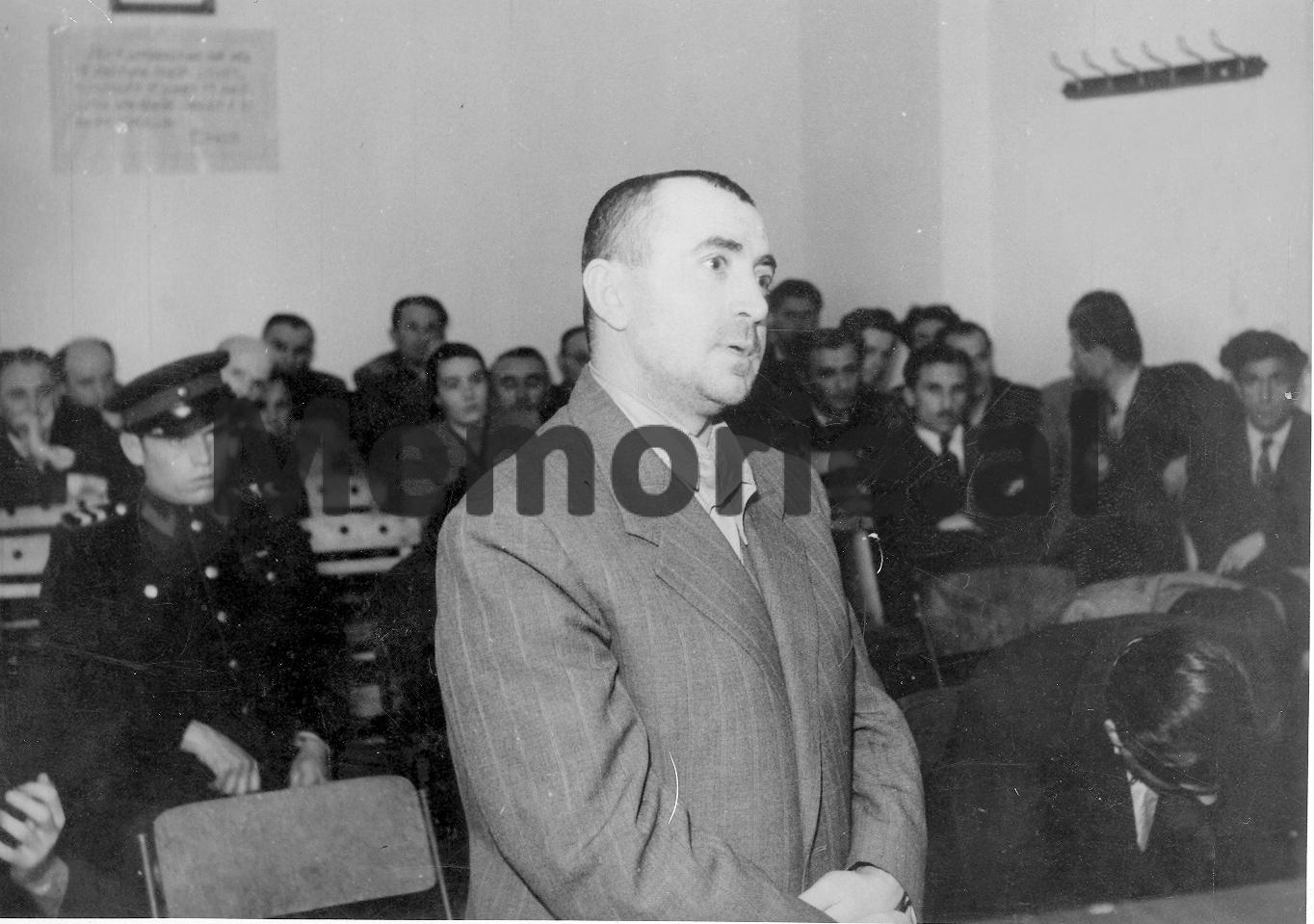
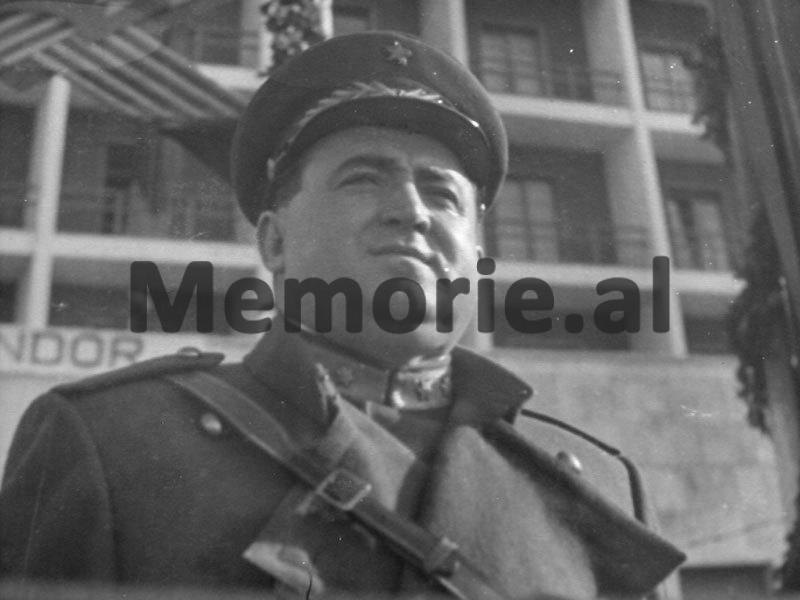
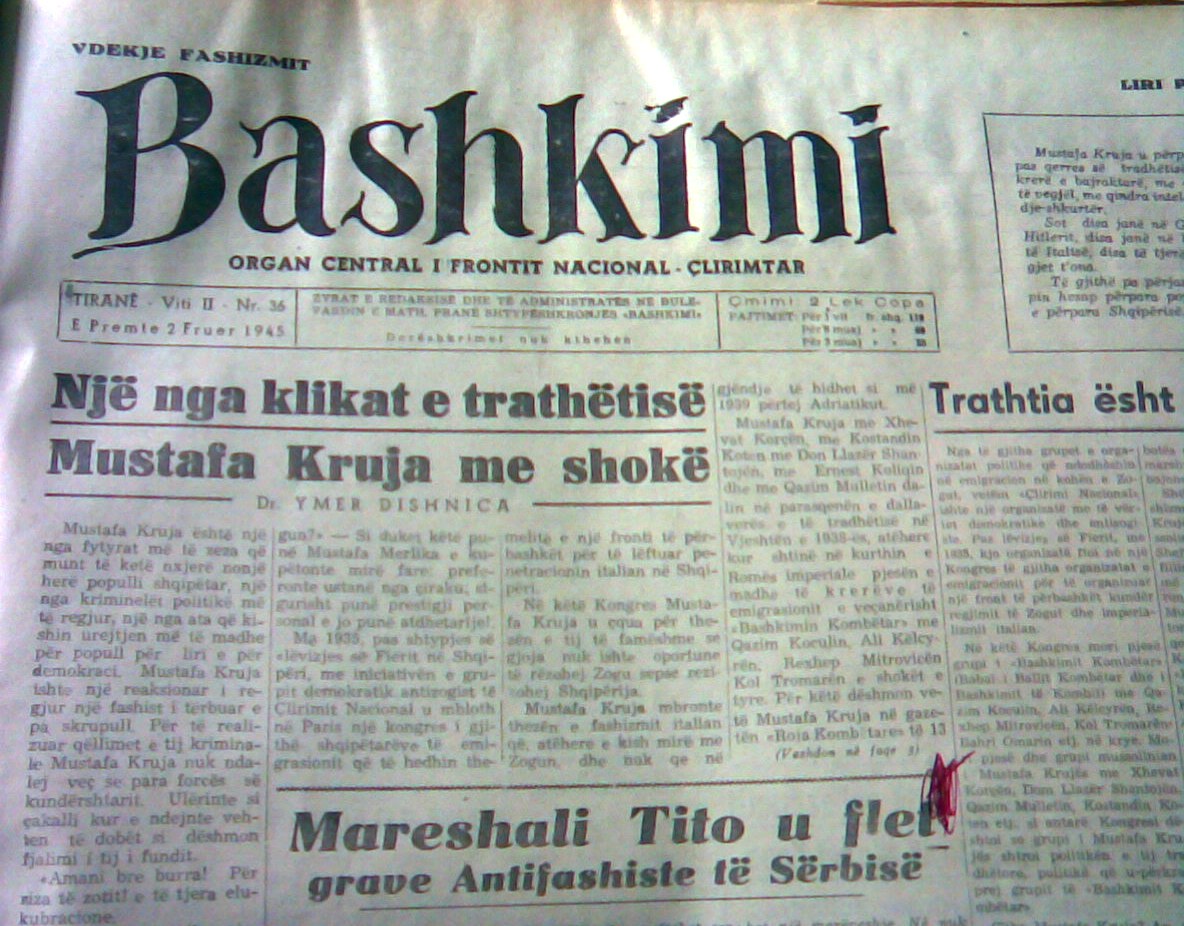
The year 1945. Koçi Xoxe, at that time Minister of Internal Affairs and Organizational Secretary of the Central Committee of the Communist Party – the second most powerful political figure of the time – is visiting the city of Korçë. The media follow him, covering the visit with relatively long reports. There, among others, Koçi Xoxe meets merchants whom the state has heavily taxed through what were called “extraordinary taxes”; in a word, it had robbed them of their goods and gold. The General, as Koçi Xoxe is referred to in the press of the time, also meets relatives – mothers, sisters – of those who had been convicted of political crimes. What do they say to the strongman of the regime that had just been installed? Let us reproduce what the newspaper writes:
“Before the talks began, the merchants expressed their remorse for their poor behavior in the early days of the setting of the extraordinary profit taxes, as well as some complaints about the rushed actions of some at the beginning:
‘Especially we large merchants,’ said Mr. Qiriako, a well-known wholesale merchant, ‘fell into a great error by not immediately paying the sums set for us…! Now we understand that the tax set for us is very fair and logical, because today we are in a better position than anyone else to contribute to the recognition and protection of the new state.’
The mother of a man sentenced to death pleaded for her son’s sentence to be pardoned—not because he was not guilty of the crimes he was accused of, but because he was an only son. But the mother of a martyr who was simultaneously there, face to face, retorted with fire:
‘You plead, sister, but you do not know that he for whom you ask pardon has wounded the hearts of many mothers and sisters…’?!
And the wife of another convict added: ‘Do not worry, mother, for justice comes to light today; nothing unjust is done today. I have experienced this myself…’!
‘Yes, yes,’ repeated the general, ‘today justice triumphs. It is the people who judge and the people are always fair and generous…’!
‘Thank you, son,’ shouted another mother who had her son in prison, ‘may the Government be recognized soon.’
Everyone, even the mothers of the convicts, insistently demands the recognition of the Government and expresses this desire incessantly.”
Again, we are in 1945.
Two correspondents from the Daily Telegraph, Hutchinson and Edwards, visit the prison of ordinary convicts (as the press calls it) and the political prison in Tirana. Their Albanian colleague accompanying them on this visit describes part of the meetings they hold as follows: “From the political prison, we went to the military prison. As soon as we entered, we saw in a large and decorated hall some 20 illiterate prisoners learning to read and write. Then we went through the other halls. All the prisoners expressed their satisfaction with the treatment they receive there and said that they deserve the sentence given to them; none of us here has been imprisoned unjustly. We have faith in our government and are with it; we have only one thing to tell you: we thank you for the recognition of our government.”
As long as the peak of media power and political power are identified, even on the human level, power and media are controlled by the same group of people. Does it follow from this that there are no differences between the message transmitted by the media and what is “thought” by power? The answer is negative: “No!” One does not necessarily follow from the other. There are cases when political discourse within party or state leadership structures, propaganda, and media content are the same thing. What power “thinks,” it transmits and communicates via the official media system.
But there are other cases when it releases only faint signals of what it develops as strategy within a very small group of individuals who occupy the heights of the power hierarchy. This political leadership group does not fail to orient the media to transmit messages and information that do not represent the truth of what is being processed in the most secret “kitchens” of power. This separation between them is discernible and repeatable, especially in the initial periods of the gradual breaking of Albania’s political relations with the Yugoslavs, the Soviets, and the Chinese.
Another question worth asking is the following: Besides the official functions assigned by power, do the media also take on other, different, opposite functions to the first ones? When talking about media, the entire system is understood, including the information technology they use or those devices that media consumers – the public – possess in a personalized manner.
This question leads to a problematic concerning the relationship between politics and the technique used for catching the signal transmitted by the media. To give a reliable answer to this problem, we would need to make some distinctions between the technological devices used by the public to capture information from the media of the time:
- Devices, means, and techniques that allow the capture of information coming from only one emitter and transmitted to a large number of receivers.
- Devices, means, and techniques through which information coming from several news sources can be freely received, captured by a large number of receivers.
- Devices, means, and techniques that receive information simultaneously from many emitters, allowing their filtering by a controller – which in this case is the power.
- Devices, means, and techniques that receive information from many emitters without passing through the censorship of power – meaning a controller – but realizing a direct contact of the receivers with the emitter of information.
Radio and television sets fulfill the characteristics contained in points two and four. Through these devices, as is known, information can be received from many emitters simultaneously, and this can be achieved by bypassing the power’s censorship. Every individual – however despised by institutions, however weak in their economic means, somewhere in a cold and dark room of a dwelling in the most distant city or village – can capture via their radio and television, however old they may be, signals coming from different countries of the world.
And power, however strong it may be, is not able to prevent this communication. In this way, radio and television, as technological infrastructures placed in the public’s possession, begin to show their autonomy from the politics in power. They begin to escape the power’s control.
Radio and television as technology are built on a moral principle and a different mindset, completely opposite to those on which a totalitarian power is based. In fact, they are two different cultures that initially seem able to assist one another, but then, after firmly occupying their positions, begin to “quarrel,” opening a real battle between them.
As we emphasized, the political culture of totalitarian power uses the media to build a monologue with society. The source center of information is the power; the periphery of the communicative field is the masses of the people. Meanwhile, the culture that creates radio and especially television makes the individual receiver equivalent to the center of emission of information regarding their freedom to choose information. Television and radio, unlike written media, are free to give the messages they desire, but every individual – part of the public – is also free to follow only those television channels and radio stations they wish.
The informative center is no longer able to monopolize the field of mass communication. One might not read the newspaper, but besides official newspaper titles, it is difficult to find the foreign press in totalitarian Albania because at its entry – in customs, post offices, libraries – the power’s censoring prohibitions are placed. The ordinary reader has no access to the foreign press. But for radio, and especially for television, this gradually does not happen, because the public no longer follows the official audiovisual media but is oriented toward external sources of information./Memorie.al
Original title: ‘Media functions in totalitarian society’ – From the history of Albania