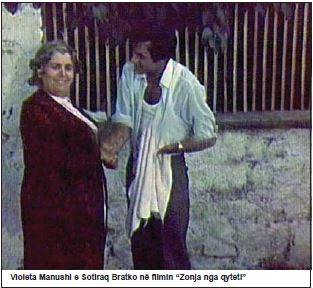
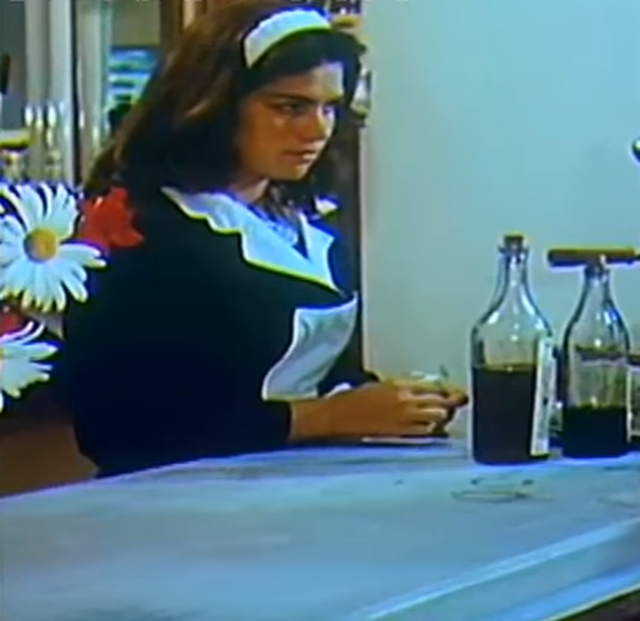
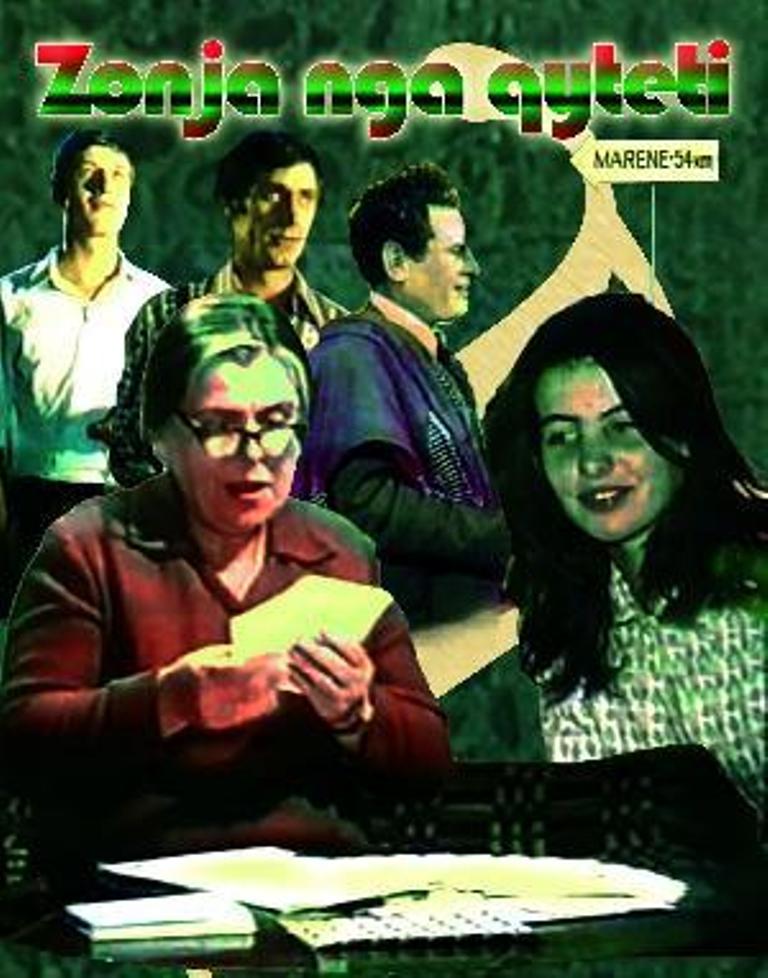
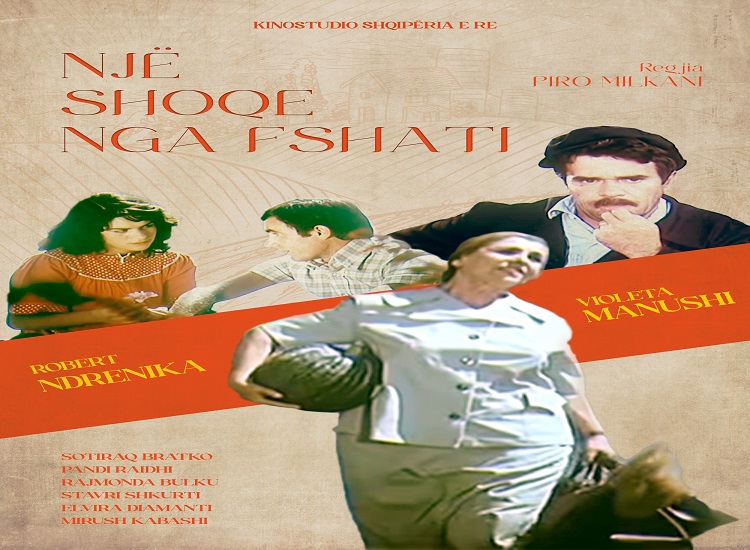
Memorie.al / “I’m so sorry I’m not a painter; if I were, Teuta, I would spend my whole life painting only your eyes.” Just like Jani in the film The Friends (Shokët), many others have thought the same while looking into the eyes of Elvira Diamanti. Do they still think so today? Their beautiful ferocity was often not just part of her film character, but part of her own. Her colleagues knew this and ‘measured’ themselves carefully during filming. But Diamanti was only one of the film partners for the Korçar actor, Sotiraq Bratko. “Tirka” of The Lady from the City (Zonja nga qyteti) maintained equally good relationships, whether they were difficult colleagues or cheerful ones, as the days always were for the cast of a film we never tire of watching even today. Violeta Manushi, Yllka Mujo, Rajmonda Bulku…! How were their days in Tushemisht after the camera stopped rolling? What did the provincial actors dream about regarding the beauties of Tirana? In these recent years since returning to Albania, Sotiraq Bratko has not lacked roles, but despite the passing years, he has not escaped the nickname ‘Tirka,’ keeping the character ever-present on screen – even though for more than 21 years, he was forced to work far from acting, in emigration.
Since I had only seen you in your old film roles, it seemed to me that the gray hair and white beard belonged only to ‘Doctor Schuster,’ but in fact, the years have passed. For a long time, you were not involved in theater at all. When did you return?
I returned only two years ago. I left for Greece in 1992, so for a little more than 20 years, I was not present at all. However, it makes me feel very good that people never forgot me. In fact, because of the films often broadcast in Tirana, people thought I lived in Korça, while in Korça, they thought I had moved to Tirana. No one thought I had left. This is a good feeling for me; in a way, I was always present.
Does returning to Albania translate immediately to a return to the theater?
That is what I lived with; in fact, I delayed my return for too long. My family still lives in Greece, but since they constantly felt my internal suffering – the absence of theater in my life – they pushed me to return, to do the thing I loved, which I had waited so many years for. Yes, I returned to the theater immediately. My first roles at the Korça Theater began as soon as I arrived.
Yours might be one of the most difficult professions to leave behind. For many of your colleagues, the post-90s era was not the best time, yet they stayed. Why did you leave?
The reasons, as you might guess, were family-related. It wasn’t about economic problems, or a desire to leave the theater. In a moment in 1993, leaving for Greece became mandatory for me, but I didn’t think I would stay so long. The initial idea was to stay for about six months. But at that time, interest in working in the theater dropped significantly; no one was paying attention anymore. Meanwhile, I saw that the situation in Albania was worsening, so I decided to stay and work there.
Where did you work?
Emigration is emigration, especially when you come from an artistic profession and end up as a manual laborer; the experience is even heavier. This was an extraordinary sacrifice. But the proper upbringing of my children was the priority; I would sacrifice for them. Today they are grown, and I no longer have those kinds of obligations. The day finally came for me to return to my work – the work I went to sleep and woke up with every morning, the work that kept me awake at night. The director, Zamira Kita, offered me roles immediately, and now I feel like I did back then, a part of the Korça Theater troupe.
Despite any regrets you might have, back then, more than as part of the Korça Theater, you were identified by the films… Jani, Nesti, Tirka…?
It’s true, and I don’t regret it at all because the impact of film is much greater. In 1973, when I became part of the Korça Theater, it was at its “peak.” So much so that one could not imagine a film without an actor from Korça.
Yes, but Tirka, in The Lady from the City, got his appointment in Tirana. Did you aim for that back then, beyond the film?
No, not then and not now. Perhaps it was the desire of many actors, but I find transferring, changing my life, and everything else difficult.
Why? Or was it because if they saw you in the city with Bulku or Mujo, you felt like you were in your sister-city, Paris… They were beautiful girls!
Well, we weren’t bad-looking either…!
I imagine a group of young people who got along just as well as in the films The Lady from the City and The Friend from the Village. What memories do you have from the filming of these movies?
Those were very beautiful times; we were all like one big family led by Violeta Manushi, who treated us all like children, perhaps because she didn’t have any of her own. Even when I came to Tirana, as soon as she saw me, she would say, “Stop by the house, I’ve made some beans.” We were a very charming group; we would walk and laugh in Pogradec after filming, staying together the whole time.
Together, sure, but these beautiful girls must have had a life of their own beyond work…?
That was a not-so-easy aspect. I was also in love during the time of these shootings. My partner was not part of artistic circles and was worried more than once, precisely because of the associations you mention, even though all of us could only remain friends with each other. It might have been the same for the girls.
Was there any case where you felt this? When you saw some ‘danger’ even while you were in character?
No danger, but if you knew that a certain actress was involved with a guy – which, if she was, word got out immediately – you had a certain hesitation. I remember, for example, the film The Friends, where my partner was Elvira Diamanti. There could have been some supposedly “compromising” scenes. However, Elvira was not among the ‘softest’ actresses. That sharpness in her eyes was part of her character. As if that wasn’t enough, you would see a guy on a motorcycle following the filming, waiting for Elvira to finish…! Don’t look at these things in today’s context; now we can only laugh at them.
So, are you saying that while you had to slap “Teuta” in the film The Friends, you had to control your hand well because of the actress’s partner…?
(Laughs) That wasn’t exactly the situation, but now that I recall, when we were filming the slapping scene, I tried not to touch her much – to make it a ‘cinematic’ slap. However, after the first take, Elvira said to me: “You don’t know how to hit at all!” I told her, wait for the next take. That time I put some force into it, so much so that immediately after, the filming was interrupted and the crew said: “What did you do!?” “She asked for it herself,” I told them…! Of course, these were episodes that made the whole experience more beautiful, and precisely for that reason, they leave very beautiful memories. Later, in another scene where Elvira had to cry but couldn’t find the tears, she came to me and said: “Will you slap me? Maybe I’ll cry.”
With Diamanti, besides The Friends, you also played in I See It in Your Eyes, and then in The Friend from the Village?
Neither “Nesti” nor “Jani” were likable characters. It’s completely different when it comes to Tirka’s relationship with Lule…! Perhaps that’s why “Tirka” is the role I am remembered for most.
What obstacles can actors face during filming that interrupt the work…?
The things you’re asking for take some time to bring to mind…! Well, do you remember the scene where we had to brush our teeth in the morning at the village tap? At the same time, I was part of a theater play and had to move constantly. While waiting for me, my colleagues had brushed their teeth about 20 times, so much so they told me their teeth had never been so white.
A scene I imagine was difficult in The Lady from the City must have been the one with the rains and the village flooding…?
That was very beautiful and, yes, truly difficult because those shots were taken during the coldest days of winter, while we had to be completely soaked. Those scenes were filmed in Qafë Thanë. It was so cold outside that during breaks, while waiting, we stayed inside the water because it was warmer than the outside air temperature. I remember that Kinostudio brought us cognac for those scenes, to keep us warm.
Did you drink cognac, girls and boys? Just enough to warm up, or did you keep going once you started?
Well, why, weren’t the girls cold?! We all drank, and the next day, partly from the cognac and partly from the cold, we couldn’t get up for filming; we slept for about 20 hours.
Both The Friend… and The Lady… were staged in the theater before they became films, right?
Yes, they were staged precisely in Korça. In fact, Enver Hoxha himself came in 1974 to see The Lady from the City. Since it created a great buzz because of its success, the Korça Party Committee invited him to come and see the show in Korça. He came unexpectedly; no one thought he would. Naturally, that day, we gave our maximum. It was a very realistic show. Enver even told us after the show that: “Problems of the time are treated here. This woman should become an example for the way she enters rural life.”
Enver spoke in superlatives about the show. The director was Dhimitraq Orgocka. But I must emphasize the beautiful performance of Stavri Shkurti and the great Pandi Raidhi. In the end, Enver Hoxha said loudly: “I watched two hours of comedy, but it felt like only two minutes.” This gave us a lot of encouragement, and later we staged The Friend from the Village. This comedy also became a film, so both of our comedies became among the most-watched films of all time.
How real was the message of the film among you? Did the actors from Tirana feel superior?
Well, inevitably, they came from the capital (laughs)…! I’m joking, we were young, almost the same age, we enjoyed what we were doing, and we had fun. I don’t believe the same thing happens today, aside from the fact that films aren’t being made anymore. Even with the time we had left, we enjoyed ourselves just the same. Now, things are never that smooth. For example, there is always someone in the group whom the others think is incompetent, but they can’t open their mouths (even though it’s obvious in the acting). They don’t do it today because it affects their interests, and they didn’t do it back then because they were afraid.
Did you have such elements in the group?
It is true that such elements always exist. No, we couldn’t talk about these things because they would be someone’s informant – only in the case where the lack of talent was completely obvious and a replacement became necessary. But even that was done by the director, who on the other hand had to be careful himself. / Memorie.al