

By Dashnor Kaloçi
Part twenty-six
Memorie.al / The history of parliamentary elections in our country, or more accurately, the attempts at elections, have its origins in the era of Ottoman rule when Albania was part of the Turkish Empire. One of the first Albanian deputies elected to the first Turkish Parliament, which opened its proceedings in December 1877, was Abdyl Frashëri. However, that parliament did not last long, as it was dissolved by the Sultan himself due to the outbreak of the Russo-Turkish War. Following the dissolution of Turkey’s first parliament, there were several other attempts at elections, but they all failed for various reasons. The first regular elections in Albania were held only in 1908, when the Young Turks came to power in Turkey. Those elections were not direct but were held through representation, otherwise known as the two-tier voting system (secondary electors).
The first Turkish Parliament opened on December 10, 1908, and out of 266 deputies, 27 were Albanians elected from the four vilayets of Albania. At that time, members of the “Committee of Union and Progress” in Turkey, which included many Albanians, split and grouped into three political factions. The first group was “Union and Progress” (the Turkish-Macedonian party) with 164 deputies, consisting of 130 Turks, 5 Arabs, 1 Greek, and 15 Albanians, led by Hasan Prishtina, a deputy from Kosovo.
The second group, called “Liberal Union” (the Greek-Albanian party), consisted of 45 deputies and included 12 Albanians led by Ismail Qemali. Among the other Albanian deputies in the Turkish Parliament at the time were Esad Pashë Toptani, Nexhip Draga, Rexhep Pashë Mati, etc. After 1908, there were several other elections where Albanians continued to vote for their representatives in the Turkish Parliament, a process that lasted until November 1912, when Independence was proclaimed and Ismail Qemali was elected head of the Government.
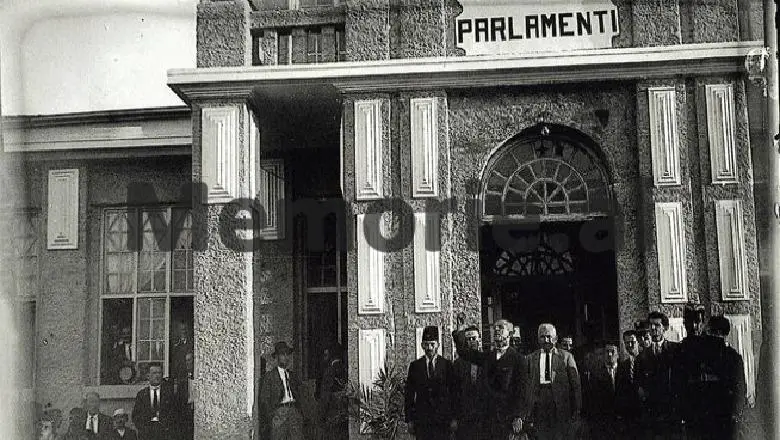
Meanwhile, the first parliamentary elections in Albania took place in the spring of 1921, as they had not been held until then due to World War I, in which Albania was also involved. The first Albanian Parliament opened on April 21 of that year; the first building of the Albanian Parliament was located where the Academy of Sciences stands today. In that parliament, 76 deputies participated, elected following a relatively regular process from the nine prefectures of the country: Berat, Durrës, Elbasan, Gjirokastra, Korça, Kosovo, Shkodra, Vlora, and the Albanian colony in the USA.
As in the past, those elections were conducted through a system of representation, or secondary electors, where based on territorial division, representatives of each province had the right to elect their deputy. The aforementioned, along with a brief history of parliamentary elections in Albania from that period until 1991, has been published by Memorie.al in previous issues. Here, we are publishing the complete Basic Statute of the Albanian Republic (the Constitution) of 1925, where a special place is held by the parliamentary election legislation of that time, as well as the Parliament’s regulations regarding the rights and duties of deputies, published by the “NIKAJ” Printing House in 1925.
Continued from the previous issue…
The Fundamental Statute of the Albanian Republic (1925)
(Tirana, “Nikaj” Printing House 1925)
Penal Code 1928
– SECOND BOOK –
Crimes
TITLE VII
Offenses against public order
CAPTAIN V
Offences relating to spectacles and public facilities and exercises
CHAPTER II:
Drunkenness
ARTICLE 549. – Anyone caught in a public place being overtly drunk and in a filthy or shameful state, shall be punished by a light fine of ten to one hundred gold francs and light imprisonment of up to five days; and if they harass others in violation of the law, the punishment shall be light imprisonment of three to twenty days and a light fine of up to five hundred gold francs.
If the offender has made drunkenness a habit, the punishment shall be light imprisonment of one to three months, and the court may decide that the imprisonment be served in one of the manners indicated in Article 23; and if the offender is a public official, a temporary suspension from office shall be added to those punishments. Drunkenness is considered a habit when the offender has been previously convicted twice for it.
ARTICLE 550. – Anyone who, in public places or places open to the public, causes the intoxication of another by intentionally providing them with drinks or intoxicating substances, or provides these to a person who is already drunk, shall be punished by light imprisonment of up to ten days and a light fine of twenty to two hundred gold francs.
If this act is committed against a minor under the age of eighteen or against a person who overtly appears to be in an abnormal state due to mental weakness or disturbance, the punishment shall be light imprisonment of ten days to one month and a light fine of thirty to three hundred gold francs.
If the offender casts out of their shop the person whose intoxication they caused to a degree that they cannot care for themselves, the punishment shall be increased by one-third to one-half.
When the offender is engaged in the trade of drinks or intoxicating substances, the suspension of the exercise of their profession or trade shall also be added to the punishment.
CHAPTER III:
Acts against public decency
ARTICLE 551. – Anyone who, before the public, appears partially or fully exposed in a shameful manner, or through words, songs, or other acts offends public decency, shall be punished by light imprisonment of up to one month or a light fine of ten to five hundred gold francs.
CHAPTER IV:
Ill-treatment of animals
ARTICLE 552. – Anyone who behaves cruelly toward animals, or unnecessarily beats or wounds them or forces them into labor that clearly appears excessively heavy and exhausting, shall be punished by a light fine of up to one hundred gold francs.
The same punishment shall be imposed on anyone who, even for scientific or didactic purposes but outside of places designated for instruction, subjects animals to such experiments that offend public compassion.
TITLE IV:
Misdemeanors regarding public care in property
CHAPTER I:
Taking possession with intent to damage
ARTICLE 553. – Anyone who, by removing it from its location without the consent of the rightful owner, takes hold of another’s movable property without the intent of appropriation or profit, but to cause damage to the owner, shall be punished, upon the request of the damaged party, by light imprisonment of up to three months and a light fine of up to three hundred gold francs.
CHAPTER II:
Unjustified possession of goods and values
ARTICLE 554. – Anyone who, having been convicted of begging, theft, extortion, racketeering, fraud, or concealing or purchasing illicit goods, is caught in possession of money or items that are inconsistent with their status and fails to justify their lawful origin shall be punished by light imprisonment of five days to two months.
If caught in possession of altered or counterfeit keys or tools capable of opening or forcing locks and fails to justify their possession for a lawful purpose, they shall be punished by light imprisonment of three days to two months; and if the offender is caught in this manner at night, the light imprisonment shall be from two to six months.
The money and goods shall be confiscated.
CHAPTER III:
Failure to take precautions in trade or pawning
ARTICLE 555. – Anyone who, without first verifying their lawful origin, buys or accepts as a pawn, payment, or deposit, items which – considering their quality or the price requested or accepted – appear to originate from an offense, shall be punished by a light fine; and if the offender is among the persons indicated in the preceding article, they shall also be punished by light imprisonment of up to two months.
No punishment shall be imposed on anyone who proves the lawful origin of said items.
ARTICLE 556. – Anyone who, after receiving money or purchasing or otherwise coming into possession of items originating from a crime, subsequently learns of their unlawful origin and omits to immediately notify the Authority, shall be punished by a light fine of no less than thirty gold francs, to which light imprisonment of up to twenty days may be added.
ARTICLE 557. – Anyone who, while engaged in the trade or pawning of valuable or used items, fails to respect the provisions established by law or regulations pertaining to that trade or those activities, shall be punished by a light fine of ten to three hundred gold francs; and in case of recidivism of the same offense, light imprisonment of up to one month and the suspension of the exercise of the profession or trade shall be added to the fine.
CHAPTER IV:
Unlawful sale of keys, master keys, and unlawful opening of locks
ARTICLE 558. – Any blacksmith, locksmith, or any other craftsman who sells or delivers master keys to anyone, or manufactures keys of any kind from wax impressions (imprinted) or other stamps or models for someone they know is not the owner or the representative of the owner of the place or property for which they are intended, shall be punished by light imprisonment of up to two months and a light fine of ten to one hundred gold francs.
ARTICLE 559. – Any blacksmith, locksmith, or any other craftsman who, upon the request of anyone, opens locks of any kind without first ensuring that the person is the owner or the representative of the owner of the place or property to be opened, shall be punished by light imprisonment of up to twenty days and a light fine of up to fifty gold francs.
CHAPTER V:
Unlawful possession of weights and measures
ARTICLE 560. – Anyone who exercises a public trade and keeps in those shops measures (mizyra) or weights different from those established by law, shall be punished by a light fine of up to fifty gold francs, to which, in case of recidivism, light imprisonment of up to one month shall be added.
ARTICLE 561. – The Penal Code dated 1274 allaturka [Ottoman calendar] and its supplements remain without force; likewise, the punitive provisions of other laws which are in conflict with this code are abrogated. Regarding the penal provisions of special laws that refer to the abrogated Penal Code, the corresponding articles of this Code shall apply.
SPECIAL ARTICLE: The law dated 23-VII-925 regarding political offenses and its supplement dated 30-I-926 remains in force for the entire duration specified in that law.
This Code enters into force on January 1, 1928.
Crimes against religious freedom and freedom of conscience
ARTICLE 140. – Punishment of three months to three years imprisonment and a heavy fine of one hundred to one thousand gold francs shall be imposed on those who use the faith or symbols of a religion as a tool, as well as those who incite religious feelings for the same purpose.
ARTICLE 155. – Anyone who, with the intent of offending one of the religions honored by the state, obstructs or prevents the exercise of religious functions or ceremonies, shall be punished by imprisonment of up to three months and a fine of 50 to 500 gold coins. If the act is committed with violence, threats, or insults, the perpetrator shall be punished by imprisonment of 3 to 30 months and a fine of 100 to 1,500 gold coins.
ARTICLE 156. – Whosoever, with the intent of insulting one of the cults honored by the State, publicly reviles a person professing said cult, shall, upon the complaint of the aggrieved party, be punished by imprisonment of up to three months or by a fine of 100 to 3,000 gold coins.
ARTICLE 157. – Whosoever, for the purpose of insulting one of the cults honored by the State, destroys, damages, or in any other manner desecrates in a public place objects destined for worship, shall be punished by imprisonment of ten days to two months and by a fine of up to 300 gold coins. Should the violation be committed during the exercise of worship, or through violence against a minister of worship during the performance of his duties, the punishment shall be imprisonment of one to six months and a fine of 100 to 1,000 gold coins.
ARTICLE 158. – Whosoever, within places destined for worship or in cemeteries, destroys or defaces statues, paintings, inscriptions, or graves, shall be punished by imprisonment of one month to one year and by a fine of up to 500 gold coins.
ARTICLE 159. – Whosoever commits acts of contempt toward a human corpse or the ashes thereof, with the intent to insult or for other unlawful purposes, or removes said corpse or ashes in whole or in part, or violates in any manner a grave or an urn, shall be punished by imprisonment of 1 to 6 months.
Excluding the cases described above, whosoever removes in whole or in part, or without due authorization exhumes a human corpse or steals the ashes, shall be punished by imprisonment of up to one month and a fine of up to 300 gold coins.
If the act be committed by the person in charge or the custodian of the cemetery or other burial grounds, or by one to whom the corpse or ashes were entrusted, they shall be punished, in the case of the first paragraph, by imprisonment of two months to one year and a fine of 50 to 1,500 gold coins; and in the case of the second paragraph, by a fine of up to two gold coins and imprisonment of two to three months.
ARTICLE 160. – Whosoever publicly insults an individual by reason of their lack of religious belief, shall, upon the complaint of the aggrieved party, be punished by imprisonment of up to three months or by a fine of up to 1,000 gold coins./Memorie.al