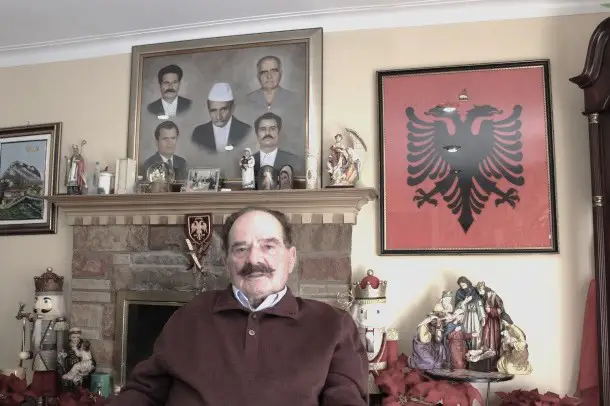
By Prof. Gjon Frani Ivezaj
Part Two
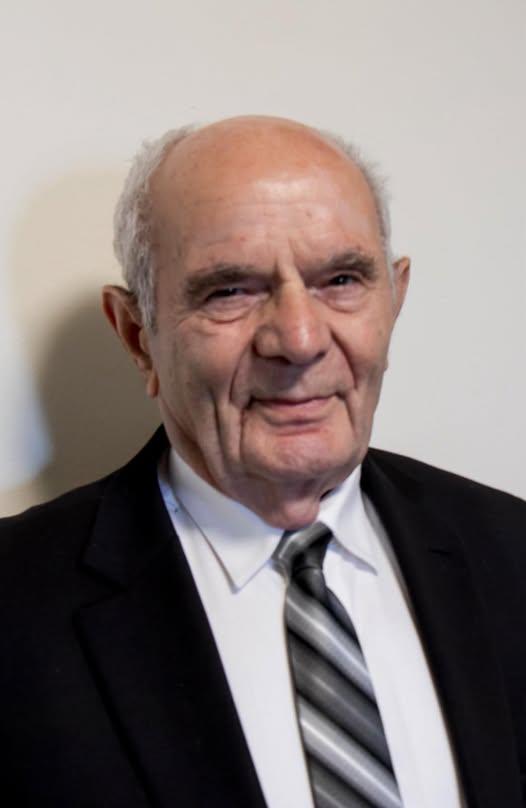
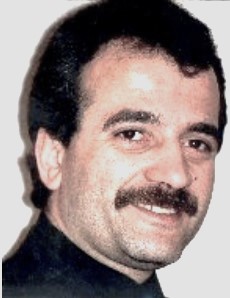
Memorie.al / Pjetër Nua Ujka Mernjaçaj were born on October 7, 1930, in the “Pshtan” neighborhood of Selcë, Kelmend. His family has been traditionally nurtured with deep patriotic feelings and spirit throughout the centuries. He began and completed his 8-year education in his birthplace and later, upon turning 20, served in the military from 1950 to 1952. While Pjetër was completing his military service, he learned that in 1951, his brother Nikollë had been arrested and thrown into the notorious Shkodra prison, also known at the time as the Internal Affairs Branch (today a property of the Franciscan Assembly and a historical museum featuring original cells from the era of the communist-atheist dictatorship, visited by various generations after the 1990s – Note by Prof. Gj.F.I.).
Continued from the previous issue
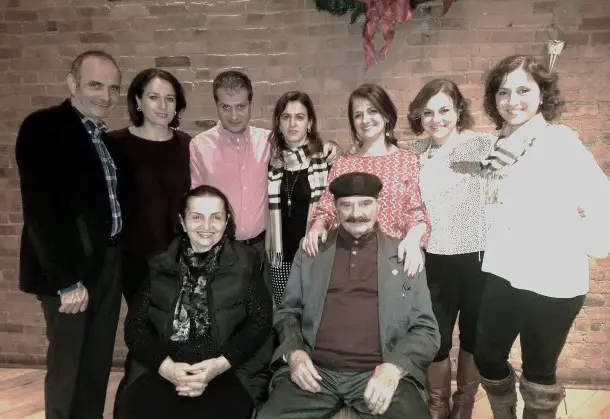
Since his youth in Kelmend, as remembered by many of his friends and companions, Pjetër held fervent patriotic sentiments close to his heart. He spoke with passion and respect about the glorious history of the distinguished men of Kelmend, their heroism over the centuries, and their fiery desires for freedom and independence. He had, and still maintains today, a great love for his ancestors, his family, his mother and father, his brothers, and all other relatives whom he was finally able to meet after his long emigration to the USA, once democracy was established in the “Land of the Eagles.”
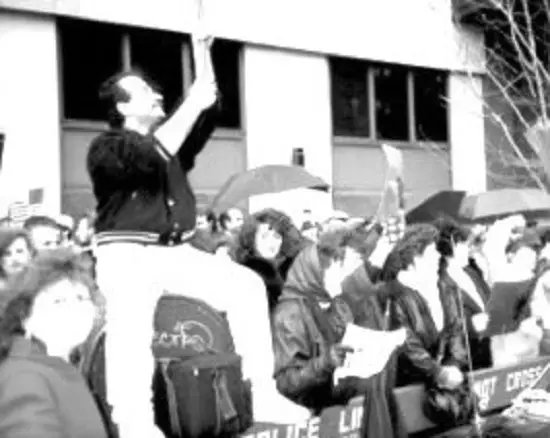
Pjetër, as a prominent and tireless activist for the Albanian cause in the USA and specifically in New York, took an active part in many anti-communist demonstrations organized in front of the UN and the White House in Washington, D.C. Together with many of his compatriots, he demanded justice and an end to the brutal communist persecution against his family, Kelmend, Shkodra, and all of Albania. He advocated for religious freedom and the return to their homes of all persons who were unfairly exiled and mistreated in internment camps and the prisons of the “communist hell.”
As a tireless Albanian-American champion of the national cause, Pjetër Marnjaçaj sought the overthrow of the brutal, barbaric communist system and the establishment of democracy for his homeland, which had suffered from successive foreign occupations and, finally, from a barbaric communist re-occupation. This regime killed, tortured, massacred, and interned its finest citizens for the sake of absurd proletarian ideas of failed Russian and later Chinese communism.
For many decades, Albania followed a harsh line of experimental communism, isolating itself from the entire progressive world and even from liberal communist countries, as the former Soviet Union and China later became. Anyone who knew and remembers the tireless, energetic activist Pjetër Mernjaçaj today recounts how, through his messages at Albanian gatherings in the USA, he called for Albanians to live in peace, prosperity, and unity – regardless of religion, region, or ideology – within the homeland inherited from our Illyrian-Arbëror ancestors.
This son of Kelmend, coming from a distinguished family of Malësia e Madhe, always sought the establishment of a progressive pluralist democratic system in Albania, with free voting for all layers of Albanian society. He believed that the people should decide their own fate through the functioning of multiple political parties, following the model of many Western countries and the champion of democracy, the USA.
At anti-communist rallies, they called upon the communist government of “Red Tirana” to allow freedom of speech and religious freedom, since until 1990, the country – through an atheist Constitution – had declared itself an atheist state and mercilessly persecuted every religious cleric and person who believed in God.
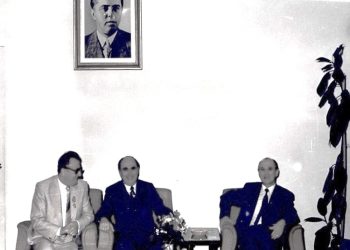
Conversing often with the tireless activist of the Albanian-American community, Mr. Pjetër Mernjaçaj, one learns that he was an inseparable part of many anti-communist demonstrations in front of the Mission of Communist Albania under Dictator Enver Hoxha in Manhattan, New York. With calmness and modesty, he speaks of these rallies and offers a closer look at documents, speeches, and financial funds collected from the hearts of compatriots who loved their birthplace with all their souls.
They lamented the cruelty into which communism had plunged the “Land of the Eagles.” He describes how many patriotic activities and other initiatives were organized during the time when his Albania suffered long and brutal communist persecution for decades. Speaking warmly with my friend Pjetër Mernjaçaj, one learns about many events and important public figures in our community while reading the notes and the rich diary of nationalist demonstrations of the Albanian-American community over several decades in the USA, mostly in New York, Washington D.C., etc.
In several important meetings, he delivered lectures filled with content and a deep spirit of patriotism and anti-communism to sensitize American public opinion, the media, senators, congressmen, the government, and US Presidents over various years. He stood several times on the podiums of improvised anti-communist demonstrations and spoke openly before his compatriots. Thus, in a gathering dated February 9, 1990, among other things (today, 35 years later, reading his memories carefully preserved by his family – Note by Gj.F.I.), he writes:
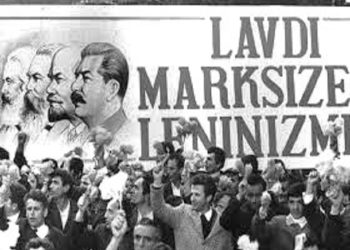
“…On January 11 and 14, the youth of the city of Shkodra, equipped with hammers and other tools, gathered around Stalin’s statue and threw bicycle rubber tires, everyone shouting at the top of their lungs: ‘Freedom-Democracy!’, ‘Down with the dictator Enver Hoxha!’, ‘Enver-Hitler!’, ‘Down with communism!’, etc. The police forces of the Internal Affairs Branch and the notorious Sigurimi arrived immediately and began beating the anti-communist youth with rubber batons and arrested many of them.
Brothers and sisters!
At a time when the socialist camp is burning and destroying the final volumes of the fairy-tale books of Marx, Lenin, and Stalin, the red communist government of Tirana is filling prisons with new generations of Albanians and building new prisons to incarcerate the Albanian people. The hopes anticipated with the death of the executioner Enver Hoxha – that Ramiz Alia would supposedly change the course of the communist carriage from dictatorship to democracy – have faded after 46 years…!”
The omnipresent and tireless activist, our compatriot Pjetër Mernjaçaj, was the initiator and primary supporter of the creation of the meaningful Cultural Club “At Gjergj Fishta,” operating in New York (957 McLean Avenue, Yonkers, New York). Pjetër, along with many other friends and compatriots, campaigned to raise funds for the initial expenses of establishing the “At Gjergj Fishta” Cultural Club.
Many of his friends responded to the noble goal of Pjetër’s heart, including: Zef Tomë Pepaj, Marash Marnjaçaj, Malot Malota, Luan Isufi, Zef Selca, Lek Gojcaj, Dedë Mark Dedaj, and Paulin Mernjaçaj. They displayed characteristic noble Albanian generosity, contributing together through voluntary work. Thus, they managed to raise funds for the construction of the podium, payments for decorating the grounds, chairs, tables, monthly rent, etc.
In a petition addressed to George Bush while he was running for US President, Pjetër and the “Albanian-American Civic League,” through former Republican Congressman Joe DioGuardi, requested that the American Government exert diplomatic pressure on the communist government of Tirana, which had been flagrantly violating and persecuting human rights and freedoms for decades.
On the other hand, the petition requested that the American Government and he, as US President, ask the Yugoslav Government to respect the Human Rights and Freedoms of the martyr people of Kosovo, who were being brutally mistreated by the military machine of the Serbian occupiers. Pjetër carefully preserves a rich correspondence with the tireless activist of the Albanian cause, former Republican Congressman Joseph J. DioGuardi (Member of Congress, 1985-1989).
After thanking Mr. DioGuardi for everything he had done and continued to do for the Albanian cause, he asked the board of the “Albanian-American Civic League” to strive together for the issue of Kosovo, sensitizing the American media to write about the systematic oppression and violence openly committed by the Serbian Government.
Pjetër, on behalf of the organization “Voice of the Albanian Youth in Exile” (Yonkers, New York), in a message-letter sent on March 25, 1992, to the Speaker of the Albanian Parliament, Mr. Pjetër Arbnori, describes how the Albanian-American community organizes important rallies for the raising of the Albanian national flag alongside the American flag. These joint rallies are attended by many high officials of the City of Yonkers, as well as American congressmen and senators who have always contributed from the heart to the Albanian cause and specifically that of Kosovo.
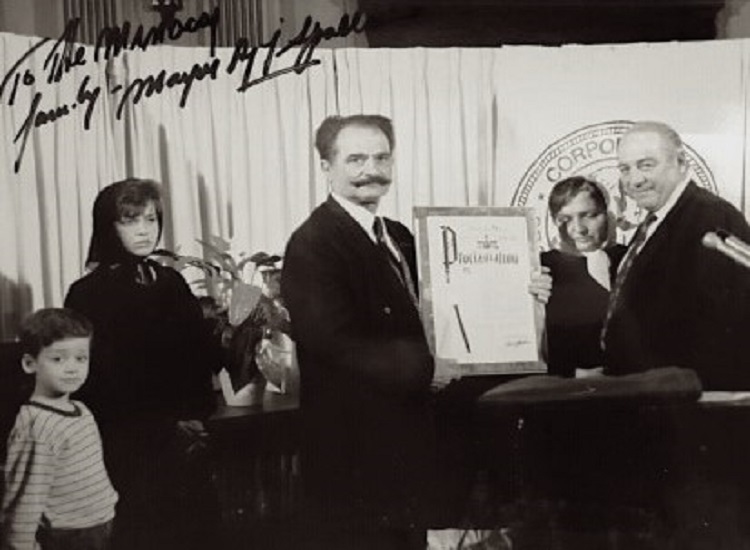
Pjetër reminds Mr. Arbnori that April 25 is the day dedicated to the raising of the Albanian National Flag in a sign of respect and memory for his nephew, Nikë Mernjaçaj – a ceremony that has become a tradition for years as a legal right granted by the administration of the city of Yonkers for all future Albanian and American generations.
Immediately after the opening of Albania and the fall of communism, in the following years, Pjetër, like many other Albanian-American compatriots, often received invitations to participate in many cultural and patriotic activities in his homeland. In an invitation from the Patriotic Cultural Association “Besa,” based in Shkodra and chaired by Mr. Dashamir Uruçi, in honor of the 80th anniversary of Albania’s Independence, Pjetër Mernjaçaj was invited to visit Albania alongside other compatriots such as Prof. Sami Repishti, Ekrem Bardha, Anthony Athanas, Prof. Peter Prifti, and Prof. Eric Hamp. He responded positively to this invitation, and upon his return, wrote his impressions of the journey to Albania and his experience of the fragile democracy there.
In the wake of continuous patriotic work and in tireless support of the Albanian-American community, the editorial board of the organization “The Voice of Young Albanians in Exile” – consisting of Paulin Mernjaçaj, Halil Lita, Gjovalin Nikçi, Luan H. Gashi, Nikoll Pjetri, Pjetër Marnjaçaj, and Vasel Camaj, aided by the valuable advice of Dr. Hamdi Oruçi, Dom Rrok Mirdita (His Excellency, Archbishop Rrok Mirdita), Dom Pjetër A. Popaj, and the former Chairman of the Council of the “Our Lady of Shkodra” Catholic Church, Mr. Tonin Mirakaj -republished in full the original text “The Albanians and Their Rights.” This work was written by the National Poet At Gjergj Fishta O.F.M. and originally delivered in French at the Great Hall of the Catholic University in Paris by His Excellency Msgr. Luigj Bumçi, Bishop of Lezha. / Memorie.al