The Unknown History of Elections in Albania in 1923! From Women’s and Sphere Voting, to Fines for Those Who Didn’t Show Up to Vote. Details of the Electoral Process that Produced the Events of 1924?
Memorie.al – One of the most problematic parliamentary elections in Albania’s history were those of 1923. These elections and their issues produced the events of 1924 in Albania, where, following the assassination of Avni Rustemi and numerous protests, what is known as the “June Revolution” of 1924 took place. This revolution brought Fan Noli to power and removed Ahmet Zog from Albania for the first time. Although they can be considered one of the most problematic electoral processes in Albania’s history, it can also be said that before them, the most advanced discussions in the country’s history took place regarding the standards elections in Albania should have.
For the first time, in the preparations for the 1923 elections, women’s suffrage was discussed – a pioneering discussion given that at that time, many developed countries in the world had not even reached the level of such debate. The separation of the police and army from the elections was also discussed, to eliminate government influence on the electoral process, as well as guaranteeing the secrecy of the vote through a new voting system using spheres. Despite the high level of discussions, the subsequent months when the elections were held showed that Albanian politics of those years had not yet, in practice, reached the level of standards defended in words during the marathon sessions of September 1923.
Women’s Suffrage
In September 1923, two draft laws for the upcoming elections were discussed in the Albanian parliament. The government’s draft essentially envisioned voting with ballots, voting by proxy, and some other changes related to election organization. Meanwhile, the draft by the Parliamentary Committee on Justice was more advanced and envisioned some innovations unthinkable for the time they were proposed. Therefore, this draft received more discussion.
In the plenary session of September 21, 1923, at 10:00 AM, the report of the committee on justice and administration was discussed, which brought several amendments to the election law. The three most debated points were the new secret voting system (with spheres), the removal of the gendarmerie from the electoral process to avoid influence, and women’s suffrage. The proposal stipulated that among the amendments to the election law, the right for women who could read and write to participate in electing the secondary electors should be sanctioned. At that time, the people voted using a two-tier electoral system, where they first elected several delegates who would then vote for their district’s deputy. In this case, the discussion was about giving women the right to choose the persons who would vote for the new deputies.
One of the greatest supporters of women’s suffrage was Visarion Xhuvani, whose speech received applause in the plenary session. However, Xhuvani considered women’s suffrage premature, arguing that very few women knew how to read and write, and in his estimation, not even a quarter of them would go to vote. Meanwhile, Hil Mosi went even further in his speech, requesting that Albanian women be granted full voting rights – not only to choose the electors of deputies but also to be direct electors themselves, i.e., to have the right to be represented on the list of those who would elect deputies.
Luigj Gurakuqi presented the committee’s proposals, while there was also a government draft for these elections.
Visarion Xhuvani: “I said that if we don’t have good mothers, no one is interested in us having a good head of state. Besides this reason, I have another one which my religious leader commands me, who says all are one kind. So women too will be honored. But how many women do we have who know how to read and write? The Ministry of Education doesn’t have such statistics. Out of the number of women who know how to read and write, even a quarter of them won’t go to vote. Therefore, for today, women’s voting is a comedy.”
Hil Mosi: “Speaking about the free will of voting, the government’s draft denies women the vote, we don’t know why. We see nations like Turkey, which is composed of Muslim elements and where the freedom of Muslim women is quite restricted, have made progress to the extent that in the Ankara parliament we even have women as representatives. I, for myself, would have given women full freedom even as secondary electors, because we have women who are much more progressive than some men.”
The Innovation of Secret Ballot Voting (with Spheres)
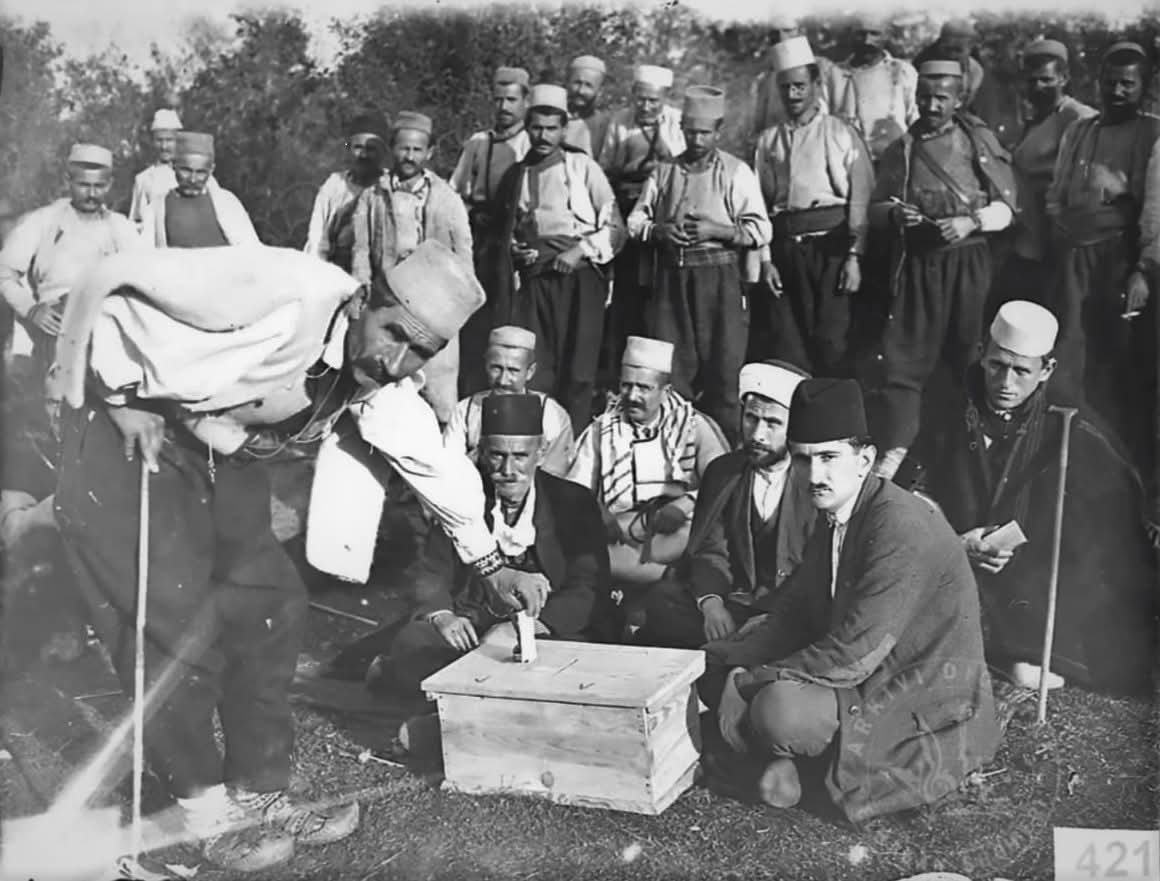
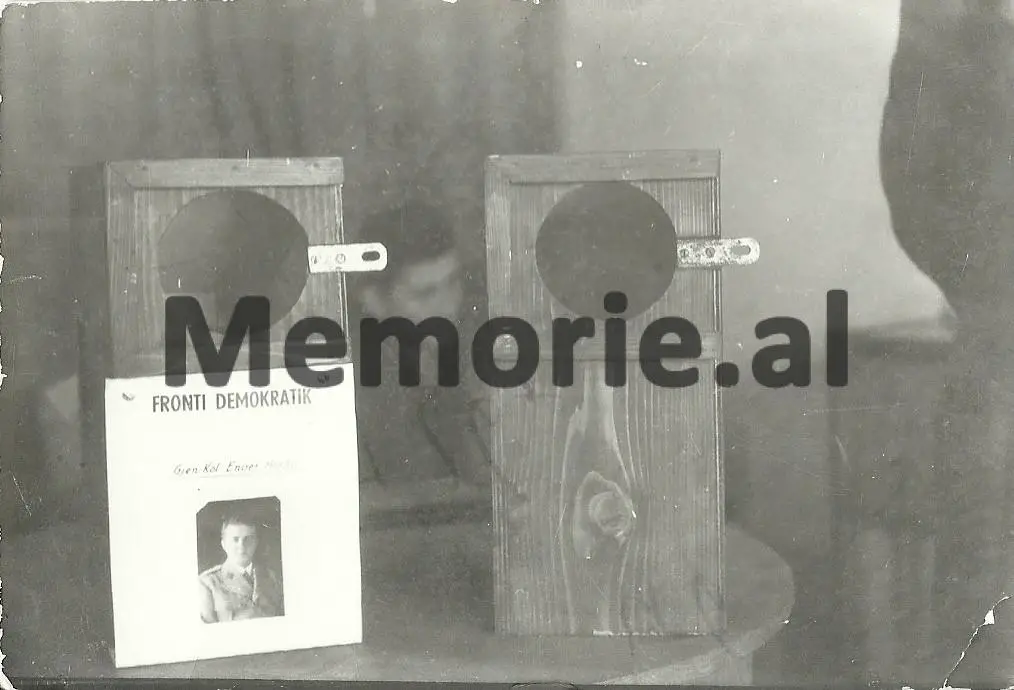
Another proposal for the 1923 elections was the voting method. In these elections, the opposition’s draft envisioned voting with spheres. It was a voting method where the voter would take a sphere (ball) in hand, close their fist, and then put their hand into boxes bearing the names of the candidates. Secretly, they would drop the sphere into the box of the candidate they wanted. This voting method solved the problem of the voters’ education level, as it did not require the ability to read or write. On the other hand, government representatives in parliament opposed this draft, arguing that paper ballot voting was more suitable and did not allow for election manipulation.
Koço Tasi:”The government in its draft has adopted the paper ballot system, which has been in use before and played the primary role. This system does not ensure the secret vote, which the government’s draft also envisions. This is only in theory, and if we take it in practice, there will be no secret voting. That voter, either out of fear or friendship, will be forced to show whom he is choosing. This point is against the principle of secrecy that the government has established. So, by majority vote, the sphere system was established by the committee. This system is as follows: There is a box divided in the middle. One side is white, the other black. There is an opening into which the person puts their hand, and it is not visible where they came from or dropped the sphere on the side they want. This is the sphere system, which is also used among our neighbors. Every person will have a box. Although this system does not ensure our ideal, we have seen that it is much better than the paper ballot system.”
Luigj Gurakuqi: “Koço Tasi explained this system very well, but it seems to me he left something unmentioned. He says that in both drafts the vote will be secret. As you well know, men who cannot read or write will also participate in the elections. By using this system, he votes himself and there is no need for someone else to lead him, and thus the voting will truly be secret.”
Ali Këlcyra: “Take my province, Gjirokastër, there we won’t find more than one in a thousand who knows how to read and write. Being so, with the government’s system that requires ballots, there will be many abuses. With the sphere system, we have two gains: it’s good both for the one who has the courage to vote for whomever he wants, and for the one who is pressured by others because by putting his hand there he can say ‘I voted for you’ while in truth he voted for whomever he himself wanted. So, since this is a vital issue, it must be taken into account.”
Visarion Xhuvani: “I also like the spheres, but I don’t know if the people have reached the level to understand this system. I don’t understand why the gentlemen of the opposition insist on this system. The people, if they have the will to choose, will choose whether with spheres or without spheres. During election times, there will be many lists with candidate names. One will tell the villager to vote for this one, another for that one, and another again for someone else. So the villager must have not just two ears, but six. Therefore, I said that this sphere business is a troublesome thing and another way must be found.”
Bahri Omari: “On one side it is said we want to ensure the freedom and secrecy of the vote, on the other side the sphere system is opposed. We show a way how this freedom can be better ensured. Not accepting this method means the other way will be accepted.”
Milto Tutulani (Minister of Justice): “One of the committee’s points is the point about spheres, which ensures the freedom of the people, say the opponents. That the ballots in the government’s draft lose the people and are eaten by absolutism. Where they have adopted the sphere system and where they have the secret system, they have done so because the people are illiterate and don’t know how to read or write. The method devised by the committee does not correspond to this right, because where they have the sphere system, the vote is direct, whereas here the vote is indirect. The sphere system does not have greater control than the ballot system, on the contrary. The voting system with ballots has also been adopted in France, and voting with ballots is secret, and the government cannot exercise any control because the vote is given closed.”
Despite debates lasting several days in the parliament of that time, both opposition proposals – for women’s suffrage and for voting with spheres – were rejected. (In fact, both projects would only be realized in the first post-war elections on December 2, 1945, by the Communist Party that came to power.) The elections were held in December 1923, a few months after parliament passed the new electoral law that rejected the proposals for sphere voting and women’s suffrage. The elections of that year were held with great tensions, which in fact reflected a destabilized political climate.
Allegations of Fraud and the Aftermath
In the plenary sessions of January 1924, the opposition denounced in parliament all the violations that had occurred during the elections. In the session of January 23, 1924, three deputies – Mufid Libohova, Vasil Dilo, and Elmas Kokona – presented a report on the problems of the December 1923 elections. According to the presented report, it was claimed that gendarmerie officers were used to influence the electoral outcome. It was also claimed that the votes of secondary electors were annulled, and to the extent that some voters were forced to go to the office of the government candidate to hand over their ballot paper, which was filled out for the government candidate and then dropped into the box.
At the end of the counting, some boxes resulted in more votes than the number of voters. In some cases, it had happened that the ballot box was opened to be counted in the middle of the electoral process, while many voters, before casting their vote, had participated in free dinners offered in hotels by government representatives. In this way, the first sessions of the new parliament resulting from the 1923 elections passed intense discussions where various deputies presented their evidence.
Faik Konica’s Resignation in Protest
The situation became so tense that resignations of various deputies were not lacking. According to the law of the time, several deputies were also elected in the Albanian parliament as representatives of the Albanian diaspora. One of them, chosen as a representative, was Faik Konica. In the session of March 12, 1924, a letter that Faik Konica had sent to parliament was discussed. This letter announced his resignation as a deputy. It is precisely this letter that summarizes the fierce debates about what was alleged to have happened in the December 1923 elections.
“To the Constituent Assembly in Tirana.
Mr. President,
The majority of the people have shown publicly that they desire fundamental social changes.
But the elections held under government intimidation and in the shadow of murders brought to the Assembly a majority that strives to preserve the old social factory, which has left the people in darkness and poverty.
Such a constituent assembly does not represent the people, but a class of parasites. Therefore, I have the honor to present to you my resignation as a deputy of the Assembly.
The miseries you are preparing against the people, may they fall upon the heads of the self-elected majority of this destructive assembly.”
After some debate, the Assembly decided to approve Konica’s resignation. Konica’s resignation was followed a few months later by the resignation of Eshref Frashëri, the deputy from Korça, from the presidency of the Constituent Assembly. The reason for Frashëri’s resignation, as written in his resignation letter, was that he was tired of this duty. The tensions continued until June 1924, when the assassination of Avni Rustemi and the start of the popular revolt produced what was called the “June Revolution.” The two ideas proposed in 1923 – for women’s suffrage and for voting with spheres – would be applied in the 1945 elections, when the communists had just come to power.
What Did the 1923 Electoral Law Stipulate?
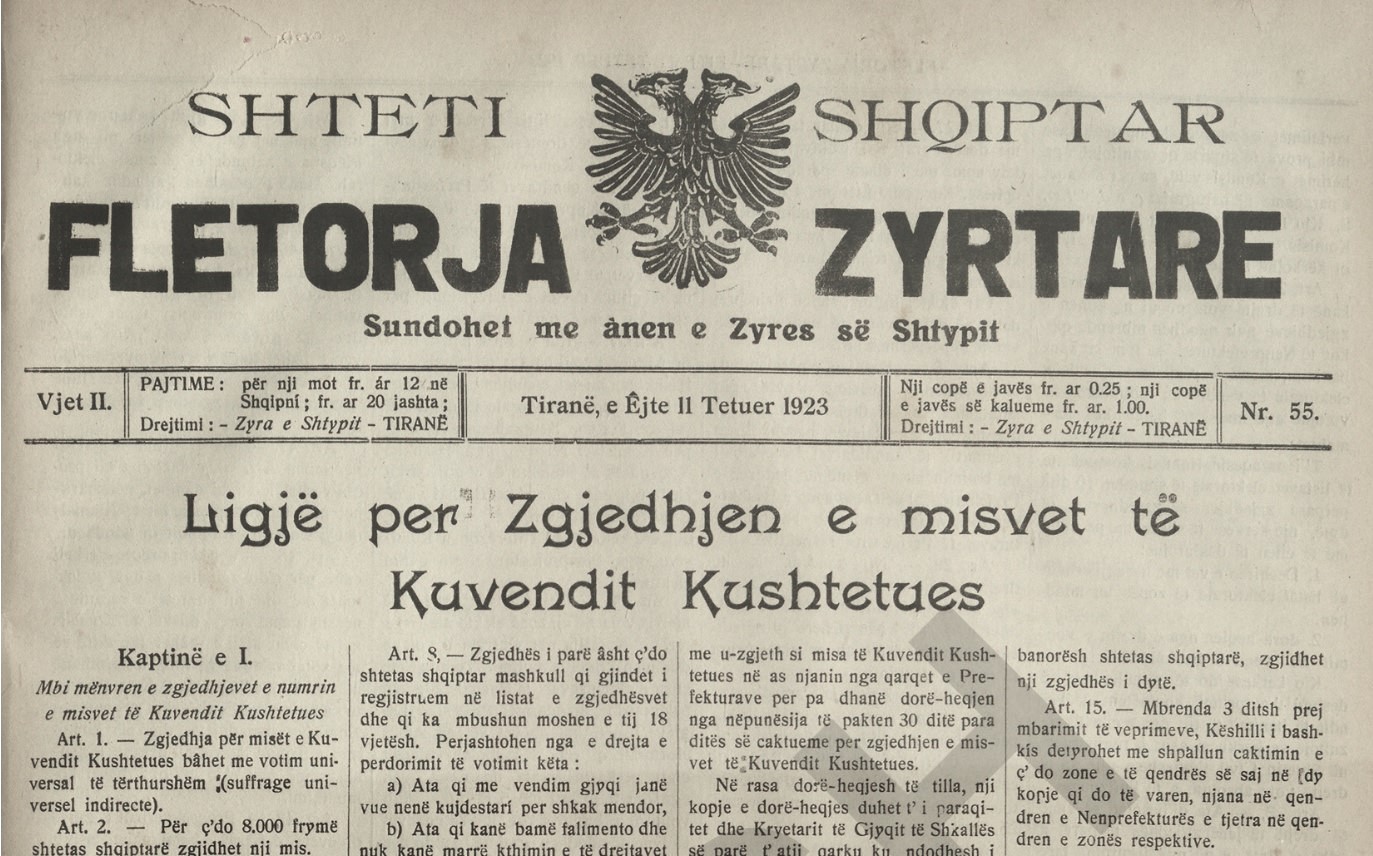
The electoral law of 1923, which was later applied in the December process of that year, stipulated that elections would be held by indirect voting; meaning primary voters would elect delegates who would then vote for their district’s deputies. According to this law, for every 8,000 inhabitants, 1 deputy would be elected. Each prefecture of the country was considered an electoral district. A primary elector was every male Albanian citizen who had reached the age of 18. However, to vote, the law stipulated several conditions, and not everyone had the right to vote. The principle followed was that the right to vote belonged to those who contributed to society. Consequently, those who had committed crimes, those who were mentally incapacitated, or those who had not received what was termed “restitution of civil rights” or rehabilitation were excluded from voting rights.
Also excluded from voting rights were beggars, the military, and any police agent. On Election Day, soldiers and police were to remain closed in their barracks and not get involved in the electoral process? The law also detailed the composition of the electoral commissions. These were chaired by the highest judges and included members of the municipal councils. The ballot papers were several uniform white slips measuring 12 centimeters in length and width, bearing the municipal seal at the top. The voting process started at 09:00 in the morning and ended at 17:00 in the afternoon. The 1923 electoral law provided for severe penalties for those who created incidents or attempted to manipulate the electoral process.
One of the strongest points of this law was the one related to the obligation to vote. Every mandated secondary elector tasked with electing deputies, if they did not go to vote and did not have a valid reason, was fined 10-50 gold francs.
The 1923 elections are considered the last free elections held in Albania until 1991. In these elections, the party led by Fan Noli won 35 mandates; Ahmet Zog’s group won 26 mandates, while the People’s Party won 20 mandates. 14 mandates were won by independent candidates. /Memorie.al