
By Dashnor Kaloçi
Part fourteen
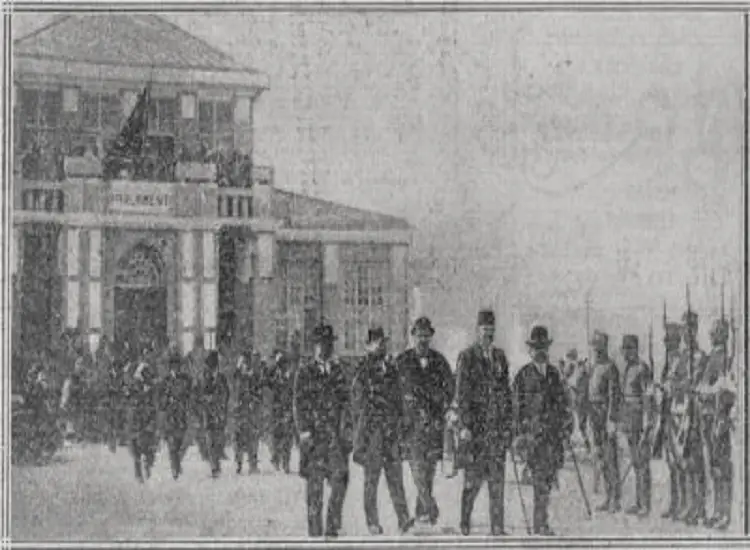
Memorie.al / The history of parliamentary elections in our country, or more accurately, the attempts at elections, have its origins in the era of Ottoman rule when Albania was part of the Turkish Empire. One of the first Albanian deputies elected to the first Turkish Parliament, which opened its proceedings in December 1877, was Abdyl Frashëri. However, that parliament did not last long, as it was dissolved by the Sultan himself due to the outbreak of the Russo-Turkish War. Following the dissolution of Turkey’s first parliament, there were several other attempts at elections, but they all failed for various reasons. The first regular elections in Albania were held only in 1908, when the Young Turks came to power in Turkey. Those elections were not direct but were held through representation, otherwise known as the two-tier voting system (secondary electors).
The first Turkish Parliament opened on December 10, 1908, and out of 266 deputies, 27 were Albanians elected from the four vilayets of Albania. At that time, members of the “Committee of Union and Progress” in Turkey, which included many Albanians, split and grouped into three political factions. The first group was “Union and Progress” (the Turkish-Macedonian party) with 164 deputies, consisting of 130 Turks, 5 Arabs, 1 Greek, and 15 Albanians, led by Hasan Prishtina, a deputy from Kosovo.
The second group, called “Liberal Union” (the Greek-Albanian party), consisted of 45 deputies and included 12 Albanians led by Ismail Qemali. Among the other Albanian deputies in the Turkish Parliament at the time were Esad Pashë Toptani, Nexhip Draga, Rexhep Pashë Mati, etc. After 1908, there were several other elections where Albanians continued to vote for their representatives in the Turkish Parliament, a process that lasted until November 1912, when Independence was proclaimed and Ismail Qemali was elected head of the Government.
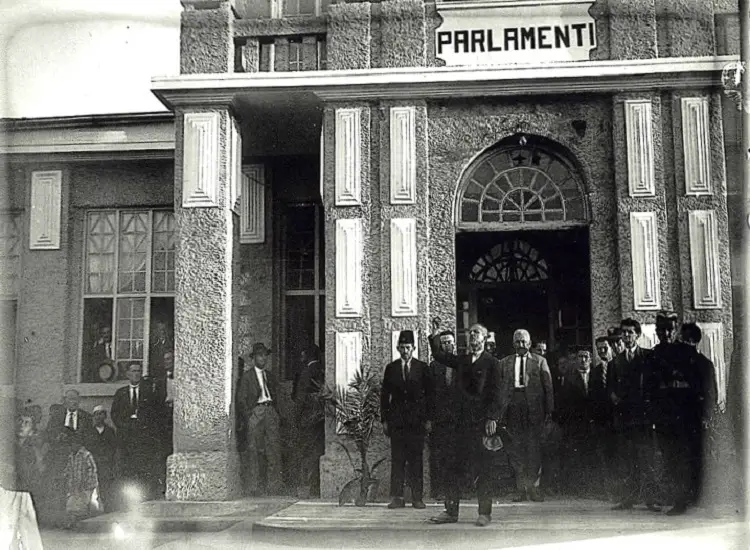
Meanwhile, the first parliamentary elections in Albania took place in the spring of 1921, as they had not been held until then due to World War I, in which Albania was also involved. The first Albanian Parliament opened on April 21 of that year; the first building of the Albanian Parliament was located where the Academy of Sciences stands today. In that parliament, 76 deputies participated, elected following a relatively regular process from the nine prefectures of the country: Berat, Durrës, Elbasan, Gjirokastra, Korça, Kosovo, Shkodra, Vlora, and the Albanian colony in the USA.
As in the past, those elections were conducted through a system of representation, or secondary electors, where based on territorial division, representatives of each province had the right to elect their deputy. The aforementioned, along with a brief history of parliamentary elections in Albania from that period until 1991, has been published by Memorie.al in previous issues. Here, we are publishing the complete Basic Statute of the Albanian Republic (the Constitution) of 1925, where a special place is held by the parliamentary election legislation of that time, as well as the Parliament’s regulations regarding the rights and duties of deputies, published by the “NIKAJ” Printing House in 1925.
Continued from the previous issue
Fundamental Statute of the Albanian Republic (1925)
(Tirana, “Nikaj” Printing House, 1925)
Penal Code of 1928
SECOND BOOK: Felonies (Delicts)
Felonies against the Inviolability of Secrets
CHAPTER V: Abuse of Office by Advocates and Other Representatives
ARTICLE 256. – Advocates or other representatives who, through collusion with the opposing party or other deceitful means, prejudice the case entrusted and confided to them, or who, being engaged by one party, undertake the representation of the opposing party in the same matter, shall be punished by heavy imprisonment from three to thirty months, a fine of no less than 100 gold francs, and temporary disqualification from public office, as well as suspension from professional practice for a period of no less than six months.
If, after having defended one party, the representative undertakes the defense of the opposing party in the same case without the former’s consent, they shall be punished by heavy imprisonment from fifteen days to six months, or a heavy fine of no less than 500 gold francs, including temporary disqualification from public office and professional practice for up to six months.
ARTICLE 257. – Advocates or other representatives in a criminal case, who, beyond the cases provided in the preceding article, demonstrate bad faith in their duties of representation and thereby prejudice the defendant they represent, shall be punished by heavy imprisonment from one month to three years, temporary disqualification from public office, and temporary suspension from professional practice.
If the person represented was a defendant for a felony punishable by deprivation of personal liberty for more than five years or by death, the heavy imprisonment shall range from three to twelve years.
ARTICLE 258. – Advocates or representatives who receive money or other items from their client under the pretext of securing favor from a witness, expert, interpreter (dragoman), the prosecutor involved in the case, or the judge presiding over the verdict, or under the pretext of compensating them, shall be punished by heavy imprisonment from two to six years, a fine of no less than 1,000 gold francs, temporary disqualification from public office, and suspension from professional practice.
ARTICLE 259. – In cases where, after a felony has been committed for which a punishment of no less than imprisonment is prescribed, anyone – without prior collusion and without having assisted the offender in bringing the felony to its final consequences – assists the offender to secure the proceeds, to thwart investigations, or to hide them from Authority searches or the execution of a sentence, as well as anyone who destroys, disperses, loses, or alters the traces or signs of a felony, shall be punished by heavy imprisonment or imprisonment up to five years, provided that the punishment does not exceed half of the sentence prescribed for the principal offender.
For other offenses not mentioned in point I, the punishment is a heavy fine of up to 1,000 gold francs.
No punishment shall be imposed upon those who commit this offense in favor of a close relative.
Escape (Evasion) and Negligence in the Serving of Sentences
ARTICLE 260. – Anyone who, being legally detained, escapes by using violence against persons or by breaking out (rupture), shall be punished by imprisonment from three to eighteen months.
ARTICLE 261. – A detained convict who escapes using the means mentioned in the preceding article shall be punished:
- By an extension of continuous cellular confinement up to two years, or a new period of such confinement for the same duration, if they were serving a sentence of life imprisonment.
- By an extension of one-third to one-half of the remaining sentence if they were serving another sentence against personal liberty, provided this extension is no less than three months and no more than three years.
These provisions also apply to convicts permitted to work outside the penal establishment (under Article 15) if they escape from their designated workplace.
ARTICLE 262. – Anyone who procures or facilitates by any means the escape (evasion) of a detainee or convict shall be punished by heavy imprisonment or imprisonment from one to thirty months, considering the gravity of the detention or the type and remaining duration of the sentence. If the convict was serving life imprisonment, the punishment shall be heavy imprisonment or imprisonment from thirty months to four years.
If the escapee had been sentenced to death, the punishment shall be heavy imprisonment from three to four years.
If, to procure or facilitate an escape, the offender has used any of the means specified in Article 260, the punishment – if the escape is successful – shall be from three to ten years, taking into account, in both cases, the gravity of the offense or the type and duration of the remaining sentence.
The punishment shall be reduced by one-third if the offender is a close relative of the detainee or convict.
ARTICLE 263. – A State official who, being charged with the guarding or transport of a detainee or a convict, procures or facilitates their escape by any means, shall be punished by heavy imprisonment from one to five years; if the escapee was serving life imprisonment, the punishment shall be heavy imprisonment from three to eight years; and if the escapee had been sentenced to death, the heavy imprisonment shall range from six to twelve years. In cases where the punishment does not result in permanent disqualification from public office, temporary disqualification shall be imposed in all instances under this article.
If, to procure or facilitate the escape, the offender collaborates in the use of violence or breaking out (rruptura), or provides weapons or tools, or fails to prevent such items from being procured, the punishment shall be permanent disqualification from public office and heavy imprisonment from three to ten years, provided the escape is successful; if the escapee was sentenced to death, the heavy imprisonment shall be from eight to fifteen years. When the escape occurs due to the negligence or imprudence of the official, they shall be punished by imprisonment from three months to two years; if the escapee was serving life imprisonment or was sentenced to death, the imprisonment shall be from one to three years, and in all cases, temporary disqualification from public office shall be added.
In applying the punishment, the gravity of the defendant’s fault or the type and duration of the remaining sentence shall always be considered.
ARTICLE 264. – When the violence provided for in the preceding articles is committed with weapons, or the act is committed by three or more persons joined together or pursuant to a prior agreement, the punishments assigned in those articles shall be increased by one-third; and if the offender was serving life imprisonment, the addition or the new period of continuous cellular confinement may be extended up to three years.
ARTICLE 265. – A State official who, being charged with the guarding or transport of a detainee or convict, allows them without authorization to leave – even temporarily – the place where they were to be held or where they were to serve their sentence, shall be punished by imprisonment from one month to one year, including temporary disqualification from public office.
In the event that, due to such permission, the detainee or convict escapes, the imprisonment shall be from one to ten years.
ARTICLE 266. – When an escapee returns to prison of their own volition in the case of Article 260, the punishment shall be imprisonment from one month to one year; in the case of number 2 of Article 261, the extension of the sentence shall be only one-sixth and may not exceed one year; and in the case provided for in number 1 of Article 261, the escapee’s punishment shall not be aggravated.
ARTICLE 267. – A State official who is the offender in the cases mentioned in these articles is exempt from punishment for the case provided in point III of Article 263 and shall not receive the additional punishment assigned in point II of Article 265, if within three months from the date of the escape, they personally or through another, cause the capture of the escapee or their presentation to the Authority.
ARTICLE 268. – Beyond the cases provided for in other provisions of this Code, a convict who violates the obligations arising from the sentence shall be punished:
- If the punishment was disqualification from public office or suspension from a profession or trade, by imprisonment up to one year, or a heavy fine from 100 to 3,000 gold francs, without changing the duration of the original sentence.
- If the punishment was special surveillance by the Public Security Authority, by heavy imprisonment from one to three years, with surveillance suspended for the duration of the detention.
CHAPTER VIII: Taking the Law into One’s Own Hands (Self-Justice)
ARTICLE 269. – Anyone who, with the sole purpose of exercising a claimed right, in cases where they could have appealed to the Authority, takes their right by using violence upon property, shall be punished with a heavy fine of up to 1,500 gold francs.
If the offender has used intimidation or violence against a person, even if they have not used violence upon property, they shall be punished by imprisonment up to one year, or internment up to two years, and in every case, a heavy fine of up to 1,000 gold francs.
If the violence was committed with weapons or if bodily injury was also inflicted (provided the injury is not more severe than that provided in Article 412), the imprisonment shall not be less than three months and the fine no less than 200 gold francs.
If the act of self-justice is not committed alongside another felony prosecuted ex-officio, prosecution for self-justice shall occur only upon the complaint of the injured party.
When the value of the object involved is small, the punishment in the case of point I shall be reduced by one-third to one-half.
ARTICLE 270. – When the offender proves that they truly possessed the claimed right, the punishment shall be reduced by one-third.
ARTICLE 271. – Anyone who occupies immovable property that has been taken and delivered to others based on a court decision, as well as anyone who occupies immovable or movable property placed under sequestration and left in the hands of a third party, or who—outside the purpose indicated in Article 232 – breaks, destroys, or damages sequestered property in their hands or the hands of a third party, shall be punished by imprisonment from three months to three years, and a heavy fine of up to 3,000 gold francs.
If the offender also used violence against a person, the punishment shall be increased by one-third.
When the value of the property is small, the punishment shall be reduced by one-third to one-half./Memorie.al