By Petrit Velaj
Part Four
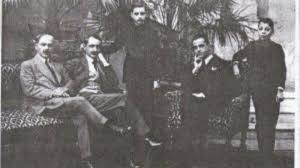
Memorie.al / During the years of the Second World War, we were almost unknowingly swept away by the waves of the Anti-Fascist War. We were schoolmates, city boys – me, Bajram Tushi, Hajredin Bylyshi, Hiqmet Buzi, Mumin Selami (Kallarati). We lived amidst dreams, desires, and the romanticism of literature. I am bound to these friends by many memories. Our parents, our mothers, were honest and generous people. One patriotic mother, Mama Tina – the mother of the well-known patriot Tol Arapi – would gather us around her like a hen with her chicks. She was the mother of my youth friend, Vllas Arapi, whom we called the “flower of Vlora’s youth,” an epithet likely given to him by Mumin Kallarati. I associated with any friend who was honest and sincere. This bond united our circle, including Hazis Sharra, Qemal Xhyheri, Xhemil Beqo, and others. Despite different opinions, we went on picnics, played games, and went to the cinema together. One meeting at Lef Sallata’s house changed everything. Suddenly, politicized views erupted in our group. A debate ignited with a young revolutionary, Kastriot Muço. He was an honest man. Four or five days later, Kastriot said to me: “Petrit, when will you hold the youth meeting in the Çerekçie neighborhood? You have been elected as the youth group leader for that neighborhood in the city’s active.” A few days later, we organized the youth meeting in the “Çerekçie” neighborhood.
Continued from the previous issue
THE PRISON OF VLORA AND THE “STEPPE BEAST”
Arturo Orlando was a man two meters and ten centimeters tall, a generous but terrified person. We had a guard there named Hate. He considered himself clever and thought he could outsmart us. He sold himself as an angel, but we knew he was a devil. One could easily notice his fake appearance, accompanied by visible servility and hypocrisy. There was another guard, Hodo, the brother-in-law of Gjon Banushi. He performed the duties of a policeman, but all the prisoners knew he held the rank of captain. The trouble was, he didn’t realize we knew he was on a “special mission”! The director of Vlora prison was Muço Maska from Kropisht. A hairy and ignorant man. In every sense of the word, a black-hearted individual.
We loathed this man, as we saw with our own eyes how he looted prisoners who were about to be executed, taking their rings and pocket watches. This is what happened with Hamdi Çeprrati’s gold pocket watch. After taking Hamdi’s watch upon his execution, Muço would show it off in the prison courtyard. He would take it out and look at it right in front of our eyes. We felt terrible because Hamdi’s father, Hair Çeprrati, and his brother, Seit Çeprrati, were also in the prison. Seit told me one day: “Every time Muço takes out my brother’s watch, it feels to me as if he is holding Hamdi’s heart in his hand!” This touched me deeply and remained in my memory. For these actions, one of the prisoners rightly called the director of Vlora prison a “steppe beast.”
After two weeks, we were visited in prison by Kadri Hazbiu, Rrapo Dervishi, Siri Çarçani, and Vasil Kati. They were accompanied by Hito Çako and Qatip Dervishi. From time to time, Rrahman Parllaku – known in Vlora as “Rrahman Havllaxhiu” – would also visit. Rrahman was raised by Vlora. He repaid Vlora by carrying out assassinations against Vlora’s nationalists and patriots. Even in prison, we recalled our youth and our anti-fascist resistance. We shared moments and memories of Vlora’s fighters like Kastriot Muço, Bajram Tushe, Teli Ndini, Mumin Selami, and others.
THE TRIAL AND THE “CAPITAL” SENTENCES
On February 2, 1946, I stood before the court in the prisoner’s dock. Before me, my professor, Bego Gjonzeneli, was sentenced to five years in prison, followed by Professor Tahir Hoxha, who was sentenced to death. Abdyl Kuçi, Tasim Murati, Qemal Xhyheri, Nazif Çala, and Muharrem Sharra were also sentenced to death and executed a few days later. On that day, I was brought to court handcuffed to Arturo Orlando, the owner of the Llakatund farm. Also present were Terrucci (Director of the Bank of Vlora), Bellucci (Deputy Director of the Bank of Vlora), as well as Luto and Rushit Grabova. The trial was public. From the prison to Shyqyri Çupishti’s cinema, which served as the courtroom, people threw stones at us, cursing and insulting us unjustly.
The prosecutor was Lufter Hoxha. His father, Tahir Hoxha, was waiting in a cell for his death sentence to be carried out, while the son was sentencing his father’s comrades. When Lufter Hoxha, my schoolmate and youth friend, requested my death sentence, it felt as if even the ceiling of the Çupishti cinema turned black, like the prosecutor’s heart. On that day, the Italians – Orlando, Terrucci, and Verdi Nino – were also given the death penalty. The moment Orlando heard the verdict, he fainted. His body, weighing over 180 kilograms, was handcuffed to me and dragged me down with him. After they threw several buckets of water on him, he regained consciousness.
THE DEAL FOR ORLANDO’S LIFE AND HYSNI KAPO’S INTERVENTION
In the following days, I stayed close to Arturo Orlando, who had not yet recovered. One evening he called me and said: “Petrit, I am leaving you some final wishes (bequests).” I smiled to myself, thinking he had forgotten that I too had been sentenced to death. Nevertheless, I listened carefully. He told me: “In March 1944, Hysni Kapo came to me at the Llakatund farm and asked for gold and wheat for the partisan war. I gave him 800 gold napoleons and promised him 1,000 quintals of wheat. Now I am astonished that they sentence me to death, me, who contributed to the Albanians!”
I took the courage to tell him to go to the iron bars and request a meeting with Rexhep Sulejmani, the father of Perlat Rexhepi, as he was a man of high political and civil standing in the city. And so he did. The next day, Rexhep Sulejmani came to the prison. Orlando asked for me as a translator. After they reached an agreement, Rexhep Sulejmani returned another afternoon, took Orlando, and they went to Llakatund. As Orlando told me later, he gave Rexhep Sulejmani another 90,000 gold francs from the Llakatund safe. Where that money went, we do not know.
A couple of days later, we sent a telegram to Hysni Kapo. I wrote the telegram myself: “I request a personal meeting with you. Orlando. Vlora Prison.” Three or four days later, Orlando was summoned to the prison directorate. He took me as a translator. Hysni Kapo himself met us there. The prison director, Muço Maska, was also present. Hysni Kapo began the conversation: “Orlando, I know why you called me. We won’t make this long. I am only telling you that not only will you not be executed, but you will receive the minimum sentence. You will serve it at the Llakatund farm. Once you finish your sentence, I will send you home to Italy!”
Orlando was overjoyed. Then Hysni Kapo turned to me: “As for you, Petrit, I was at your Uncle Murat Terbaçi’s house in Ujët e Ftohtë. We even had coffee with your father, Ahmet. Stay calm, for I know the ambitions of the Vlora people well.” Later I learned that Hysni had defended me at the Party Committee meeting. When Rrapo Dervishi attacked me, Hysni replied: “Rrapo, you are just bitter because Petrit Velaj was the most brilliant student at the Trade School. Even in the war, he was very brave. I saw him myself in the battle of Tirana.”
After a few days, we went to court for the final decision. Hysni Kapo’s statement was read, calling me a “young revolutionary” who had participated in anti-fascist demonstrations. Following this, other testimonies from Nënoçe Osmani and Neka Osmani were read in my favor. Despite these, the sentences were delivered: I was given life imprisonment, while Orlando was given four years of forced labor at the Llakatund farm.
THE FATE OF KARAFIL KAPO AND THE KOKOSHIS
While in Vlora prison, I was visited by Hysni Kapo’s brother, Karafil Kapo, who had been appointed commander of the prison guards. We had played together as children. He would bring me clothes and food from his home. He told me: “Petro, since I’ll be working here for a while, I’ll take your laundry home for you.” I hesitated. He said: “Don’t worry, nothing will happen to me, I am Hysni Kapo’s brother!” I whispered to him: “Karafil, this system doesn’t even spare Lenin or Stalin who created it, let alone you or Hysni Kapo…” He listened and said nothing. Later, I heard that while studying in the Soviet Union, he committed suicide – some said he was killed.
Among the prisoners, Fatosh Kokoshi left a great impression on me. He had studied Law in Italy and France. He suffered economically and spiritually, especially seeing his father, Qazim Kokoshi, in prison. I had admired Qazim Kokoshi since childhood. Qazim was a staunch opponent of Ahmet Zogut, who had once sentenced him to death. Yet, shortly after leaving prison, he was summoned by the Italian consul, Salvoni, who told him: “Excellency, we have great respect for you. You showed your bravery in 1920. Fascist Italy values you as a statesman. Fascist troops will soon land in Vlora and Durrës.” Qazim Kokoshi replied sternly: “Do not make the mistake of coming again, gentlemen. Otherwise, the fate of Drashovica awaits you. If you have spare heads in Italy, try stepping on our land…”/Memorie.al