By Prof. Dr. Mentor Petrela
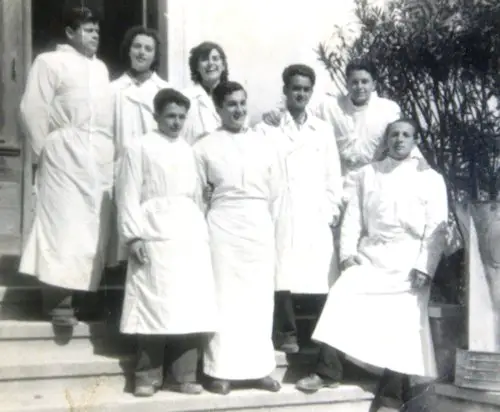
Memorie.al / King Zog’s ambitions to reform the healthcare system through the inauguration of the hospital in 1932 and the establishment of the school for nurses and midwives – advised by Dr. Jani Basho – led him to begin inviting Jewish professors and doctors fleeing Germany and Austria.
As a child, I passionately leafed through Gustave Doré’s illustrations of the “Divine Comedy,” one of my father’s favorite books. Observing me, he began to explain their content, reciting the terza rima – the Father, the Son, and the Holy Spirit – that Dante Alighieri had chosen as his style. He paused for a long time after reciting the opening of the Inferno:
“Midway upon the journey of our life
I found myself within a forest dark,
For the straightforward pathway had been lost.”
“You will understand later,” my father told me. In another conversation, just after I had graduated in Medicine, he told me about the activities of the Jewish doctors who served during King Zog’s reign. Apparently, the information about them came from Dr. Ludwig Kalmari and Dr. Frederik Shiroka, both doctors and family friends. In the First Circle of Hell, Canto IV, it is written of the pagans:
“At these words, my heart was struck with grief,
For I knew people of great worth and honor,
Who now in that Limbo were suspended?”
(Translation by Pashko Gjeçi).
The first poets, Homer, distinguished by his sword for the “Iliad,” Horace, Ovid; the philosophers Socrates, Plato, Aristotle; and later the scientists Avicenna, Averroes, and others – the entire universal monarchy expressed through the Dantean Holy Trinity – waited in Limbo as non-Christians. After the fall of communism, I was driven to seek the traces of these Jewish professors and doctors in Albania and their subsequent fate.
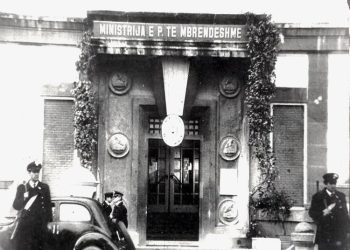
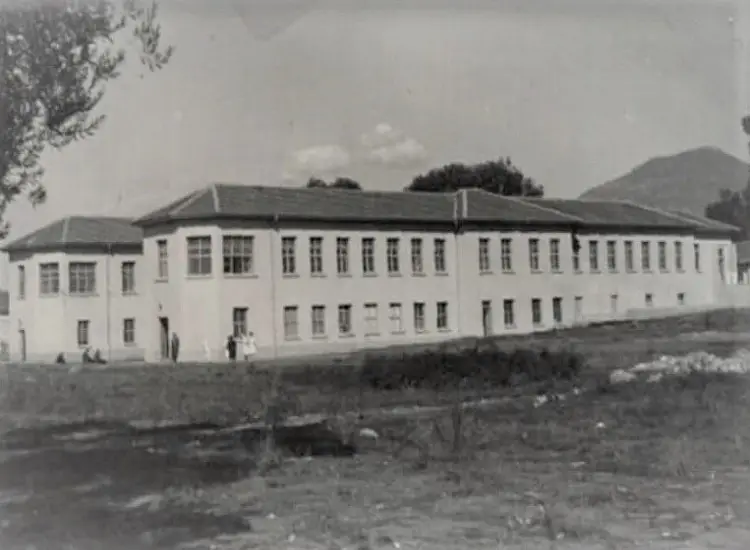
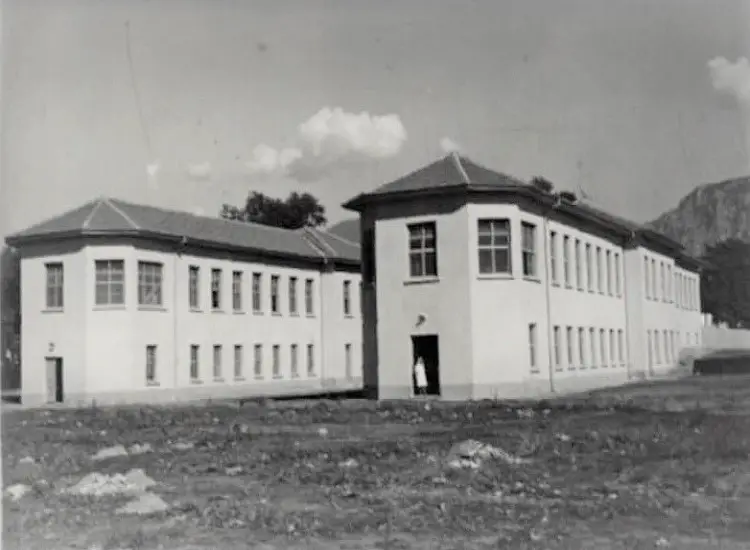
In my role as Director of the University Hospital Center (QSUT) in 1993, I discovered that in the basement of the hospital’s historical building (photo of the 1932 inauguration), there existed a “mammoth” of patient records and documents from that era, coexisting with the protocols of the meetings of the Labor Party of Albania (PPSH) organizations. I took the first records. Leafing through them gave me a sense of respect, as I touched the pages containing the “DNA” of Professors Lehmann and Schlesinger, with their beautiful calligraphy and clinical descriptions that cannot be found even today in Albanian medicine.
The health director of that time was right in a report when he stated that with the arrival of professors from Vienna and Berlin, the level of service increased qualitatively, including the staff and the clinical discussions. A “Nota Bene” of his indicates that several Albanian doctors left the hospital and set up private practices after their arrival. It is clear that the “testosterone of hierarchy” functioned much better at that time. After the year 2000, I continued my search for documents and patient records at the Central State Archive (AQSH).
Based on the Gendarmerie report regarding residency permits for Jews, Lehmann, with a party of three, appeared in 1933 (facsimile AQSH). Lacking the exact dates of entry into Albania, I could not find the proper traces of Lehmann in those years, 1933–1935. Ironically, the bystanders consulting in the AQSH hall often asked me: “So, did you find anything, doctor?” They were referring to property claims.
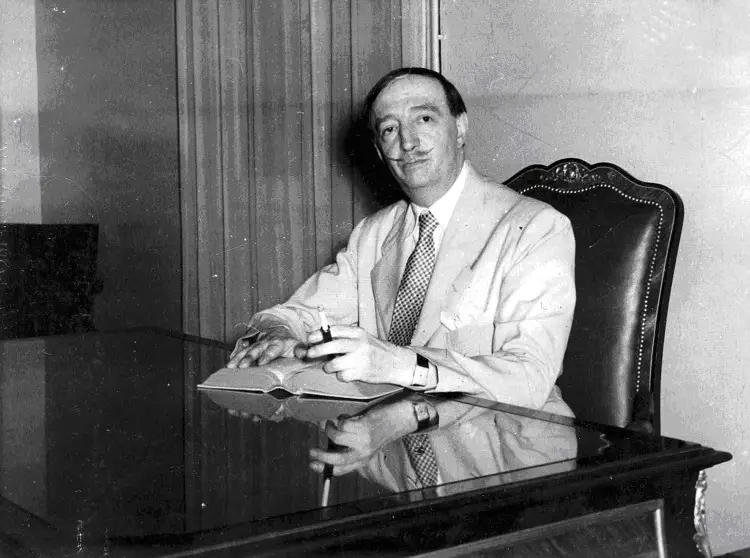
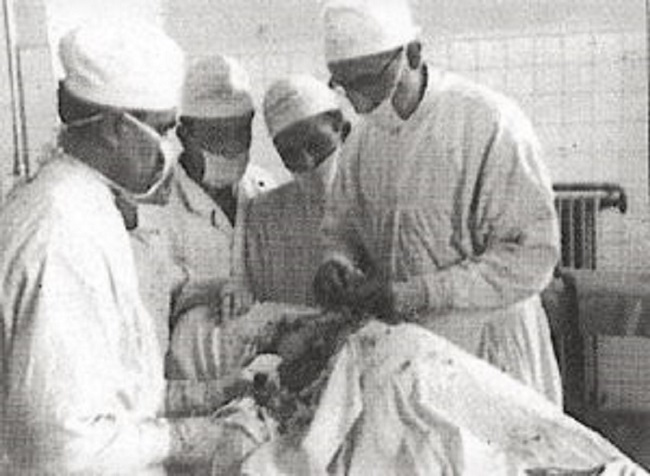
Walter Max Ludwig Lehmann was born on November 17, 1888, in Frankfurt. He studied medicine and later specialized in surgery. In the USA, neurosurgery had separated as a distinct specialty under Harvey Cushing in Boston. According to the Peter Bent Brigham (Harvard) annual report, Walter Lehmann spent about a year with Cushing, learning ether anesthesia, the use of cotton and muscle for brain protection and hemostasis, and the use of silver clips for vascular closure.
Later, he faced difficulties establishing himself in Berlin because general surgeons – who also performed brain surgeries there – could not accept Professor Lehmann, who had arrived with advanced American experience, due to their jealousies and contradictions. In a letter to Harvey Cushing, he expressed regret over this fact, saying that “the time has not yet come, so I am returning to Frankfurt.” Meanwhile, he had published 61 scientific articles and the book “Foundations of Neurosurgery” based on the American model, the first text in this field in Germany.
He married the pediatrician Wera von Kuczkowski, from a family of chocolate manufacturers. The rise of Hitler to power with his anti-Semitic spirit – even though Walter Lehmann’s family had been baptized Catholic long before – created a “miasma” for the practice of his profession and normal life in Germany. After 1933, he began efforts to settle in the USA, near Cushing and other institutions, but even there, he found an unwelcoming atmosphere. The couple had two children, Klaus and Hans, while the Nazi fury was growing, causing the exodus of the Jews.
A significant difference from communist totalitarianism. Meanwhile, the US Ambassador to Tirana, Herman Bernstein, who was of Jewish origin, was negotiating with King Zog to create a Jewish enclave in Albania. King Zog’s ambitions to reform the healthcare system… led him to begin inviting Jewish professors and doctors fleeing Germany and Austria.
Such an invitation also reached Lehmann, who in the meantime had transferred his family to his brother Julius in Zurich. In December 1935, he arrived in Tirana by plane from Rome, accompanied by his younger brother Artur. He met with the General Director of Health, who proposed a contract as Chief Surgeon at the Military Hospital of Tirana (today the QSUT surgery department).
They agreed on a contribution to the organization of Albanian healthcare and his role as a personal consultant to King Zog. From April 1936, Prof. Lehmann was stationed in Vlorë in a local administration building, as the bureaucracy of the time required his contract to be signed by military bodies and not by the director of civil health. It took them four weeks to settle with furniture brought from Germany in an environment that was somewhat “wild” compared to the life they were used to in Frankfurt.
Vlora Hospital, built by the Italians during World War I with a facade facing the Adriatic Sea, had poor conditions, and furthermore, an Albanian colleague incited the staff and patients against him. Due to the lack of materials, he used silk threads that his wife, Wera, had brought for her clothes. She served as an assistant, patiently participating in many interventions. “The zeal with which they both served often made them forget the exhaustion from the stress of surgical work,” testified the children’s educator, Ingmar.
In contrast to Germany, he faced various diseases he had not seen before, which were treated with tobacco and plant leaves, as patients stigmatized the hospital and had more faith in the amulets (nuska) of the hoxhas. He practiced surgery mainly in traumatology, especially due to blood feuds and religious conflicts. Very quickly, Albanians gained trust in Prof. Lehmann and were grateful to him. Although poor, they offered him their products, such as honey, chickens, embroidery, and other gifts.
In 1936, Prof. Lehmann was transferred to Tirana as Chief Surgeon for both the civil and military hospitals. Wera carefully managed the transfer to Tirana together with the children. According to references, he performed operations in general surgery and neurosurgery using instruments he had brought from Germany. Professor Xhelal Kurti, who opened the Neurosurgery Clinic in 1964, began operations with Prof. Lehmann’s neurosurgery kit that remained in Albania, according to a letter addressed to the hospital director, Dr. Sabri Tefiku, in 1939.
The excellent relations Dr. Tefiku established with the Jewish professors demonstrate his competence and authority. According to documents, Professor Schlesinger had a car and driver at his disposal paid for by the state, while two government ministers of that time shared one car and one driver. We have evidence of spinal surgery performed on the father of humanist Sami Repishti (my cousin), and brain abscess operations with Dr. Besim Zyma, followed by brain tumors.
The difficulties he faced with biopsies, when in doubt, were resolved by sending them to Zurich. Dr. Frederik Shiroka, his assistant, was a major participant in Prof. Lehmann’s neurosurgical activities. Meanwhile, Wera Lehmann secured sewing materials and wound care supplies during her travels between Tirana and Zurich. Parties were organized at their home in Tirana. Being a wonderful musician, Professor Lehmann played the piano himself.
Regular guests at the festive evenings in his home were colleagues, state officials, and ambassadors, where tea and bridge were never lacking. His main preoccupation became when Queen Geraldine became pregnant. According to Ingmar’s data, he said that “the heir to the throne must be brought into the world safely as a child and without health problems.” Due to pressure from Italy – as Ambassador Bernstein had predicted five years earlier in an article in the “New York Times” – the situation in Albania was deteriorating.
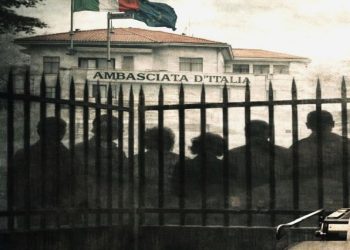
Lehmann, according to Italian secret services, was being tracked in his activities, and he began efforts to secure a visa at the Italian Consulate. In a conspiratorial manner, the Lehmann couple and their children were assisted by the American Embassy for emigration to the USA. On the eve of the invasion of Albania by Italy, Prof. Lehmann assisted in the birth of Leka I and traveled on the last ship from Durrës to Bari on April 5, 1939. Later, he settled in the USA. He passed away there on July 20, 1960, in Carmel, California. His children, in a letter in 2013, wrote that their father had once told them that the years in Albania had been the most fulfilling years of his life.
The Walter Lehmann memorial is located at the University Neurosurgery Service; the operating theater block bears the name Lehmann along with the paraphernalia. At the annual congress of the American Association of Neurological Surgeons (AANS) in New Orleans on May 2, 2018, in the history of neurosurgery session, the paper “Walter Lehmann, Who Started Neurosurgery in Albania” was presented. His presentation drew attention and was proposed for publication as an article in the prestigious Journal of Neurosurgery and World Neurosurgery.
There has been a long silence regarding them; history needs truths, not passions. Thinking with empathy about Lehmann’s life, I understand his measured courage and his difficulties. Prof. Fejzi Hoxha, the most serious [historian], in the 1962 book “History of Medicine in Albania,” mentions the Jewish doctors only in passing; thereafter, they remained again in Limbo. The Jewish doctors remained forgotten, exiled, and betrayed, as my colleague Ulrike Eisenberg also writes to me.
“Totalitarian societies, Nazism, Communism, have deep roots and are not easily uprooted,” Konica spoke on the “Theory of Mind” – who allowed it for five decades?! Today, they use the figure of Faik Bey as an ornament, as Noli addressed him with respect. Generations are not being irritated with their minds. The culture of honor in Albanian society before communism is not enough to eradicate totalitarian ideology; there must be a national strategy and continuous moral education at all levels of society.
Professor Schlesinger’s notes wait in the hospital basement with the first interpretations of Dr. Quastler’s electrocardiograms, with the imaging and irrigoscopies of Dr. Nobel and others, with their writings in German or French, in records of a European medical standard – acts performed long before those written as the History of Albanian Medicine for students by communist nostalgics.
The opening of the Faculty of Medicine was proposed to King Zog by the honorable Jewish professors in 1937, according to the notes of Professor Xhavit Gjata. Some of the many romantics of communism, out of ignorance, reading these lines will feel “anger in the air” or on the plane, as described in Robert Sapolsky’s book “Behave.” The long-standing oblivion of Jewish professors in Albania is Dantean, as is the historical obligation to lead them out of Hell’s Limbo and into Paradise. / Memorie.al