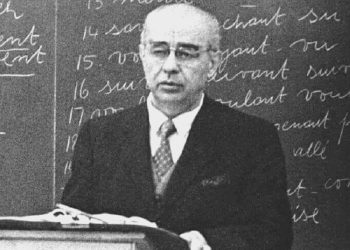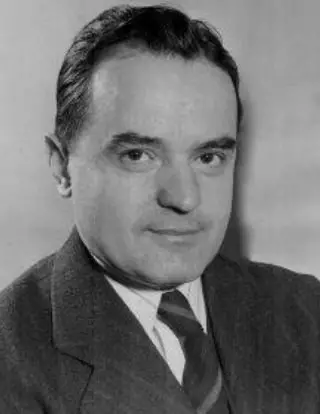
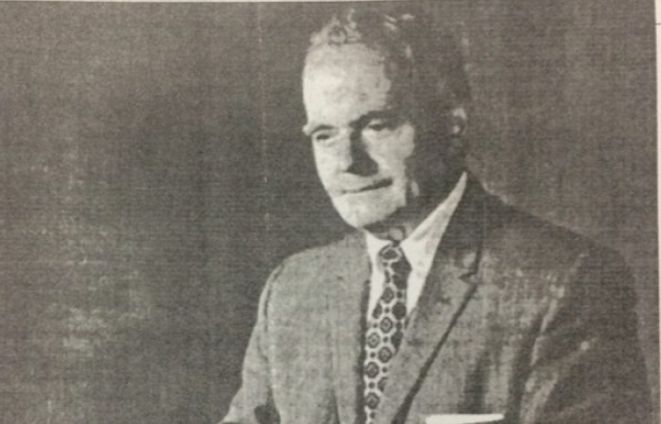
Memorie.al / Among the prominent figures produced by Albania during the last century, the name of Nelo Drizari is also mentioned – a figure who, for several reasons, mostly related to past politics, has remained unknown to Albanians. This is also due to the fact that he carried out his intellectual activity for a period of over 50 years (1928-1978) in the USA. Zenel Sulaj, as is his real name, or Nelo Drizari, as he is known in intellectual circles, was simultaneously a historian, publicist, journalist, researcher, linguist, writer, painter, and above all – something few people know – he is the founder of the Albanian section of Radio “Voice of America.”
It was the year 1942, when the USA, involved in World War II as the main contributors to the Global Anti-Fascist Coalition, launched for their propaganda purposes the Albanian broadcasts of “Voice of America,” where its first speaker would be precisely him, Nelo Drizari.
Zenel Sulaj was born in Drizar, one of the well-known villages of Mallakastra, in 1902. For economic reasons, as he himself states in a letter sent in February 1930 to the World Arch-Grandfather in Tirana, Sali Njazi Dedei, he left his homeland for the USA at the age of 10. He went to the distant continent, where he initially lived with brothers Riza and Shaqir Hamitaj, nephews of the hero of the popular uprising against the Tanzimat, Rrapo Hekali.
“His father, impoverished by life’s troubles,” writes author Nishat Hamitaj in his book “Hekali and Mallakastra in the Depth of Centuries,” “sacrificed Nelo so far away on the paths of emigration, even though he knew it was unlikely he would return alive.” Thus, the young boy faced the hardest jobs in factories, but as a courageous, agile, and smart person, he managed through sacrifices to complete his secondary and higher education, graduating from Columbia University in the field of journalism.
From his rare photos, we have one preserved in the Hamitaj family archive. The photo was taken somewhere around 1913, featuring Riza Hamitaj – the man who initially looked after him in America—and the young Nelo. Even from a quick glance, one can notice an intelligent child living among an environment of immigrant men.
From Riza Hamitaj’s correspondence with the family, the concern of Albanian immigrants regarding political developments and the national movement is evident. In these environments, where people worked with honor and the sweat of their brows to support their families and where concern for the country’s fate was expressed, Nelo Drizari’s patriotic character was formed.
During his life, he maintained ties with many prominent figures of the Albanian diaspora, including personalities such as Konica and Noli. As a journalism graduate, his name would appear in the pages of the written press, not only in Albanian diaspora newspapers but also in well-known American ones, including the prestigious New York Times. It should be noted that he served for some time as the editor of the Albanian newspaper “Dielli” (The Sun) and as president of the “Vatra” Federation branch in New York.
In his journalistic profile, he appeared as a reporter, analyst, publicist, editor, and publisher. This experience later helped him, during the war years and with the engagement of American authorities, to establish and lead the Albanian section of Radio “Voice of America.” But as a passionate and ambitious man, Nelo Drizari also dealt with several different fields and disciplines during his life.
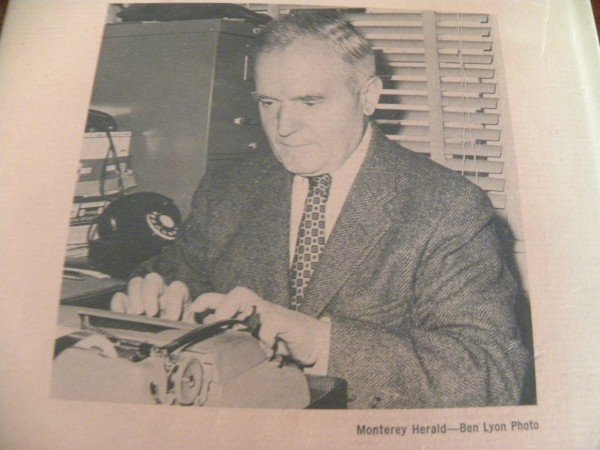
First, he worked as a lecturer of the Albanian language at Columbia University, and later at the “Defense Language Institute” in Monterey, California, where, in service of his work, he wrote several works, as Prof. Nasho Jorgaqi informs us in an article from a few years ago.
Among them we can mention: “Albanian-English and English-Albanian Dictionary” and “Spoken and Written Albanian.” Additionally, Nelo Drizari engaged in literary studies. His works such as “History of Modern Drama” and “The Columbia Dictionary of Modern European Literature” are well-known.
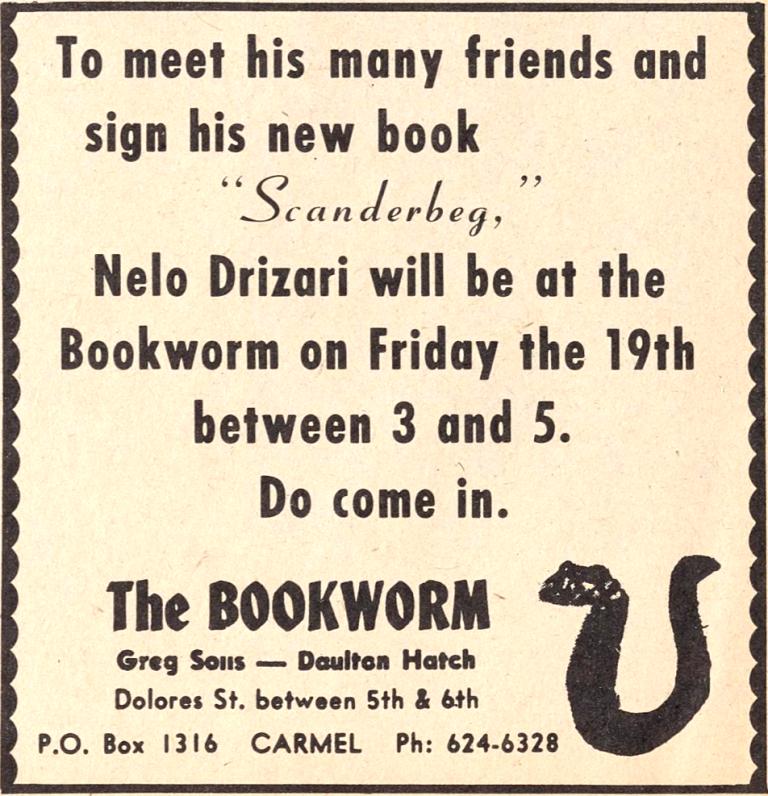
Meanwhile, he completed the scope of his intellectual profile with publications of a historical nature. In 1968, Nelo Drizari published the historical work “Scanderbeg, His Life,” adding his name to those who have contributed to National History.
“Among the treatises published outside Albania on the occasion of the jubilee” (the 500th anniversary of Scanderbeg’s death), notes Prof. Kristo Frashëri in his book “Scanderbeg, Life and Work,” “we will mention the work of Nelo Drizari, ‘Scanderbeg. His Life. Palo Alto, California, 1968’,” where “…the author tries to treat the Hero’s history from a perspective suitable for the American public…”
Furthermore, Prof. Nasho Jorgaqi, in his article “The Albanian-American Voice of Nelo Drizari,” published in ‘Shekulli’ on March 11, 2007, writes: “Nelo Drizari’s portrait as a creative intellectual would be incomplete if we failed to mention other aspects of his activity.”
In this regard, we mention his literary activity as a prose writer, where he wrote short stories and a novel; several literary translations, as well as his passion for painting, through which he managed to open several exhibitions. Finally, his novel “Song of Irena,” published years ago in the USA, was also published in Tirana in 2010.
After an intensive intellectual and artistic activity, Nelo Drizari passed away in 1978 in the American state of California, where he was buried in Carmel. Just as he lived throughout his life, as a simple and quiet man, his funeral was conducted without much publicity, while in communist Albania; it was a taboo to mention his name.
Only in these recent years has Nelo Drizari’s name begun to be frequently mentioned. We recall that some of the honorable authors who have contributed with their writings and articles in this direction have been: Prof. Nasho Jorgaqi, Nishat Hamitaj, Dalip Greca, Zaho Sula, Bujar Muçaj, etc. Precisely in one of the biographies formulated about him, one of the above authors would consider Drizari as: “The pioneer of teaching Albanian language and literature in American universities.”
Meanwhile, recently, in his book “Faik Konica – Life in Washington,” author Ilir Ikonomi also quotes a definition for Konica made by the editor-in-chief of “Dielli,” Nelo Drizari. Regarding his friend Faik Konica, among other things, Drizari wrote: “An example for others” and “A man with heroic qualities.”
In December 2010, the Ballsh Municipal Council honored Nelo Drizari with the title “Honorary Citizen.” In May 2011, the Fier District Council followed this initiative, where during the evaluation with the “Honorary Citizen” title of several representative figures and intellectuals, the name of Nelo Drizari stood out – a figure that has now begun to be known not only in intellectual circles but also by the general public. / Memorie.al