



By Agron Alibali
Part Two
Instead of an Introduction
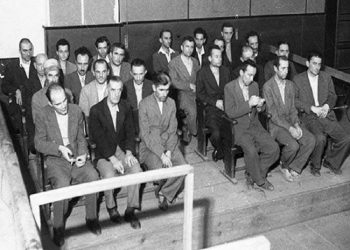
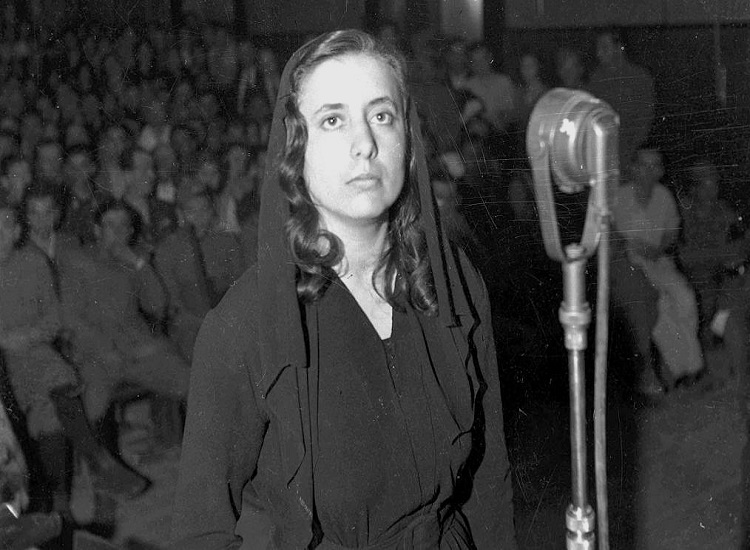
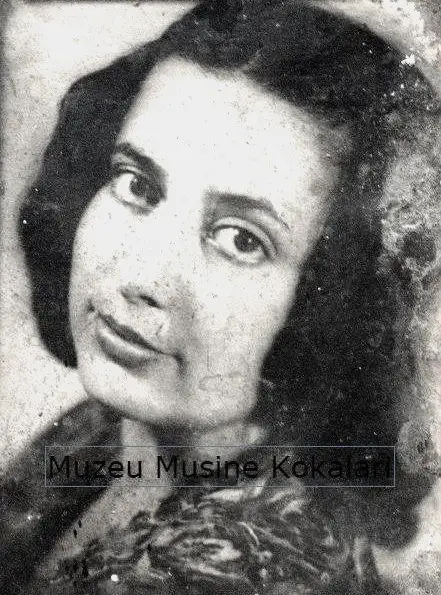
Memorie.al / The image of her in the courtroom remained in my mind – graceful, elegant, with long chestnut hair flowing over her shoulders. Captured in tragic moments, the photograph radiated courage, defiance, determination, wisdom, and intelligence! I had also heard about Musine Kokalari [1917–1983] from my father, who had known her in Tirana, I believe at the “Lumo Skëndo” bookstore, one of the intellectual centers of the time. I had just passed through a period of ordeal in the villages of Gjirokastra where, in collision with the dictatorship, I found myself immersed in the realm of that culture, tradition, and language of our precious South, when in Tirana, I came across the charming volume “As My Old Grandmother Tells Me” (Siç më thotë Nënua Plakë).
Continued from the previous issue
It is written there: “On June 5 [1945], an Albanian well known to us, who claimed to represent the opposition, came to meet me. He stated that there existed a large and growing group of Albanians, some of whom are partisans of the FNÇ (National Liberation Front), who are opponents of the current regime, as its policies are too closely link Albania with Yugoslavia and the Soviet Union, whereas his group believes that Albania’s ties should be with the democracies of Great Britain and the USA. They fear that the current regime will never hold secret elections that would enable the people of Albania to choose the government they desire.
He said that a committee composed of 10 people was organized, and that a large number of army officers were ready to join it and take to the mountains if they were to have the material support of Great Britain and the United States. The visitor said he wanted me to convey this information to my government and added that a prospectus of the movement was being drafted and a copy would be delivered to me later, either by him or by someone else, as large-scale arrests were expected soon.”
Jacobs’ further comment is very significant:
“Given that the story sounded like hearsay, which Brigadier Hodgson had also mentioned to me, I asked the visitor if he had met Hodgson. He replied that he had not met him personally, but two of his assistants, and that the Brigadier was aware of the movement.”
Jacobs was then forced to take a clear and precise diplomatic stance:
“I explained to the visitor the purpose of my mission and told him that while we were interested in hearing the views of the opposition, the problem of recognition or refusal to recognize the government was one thing, while the issue of giving moral and material support to opposition groups was an entirely different matter, which I was sure the American Government would not consider. I clarified that I would report the meeting to the Department but could not give him any encouragement of any kind.”
The Intelligence Game and Musine as Victim
The principled stance was correct. However, Jacobs had reasonable doubts after this strange visit. Therefore, he took further steps:
“Suspecting that the meeting might have been engineered to prove whether my mission had come to the country to support the opposition, I asked Intelligence – which knew nothing of this movement – to investigate whether it could learn anything about it, and I also discussed the matter with Hodgson.
Our Intelligence had caught wind of something about the movement, which indicated that it was either a ‘plant’ (trap) or its instigators were so crude in their techniques that they would likely be arrested very soon. Hodgson also told me that this was the group supplying him with information about the opposition, and that he too had begun to suspect and was conducting further investigations…”
Thus, how can we explain the non-engagement of the allies in this opposition movement, while local authorities had kept the group under surveillance for a long time? Was all of this an intelligence combination or game – with multifaceted grave consequences – to put the allied missions in Albania in a delicate position, a game where Musine Kokalari fell victim to her pure democratic ideals but also to the naïveté that often accompanies sincere enthusiasm?
A weekly report from the American Mission conveys a cold judgment of the event. The report characterizes the defendants as “politically insignificant” and lacking “administrative or organizational” experience. In a clear reference to Musine, the report emphasizes that “some of them seem to have been motivated by a sincere desire to promote and organize a political party in good faith as an opposition to the Democratic Front.”
However, “they did nothing but set up an organization on paper and were sunk as soon as Koçi Xoxe’s Sigurimi intervened.”
Jus Non Scriptum: The Overturning of the Ancient Code
Finally, returning to Jacobs’ tragic telegram regarding the mistreatment of Musine after the June 1946 court session in Tirana, let us analyze some events of her life in relation to Albanian customary law (jus non scriptum).
- Ndore and the Institute of the Inviolability of the Woman
In the family’s history, the return from Turkey to the homeland in the first decade of the last century is mentioned. On the way, a destitute orphan girl appears before Musine’s parents. The Kokalari family did not hesitate but took Fatime, the unknown Turkish girl, under their protection, adopted her, and made her part of the family.
Here we see clearly the ancient institution of ndore, among the most noble in Albanian customary law. Often confused with hospitality (mikpritja) and the word of honor (besa), ndore is a sacred institute: it sanctions the host’s obligation to give shelter and save anyone found in extreme need who begs for protection.
“In your ndore” (N’dorën tande) – it was like a call from Heaven. Violating it faced the severest sanctions in the Kanun. In the variant of Puka, we find the specific position of the woman:
“A woman’s ‘ndore’ cannot be cut. If someone falls into the ‘ndore’ of a woman who came before him, the woman has the right to protect him. If someone cuts the ‘ndore’ of a foreign woman, he is shamed and ostracized. A foreign woman is not to be touched by hand.”
- The Desecration in Tirana, June 1946
The sacred principle of the inviolability of the woman is at the foundation of Albanian customary law. Absolute immunity derived from it covers even a murderer if he travels in the company of a woman. Yet, everything was kicked aside that June morning in 1946 in Tirana.
A woman had been violated; Musine Kokalari had been assaulted. Neither the investigation nor the court session had broken Musine. Only one tool remained – physical violation. And a cruel hand had dared to touch her hair…! The world in its normal sense had been overturned. The ancient Albanian customary code was shaken to its foundations.
The image of armed guards standing indifferent, without reacting, in the face of that quasi-lynching, is simply indelible. By their inaction, the guards of the Ministry of Internal Affairs of the time became co-perpetrators in the brutal assault against a hero woman like Musine Kokalari.
The Question of Mirdita
Finally, a question arises naturally: when public indignation toward the writer did not exist in 1946, how was she treated by the locals during her long years of internment in Mirdita [1961-1983], found precisely within the realm of the Albanian jus non scriptum?
It is true that Musine Kokalari was under strict and continuous surveillance until the end. It is equally true that she faced unspeakable suffering in solitude. However, urban legends have also been told, which we will not deal with. The question narrows down here: did the people of Mirdita apply the institute of ndore and the inviolability of the woman even toward the writer who lived for 22 years among them?
A reliable source leads us to the conclusion that, although in suffering and solitude, the noble woman of Gjirokastra was treated by both locals and newcomers in Mirdita with the honor and respect that, in silence, the ancient Albanian custom commanded. / Memorie.al