By Shkëlqim Abazi
Part sixty-two
S P A Ç I
The Graveyard of the Living
Tirana, 2018
(My memories and those of others)
Memorie.al / Now in old age, I feel obliged to confess my truth, just as I lived it. To speak of the modest men who never boasted of their deeds, and of others whose mouths the regime shut and buried in unmarked graves. In no case do I presume to usurp the monopoly on truth or to claim laurels for an event where I was only accidentally present, even though I desperately tried to help my friends, who tactfully and kindly avoided me: “Brother, open your eyes… don’t get involved… you only have two months and a little left!” A worry that clung to me like an amulet from the morning of May 21, 22, and 23, 1974, and even followed me in the following months until I was released. Nevertheless, everything I saw and heard those three days, I would not want to take to the grave.
Whatever the reasons were that forced them to revise the lists of May 21st and hold back their hand, the Deputy Minister was clearly seen making the stop sign, and the card-filer’s reaction, whose next name got stuck in his throat. When the trucks carrying our shackled comrades left, we felt like halved ghosts; with a sharp blow, half of our bodies wandered in the dark cells with our friends, the other half lay sprawled on the thorny square.
We dug our nails into our flesh to flatten our heartbeats and console one another for the loss of the friend we were shackled to. Even after five o’clock, the sun burned like a frying pan, as we gasped, panting on the heaps of thorns. As sweat streamed down, the heat paralyzed us, making it difficult to breathe. The agony of waiting and eight hours without access to the latrine forced the elderly to wet themselves, and some even lost control of their bowels. The environment became contaminated by the stench of urine and feces, and it became unbearable.
When it was our turn to stand up, many couldn’t keep their limbs steady, suffered from dizziness, and collapsed to the ground. Nevertheless, the strong helped them and pulled them away from the executioners’ claws; someone had to survive the carnage to convey the episodes of those three heroic days to future generations, to speak of the great deeds and the proud men. The mass investigation now began. It seems over eighty victims were not enough to quench their hunger. The murderers aimed to increase the tension, forcing everyone who passed through the pen to submit to standard questioning, although it was clear that this type of pressure would fail before it even started.
“Were you part of the revolt?” the ignorant one asked.
“No,” the convict replied curtly.
“Who started the revolt?” the first continued.
“I don’t know,” the second replied.
“Who raised the flag?”
“I didn’t see anything! I was asleep.”
“Who took it down?”
“I don’t know anything.”
This continued, from the first to the last. Naturally, with this procedure, they fulfilled a formality that would yield no results but prolonged the agony. Around eight o’clock, we entered the dormitory; the total disarray we faced caused us headaches. Chaos prevailed everywhere: chaff on the floor and dust in the air. A mishmash of rags and straw; mattresses, quilts, pillows, clothing; where you found a shirt, you wouldn’t find a pair of underwear; patches smeared everywhere, mixed with food; boots and rubber sandals atop torn and scattered pages of books, notebooks, magazines, and newspapers, like intestines with dung! Oh God, our spirits were broken! Dread descended.
Ancient hatred and the new failure wounded our hearts, while the pain for our friends, who would face the regime’s beasts, confounded our minds, and we lay down, exhausted. To my right and left, my comrades were missing: Dervish Sulo, a Cham, on one side, and Fiqiri Muhaj, a Kardhiqot, on the other. This absence troubled me: “Why did they have to take my compatriots? They are experienced prisoners, Fiqua, thirteen years served, Dervishi, over ten, and in a few years, they expected release! When this calamity struck these intelligent men, woe to the others! Especially the Cham, known as an excellent jurist, who has helped so many people in his field! And Fiqua, a pure soul, who never messes with anyone, except for Tarti!
The last three days, he didn’t leave the room at all, except for personal needs! He even advised me constantly: ‘Keep your eyes open, brother, don’t mix with the crowd, you only have two months and a little left!’ Oh, and Tarti? Yes! As his direct guardian, he didn’t bother to educate him with party loyalty, and here’s the result: Tarti, a sworn enemy, and Fiqua under arrest! Fine! But what about the others, whom the murderers seized without doing anything at all?! Eh, what could Hodo Sokoli, a heavenly angel, have done? What about Luan Koka? What about Sami Dangëllia? What about Mërkur Babameto? What about Zef Ashta? What about dozens and dozens of others?! O God, I felt faint and slipped out of reality!
“Everyone to the square,” the town crier’s yell was followed by dozens of whistles: “Fiu-fri-fiu! Fiu-fri-fiu! Fiu-fri-fiu” – the storms that struck our ears those three days were resurrected! I shuddered and became confused. Instead of taking the stairs, I almost jumped over the second-floor balcony. “The stairs are this way, grandpa!” – At the final moment, someone grabbed my arm and pushed me toward my fellow sufferers, who rushed, grim and in a more miserable psychological state than I was.
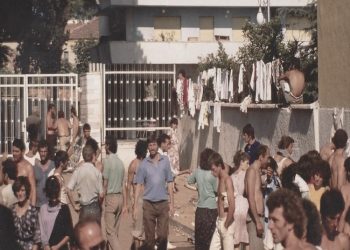
No one spoke; everyone was missing a friend, a row-mate, a work-mate, or a walking-mate and their fate intertwined with their own worried them. Dozens of police officers invaded the square; hundreds of others stood guard on the upper terrace. It was the first time I had seen armed men inside the perimeter. Perhaps they took these extreme measures as a form of pressure, or they feared a breakdown like three days ago. The determination to maintain control of the situation was evident, even if it meant causing casualties.
Behind them was a group of officers in parade uniforms, and in the middle, the commander and the commissar. It seemed they had replaced the uniforms torn up hours ago with new ones. The leaders stopped at a type of tribune that overlooked the far end of the camp and strutted like roosters, while the others surrounded them. Haxhi Gora, with a turban around his head and a bundle of papers in his hands, cleared his throat.
“Well now, did you see what the revolt and the stubbornness of some brought upon you?” and he himself answered the rhetorical question he posed: “The special trial in the command offices just concluded, where the comrade’s judges handed down extremely harsh measures. The twelve leaders of the revolt received what they deserved, some even a bullet to the back of the head!” – he immediately hardened his language.
“Convicts, we know there are others among you who hide like mice, but the main ones were these who undertook vandalistic acts, pressured others, and forced them to join the criminal activity. We are convinced that the overwhelming majority did not support them, did not agree with their rebellion and bandit actions,” he took a breath and continued:
“According to the data we possess, which speaks of collaboration between foreign enemies and internal ones, for the coordination of actions aimed at overthrowing the people’s power with arms, we also applied arrests. But they will continue in the coming days, until the last criminal is caught” – he paused for a moment and shook his finger over our heads.
“Convicts, we urge you to be responsible and cooperative. As you saw, the unity between the freedom-loving people and the Party is at the highest level. We are capable of facing any imperialist-revisionist aggression, even if it comes from all of them together. You saw how thousands of soldiers and volunteers responded to the call and surrounded Spaç inch by inch, even all of Mirdita, from the Milot Bridge to Mat, from Luma to Krumë, from Lezha to Pukë, and wherever the enemies might attack. We will respond with the utmost severity to any provocation on our borders; the aggressors who dare will pay with their heads!” He raised the palm of his hand, made a circular motion in the air, and burst out:
“Oh, oh, there are some rascals whose heads have been turned, and we are supposed to let them continue their hostile adventures from prison right under our noses, or to continue their ties with the Vatican, with the American C.I.A., and with the services of enemy countries? Not for idealism, we will all go to the rope and the bullet!” He sifted through the papers and singled one out: “As I told you, the special court, led by comrade Hilmi Telegrafi, with assistant comrade Ymer Alikaj and prosecutor comrade Mit’hat Goskova, handed down twelve sentences, as follows: Four with death by firing squad, and eight with twenty-five years each.”
He paused to see the effect this disaster would cause. Our fists were clenched from boundless pain, and tears streamed down uncontrollably. But the murderer Haxhi Gora plunged the spear into the bone:
“Here are the respective sentences:
-Skënder Daja, with death by firing squad.
-Dervish Bejko, with death by firing squad.
-Hajri Pashaj, with death by firing squad.
-Pal Zefi, with death by firing squad.”
Some elderly men suffered heart failure from this news and folded over onto the cement of the terrace. But the killer continued: “The executions will be carried out after the appeal and the response of the Presidium of the People’s Assembly.” A few seconds of silence and he added: “Now the list of those sentenced to twenty-five years:
-Luan Burimi.
-Paulin Vata.
-Sami Dangëllia.
-Hodo Sokoli.
-Luan Koka.
-Jorgo Papa.
-Syrja Lame.
-Dashnor Kazazi.
These eight do not have the right to appeal, by decision of the Special Court.” The military men left as they came. After the officers, the police platoons also left.
“Disperse,” yelled the crier, but we stood frozen like wax figures on the terrace platform. Then a deathly silence fell over the entire camp. We stood still, mouths closed, until the cold-blooded ones overcame the pain and woke the others from their apathy. We returned to the rooms with tears in our eyes. The empty beds looked like a mouth with missing teeth, one there, one not, and the pain took concrete dimensions. After the day burdened with violence and pain, they did not give us food, but no one remembered; we lay down exhausted amidst the dust and chaff and were lost in nightmares.
I don’t know about the others, but the moment the beasts snatched our friends, chained them, and dragged them horizontally before me and Nexhat Xhaçi, crushing us with the studs of their boots, came back to me on the reel of memory like an animated film. After pushing five or six unfortunates, the same number of soldiers jumped onto the sides, and the truck blew bitter smoke in our faces, inducing nausea and tension. The memory of friends writhing in pain tormented me, while the ferocity of the executioners tightening the handcuffs to zero and hitting them with rubber clubs or poles awoke hatred in me.
During those moments of melancholy, I remembered the doctor-writer and his sentence: “The communists will wreak havoc! But this event was absolutely necessary to show the world that freedom does not die, even though it has languished for thirty years under the most despotic regime humanity has ever known. This unique fact will enrich national history and will have delayed effects, shaking the foundations of the power and bringing its end closer.” And I considered the defeat a victory for the future. Right at this stage, I lost consciousness and slept…! Sleep or delirium, God knows?!
Post-Revolt
“Get up,” “Fiu-fri-fiu”! Morning came with the old customs. I immediately got up. I missed the comrades on my left and right. Across the empty bunk, Ali Hoxha sat cross-legged, gazing out the window like a medium, while across Dervish Sulo’s bed, the other Cham, Telha Çakua, scratched his cheek with the look of a medium, and they were silent like two modern sphinxes! “Hey, damn,” this murderous silence bothered me.
I put on my sandals. Dozens of people were rushing around the balcony like in a morgue. The same downstairs, in the square, everywhere! People shuffled head-down from the bathrooms to the faucets, finished their business, and returned with their eyes fixed on the ground. I joined them and became one of the actors in the absurd theater, with the same actions and gestures. Under the stairs, I ran into Tomor Balliu.
“How was your morning, Tomçe?” I asked, for the custom.
“Horrible, my friend!” he replied, head bowed. “I didn’t close my eyes all night!”
“I also had restless sleep, almost in a delirium,” I complained.
“Eh-ee, after this disaster, it’s hard to recover completely!” he vented and added, “We knew the end, but freedom tempts and seduces you, even when it must be paid for with the price of life!” He entered the first floor, head bowed.
I went up like a sleepwalker and entered the room.
“Aren’t you going to get the food, boy?” Uncle Telha had flattened his bowl on a plywood tray.
“They opened the kitchen?!” I asked, surprised.
“Go on, take it!”
“I’m on the second shift, Uncle Telha!”
“It’s the morning soup, my son!” He probably added mentally: “This one got it too,” and looked at me with parental pain. “Be careful, my son, grain is poor and fiu, it flies away…”!
“Does logic function?” I asked myself, but the answer was too difficult for a man as confused as I was.
“Will they send us to work today, Uncle Telha?” I addressed the old man next to me.
“What can I tell you, my son, I don’t think so?”
“Perhaps they’ll let us recover after three days and nights without sleep?” I added, even though the answer was clear to me: “Who cares about our lives and health?”
“You’ve slipped up, my son!” He wiped a couple of drops of soup from his unshaven beard and added: “Man, why would they care about us?! They care about the police, who haven’t washed or slept for a week! Besides, they took the cream of the youth, over a hundred souls!” He slurped two or three spoonfuls: “Undoubtedly, they will make some kind of reorganization so that the club will strike tomorrow morning!”
At the kitchen window, I held out the bowl and turned my head to see the line snaking all the way down to the square. No one spoke, while armed soldiers paced back and forth, enraged, on the embankment. Beneath the loudspeaker pole, my ears rang from the scream of Sergeant Prenga: “Hey you, I am not your comrade that you address me like that!” The whip lashed against a back. “By the ideal of the Party, we will kill all the enemies of the people!”
An unfortunate man collapsed at my feet. I moved to help him, but Arif Muja grabbed my arm and whispered: “Go, man, we’re all miserable enough!” He pushed me and spilled half of my soup. “Get away, you only have a little time left!” Nok Ndoji threatened me, avoiding stepping on the macaroni scattered on the cement. I descended the stairs under the threats of Preng Rrapi: “Now you will see your guts hanging on the wires!”
Eight o’clock. “Fiu-fri-fiu, fri-fiu,” dozens of whistles sounded simultaneously, as the mass of police attacked the camp. “Roll call, to roll call!” The cry of Malo, returned to his primary role, awoke the prisoner’s instinct, stimulating personal or collective memory regarding such events, especially this one, which surpassed all rebellions put together. They dropped what they had in their hands and rushed into formation. The crowd gathered in record time, while the police swept through and divided the dormitories, coming out like beasts from their lairs.
“Now we’ll see your bravery!” They occupied the four segments of the square and rattled the sand-filled whips until the duty officer and three others completed the count. After five minutes, they circled us again in the volleyball court, which would reclaim its old status: “A place of suffering or a parade ground for re-arrests, or still a re-education yard for the ‘rebels,’ where Commissar Shahini would display his oratorical skills.” The duty officer announced over the megaphone from the upper platform:
“We have gathered you to inform you that you will not go to work today. This does not mean you have a day off! No! For the good of the work and yourselves, reorganization will be done; the card-filer and the head of the Technical Office will explain it to you in a few hours. Meanwhile, I emphasize: no claims, no opposition! No more excuses like, ‘I have an uncle,’ ‘No, I’m sick,’ ‘No, I have a medical report,’ ‘No, I’m a friend of so-and-so!’ Did you understand?” He turned his back and disappeared under the sheet metal gate.
“Disperse!” Malo yelled. After this, the police retreated, and we returned to the dormitories. People waited for the lunch signal, lying on their bunks and keeping silent. No one wanted to start conversations that would cause trouble or vent the worries that plagued them. I closed my eyelids and pretended to sleep, but in fact, I hoped to recover from the three-day shock. After the arrests, worries gripped us.
From now on, everyone was wary of everyone else; the anxiety of “raised ears” would dominate Spaç! It wasn’t necessarily that you doubted the character or loyalty of the friend with whom you had shared countless hardships over so many years, but no one wanted to open trouble for themselves or for others.
Intuition sharpened to an edge; everyone sensed the danger and avoided falling into the hands of the murderers, who would punish and torture them mercilessly, for themselves and others, even using them as a model for blackmail. The camp was sentenced to total isolation; communication with the outside world was cut off, and they demanded strict adherence to regulations inside the dormitories and throughout the territory.
Lunch was distributed under a sky of darkness. Black clouds laden with lightning and thunder hung over the Spaç gorge and isolated us in our well. Occasionally, lightning zigzagged like fiery streaks, accompanied by large drops that pierced the dust like nail heads. But the rain abandoned the Spaç arena and poured elsewhere, while the marks on the red dust remained like scars from a whip on a sick body.
The afternoon passed in apathy and silence; the wounds of the failed revolt-uprising were still open and bleeding. The mass of prisoners reacted just like a body after a severe operation, needing time to regain vitality. Meanwhile, the opposing side, after their failed victory, became brutally enraged. I emphasize “failed,” because the echo reached the most extreme edges of Albania and certainly the diplomatic world.
At that time in Spaç, about seven hundred political prisoners were serving their sentences. Family members who were caught there huddled against the wires and tried to understand what was happening, even though the authorities cut off visitation from the first moment. Even when they were driven out of the boundaries of Mirdita, they inquired about the lives and health of their loved ones, and the news spread far and wide.
I refer to my family members, but not only them: as soon as they learned of the disaster, they rushed towards Spaç, but police checkpoints on both sides of the Milot bridge turned back anyone they suspected was heading for the prison. Thus, the news accelerated. One person told another, and by word of mouth and ear to ear, it reached the cities and villages where the convicts’ families lived. The more it was discussed, the more gigantic the dimensions became. The fearful event alarmed family members, disturbed the sleep of even the most indifferent, who abandoned their comfort and took the long road to Mirdita. Memorie.al