By Shkëlqim Abazi
Part sixty-one
S P A Ç I
The Graveyard of the Living
Tirana, 2018
(My memories and those of others)
Memorie.al / Now in old age, I feel obliged to confess my truth, just as I lived it. To speak of the modest men who never boasted of their deeds, and of others whose mouths the regime shut and buried in unmarked graves. In no case do I presume to usurp the monopoly on truth or to claim laurels for an event where I was only accidentally present, even though I desperately tried to help my friends, who tactfully and kindly avoided me: “Brother, open your eyes… don’t get involved… you only have two months and a little left!” A worry that clung to me like an amulet from the morning of May 21, 22, and 23, 1974, and even followed me in the following months until I was released. Nevertheless, everything I saw and heard those three days, I would not want to take to the grave.
“Like in a retro film, a distant episode flashed before me: two policemen were dragging me by the arms, shoving me towards a black prison, from which the stench of repulsive carrion puffed out. I tried to escape them and kicked them because my hands were bound; nonetheless, I slipped on a mass of dung, where I got filthy, God forbid. Suddenly, a prolonged whinny: ‘hi-hi-hiiii’ was followed by a sharp scream: ‘come on, father, hey!’ and the crack of a whip on sheet metal: ‘pia-uuuu.’
U-ah, I had ended up as a “groom” in Xhika’s prison-cart!
‘You wanted to kill our people, you pimp, and you’ll leave your bones here!’ ‘I didn’t know that spies and immoral people were yours!’
‘Oh-u-ah, so many things you don’t know, my son!’
‘Friend, do you have any water left?’
Someone mentioned my name and emphasized “water,” but I was wrestling with the devils.
‘My lips are dry for a drop of water, friend!’ – again they mentioned my name and again I heard it, but I had migrated to another world.
‘Water-er-er!’ – they screamed in my ear.
‘What business do I have with spies!’ – I don’t know what gestures accompanied these words.
‘Hang the satchel, now give me the flask to wet my mouth, my throat is parched!’
‘Did you want water?’ – inside my head, a hive buzzed.
I reached out my hand over the shelf; the flask was empty. I remembered Rama’s canteen, which still had a few liters. I plunged my arm under the bed, handed it over mechanically, and collapsed, eyes closed, onto the pillow.
‘May your honor be raised, comrade, and don’t get involved in this matter, you only have a little time left!’
The repeated sentence sobered me up. When I opened my eyes, Dash Kazazi was talking to Fiqo and Ali Hoxha.
“You here?” His sudden presence surprised me.
“Thirst dried me up, but I advise you not to get involved in this matter, you only have a little time left!” – he thanked me a second time and left without turning his head. The next day, Dash, along with three others, would be carried out on barrels, and we would meet again thirty-three years later, in different circumstances.
In the anxiety of waiting the new dawn, we spent almost the entire night on our feet. Would we rejoice in freedom, like the two previous days, or would we end up as corpses, as the Deputy Minister threatened? Only God knew, but spiritually we prepared for the worst.
The morning of the twenty-third came without whistles; the shouting of Malo, who had been out of circulation for two days, was not heard either. Although his absence did not worry anyone, because he had no friends, the short man from Fier-Kosovo was present in everyone’s life, for better or for worse, because of his booming voice.
Around eight o’clock, sooner or later, God knows, the loudspeakers’ screeching tore at our ears: “Attention! Attention! Whoever wishes to report for work, approach the gate; whoever resists, let them stay inside and face the consequences!” threatened Kasëm Kaçi. O God, the years flow, time gets stuck on the rusty hook of crime!
It was precisely the General Director, Kasëm Kaçi, who threatened us for the last time, and who would eventually be decorated on January 13, 2017, by the mafia minister, bandit, and drug dealer, Saimir Tahiri, for undeniable merits in suppressing the May 1973 Revolt with fire and iron, and for the execution of the four heroes, Hajri Pashaj, Skënder Daja, Dervish Bejko, Pal Zefi, and the fifth martyr, “Tarti,” as well as for the contribution to the re-sentencing of over eighty others, to 1700 years in prison.
“Eh-e-e, this whore-democracy of scoundrels abandoned the heroes!” my friend, Bajram Dervishi, would vent after 28 years of suffering in the Enverist prisons. “Hajri Pashaj, Skënder Daja, Dervish Bejko, Pal Zefi, Fadil Kokontani, Vangjel Lezho, Xhelal Koprëncka, and thousands of others still don’t have a grave, while criminals Enver Hoxha, Mehmet Shehu, Kadri Hazbiu, Feçorr Shehu, etc., enjoy the decorations of ‘Hero of the People’ and the title ‘Honorary Citizen,’ when they should have been unequivocally labeled: ‘Black Devils’! Meanwhile, the temple of democracy, the America of Trump and Lu, offered political asylum to Kasëm Kaçi, along with the communist criminals!
Eh-e-e, for this whore-democracy, we sacrificed the most beautiful years of our youth! Better we had died in prison, like our friends!”
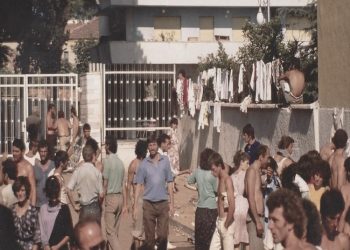
On the upper terrace above the dirt stairs, a swarm of police officers was lined up, easily exceeding two hundred in number, while outside the main gate, thousands of special forces military men, brought specifically from Tirana to suppress the uprising of seven hundred angels, paraded with measured steps and song. Several thousand others had taken up positions and trenches on the slopes of the hills opposite.
In the funnel of Gurth Spaçi, battle marches boomed as if in Skënderbe Square, where massive parades were held, except that a few stanzas were added to the hymns, adapted to the situation. Two additions from two different hymns are fixed in my memory.
The first: “We are two million soldiers, / we will dig graves for the enemies, / we will break their bones and heads, / we will stuff them into pits!”
The second: “Enver’s commandment / to throw them into the flames of hell, / all the enemies the world has, / America and Europe!”
When you heard these stanzas from the mouths of beasts thirsty for blood, the fear quadrupled and terror gripped you! Let alone those demonstrations, when the fate of hundreds of political convicts, who had been marked as the next sacrifice, was being decided! The operative group, just like a butcher who chooses the fattest, had compiled the lists since the first day, with the help of the Head of the Technical Office, a few spies, and Doctor Kosovrasti, and now the moment was coming to update them on the spot.
Oh God, my heart almost stopped, and a nightmare gripped me when the call was repeated:
“Attention! Attention! You have five more minutes to present yourselves at the gate; whoever opposes the order will face the consequences!”
Before the screeching of the loudspeaker died out, the gate opened, and through it entered Haxhi Gora, Shahin Skura, Fejzi Liçaj, Xhevdet Balla, followed by a throng of unknowns and two battalions of medical orderlies, a platoon with boxes filled with handcuffs, chains, and padlocks, who accompanied them to the stairs, left them there, and withdrew. Meanwhile, dozens of military vehicles parked outside the gate, while others rumbled beyond the funnel of Spaç-village.
Some pot-bellied officers occupied the platform that dominated the arena, just like Roman senators in the Colosseum boxes, with Feçor Shehu blackening the center of the “tribune.”
“Start,” ordered the Deputy Minister, and he directed his arm like a conductor of a macabre orchestra.
That was all Kasëm Kaçi needed, who ordered: “Forward,” and led the throng into the confrontation between freedom and the beasts. The terrace of the second level was dark with the uniforms of thousands of police. A group descended the dirt stairs, spread out a pre-prepared wire barrier across some metal trestles, thus creating a kind of pen, leaving a sort of passage in the middle, like shepherds when milking cattle, and positioned themselves on both sides, with a wooden crate at their feet.
The policemen were familiar faces, except for a few who had perhaps been brought in as replacements. Enraged and pale from anger, or fear, and with hands trembling from exhaustion, or three days and nights of sleeplessness, they leaned against the wire barrier, not daring to step further inside. Perhaps they were waiting to take revenge for the trampled honor seventy-two hours ago, when this very crowd, now bowed, chased them away like dogs with their tails between their legs, beat them, desecrated their uniforms, and threw their caps with the red star into the ditches.
Kasëm Kaçi, Xhevdet Balla, and two unknowns passed the sheet metal gate, approached the loudspeaker pole, and stared sternly at the convicts, who remained silent in the middle of the volleyball court. They scanned the entire area and ordered: “Start,” “Approach!”
The policemen took chains from the crates, from which hung a lock with two keys, and shackled the first ones. They passed them to others at the top of the stairs, who took them quickly and led them somewhere, but we could not spot where, due to the sheet metal fence. Thus, the upper ranks were depleted, two by two.
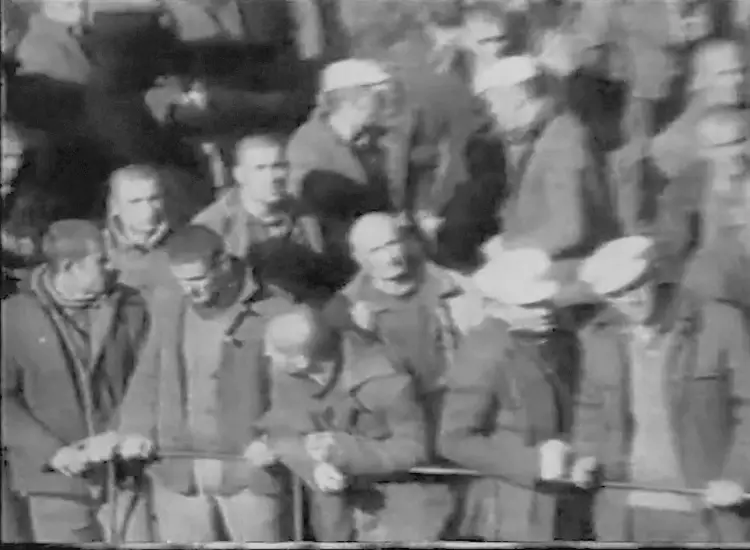
The majority gathered in the field; others rushed in twos and threes from the dormitories toward the assembly square, and still others shuffled head-down like prisoners of war and huddled in corners. While the “milking” continued at the pen, the lines thinned out. Everyone aimed to approach or avoid a specific policeman, depending on the relationships they had maintained.
Since the first half of 1968, there had been nearly five years of coexistence between the convicts and the police. Although they were in antagonistic roles, the forced symbiosis had left its mark, for better or worse, on the mentality of each, and time had influenced the birth of mutual sympathies or antipathies, depending on the case and the person. Thus, everyone aimed for the policeman they got along with, or tried to avoid the one they hated.
This “selective” tactic slowed the rhythm. Now, apart from a few frail old men who could barely move their feet, and those aiming to show they had no connection with the revolt, striving to detach themselves from the “spendthrift rebels” who rushed to the front, the others chose the method I described above.
Nevertheless, the line progressed slowly, as there were seven hundred men.
The order to line up caught me in the bathroom. I came out with my trousers in my hand and ran towards the building to grab a crust of bread and my tobacco pouch, but at the top of the stairs, I was blocked by the two Tomors, Balliu and Allajbeu, who sandwiched me and forced me to follow the others who were pushing to reach the pen. But many sneaked in from the sides, and the line stalled. When I got bored, I reached into my pocket to pull out my tobacco pouch, but I remembered I had left it under my pillow. I was hardened by daily shortages, but without tobacco, it seemed impossible to get through the day. Meanwhile, the crowd was growing; I decided to go to the room and return quickly.
I ran without delay, but under the collective mess hall, I ran into Zef Ashta.
“Have you gone mad, boy?” he scolded me, and when I continued my way, he added: “Turn back or you’ll be lost!”
“I forgot my tobacco pouch in the room!” I replied while running.
“What is this tobacco that has seized your mind, man? Collect your thoughts or they’ll take you for a rebel!”
I had already crossed the volleyball court and climbed the stairs, where I almost collided with a banned man hobbling on sticks like crutches, and two men supporting him by the arms.
“Turn back, man, there’s no one inside!” one of them said and continued to shuffle along.
I didn’t answer them, I climbed the stairs two or three steps at a time, grabbed the pouch from under the pillow, and quickly got up. But, “Oh God, my head!” From the rush and carelessness, I hit my head on the upper bed and passed out.
A moment later, a weight pressed on my chest, and my face was licked by a rough tongue. When I opened my eyes, I saw “Tarti” who had placed his paws on my chest and was licking me with his rough tongue. In a fraction of a second, I remembered why I was there. I hugged Tarti’s head and took out the last crust from my bag. When I threw it to him, he continued to rub against my knees and caressed me, as if he sensed that we would not meet again in this world. “Thank you, Tarti, for saving my life; I won’t mention the sure re-sentencing!” I pushed his paws away and ran to regain the lost time.
Now, only a handful of convicts remained, while dozens of police officers screamed: “Hurry up, you lot!”
“Are you going to resist us, you lot?” one of them addressed me.
“No.” I approached with long strides.
“Throw those feet in the air then, or we’ll take you sliding!” he threatened and put handcuffs on me.
“Leave Ndrec, now we’ll shackle him with this one!”
Fate was on my side this time too; “Mark Mustache-Red” unchained Nexhat Xhaçi, a former Kavaja officer, wrapped the chain around my left wrist, and around Nexhat’s right, and said to me:
“Were you out of your mind, you lot, that you were delayed so much?”
“I was in the room, I forgot my tobacco pouch,” I justified myself.
“Does tobacco hurt you more than your head?” He threw the key into the crate and pushed us forward. Before we even left the top of the stairs, we heard a loud voice:
“Should I come too, Commissar?” It was Gëzim Medolli.
“Come, Gëzim!” Shahin Skura invited him and ordered the policeman: “Chain him!”
Due to the rattling of the chains and the shouting, I couldn’t make out what Gëzim murmured, but I heard the lanky officer:
“What are you waiting for, comrade policeman, put the handcuffs on him!”
“Check if there’s anyone else after him!” he asked someone, holding Gëzim by the arm.
“Hey, comrade policeman, put the handcuffs on him, we’ll take him anyway!” the lanky one yelled again. Gëzim’s case showed that the lists had been drawn up and the people had been marked.
He was the last one. After him, the handcuffs snapped shut, and the gate closed, simultaneously shutting down the world around us.
Two policemen at the top of the stairs took us and directed us to the pre-determined spot. I say “pre-determined” because one of them asked: “Mark, did you chain these ones?” “Yes!” the other replied. After the reply, they turned us right. As I understood, the positions were designated by name for each policeman, so as not to confuse the keys of the respective locks. A few meters from the main gate, they pushed us onto a pile of thorns and dog roses, whose thorns bloodied us horribly.
I looked at who was next to me: on one side, the pair; Zef Ashta-Qani Çollaku; on the other; Luan Koka with Bebi Konomi.
After the last convict was brought out, hundreds of large-bodied medical orderlies (sampistë) flooded the camp with gas masks and helmets on their heads, carrying iron rods, tool handles, and climbing ladders in their hands, while from the emergency entrances, from the ordinary camp, and behind Kosovrasti’s infirmary, hundreds of others rushed in, beginning to comb the territory through the barracks, depots, private kitchen, Bozho’s laundry, Met Karakashi’s clinic, in every room of the building, and even the latrines.
Before five minutes had passed, the megaphone roared again: “Surrender!” Apparently, someone had decided to see the madness through to the end!
“Surrender, surrender,” they repeated several times, then the screams, howls, and Tarti’s barking drowned out the sound.
A few moments later, a platoon of soldiers entered with empty barrels and left with litters covered with tarps, from which trickles of blood dripped. The barrels, whose contents were unclear – injured or corpses, because none showed any signs of life – were followed by some bloodied military men, scraped and torn on their arms and legs, among whom the bloodied head of Haxhi Gora stood out. I cannot say whether they were stained with the blood of our friends or wounded in a clash with them, but the involvement of the military doctor and Kosovrasti suggested a serious condition.
After the punitive expedition, no living soul remained, except for “Tarti,” who barked, but no one saw him. When the search in the barracks and the rooms of the building was completed – a procedure that took considerable time – one of them reported the results to the superiors and the number of rebels who resisted the state. Meanwhile, the commissar informed Feçor Shehu, who was observing like a battle strategist:
“Comrade Deputy Minister, including those who harvested what they sowed, the number came out solid!” – he was certainly referring to the four corpses in the barrels.
Following this, Feçorr crossed the gate and marched triumphantly before the ranks of men bound in chains. He stopped at the resting area before descending into the camp, glared at the prisoners on the thorns, but apparently couldn’t spot the one he was looking for.
“Where is that Hajri Pashaj?” A cynical smile lit up his face.
“I am here!” Hajri stood up halfway, hindered by his hand tied to the other man.
“Unchain him and tie him up alone!” he yelled.
Xhevdet Balla and two policemen removed the chain, put handcuffs on him, and hesitated.
“What are you waiting for, take him to his comrades!” The Deputy Minister followed him with his eyes, until the others snatched him like a hawk grabs a dove and disappeared behind the offices, from where screams and hellish howls resounded, which soon died down. The dictatorship was now taking revenge, sinking its claws into the most prominent opponents.
The four bloody corpses, especially the case of Hajri, terrified us and sent shivers down our bones. But this was just the beginning; the decimation would soon begin.
After the mutilated or dead in resistance – Skënder Daja, Jorgo Papa, Dervish Bejko, and Dashnor Kazazi, as well as Hajro Pashai, dead by order of the Deputy Minister, plus Pal Zefi, the detainee who caused the unprecedented Revolt in all of communist Eastern Europe – they added Luan Burimi, Sami Dangëllia, Hodo Sokoli, Syrja Lame, Paulin Vata, Luan Koka, completing the mystical twelve, the number that would offer four martyrs and eight heroes to the centuries.
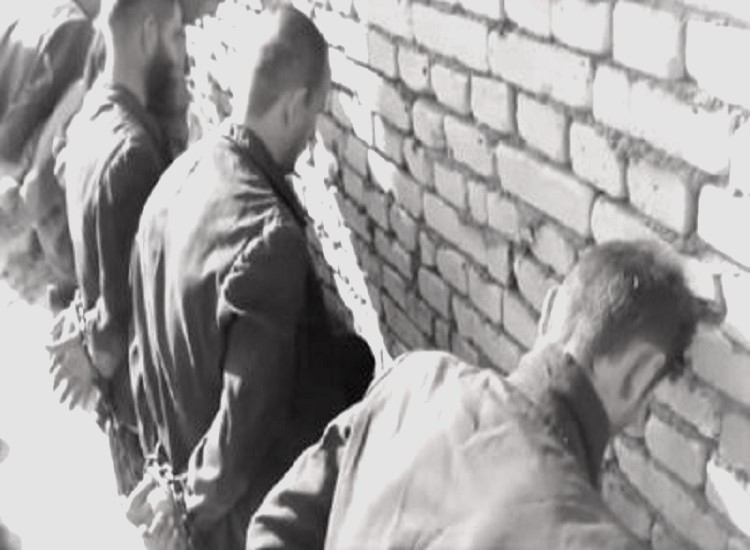
But the communist beast was not satiated with blood and human flesh! Every five or six names, they singled one out, bound him with handcuffs, and threw him like a sack of chaff onto the waiting truck with open sides, inside the main gate. One was filled and left; another was filled and left and they sent twelve such trucks, with over eighty people, to Koci prison!
When they took Luan Koka, who was next to me, Bebi Konomi was chained to Tomor Allajbeu, but soon both were snatched, one after the other. And it continued without pause! They seized Shuaip Ibrahimi, Muharrem Dyli, Pavllo Popa, Hasan Hibo, Naim Uka, Pal Marku, Haxhi Bena, Marash Gjoka, Dilaver Kuçi, Ulsi Pashollari, Ndrec Çoku, Muho Curri, Gramos Spahiu, Dervish Sula, the two Çoku brothers, Çaushin and Bedriun, Jonus Norja, Mërkur Babameto, Demir Pojani, Gëzim Medolli, Bashkim Fishta, Sotiraq Simaku, Njazi Bylykbashi, Theofilo Gjika, Ylber Merdani, Koço Papa, Fiqiri Muha, Pjetër Koka, Polikron Kala, Napoleon Koleci, Qemal Demiri, Bardhyl Fejzullai, Spiro Nasho, Murat Gjonzeneli, Gjet Kadeli, Gëzim Çela, Shefqet Gjana, Pandi Sterjo, Sulo Veshi, Fadil Dushku, the professor and my friend, Zef Ashta, whom they threatened while cuffing: “Now we’ll see how you will preach in the Koci cell, you priest!” – regardless of the fact that Ashta was an officer, they took him as a substitute for Zef Pllumi, who had been transferred to Ballsh camp a few days earlier! They also took Ferit Lopa, with his friend, who would henceforth openly declare: “I am a politician!”
They took many, many others, whose names, due to the forty-five-year distance and the confusion of age, I apologize for unintentionally forgetting, but their deeds will shine through the centuries and be remembered with respect by succeeding generations. With few exceptions, they could have taken all of us, thus increasing the ranks of freedom’s disciples, because we all openly or slightly camouflaged, solidarized with the Revolt, but someone gave the order to stop the arrests. Perhaps the cells were full, or the realization of the “plan” was jeopardized! Nevertheless, the number of arrests shocked us; neither the most pessimistic nor the military foresaw such a catastrophe. Memorie.al