

By Elsa Demo
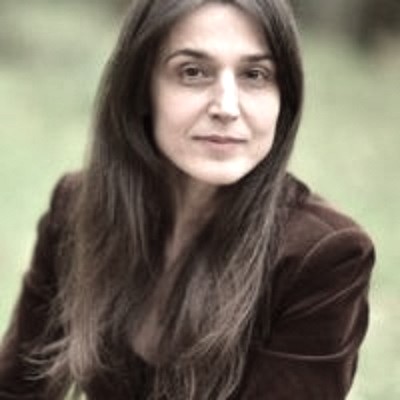
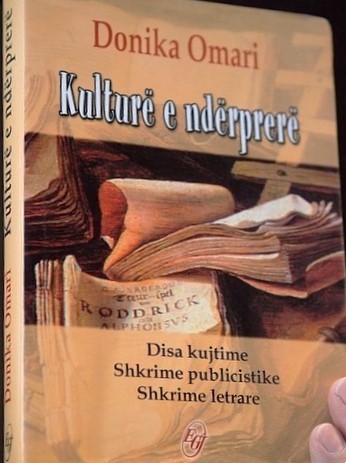
Memorie.al / Interrupted culture is the result of an external act, a violent one even, upon formations whose principle of development is the displacement of traditions. The effect of such an interruption of relations between the past and the present is the same as that of poisons in industrial areas where maimed children and animals are born. Specifically? A foreign woman comes as a governess to the Vrioni family, instilling a “barbaric” culture, teaching children to speak French and interact with the world, but the “manner” of the lady is cut short, while the family of her Albanian peers is exiled within the homeland. This is just to bring an example from the book “Interrupted Culture”, where Donika Omari, for the first time, recounts her childhood memories, keenly capturing the core of Tirana’s neighborhoods in the 1940s.
The memories are written with the sincerity of a child and the maturity of an intellectual who continues to worry about the “burning of stages,” and along with them, the people and values that are created without being visible in Albanian society. The book (published by “Botimet Elena Gjika,” 2009) contains a fair amount of good journalism, as well as literary notes that Omari has published in the daily press over the past 20 years.
The memories are the new element of this book, which, though small in volume, is authentic in the series of memoirs that have emerged in recent years from our interrupted culture. Add it to your library!
It is regrettable that in your book “Interrupted Culture,” you cut short the memories of your childhood so quickly, because they are recollections related to the private as well as the social and historical life of the country in the decade of the 1940s. Why did you leave them so brief?
Because I did not intend to write memoirs. In fact, it was the problem I wanted to raise – the concern about how little we benefit from proximity to countries that are the cradle of civilization – it was this concern that naturally led me to the past and to the acquaintances during the time of the Italian fascist occupation, which also cover four years of my childhood. It should be kept in mind that some positive developments that Albanian society experienced from contact with a higher civilization, such as the Italian one, occurred under conditions of occupation. Isn’t it a great concern that today, in conditions of freedom, we do not know how to orient ourselves towards the positive, healthy values of the world, be it the Western or the Eastern one?
Why did you follow a structure that mixes autobiography with your life’s work, journalism, and literary writings?
This was a decision I made after having changed my mind so many times: whether to publish only the journalism and literary writings, or only the memoirs after expanding them, or to publish all the material in a single volume, in one collection. Often, striving to achieve the best possible, things remains unrealized altogether. So, I finally decided to “get rid of” this hesitation, this doubt, by publishing the book as you have it in hand.
You say: “We cannot afford the luxury, for the sake of a person’s mistakes, to set aside or deny the author and his work, when the latter still contributes to the construction of Albanian culture today.” You are referring again to the interrupted culture. Can you mention some delicate examples that express the contradiction between a person’s life and his work?
We have often, very often, made the unforgivable mistake of judging authors by their biographies and not by their works. The list is very long regarding the period of monism. But unfortunately, this mentality still influences today’s hesitant attitudes toward publishing authors who, at some point in their lives, may have held mistaken views and positions, sometimes even reflected in their works. For such cases, the name of Nebil Çika comes to mind.
I cannot say that I know his activity and creativity enough to give certain judgments about them. I have read the praises he gives to Italian Fascism in one work during the occupation. But in the same work, he makes very interesting and profound analyses and observations about the mentality, characteristics, behavior, and attitudes of the Albanians of his time, especially the Albanian intellectuals, which resonate with astonishing relevance even today. The publication of Mustafa Kruja’s works is also being delayed and done with great hesitation. On the other hand, there is the other side of the coin: there are revolutionary authors whose works are not preferred to be made known, even though they possess great artistic value and serve the patriotic and aesthetic education of the new generation very well.
Such as, for example, the poem: How I Love Albania, by Sejfulla Malëshova, written with a powerful pathos and a touching compassion for the country. The verses of Lame Kodra are not just written, the eye does not just see them, the ear also hears them resounding. There is a poem by Hugo where the thought is expressed that a wise king knows how to put the abilities and skills of every citizen, from the most capable to the most lost, at the service of the country. Thus, it conveys the idea that within every person there is a special potential that should be utilized. Now, imagine what a loss it is when we discard or set aside and forget values already created, demonstrated, not as potential but as realized achievements…!
These days I am reading Isuf Luzaj’s book, The Philosophy of Beauty. I am surprised how an author of such a caliber has remained unknown until now. I do not believe that this has anything to do with biographical reasons. Perhaps it is the financial inability of his family that has left his works unpublished until now. But, in such cases, with such values that belong to the entire nation, shouldn’t the relevant institutions take on this endeavor? Because every neglect of works that are truly enlightening for a country’s culture, and not just one country’s, is again an interruption of culture.
We are asking you a question that you yourself pose for an answer in the book: What protects you from the infringement of independent thought? This is a question to revisit once again in this conversation the most important works you list among the readings you have done throughout your life. To have interests: social, literary, artistic.
To ask questions. Einstein says: “It is important not to stop questioning.” To have contact with people wiser than yourself. To listen carefully, because even a child or an illiterate person can teach you things that open your eyes. To keep your eyes open. Diverse readings, from authors of different viewpoints, help with all of this. I have been fortunate enough to have access, even in my early youth, to magazines and books by a Noli, with his poems as a tribune of the people, as well as the writings of a Branko Merxhani, who explained why he was not a Marxist. Both Sterjo Spasse’s pessimistic novel Pse? (Why?) and Gorky’s optimistic novel Mother, both literature of a religious nature and Aeschylus’ rebellious Prometheus, etc. Naturally, there are other factors that protect you from brainwashing, and which are elaborated in the book.
There are dozens of your journalistic writings in the daily press where you address issues of “social behavior,” morality, belief, and national symbols. These are writings for which you attribute a quality to yourself: objective opinion. What has influenced you to maintain an objective opinion?
I made a reservation: one can have a mistaken, subjective opinion about oneself. Nevertheless, to be objective in judgment, one must be honest with oneself. To respect free thought even when it conflicts with your interests. This requires not only an open mind but also magnanimity. Perhaps a mother who resembled the female figure in Tolstoy’s story Father Sergius, I believe, influenced me to always keep in mind that one must “step into the other’s shoes” to feel what the other person feels. We would save ourselves great family, social, and national disagreements and misfortunes if we had this moral attitude as a guide.
It is striking that you have neither abused nor partisanly defended women’s rights in your public discourses (referring to your position as an intellectual). Is there an explanation for this?
I have written only two articles in defense of an emancipatory attitude toward women. But I have not compiled everything I have written in the book.
Since books were mentioned and your life is connected with books: Your publishing house “Elena Gjika” has brought authors in recent years like Canetti, Zweig (whom you yourself translated), Goethe, or Hesse. Authors who guide not only toward undisputed aesthetic tastes but also toward an ethic.
Art is definitely also an educator of human values. Exceptions are rare: a Nietzsche, an Oscar Wilde, a Wagner have had (partially) unhealthy works in their creativity. Generally, great art, even when it is tragic, comforts, gives hope, which means it serves life. The authors you mention in your question convey universal human messages not only to every reader, but Goethe and Hesse in particular have had the issue of youth education as a special theme in their works.
There is a misunderstanding here that the educational goal does not align with art. A misunderstanding born, I think, from artistically weak educational works. But it is not right to generalize from these cases. It is somewhat like the prejudice that beautiful girls are not smart. Art, literature, painting, and poetry are educational even when they do not convey any specific idea or message: they educate good taste, which is not insignificant for the quality of the person and life.
Regarding life under the dictatorship, we would like you to elaborate further on your opinion: “It was no small thing to live life to the end without being tainted.” In this aspect, what weight did the surname Omari carry?
It further strengthened my belief in maintaining moral integrity. I had admiration for the figure of Bahri Omari since childhood (I was nine years old at the time of the Special Court). My father would return from work shaken: how was it possible to condemn to execution such a patriot, of pure honesty, devoted his whole life to the homeland…?! His shock, the words full of admiration I heard later about him from others, certainly left deep impressions on me.
Entering the Omari family was a continuation of an education already received from my family. Therefore, our house, starting from the example set by my mother-in-law, Fahria, who welcomed everyone with goodwill and joy, has always been open to anyone. Neither the propaganda nor the practice of the class struggle found a place in the minds or concrete actions of my husband and me. Despite family ties with Enver Hoxha, we also maintained connections with those who were called “declassed” or those condemned by the regime, sometimes openly and sometimes, naturally, secretly.
Cases where one might be obliged to harm another, or not give the necessary help, we turned, not without risk, into opportunities to help. This is, among other things, how one avoids falling into baseness.
If we were to return to your childhood memories, did you leave out any stories from the time when you held the surname Sahatçiu for specific reasons?
Of course, I left much untold. I spoke only about a very short period of my childhood. As I said above, I started writing those few memories driven by the goal of elaborating an idea, of conveying a message. And I couldn’t extend further: otherwise, the narrative would lose coherence.
It is great when you quote Merxhani: “Albania is like a folk hospital for psychological diseases.” Would you tell us what the most severe manifestations of these diseases are today?
The same ones that existed when Merxhani wrote: lack of self-awareness as individuals and as a nation, which leaves room for great prejudices and misunderstandings. Relations of distrust, which makes the construction of a true human community difficult. A political and intellectual class preoccupied only with themselves, without an ideal, without high aspirations for society and the homeland, etc. / Memorie.al