
By Dom Zef Simoni
Part eight
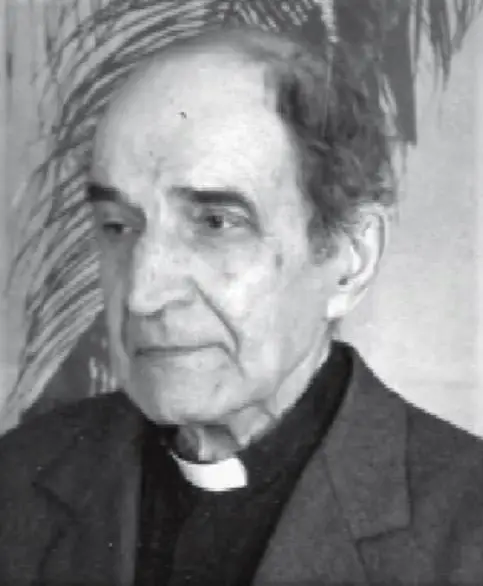
Memorie.al/ publishes an unknown study by Dom Zef Simoni, entitled “The Persecution of the Catholic Church in Albania from 1944 to 1990”, where the Catholic cleric, originally from the city of Shkodër, who suffered for years in the prisons of Enver Hoxha’s communist regime and was consecrated as Bishop by the head of the Holy See, Pope John Paul II, on April 25, 1993, after describing a brief history of the Catholic Clergy in Albania, dwells extensively on the persecution suffered by the Catholic Church under the communist regime, from 1944 to 1990. Dom Zef Simoni’s full study, starting from the attempts by the communist government in Tirana immediately after the end of the War to separate the Catholic Church from the Vatican, initially by preventing the return to Albania of the Apostolic Delegate, Archbishop Leone G.B. Nigris, after his visit to the Pope in the Vatican in 1945, and subsequently with pressures and threats against Monsignor Frano Gjini, Gaspër Thaçi, and Vinçens Prenushi, who firmly opposed Enver Hoxha’s “offer” and were consequently executed by him, as well as the tragic fate of many other clerics who were arrested, tortured, and sentenced to imprisonment, such as: Dom Ndoc Nikaj, Dom Mikel Koliqi, Father Mark Harapi, Father Agustin Ashiku, Father Marjan Prela, Father1 Rrok Gurashi, Dom Jak Zekaj, Dom Nikollë Lasku, Dom Rrok Frisku, Dom Ndue Soku, Dom Vlash Muçaj, Dom Pal Gjini, Fra Zef Pllumi, Dom Zef Shtufi, Dom Prenkë Qefalija, Dom Nikoll Shelqeti, Dom Ndré Lufi, Dom Mark Bicaj, Dom Ndoc Sahatçija, Dom Ejëll Deda, Father Karlo Serreqi, Dom Tomë Laca, Dom Loro Nodaj, Dom Pashko Muzhani, etc.
Continued from the previous issue
The Destruction of Laç Church and Arrests
The Church of Laç was completely demolished, and the area was turned into a military camp, to prevent people from going for devotion. The city of Durrës had Dom Pal Gjini as its parish priest. Dom Ndoc Ndoja, zealous for the faith and a man of prayer, after serving many years in Selitë of Lurë, was assigned to the parish of Bilaj, in the Kruja district, bordering Durrës. He was certainly removed, but would serve secretly, in his own home and among the people, often troubled by the Neighborhood People’s Council.
He would be arrested and sentenced to ten years, enduring suffering in Burrel prison, remaining always a high example of a priest and a man. Before the freedom of belief came, it would be Dom Ndoci who, before the opening of the churches, would confess and give communion publicly in the square of Our Lady of Good Counsel Church, at the Castle.
In the parish of Bizë, the active Franciscan priest and intellectual, Father Viktor Volaj, was found. A reserved nature, and in these circumstances, a man unto himself; when they managed to evade him, he returned to Shkodra, to spend his life in a room with his mother, who died quickly, she who had lived through the death of her son, Monsignor Gjergj Volaj. The only church that remained open for some time was that of the Parish in Tirana. Here, a Mass was celebrated on Sunday until the end of June 1967.
Dom Ndoc Sahatçia, Ordinary of the Diocese of Durrës and Tirana, performed services for people coming from other dioceses, especially villagers. The situation reached this point by forcing priests into hard labor, and arresting many of them, repeatedly for the second and third time, imprisoning and executing them. Thus, the priests arrested were: Dom Mark Hasi, Father Pjetër Mëshkalla, and Dom Frano Illia. Dom Zef Bici and Dom Mark Dushi were executed.
In order came: Father Gegë Luma, Dom Nikollë Mazreku, Father Zef Pllumi, Dom Martin Trushi, Monsignor Nikollë Troshani (Bishop), Monsignor Ndoc Sahatçia, Father Aleks Baqli, Dom Nikollë Gjini, Dom Ndrekë Krroqi, Father Anton Luli, Dom Pjetër Gruda, Father Gjergj Vata, Father Leon Kabashi, Dom Ndoc Ndoja, Dom Anton Doçi, Dom Marin Shkurti, and Dom Mikel Beltoja (executed). The exemplary religious, Brother Gaspër Jubani, was arrested. All were scattered in Burrel prison, Spaç Camp, No. 303, and Ballsh.
Out of a contingency that Albania had on the threshold of the entry of Communism, nearly 200 priests, almost all of them went through torture and experienced prison life, with 30 priests executed, two of whom were Bishops. A homeland suffering for several centuries, which had negative forces, and for attacking God and faith. An unrestrained rage fell, especially upon the Catholic faithful and their clergy, who had shed great sweat for faith, homeland, and national and Western culture. Events on earth: In a deep Albanian bondage, the flock remained without a shepherd.
Arrests and Legal Justification
Did this happen, without opposition – let us be clear, without any opposing effort, without raising a voice, without civil or religious courage – except for one person in the city, named Dedë, whom they quickly found a circumstance to arrest and imprison, and one cleric who, in a broad plan, spontaneously caused his own arrest and imprisonment: was it the Jesuit Father Pjetër Meshkalla – did this confirm the cunningly formulated slogan that: “the people closed the churches,” and that the state does not keep them standing for some old man or woman and for some declassed person?
And with that truth without opposition, without raising a voice, but not without tears and cups filled with them, was it reached so far as to ensure the legal side of such a prohibition, which would bring the reality of a terrible life, with the destruction of brains and hearts, made to live forever? And that freedom is the majority over the minority, and even if this is true and real, did the majority win? The freedom of speech, of conscience, of belief, first and foremost has legal certainty in itself, even for a single person.
But if we add the historical evidence of religion, we will find that humanity has never been left without a very large majority in faith, and it will not remain so. The freedom of belief is an axiomatic freedom, it is a law, and it is the most natural quality of every individual. If man is a reasonable being, religion is in this being, evolutionary. These mad movements are made for several reasons. His reasons for extinguishing some evils are a good thing, but the method of extinction, spreading these bad thoughts with bloody violence, is a wild weed thrown into the wheat field.
Sooner or later, history reveals and verifies such faults. Humanity wept even more after the revolutions. Who would believe that an uncultivated land, a place of backwardness, where we need to hear and learn from others, we are coming out with the communist truth, to teach, inform, and guide the world? The radios played revolutionary songs and announced youth movements, spread across actions. That Internationale, with angry stanzas against God and proclaiming the new world of violence, knew not how to say anything but great words, horizons, and the future.
Our suffering land always had wailing and misery, and when suffering is not removed, it is always new. We, who had inherited much darkness from the past, confirmed ourselves with our events. Enver Hoxha did not do all the bad things in one day, but gradually introduced it, until he disarmed the people to a final point, to prevent any resistance. And then, we certainly suffered, even from a fear we had, of not fully defending the good.
Is there any truth that, by not opposing the events, our fault and our shortcomings were also revealed? Surely, when you do not defend the good, you also lack love for it. The people love the good, their hearts weep and their eyes tear up when it is missing, but this people, raised to fear the state that torments and tortures them, this system of dictatorship also reached a peak where it left them without strength, without bread, with a mouthful earned from a bad employer, and putting people in positions of denunciation, hostility, and fear of one another.
People, tired in this way, use wisdom even where they shouldn’t. We had to accept the oppression, letting God, circumstances, and conjuncture solve our problems. The people never closed the churches, but allowed themselves the accusation that they closed them, choosing the path of silence and conversations in low voices with each other, about the misfortunes found and accumulated.
This problem, the closure of churches and all religious institutions, which is religious and sociological, requires a detailed study, and this can be achieved when Albanian society also has progress, a level, and breadth to point the finger at the wound. The first Easter after the closing of the churches, which came this year after eight days, did not have the courage and power of the resurrection for us. We had historical death.
It seemed to us that Christ was in the grave. Blessings of bread and përpeqa (special Easter cake) in the church, which were announced with such joy, that they would be done from 3 PM until 10 PM, did not happen. Red eggs, none. In many homes, përpeqa and sweets were made, very secretly, and with tears in their eyes, they would say: “Happy Easter for many years!” Never such an Easter. People took down the religious images that were hanging on the walls in their homes, locking them in chests, trunks of mothers and brides, or even tearing and burning them, so as not to be found by the terrifying controls that might come. Prayers would be said in a low voice.
Easter fell at the beginning of spring. At this time, they also conducted an organized property control, because the state would poke its nose into the affairs of every family and individual. They would enforce this strongly this year, in the neighborhoods with a Catholic population, through schoolchildren, and precisely on Easter night.
Easter Night and Political Meetings
Two goals at once: a cleanup action and an action against religion. The second one was the main one. They taught some children, ordering them to be observant, lest they find red eggs, or smell the aroma of sweets from the stoves. Such baseness and such horror! Meetings after meetings were always held in the presidiums.
The meeting would begin with calmness, with a presentation of the problem, and continue with discussions, harsh criticisms, some formal self-criticism, and end with a conclusion full of lies and reports of achievements, so that the high organs should know the results, to see a success intoxication, and for the leaders, the enthusiastic directors, and the fanatics, who rejoiced over the revolutionary days of the new Albania, to sleep soundly in sweet slumber.
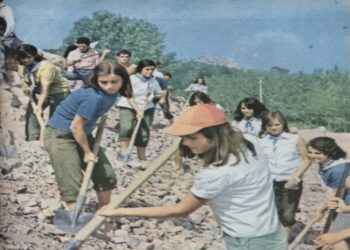
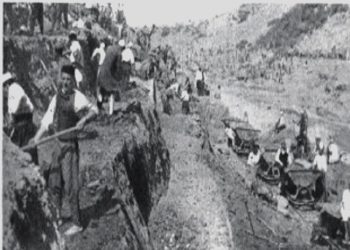
Every day passed with tension, bad noise, and the work of the Cultural Revolution, which included curses, insults, controls, mandatory voluntary actions, and attacks with Lightning Sheets. What is this wild culture that has never existed?! In the last weeks of March of this monstrous year, the clerics were forced to go to work. They would work in bricks, on farms, in construction.
Preparations were made to send them to prisons, because a priest should not be seen, he must disappear from the city, from the village, because a priest is an open church. The large meetings and mass arrests were not yet over. The Cultural Revolution wanted cultural centers. The Pedagogical Institute of the city would have a square in front. This building of meetings and flawed, distorted knowledge would gather thousands of people near it, on an afternoon in the first days of April.
Dom Mark Hasi Arrested (April 7, 1967)
An April 7th, a day of accusation against the clergy for the fascist occupation. The clergy even had to answer for April 7th! A day with bad weather, when Dom Mark Hasi would be arrested. The large square, even towards the park, where people gathered from all sides, gave the impression that the whole city was coming. A city with events. These events awakened all memories and simultaneously opened all the wounds of a country, perpetually in misery and suffering, which never came to light.
There was so much rage in this meeting of fanatics and the ignorant, and those who considered themselves knowledgeable against religion, and especially against the Catholic faith. They spoke fiercely about the Inquisition, the Crusades, about the Vatican, calling it the center of global obscurantism. They spoke unbridled. Dom Mark, who had strength of speech, tried to respond. They would not let him speak, because in the hall where he was, officers and police, seated on benches, had surrounded him.
This confused meeting ended with the noise of barbarians, who took Dom Mark out of the hall, where the State Security car, with an open door, was waiting for him outside. This passed through rows of people, who were on both sides. People raised their heads to see him, as the deep evening of mourning approached, with large, heavy clouds crossing the sky in frenzy.
Night fell, a testimony of pain. The people were tired and weak to oppose, but strong to hate evil and evildoers. Popular anger exceeded the law of faith and took the path of curses, which in their formation were like a prayer of offices, when seeing the savagery of the occupation. The Catholic people were among the outcasts. The Christian faith, in its own way, had heartfelt contingents.
That was the beginning of April 1967! What about the end?!
Father Pjetër Mëshkalla’s Speech
For the priests who had acquired knowledge where it is worked on, who had stayed close to this people, rolled over even after the fall of the fortresses, into the hands of the bad Turkish empire, who had made efforts to save the borders and the nation, and to form and raise altars and schools, the destroyers carried out acts to completely wipe them out. Again at the Institute at 5 PM. Loudspeakers. Officers. Police. Cars, Security. People. A very large crowd. The city was weighed down. It was towards the end of April, and the beautiful sun made this afternoon bright. “They have Father Mëshkalla,” voices spoke. Everyone knew him.
They had gone to pick him up at his house, a hut in the “Ballabane” neighborhood, and had surrounded the gray-haired elder, the short man, the energetic Jesuit, like a Father Pro of Mexico, front and back with appointed people. In slightly different times, one from the other, but linked hand in hand, with the same force, in the same testimony.
He was the 67-year-old Father, who for 43 years had preached Christ, with words and examples. Never today was this Father more at the head of his duty. He would publicly tear up the speech of February 6th. Defending the faith, and, at the same time, not separating this defense from the ideal of the homeland, this Father kept in mind the binomial: “Faith and Homeland” (Fe e Atdhe).
The Father spoke, and it was not easy to stop him. His words resonated, renewed, and vitalized people’s hearts, but they entered like arrows into the hearts of those who brought him there. For the majority, it became a new day, a day of freedom. His words were many, but these stood out: “Do not think that the youth belongs to you. The people will never want you. You have bound them for a mouthful of food.” The people could not raise their voice, but the faces of the many people shone with everyone’s joy, Christian and Muslim. It seemed that they too had spoken through his mouth. A holy connection had been realized. Father Mëshkalla gave heart to everyone.
The news hit Mehmet and Enver like a bomb. They did not foresee such a loss, a moral breaking, a public defeat. “Enver is broken. Mehmet is discredited!”
Mehmet had received a letter in which Father Mëshkalla reminded him of the meeting they had at the Jesuit House in Tirana, in 1945. Mehmet had told the Father that they would never close the churches. Father Mëshkalla testified to their lie. The Security forces violently grabbed him after the meeting and threw him into the car like a bale, hitting him with fists, shins, and even the butt of rifles. The people, even if they sometimes abandon heroes, love them very much.
In this twilight, the beauty of April, hearts were resurrected by this Father, they were electrified, and a great, very great Albanian reaction was seen. The rulers had the violence. The rulers sent this great man, after a semi-secret trial, in the heat of a July day, to spend the years of torment in the prisons of the totalitarian regime, remaining forever an attractive figure, in a sky that may clear late, in a future prepared by many factors, and among these, the heroic resistances rewarded by God.
Personal Suffering and Reflection
When we experience great, dangerous, bad, and shocking events, in the first days we can face them, but as the days pass in a long war, our energies may decrease, and the suffering then doubles, multiplies, and torments our entire being, and then we have the true heaviness of life. These were beautiful days of May, towards the end, and for a few moments it seemed to me that I had rarely seen such nature, so much so that it made me, without realizing it, detach myself from the terrible reality we were in.
In these days, there was some very thin, white cloud, necessary to give beauty to the sky in spring. Sun, coolness, flower aroma. How quickly I crossed into the bitter reality near the “Sarreqi” neighborhood, and in its center, I saw the silent Cathedral, this temple of weeping, and the magnificent bell tower, which still preserved strength and presence. When I returned home, I found everything mixed up: my mother’s chest overturned, the lid of which they had violently removed, a figure of Our Lady of Sorrows, which her parents had given her for her marriage, as well as trunks, and sacks filled with books and religious figures.
Angjelin Nallbani, of the Front! (The Conclusion)
They had come from the Executive Committee, from the “Democratic Front,” with the chairman of the Neighborhood People’s Council, Angjelin Nallbani, from a family with a communist tradition, to take the books. My brother, Gjergji, had told them that without his brother coming, they should not take anything. And so it was done, after they brought a policeman to take them.
9 sacks of books were loaded, and with a car, the thieves and robbers of their styles fled the heat of the day. They took the books published before 1944 and books of faith. Gjergji had hidden some books of faith between the floorboards. These would be taken later. Throughout life, I had gone through some trials, but I always told myself that if life passes this way for me, it is not so difficult. The strong sufferings had not yet entered my soul. I was not without a spiritual world, but this was more on the surface.
Now I walked through the streets of the city, and they seemed not to be the same. It seemed to me that even a stone suffered, as if even a building had changed its appearance. I turned towards all the closed churches, giving them only a glance from a distance, and in my inner self, I connected only with memories. I encountered people, unable to speak to them, having from them, in passing, painful and loving greetings. But my soul was rightly directed.
I began to be attentive in ambushes. If once I passed without knowing life in substance, the high theology had given me clarity. I already knew that the origin of evil and suffering resided in sin. And the sin of the first people is the beginning. Let there be torments, I managed to say, but let the high helps not be lacking. It is darkness, but let there also be lights. And I have seen and experienced that there is knowledge of life without religion. Let us understand the natural reality as much as we can, but let us cherish and value the supernatural. God created the first people, having them in a bond of friendship with him. And this means that we are with the grace of the sanctifying supernatural./Memorie.al